How do you spruce up a city? Pint-sized forests packed full of trees
By ZOI GOSS
Communications representative, Forest Resources Division
Michigan Department of Natural Resources
What do you picture when you think of a forest?
Big, tall trees that have been growing for 100 years, lots of animals and birds and insects roaming and flitting around?
Think a little smaller – actually, a lot smaller – in a more urban area and a great deal more concentrated.
These are micro forests.
Micro forests, also known as Miyawaki forests, were developed in the 1970s by Akiro Miyawaki, a Japanese botanist and ecologist who was inspired by Japan’s sacred forests to develop a new, small-scale method of forest building.
These forests are planted in urban areas and mimic the forest layers and biodiversity of much larger forests.
They can help absorb carbon to counteract climate change, remove pollutants from the air and improve the health of the people who live near them. They also are hotspots for insects and small animals in urban spaces.
Micro forests can grow more than 3 feet per year and begin to resemble a regular forest in as little as three years because they are planted at a density of 20 to 30 times higher than a typical forest.
Consulting the experts
To learn more about these forests, I reached out to Lawrence Law, an urban and community forester with the Michigan Department of Natural Resources, and Marilyn Trent from the Rochester Pollinators. The group recently led an effort to plant a micro forest in their Oakland County community.
Biodiversity – using lots of different species of plants and trees – is key in micro forests, according to Law.
“These micro forests have a shotgun approach to trees in a community rather than precise plantings that most communities usually do,” Law said. “Having multiple species is meant to provide the most benefit to local wildlife possible and create support between species that happens naturally in nature.”
|
Micro forests are usually planted in parks or spaces that see little use to enhance the urban landscape. Law said they are a great source of air and water filtration. They have all the benefits of regular tree plantings, but with the bonus of quick growth and community involvement.
Instead of planting large trees in burlap or containers, micro forests often are planted with small, bare-root seedlings, which are easier to plant for senior citizens and children, helping to provide an engaging activity that can bring an entire community together.
“Plus, by design, those community members get to see the impact of their work since the micro forests grow faster than traditional, singular tree planting,” Law said. “Being able to visually see progress in a short amount of time helps foster a sense of importance and pride in community trees and the work that goes into it.”
So far in Michigan, Muskegon, Detroit and Rochester all have their own micro forests. Warren and Sterling Heights will soon join the list.
Moving parts
Trent said the main inspirations for the micro forest project in Rochester came from Green Communities Canada, which offered direction on how to plant a micro forest using the Miyawaki method, as well as the work of Dr. Suzanne Simard, whose research shows how forests communicate through underground fungal networks some refer to as the “Wood Wide Web.”
These resources helped Trent see the forest as a living, interconnected system, which she wanted to bring into Rochester’s urban environment.
Trent said that putting together a project like this has a lot of moving parts. She worked closely with the City of Rochester’s Public Works and Parks Department.
|
They selected a vacant parcel of land that used to be a garbage dump. The city’s public works department excavated 4.5 feet of contaminated soil and replaced it to help support plantings of mycorrhizal fungi that helps trees grow strong and resilient.
Trent also was able to secure grants from First State Bank and the Community Foundation of Greater Rochester to fund the purchase of native trees, shrubs and soil.
A lot of people were involved in this project, including Rochester Pollinators, City of Rochester Department of Public Works and Parks Department, the Rochester City Beautiful Commission and the Rochester Tree Committee.
“This project has truly taken on a life of its own. Our mini-forest has sparked community engagement far beyond what we expected – drawing in young children, students, neighbors, volunteers and city leaders,” Trent said. “People want to be part of it. They want to see it grow.”
At a recent Community Outlook Breakfast, leaders from Rochester, Rochester Hills, Oakland Township and Rochester Community Schools shared updates on recent projects.
Nancy Salvia, mayor of Rochester, spoke about the micro forest project with pride. Four other communities have reached out to Trent so far about planting their own micro forests, and the City of Rochester wants to plant another one next year.
Key to the micro forest
Planting a wide variety of taller and shorter trees, as well as shrubs, is key to packing the forest full of life.
The Detroit micro forest is located at Jayne Lasky Park, which is also home to a mini golf course, a recreation center, a splash pad and soccer fields.
The park’s micro forest contains an overstory (the tallest forest trees) of several types of oak, maple and hickory, among others and a subcanopy (middle forest layer) that includes juneberry, basswood, elm, dogwood, ironwood and maple and shrubs including spicebush, elderberry, choke cherry and witch hazel.
The biological idea of a micro forest really is about creating an ecological hotspot, space for native plants, animals and insects and helping to clear pollutants and carbon from the air.
The community aspect of micro forests has grown over time, and Law and Trent have helped demonstrate the tremendous importance of community growth alongside plant growth.
To learn more about micro forests, read this University of Iowa bulletin or the book “Mini-Forest Revolution: Using the Miyawaki Method to Rapidly Rewild the World” by Hannah Lewis.
Check out previous Showcasing the DNR stories in our archive at Michigan.gov/DNRStories. To subscribe to upcoming Showcasing articles, sign up for free email delivery at Michigan.gov/DNREmail.
|
Note to editors: Contact: John Pepin, Showcasing the DNR series editor, 906-226-1352. Accompanying photos and a text-only version of this story are available below for download. Caption information follows. Credit Michigan Department of Natural Resources, unless otherwise noted.
Text-only version of this story.
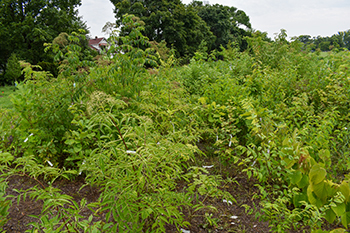
CLOSE-UP: Close-up view of trees planted within the Detroit micro forest.
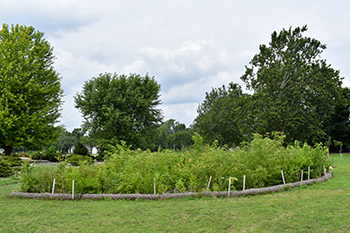
GROWTH: Growth is shown at the Detroit micro forest 16 months after planting.
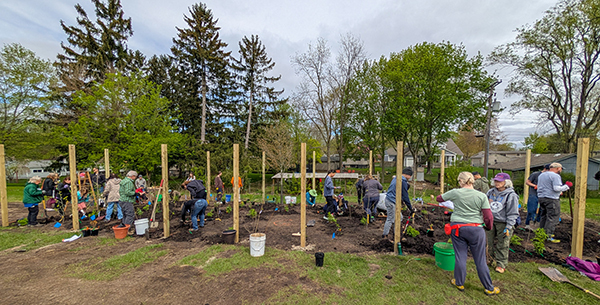
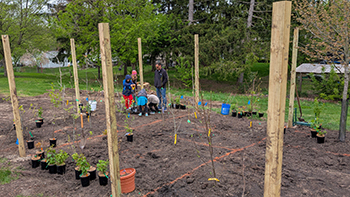
PLANTING-1 and PLANTING-2: Community members participating in the Rochester micro forest planting.
|