|
Share or view as a webpage I Update preferences

Part 115 Implementation Series:
Part 3 - Solid Waste Processing and Transfer Facilities
This is the third part of a seven-part series of messages from the Michigan Department of Environment, Great Lakes, and Energy (EGLE). The messages share details on the amendments to Part 115, Solid Waste Management, of the Natural Resources and Environmental Protection Act, 1994 PA 451, as amended (Part 115). The amendments were passed by the legislature in December 2022 and became effective on March 29, 2023.
The changes to Part 115 make a fundamental policy shift from focusing on disposal capacity for waste to viewing waste as a resource to be utilized. The goals of this policy shift are to:
- Reduce overall waste generated.
- Provide for innovative reuse of materials.
- Create an integrated waste management system.
- Increase recycling, waste diversion, and utilization.
The changes to Part 115 create updated requirements for facilities that manage unwanted materials. These requirements were designed to safeguard our state’s public health and environment and support the economic growth and development of Michigan’s future. Creating standardized requirements levels the playing field across industry while minimizing environmental and human health impacts, nuisances, and providing more regulatory certainty.
Solid Waste Processing and Transfer Facility
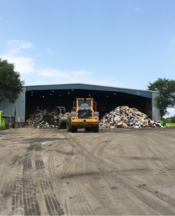
In Part 115, prior to the December 2022 amendments, solid waste Processing and Transfer Facilities used to be two facility types, either a processing plant or a transfer station. Under the Part 115 amendments, both solid waste Processing and Transfer Facilities are now regulated as one type of facility, a Solid Waste Processing and Transfer Facility (PTF) [11506(3)].
New Requirements for all Processing and Transfer Facilities
The Part 115 requirements for PTFs are based on the size of the operation and their risk to public health and the environment. All PTF notifications, registrations, and reporting must all be submitted through Re-TRAC, a web-based system utilized by EGLE for tracking materials management. Applications for construction permits and operating licenses are still submitted using paper forms available on the Solid Waste Disposal Areas Webpage.
PTFs that are required to register or obtain a construction permit and operating license must be consistent with the county/region Materials Management Plan [11508(1)(c)]. PTFs can be sited using local zoning. However, consistency documentation must be submitted with the PTF authorization application, either as an attachment in Re-TRAC for a registration (along with the operations plan and site map) or with the paper application form for a construction permit or license application (along with the Financial Assurance).
|
New Requirements for Small PTFs
Small PTFs have no more than 50 cubic yards of solid waste on-site at any time and are not designed to accept waste from vehicles with mechanical compaction equipment. Small PTFs are required to:
- Notify annually [11513(1)].
- Report annually [11513(1)].
Initial notifications for new, Small PTFs must be submitted to EGLE upon start-up. Initial notifications for existing, Small PTFs are due by no later than March 29, 2024. Subsequent notifications from Small PTFs must be submitted by no later than November 15 annually and must report the amount of solid waste managed during the preceding state fiscal year (October 1 through September 30).
New Requirements for Medium PTFs
Medium PTFs have more than 50 cubic yards and less than 200 cubic yards of solid waste on-site at any time and are not designed to accept waste from vehicles with mechanical compaction equipment. Medium PTFs are required to:
- Register every five years [11513(2)].
- Report annually [11513(2)].
- Submit an operations plan and site map [11513(3)].
- Be consistent with the county/region Materials Management Plan [11508(1)(c)]]
Initial registrations for new, Medium PTFs must be submitted to EGLE upon start-up and registrations must be issued prior to operating new, Medium PTFs. Registrations for existing, Medium PTFs must be submitted by no later than March 29, 2024. There is a registration fee of $750. The operations plan, site map, and consistency demonstration from the county approval agency must be submitted with the registration application in Re-TRAC. Registrations are valid for five years and registration renewal applications are due at least 90 days prior to expiration of an existing registration. All required information must be submitted and registration fees must be paid before EGLE can issue a registration.
Medium PTFs must report the amount of solid waste managed during the preceding state fiscal year (October 1 through September 31) by no later than November 15 each year.
New Requirements for Large PTF
Large PTFs have more than 200 cubic yards of solid waste on site at any time or are designed to accept waste from vehicles with mechanical compaction equipment. Large PTFs are required to:
- Obtain a Construction Permit and Operating License [11509].
- Provide Financial Assurance of $20,000 for an operating license [11523(1)(d)].
- Maintain Financial Assurance through a two year post closure period [11523(1)(d)].
- Be consistent with county/region Materials Management Plan [11508(1)(c)].
Large PTFs in operation before March 29, 2023, must meet their existing license renewal schedules. Construction Permit fees range between $500-$2,000 [11509(4)] and the Operating License Fees run $1,000 [11512((18)]. A consistency demonstration from the county approval agency and Financial Assurance must be included with all license applications [11508(1)(c) and 11513(4)(a)]. All required information must be submitted and permitting and licensing fees must be paid before EGLE can approve an application.
Large PTF are required to report the amount of materials managed during the preceding state fiscal year (October 1 through September 31) by November 15 each year [11512 (25)].
Existing PTF Operating Requirements
Owners and operators must comply with the operational requirements identified in the Part 115 Rules. Specifically, Rule 507 has operating requirements for Transfer Facilities and Rule 509 has operating requirements for Processing Plants.
Conforming Rule Changes
EGLE is in the beginning stages of updating the Part 115 Rules to reconcile the rules with changes in the statute, known as conforming rule changes. An example of a conforming rule change would be to update the administrative rules for PTF to be subject to a single rule, instead of the Part 115 Rules, Rules 507 and 509.
In Case You Missed it
If you missed any of the initial Part 115 amendment notices or those in this series, you can view them now.
How to Stay Informed
Join Us for Upcoming Training Opportunities
-
February 13 - 14, 2024 Virtual Materials Management Conference. Save the date. More information is coming soon!
Please send question on the Part 115 amendments to the Solid Waste Mailbox at EGLE-MMD-SW@Michigan.gov. Please see our Materials Management Program Maps Web page to find staff to help with questions on solid waste, recycling, and Materials Management Planning.
|