This is the second part of a seven-part series of messages from the Michigan Department of Environment, Great Lakes, and Energy (EGLE) sharing details on the amendments to Part 115, Solid Waste Management, of the Natural Resources and Environmental Protection Act, 1994 PA 451, as amended (Part 115). The amendments were passed by the Michigan legislature in December 2022 and became effective on March 29, 2023.
The changes to Part 115 make a fundamental policy shift from focusing on disposal capacity for waste to viewing waste as a resource to be utilized. The goals of this policy shift are to:
- Reduce overall waste generated.
- Provide for innovative reuse of materials.
- Create an integrated waste management system.
- Increase recycling, waste diversion, and utilization.
The changes to Part 115 create updated requirements for facilities that manage unwanted materials. These requirements were designed to safeguard our state’s public health and environment while supporting the economic growth and development of Michigan’s future. Creating standardized requirements helps level the playing field across industry while minimizing environmental and human health impacts, nuisances, and providing more regulatory certainty.
Waste Diversion Centers
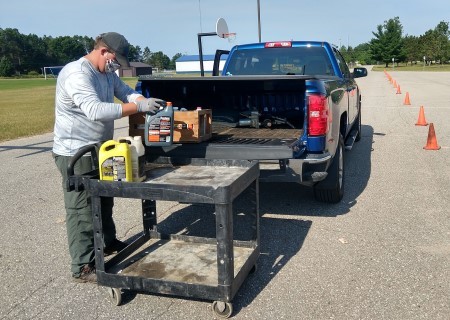
Waste Diversion Centers (WDC) [11506(14)] are locations that receive or collect diverted waste [11503(8)]. Diverted waste is waste that can lawfully be disposed at a licensed solid waste landfill or municipal solid waste incinerator, that is separated from other waste and is diverted to an environmentally preferred management method. Examples of diverted waste include:
Existing Operating Requirements
WDC must meet the Waste Diversion Center operating requirements initially enacted by the legislature in 2014 [11521b] which specify that:
- WDC must record:
- The types and quantities for diverted materials collected.
- The period of storage.
- Where the diverted waste was transferred, processed, recycled, or disposed..
- WDC must maintain required records for at least 3 years and make them available to EGLE upon request.
- WDC annually must receive 15% or less solid waste by weight of the diverted waste received by the facility.
- Personnel operating WDC must be knowledgeable about the safe management of the types of diverted waste accepted at the WDC.
- WDC must manage diverted waste in a manner that prevents the release of any diverted waste or component of the diverted waste to the environment.
- WDC must not store diverted waste overnight unless it is in a secure location with containment that is adequate to prevent any releases.
- Within 1 year of collecting the diverted waste, WDC must transfer the diverted waste to another waste diversion center, recycling facility, or disposal facility that is properly notified, registered, or licensed under Part 115 [11508(1)(a)]; and is properly authorized under other applicable environmental regulations to accept the diverted waste for processing, recycling, or disposal.
- WDC cannot process diverted waste except to the extent necessary for the safe and efficient transportation of the diverted waste.
- WDC must limit access to the WDC to times when a responsible individual is on duty.
- As appropriate for the type of diverted waste, WDC must protect the area where the diverted waste is accumulated from weather, fire, physical damage, and vandals.
- WDC must be kept clean and free of litter and be operated in a manner that does not create a nuisance or hazard to the environment, natural resources, or the public health, safety, or welfare.
New Notification Requirements
If the primary function of the site is to serve as a waste diversion center and the waste diversion center anticipates collecting more than a total of 50 tons of diverted waste a year, a notification must be submitted within 45 days of the end of state fiscal year (by November 15) for existing WDC or upon initial operation for new WDC. Notifications must be submitted through Re-TRAC, a web-based system. WDC required to notify must re-notify each state fiscal year by November 15. [11521b(k)].
New Materials Management Planning Requirements
WDC that are required to notify and report must be consistent with the Materials Management Plan (MMP) [11508 (1)(c)]. WDC whose primary function is to serve as a waste diversion center that collects a total of more than 50 tons per year is considered consistent with the MMP if they are in compliance with the Part 115 notification and reporting requirements, possess any required local and county approvals and meet local zoning requirements.
New Reporting Requirements
WDC have been required to keep records of the types and quantities of diverted materials collected, their period of storage, and where the diverted waste was transferred, processed, recycled, or disposed since 2014. Part 115 requires EGLE to make this information available to the public, counties, and regions, to help with evaluating materials management capacity, setting a progress goals, and developing MMPs. WDC will be able to report this information through Re-TRAC by November 15, 2023, and are require to report details on the diverted handled at WDC during the preceding state fiscal year by no later than November 15 [11521b (k)].
How to Stay Informed
Join Us for Upcoming Training Opportunities
Please send question on the Part 115 amendments to the Solid Waste Mailbox at EGLE-MMD-SW@Michigan.gov. Please see our Materials Management Program Maps Web page to find staff to help with questions on solid waste, recycling, and Materials Management Planning.
|