|
The Connection Initiative (TCI) is a county-wide program hosted and coordinated by the Community Caring Collaborative (CCC) that links community members to needed resources. An online platform is used which allows the moderator to connect community members to needed resources or organizations.
TCI’s mission and value are to make lives better by connecting our neighbors in Washington County to community resources; and responding to Washington County neighbors’ needs with care, connections, and options.
History of The Connection Initiative
TCI began at the 2015 Community Caring Collaborative Visioning Day, when CCC and partners brainstormed the core of TCI’s program as a response to community needs. Following CCC's designation of this concept as a program of importance, a committee was established to build the framework and methods and solicit feedback from community members and their providers.
How does TCI work?
TCI utilizes a customer service platform called Zendesk. Individuals seeking assistance reach out via phone, text, email, chat, social media or website, then a ticket is automatically created where TCI’s primary agent and Resource Partners can view and manage the ticket through accessing the Zendesk dashboard.
The TCI moderator directs the submitted request to one of three resource categories for ticket resolution:
- Resource Partner: Organization employees that help community members meet their needs by collaborating with the main support person from TCI.
- Agency: An agency can be any organization in Washington County that has services and resources available to it.
- Groups: Resource Partners are organized into groups and further divided into specialty areas.
These resources connect with the customer to assist them with the request and TCI moderator follows up with the customer to ensure resolution and appropriate assistance was provided.
TCI's Future
With the guiding idea that people with needs have something to contribute, TCI will broaden its offers beyond simply linking community members to resources and adding life coaches, volunteers, and other individuals.
Downeast Population Health Initiative (D-PHI)
The Downeast Community Population Health Initiative is a 2-year collaborative effort funded by the Maine Community Population Health Initiative to improve health outcomes for Tribal and non-tribal community members aged 65 and older in Washington County and Passamaquoddy communities using a community health worker approach and leveraging the coordination and communication platform of The Connection Initiative (TCI). CCC through its TCI Program is the lead organization on this grant, partnering with Beth C. Wright, Downeast Community Partners, Community Health and Counseling Services, Eastern Area Agency of Aging, Eastport Healthcare, Harrington Health Center, Sunrise County Economic Council, Indian Township Tribal Government and UMaine School of Nursing (evaluation partner).
Connect with TCI:
Visit: www.connectioninitiative.org
Call: 207-255-7786
Emails: support@connectioninitiative.org
dzanoni@cccmaine.org
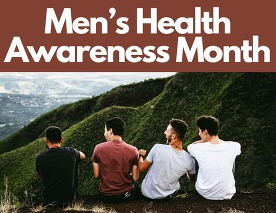
June is Men's Health Awareness Month and June 15 marks Father's Day. It's an opportunity to encourage men to prioritize their health and shed light on the health challenges they face.
Data shows that:
- 14.7% of men 18 years and older are in fair or poor health!
- 30.9% of men 18 years and older have had 5 or more drinks in 1 day at least in the past year.
- 28.3% of men met the 2018 Federal Physical Activity Guidelines for aerobic and muscle strengthening activity.
- 12.5% of men are current cigarette smokers.
- 41.6% of men 20 years and older are obese and 40% of cancers are associated with overweight and obesity.
- 51.9% of men 20 years and older have hypertension.
- 10.4% of men younger than 65 years are without health insurance coverage.
- Men die an average of 5 years earlier than women!
- Men Mortality rate was 1,040.2 deaths per 100,000 population.
- In Maine the total number of deaths in men 15 years and older was 9,119 in 2022 (391 in Hancock county, 333 in Washington).
- Nationally the leading causes of death in men are heart disease, cancer and unintentional injuries.
- In Maine, the leading causes of death in men is cancer, followed by heart disease and unintentional injuries.
Men and Cancer
Men have higher rates of getting and dying from cancer than women. Some of the cancers that most often affect men are prostate, colorectal, lung and skin cancer. Lung cancer is expected to become the most diagnosed cancer and leading cause of cancer in men. A recent study reported that by 2050 global cancer cases in men are expected to increase by 84% and cancer deaths by 93%.
Men and Heart Disease
Heart disease is the leading cause of death for men in the United States with over half of men age 20 years and older had high blood pressure which is a major risk factor for heart disease and stroke. Diabetes is considered another risk factor for heart disease in men where 16.1% of men were diagnosed with diabetes, while 3.7% remained undiagnosed.
Men and Mental Health
The prevalence of several mental disorders is lower in men than in women, however men are also more likely to die by suicide than women and certain disorders are diagnosed at higher rates in men such as ADHD. Men are less likely to receive care for mental health disorders than women.
Mental health support visit OBH.
What organizations can do?
- Community health partners must work towards providing men with quality, reasonable and respectful services that are approachable to cultural diversity, language preferences, socio-economic and environmental circumstances and literacy levels.
- Raise awareness about preventive screenings and regular health care for men of all ages: prostate cancer screening, colorectal cancer screening and lung cancer screening.
- Introduce interventions that reduce smoking and drinking and promote healthy behaviors that can help prevent diseases and improve men’s health.
Learn more about the Heathy People 2030 Objectives and Goal for Men.
What is Alzheimer's Disease (AD)?
In healthy aging, the brain usually shrinks to some extent, but it does not lose many neurons, which are nerve cells that transmit signals throughout the body to enable breathing, talking, eating, walking, and thinking. Alzheimer's disease (AD) causes extensive damage to neurons, which leads to their malfunction, loss of connections with other neurons, and eventual death.
As a result, a person with AD gradually loses their capacity to live and function independently, and the condition eventually becomes fatal. Cognitive functions, including the ability to think, recall, and reason, as well as behavioral skills, are lost in AD. In the United States, it ranks as the seventh most common cause of death, yet the interval between diagnosis and death varies greatly.
More than 6 million Americans aged 65 years and older are estimated to have Alzheimer's as age is the biggest known risk factor for the disease. More than 29,600 people in Maine are living with AD and 66,000 caregivers dedicate 102 million hours of unpaid care.
Although there is currently no treatment for AD, there are medications that can help manage some of its symptoms and behavioral issues, slow the disease's course, and temporarily enhance or stabilize memory and thinking abilities.
Prevention
Brain alterations take place years before AD symptoms appear; these early alterations provide a potential window for preventing or delaying dementia symptoms. Although there is conflicting evidence, there is encouraging evidence that some therapies can delay or prevent AD, including:
- Cognitive training
- Blood pressure management
- Increased physical activity
What organizations can do?
- Educate the public and Raise awareness by requesting a speaker from Alzheimer's Association (ALZ).
- Get involved.
- Educate health care providers on signs and symptoms of cognitive impairment and dementias to encourage early detection and diagnosis.
- Read and Share NIH Infographics.
Learn more:
Alzheimer's and Dementia Prevention, visit: NIH and ALZ.
10 Healthy Habits for your Brain
10 Early Signs and Symptoms of Alzheimer's and dementia
ALZ Maine Chapter
Caring for a person with AD comes with unique challenges, some useful resources:
Take care of yourself and a person with Alzheimer's Disease.
Access support here.
The Alzheimer's Association (ALZ), Maine Chapter offers a 24/7 Helpline that provides reliable information and support to all those who need assistance. Call toll-free anytime day or night at 1.800.272.3900.
Invitation to Participate
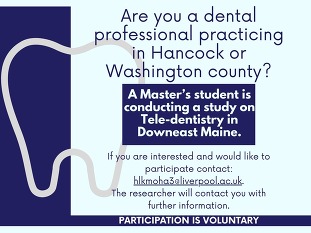
A Master's student is conducting a study on the Utilization of Tele-dentistry in Downeast Maine. If you are a dental professional practicing in Hancock or Washington counties on adults and are interested in participating in this research, please contact: hlkmoha3@liverpool.ac.uk.
Note: Participation is voluntary.
|