OPC responds to opposition to its complaint challenging $2 billion in data center-driven transmission costs assigned to Maryland customers
BALTIMORE – The majority of parties responding to the Office of People’s Counsel’s complaint before the Federal Energy Regulatory Commission (FERC) largely agree that data centers are driving the transmission expansion that PJM rules force Marylanders to pay for, the Office of People’s Counsel said in a comprehensive filing this week defending its complaint.
“The central contention of our complaint is straightforward and grounded on longstanding regulatory principles that those who create the need for the costs should bear the costs,” said Maryland People’s Counsel David S. Lapp. “Under current PJM transmission cost allocation rules, Maryland ratepayers are required to shoulder a substantial and disproportionate share of the costs for transmission projects that they did not cause and which do not provide them corresponding benefits.”
OPC’s complaint filed in May challenges PJM’s “hybrid” transmission cost allocation methodology that broadly spreads data center-driven costs across PJM. Of $22 billion in transmission project costs advanced over the last three years through PJM’s competitive regional transmission procurement windows, the complaint says, PJM’s rules for allocating these costs have unlawfully assigned Maryland customers responsibility for $2 billion in capital expenditures. These costs will be recovered in rates, with added utility profits, for decades, driving up Maryland customer bills by $1.6 billion over the next ten years alone.
OPC’s filing this week at FERC points out that opponents of its complaint, even while largely accepting its factual premise, oppose fixing PJM’s cost allocation rules for various reasons that lack legal and factual support. OPC’s filing argues that while FERC’s recent “show cause” order deals with costs related to large-load and data center growth, it does not address PJM’s cost allocation rules that apply to the more than $20 billion in capital expenditure costs for large regional projects, also driven by forecasted data center electric demand. The consequences of leaving PJM rules intact would be “severe” for Marylanders, OPC’s response points out.
If FERC fails to address the complaint’s focus on responsibility for regional baseline projects, data centers would be able to evade a major portion of their responsibility for transmission costs, OPC’s filing says. That failure would leave in place unlawful, unjust, and unreasonable costs and would undermine the Ratepayer Protection Pledge agreed to by data center developers and utilities.
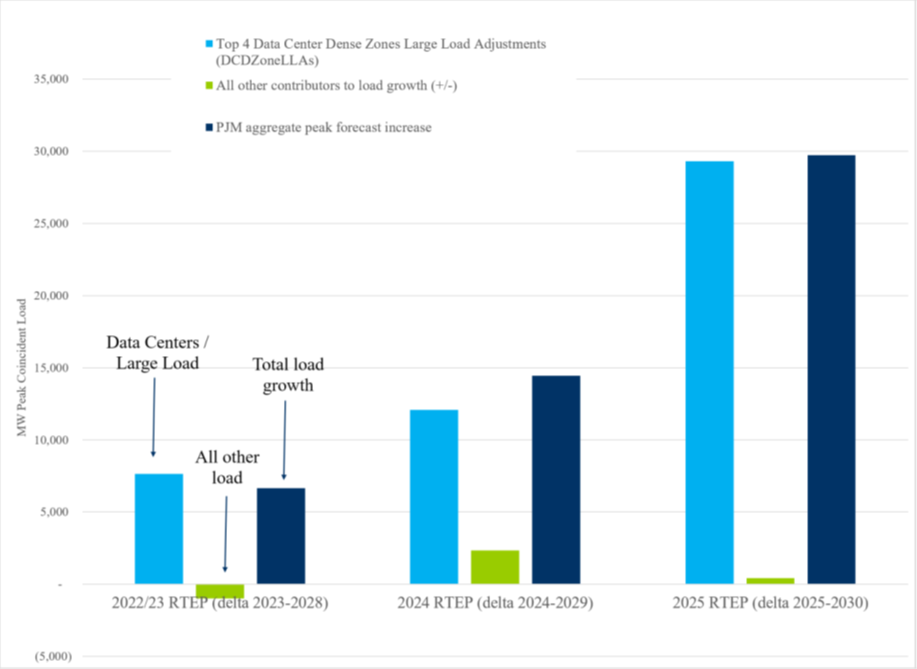
OPC’s filing was supported by an extensive affidavit with data and analysis, illustrated in part in the figure below, showing the overwhelming contribution of data centers to PJM’s forecasts. Those forecasts drive the peak load growth used in the transmission expansion planning resulting in $22 billion in regional baseline project capital expenditure costs.
Incremental forecasted coincident peak load growth — PJM 2022/3, 2024 and 2025 regional transmission plan year 5 of PJM annual forecast
 For more on OPC’s work to protect customers from bearing risks and costs associated with data centers, visit OPC’s website.
The Maryland Office of People’s Counsel is an independent state agency that represents Maryland’s residential consumers in electric, natural gas, telecommunications, private water and certain transportation matters before the Public Service Commission, federal regulatory agencies, and the courts.
* * *
|