IN THIS ISSUE
- Bald eagles still soaring
- Loggerheads are surging and why
- The power of purple coneflowers
- Wasp: It's what's for dinner
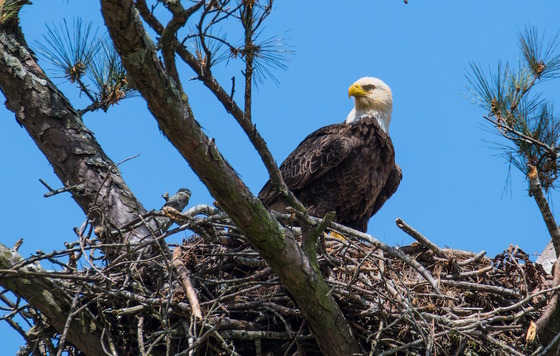 Bald eagle nesting in north Georgia this year (Ron Goldfarb/Special to DNR)
DNR’s survey of nesting bald eagles in Georgia covered less territory than usual this year. But the results point to a population that continues to soar, with above-average nesting success in all areas checked.
Factors such as the March retirement of survey leader Dr. Bob Sargent (some follow-up flights are usually done in April) and bad weather canceling some northeast Georgia nest checks yielded a smaller sample size. However, nearly half of all known eagle nests in the state were monitored, providing a reliable measure of productivity for our national bird, according to Sargent.
Of 113 occupied nest territories recorded, 101 were successful, fledging 170 eaglets (1.7 per nest) – an 89 percent success rate. The totals for both nest success and fledging topped long-term averages.
Accounting for nests not checked, Sargent said the findings suggest Georgia again had over 200 nests, as it has since 2015. The number of nesting eagles also is still increasing in some areas, although that trend has slowed the last 10 years.
“This year’s results reflect a population that is having a strong year acquiring food resources and has clearly bounced back from the serious hit productivity took – especially on the coast – during the initial avian influenza outbreak in 2022.
“Unfortunately, we have evidence that the disease persists in Georgia and elsewhere across the U.S. But our survey shows that these magnificent birds are resilient.”
KEEP THEM FLYING
Georgia's bald eagle license plates provide vital support for DNR work to conserve native wildlife, including these iconic raptors. Join the drive to help them thrive!
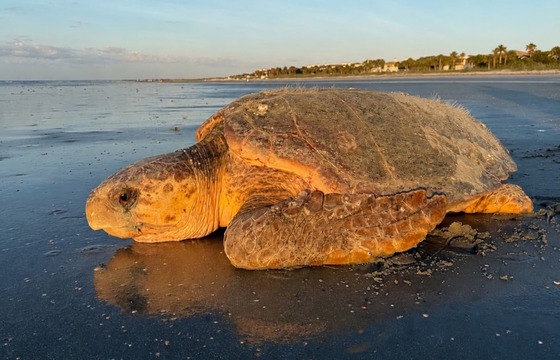 Dawn-nesting loggerhead returns to the surf off Sea Island (Haley Watkins/Sea Island)
Halfway into nesting season for loggerhead sea turtles, Georgia’s No.1 marine turtle is bound for a record summer.
By June 22, roughly the midway mark, the Georgia Sea Turtle Cooperative had documented 2,366 nests. (The total has since climbed to over 2,800.)
Citing the first-half count, DNR Sea Turtle Coordinator Mark Dodd expects about 4,700 nests by season’s end. That would easily be the most since comprehensive surveys began on Georgia beaches in 1989. The previous high was 4,072 in 2022.
The prediction isn’t a sure thing, of course. This has been a weird season, Dodd said, one characterized by stronger-than-normal “pulses” of more females nesting during a night. Those surges also have come in regularly timed patterns, like waves, or what Dodd calls “a high level of temporal nesting synchrony.”
Small pulses are not uncommon, he explained. They are usually caused by factors such as stormy nights deterring turtles from the beach and creating pent-up demand to nest. What’s odd this summer is not only the higher numbers of loggerheads nesting at a time, but “the extent to which the pulses are synchronized,” roughly every 12-13 days.
“We’re having these really big pulses,” Dodd said. “And then these slow days.”
For example, Ossabaw Island set its single-day record with 31 nests June 16. Two days later, only eight loggerheads crawled onto the island’s wild beaches to lay eggs.
Georgia was due a big year, though. Thanks to conservation efforts such as the cooperative monitoring and protecting nests, the big, federally threatened turtles are steadily if slowly recovering. Also, nesting in the state had followed a three-year cycle until last summer, which was the third since 2022's record count and thus expected to be ultra busy, but only had about 1,900 nests, the fewest in four years.
The up-and-down nesting so far this year helped mask how well things were going for loggerheads – which could also help explain why cooperative members checking the beaches at dawn every day are so tired, Dodd quipped. “Now maybe we know.”
FOR MORE …
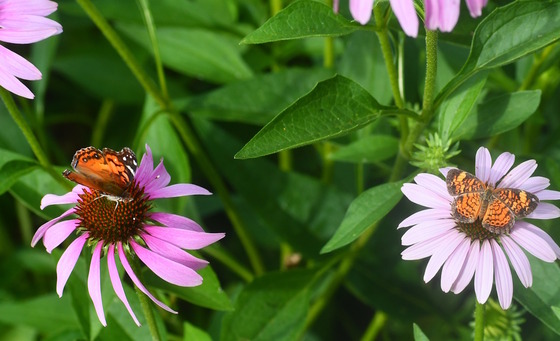 Pearl crescent butterflies nectaring at purple coneflower blooms (Terry W. Johnson)
By TERRY W. JOHNSON
Some will argue that purple coneflower is my family’s favorite native plant.
While I cannot attest to the validity of that claim, I can confirm that Echinacea purpurea is indeed a prized member of our backyard plant community.
There are many reasons why my wife and I are so fond of purple coneflower. It flourishes in spite of my lack of gardening acumen. It produces a crop of breathtaking blooms that last for weeks. It doesn’t require a lot of water. Deer usually don’t eat it.
And, if we needed another reason to admire the plant, there’s this: It provides food for a variety of wildlife. …
Read Terry’s column for more on the power of coneflower.
Terry W. Johnson is a retired DNR program manager and a veteran naturalist. Check out past columns and his blog. Permission is required to reprint a column.
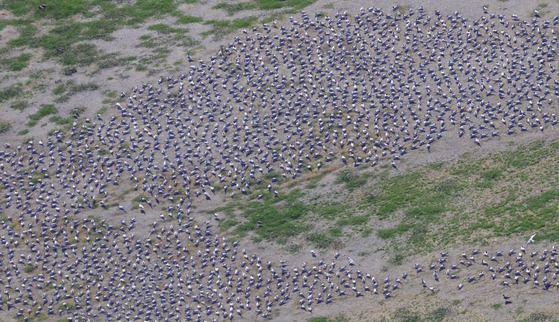 Nesting shorebirds crowd Brunswick Bird Island (Tim Keyes/GaDNR)
Beach-bound this weekend? Take care to share the sand with beach-nesting birds and sea turtles, creatures whose nesting success depends on limiting disturbances. Meanwhile, Georgia’s Bird Islands are bustling with nests and chicks. Boaters are reminded that new Bird Island Rule protections have Ogeechee Bar (near Ossabaw Island), Brunswick Bird Island and Cumberland Dividings in Camden County closed for the season: No landing boats or walking on these shores.
With the nomination period for changes to Georgia’s protected species list ending June 30, next steps include reviewing recommendations and making needed revisions. A proposed list – which will help protect species, focus DNR efforts and encourage voluntary conservation – will go to the Board of Natural Resources and then be posted for public comment.
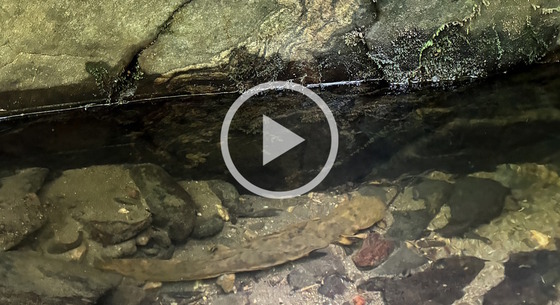 A hellbender found during a fish survey on a northeast Georgia stream (James Miles/GaDNR)
Eastern hellbender sightings have been cropping up in northeast Georgia, including the video above by DNR fisheries biologist James Miles and technician Leon Brotherton. Please report encounters with hellbenders or Georgia’s other four giant salamanders at GaGiantSalamander@dnr.ga.gov to help DNR’s Wildlife Conservation Section conserve these whopper amphibians.
Shoals spider-lilies show out in May, dotting rocky shoals in Piedmont rivers with their bright-white blooms. This spring, DNR botanical staff teamed with the Broad River Watershed Association and Chattahoochee River Conservancy to hone efforts for restoring the lilies, a species of greatest conservation need in the State Wildlife Action Plan.
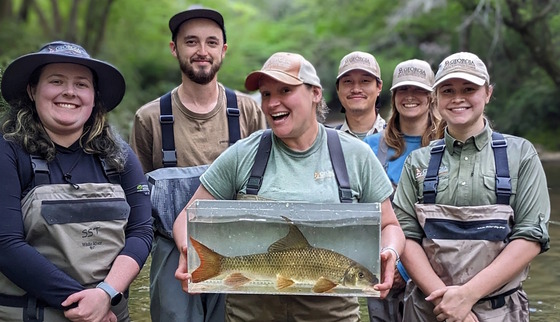 DNR staff pose with one of the Brasstown Creek sicklefins (GaDNR)
Annual sicklefin redhorse monitoring tagged and released 29 of the state-endangered suckers found in Georgia only in Brasstown Creek near the Tennessee line. Ten of the sicklefin had been caught before – one had a PIT tag from 2015 – and eggs collected from spawning females will help raise fish for stocking across the species’ historical range.
A National Fish and Wildlife Foundation grant project to improve habitat on Georgia public lands for monarch butterflies and other pollinators is off and fluttering. Over 550 milkweed plants and clusters have been mapped, training provided for partner groups and volunteers, and a first-round of sampling completed on most plots that will be tracked to measure improvements.
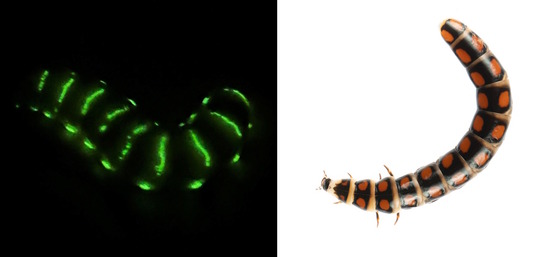 A railroad worm by night (glowing green during a firefly survey) and day (GaDNR; Adobe Stock)
Quick hits:
- Finds during firefly surveys in May included blue ghosts – a State Wildlife Action Plan priority species – and a railroad worm, which, like lightning bugs, is also a bioluminescent beetle.
- Using a new $387,000 National Fish and Wildlife Foundation grant and matching support, DNR and Berry College will manage and restore over 3,000 acres of montane longleaf pine savanna and Coosa flatwoods at Berry College Wildlife Management Area and other college lands.
-
Diamondback terrapin surveys underway on the Georgia coast are aimed at sizing up the state’s distribution and abundance of the colorful, brackish-water turtles.
- Up your aquatic nuisance species IQ by completing ANS certification training, DNR’s free online course exploring target species, the threats they pose and how to prevent problems.
- Upcoming butterfly surveys open to volunteers are set for July 17 and Aug. 14 at Piedmont National Wildlife Refuge near Juliette and Aug. 7 at Panola Mountain State Park near Stockbridge. Email for details.
- Fido’s food can feed more than the family pet: Where there are bears, be BearWise by feeding pets inside or removing food outside as soon as Fido finishes.
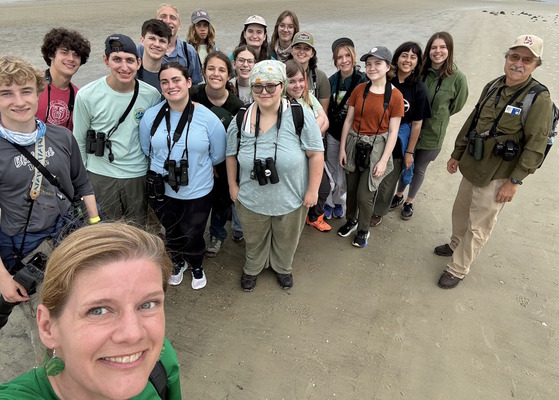 Camp TALON group selfie on Jekyll Island beach (Linda May/GaDNR)
Names in the news: The 16th annual Camp TALON proved – like the previous 15 – a memorable success. Led by Dr. Bob Sargent, a retired Wildlife Conservation Section program manager, and agency outreach coordinator Linda May, 18 teens from five states birded Georgia’s coast, from barrier islands to Fort Stewart, and benefited from a lineup of other experts that also helped teach and guide the group. (By the way, TALON stands for Teen Adventures Learning Ornithology and Nature.) Wildlife Conservation Program Manager Erin Cork toured a 930-acre Coosa Valley prairie in Floyd County with staff from Forest Investment Associates and The Nature Conservancy. The Nature Conservancy has a conservation easement on the site and FIA – the property owner and a partner in DNR’s Forestry for Wildlife Program – is working with the nonprofit and DNR to survey for and protect and manage the tract’s rare-plant communities.
WHAT YOU MISSED ...
In the previous Georgia Wild:
- Bald cardinals
- Big Hammock's 50th
- Protected species list updates
- Video of a very robust redhorse
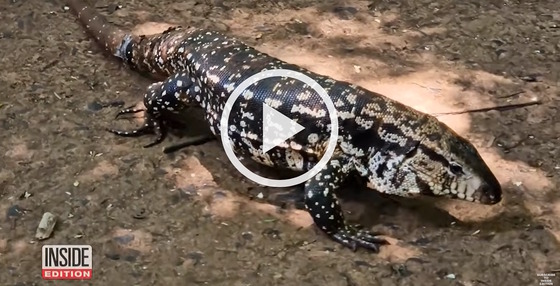 "It's open season on these giant invasive lizards," Inside Edition, interviewing DNR's Daniel Sollenberger. Related: Meateater podcast segment (interview with Sollenberger starts at 16:50 minutes in).
Interview with DNR bear biologist, WMAZ-TV (ch. 13, Macon)
"When a turtle patrol spots a white light on the beach," Georgia Sea Turtle Center
"Let wildlife do their thing," U.S. Fish and Wildlife Service on not disturbing nesting sea turtles
Mayflies swarm Ohio visitor center, Ohio DNR
"Georgia updating protected species list for first time in two decades," WABE-FM (90.1, Atlanta). Also: Grice Connect, WRDW-TV (ch. 12, Augusta), WTOC-TV (ch. 11, Savannah). Related: "Middle Georgia wildlife included in state’s protected species list update," The (Macon) Telegraph; "State cautions CSRA residents to be careful around protected species in Savannah River," WFXG-TV (ch. 54, Augusta).
"Training targets invasive species harming state's waterways," The Augusta Chronicle
(+audio) "State biologists warn of risks posed by invasive Argentine tegus," Georgia Public Broadcasting. Related: WTOC-TV (ch. 11, Savannah), CBS News, New York Post, Fox Weather, People, Newsweek.
"Giant lizards are invading Florida yards," Florida Today
"Georgia losing farmland; is state conservation fund enough to save it?" Grist
"Comment period for potential roll back of whale-protecting speed rule closes," The Brunswick News. Related: "Speed limits for ships: Could right whales survive without them?" Smithsonian
"Pitcherplants, wasps blur line between friend, food," Okinawa Institute of Science and Technology
"State’s largest documented robust redhorse found in Savannah River," WSB-TV (ch. 2, Atlanta)
"Marsh on the move," CoolGreenScience (The Nature Conservancy)
(+video) "Warnell Day on the Lawn celebrates wildlife, natural resources," UGA
"Wildlife official explains ‘cardinals gone bald,’" WSAV-TV (ch. 3, Savannah)
"Okefenokee moves closer to World Heritage status," WSB-TV (ch. 2, Atlanta)
"Realtree, DNR team with Braves for Hunting & Fishing Night," AllonGeorgia
"Massive sturgeon reeled in on Canada river," Canadian Broadcasting Corp.
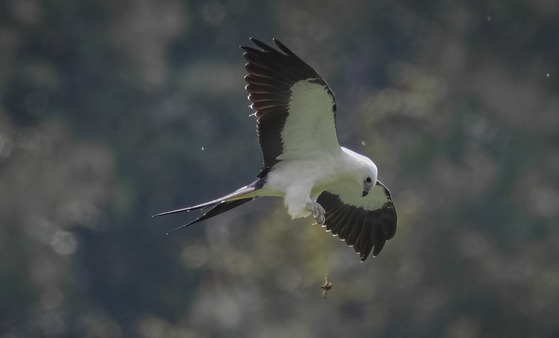 A swallow-tailed kite tracks a flying beetle (Brian Mitchell/Special to DNR)
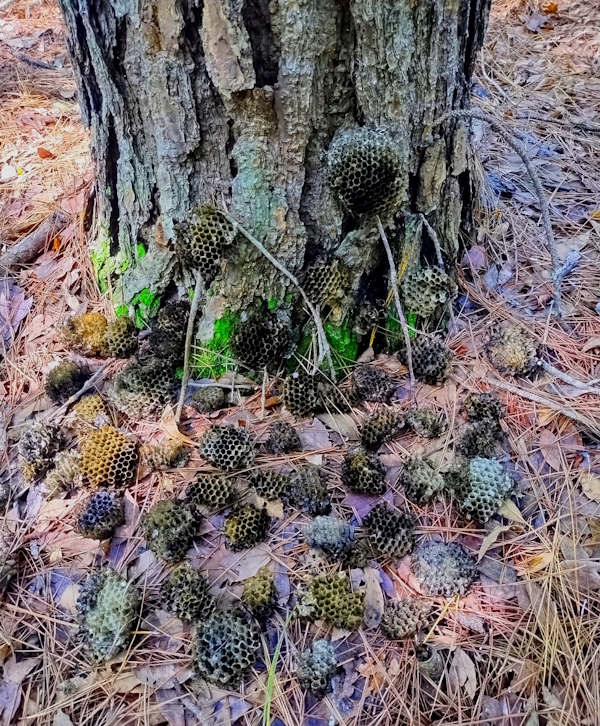
Wasp: It’s what’s for dinner? Swallow-tailed kites prey on a range of other wildlife. The black-and-white fork-tailed raptors are known for catching and consuming bugs in flight and snatching lizards, tree frogs and rough green snakes from trees. But they also will nab wasp nests, snacking on the larvae in mid-air and sometimes carrying the protein-packed paper combs back to their chicks. (The kite's thick-lined stomach helps when eating insects that sting.) DNR wildlife technician Andy Day took the photograph at right of wasp nests littering the base of a kite nesting tree on Townsend Wildlife Management Area. “That’s about 10 times as many as I usually see,” Day wrote. He has also found the nests of gnatcatchers below kite roosts, evidence of the raptors preying on the young of smaller birds. Swallow-tailed kites will nab bats, as well. And a South American subspecies is even known to eat fruit – which seems a much-too-easy target for these acrobatic aerial predators.
|
Top
|