IN THIS ISSUE
- Pumpkin Spice debut
- Update on wild tegus
- A beloved nut for birds
- Right whales are ... back!
- Mussel crew gets gator shock
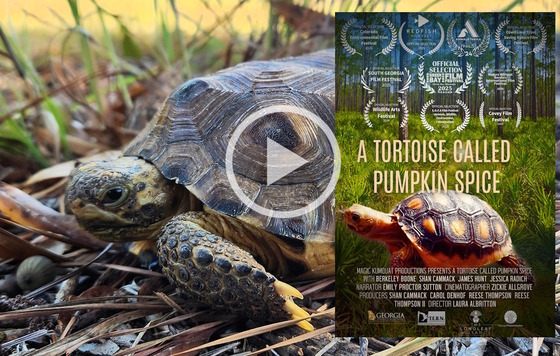 Pumpkin Spice has proven a favorite for outreach and film festivals. (Photo by Berkeley Boone/DNR)
’Tis the season for giving thanks and savoring pumpkin spice. And both fit the recent release of a short film highlighting a unique Georgia wildlife story.
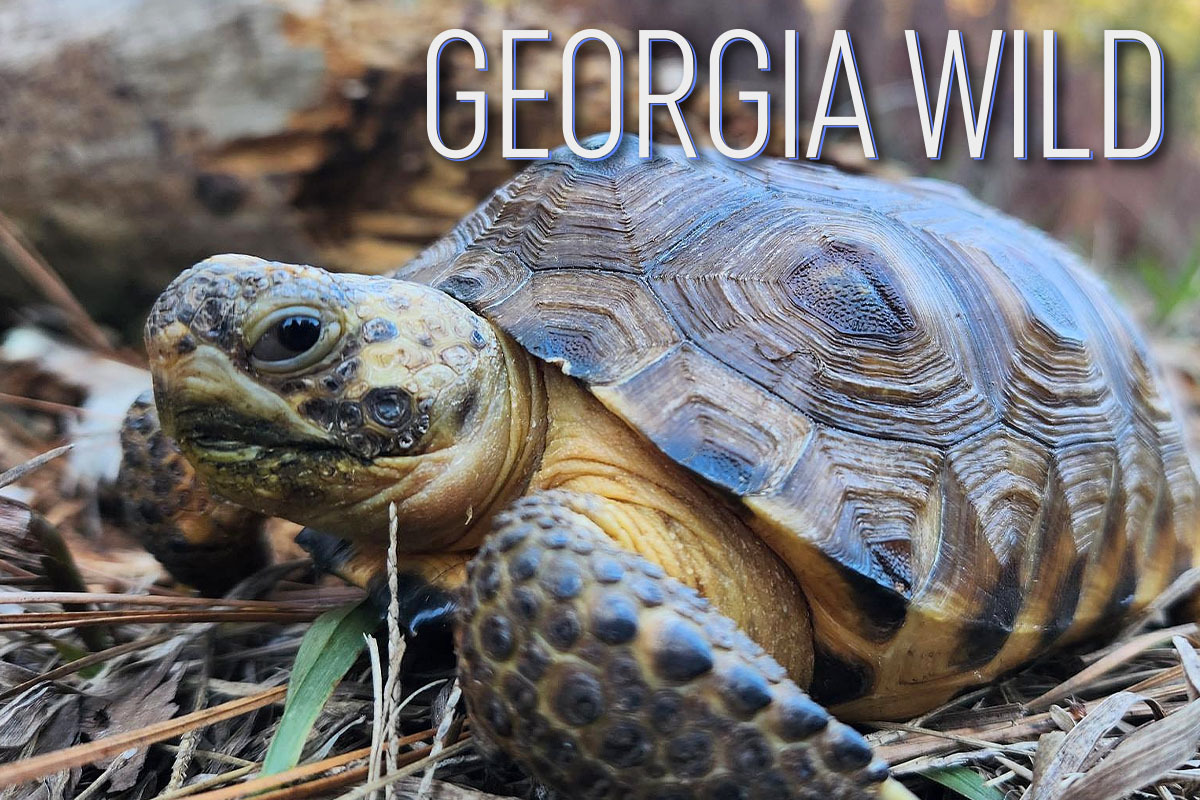
“A Tortoise Called Pumpkin Spice” tells how an orange-tinted gopher tortoise (thus the nickname) has become an ambassador for conserving the species, which also happens to be Georgia’s state reptile.
The 11-minute documentary by Magic Kumquat Productions digs into the young turtle’s history – hatched by the Georgia Sea Turtle Center and raised at the University of Georgia’s Coastal Ecology Lab, the only viable egg of eight from a mom fatally hit by a car. The video also shows how Pumpkin Spice’s role as an outreach animal at DNR's Charlie Elliott Wildlife Center highlights the importance of gopher tortoises and work to conserve them and their longleaf pine and sandhill habitats.
Directed by Laura Albritton with videography by Zickie Allgrove, the video was supported by The Environmental Resources Network (friends group of DNR’s Wildlife Conservation Section), DNR and The Longleaf Alliance. Clips include DNR’s Berkeley Boone, James Hunt and Shan Cammack – who also helped produce the film – and the U.S. Fish and Wildlife Service’s Jessica Radich, who coordinates raising tortoises at Warm Springs Federal Fish Hatchery for release into the wild.
The latest documentary by the conservation-focused south Georgia company, "Pumpkin Spice" has been shown at or accepted by a number of film festivals. The public debut follows the Georgia Gopher Tortoise Initiative announcement that 65 viable populations have been permanently protected in the state, a long-sought goal to help conserve tortoises and keep them off the Endangered Species List in the eastern part of their range ("Gopher goal reached," October).
ALSO WATCH: SAVING ‘DEVOURERS’
Another new film from Magic Kumquat Productions titled “Devouring Beauties” explores the carnivorous side of pitcherplants and a partner-powered project to rescue and relocate scores of them threatened by roadwork in Georgia. Watch.
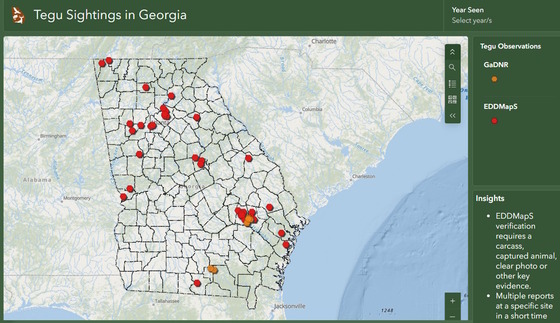
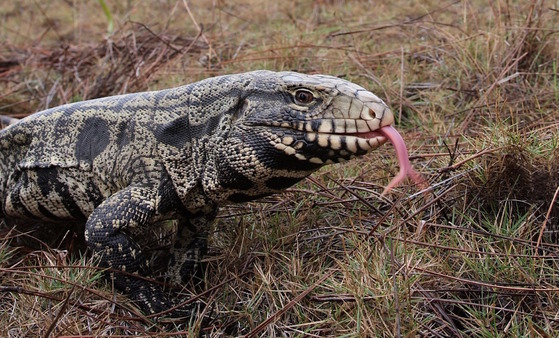 Confirmed tegu reports in Tattnall and Toombs hit a seven-year high this year (Dustin Smith)
In 2018, DNR began investigating odd reports of big lizards scuttling across dirt roads, hiding under homes and lurking around chicken houses in Tattnall and Toombs counties.
That response quickly turned into an all-out push to eradicate what is now considered a wild population of Argentine black and white tegus. These south American reptiles may be popular as pets, but – growing up to 4 feet long and able to weather Georgia winters – they're a nightmare for native wildlife.
Confirmed tegu reports in the two southeast Georgia counties surged to 11 this year. The total, the most since 2018, could reflect more reports, more tegus or both.
While it's unclear whether the battle with this invasive species is being won or lost, here are five things we know:
-
No young tegus have been confirmed, but females have been found with eggs. DNR senior wildlife biologist Daniel Sollenberger said the signs point to a wild population. “There’s no (other) reasonable reason for having that many tegus in such a small area.”
-
Tegus seen elsewhere in Georgia are considered one-offs, such as an escaped pet or illegally released animal. But Dr. Lance McBrayer of Georgia Southern University, a partner with DNR in the Toombs and Tattnall effort, said the number and spread of sightings “speaks to the fact that the pet trade is a significant hurdle” and underscores the looming threat that if tegus "make it into the wild in very many numbers, they could breed and increase rapidly.”
-
These lizards eat on the move, even eating things that don’t move. Analyzing the stomach contents of tegus from Tattnall and Toombs has revealed everything from frogs, lizards and small snakes to muscadines, strawberries and “bugs of all stripes,” McBrayer said. “Each had a mix of invertebrates, plant matter and small vertebrates.” They’re also likely eating any eggs they find, he said.
-
Tegus in Tattnall and Toombs do not appear to be increasing fast, unlike in Florida. While that could be hopeful, it’s not uncommon for invasive species, McBrayer said. “There can be long periods when the population simmers at a low abundance and at some point it may take off. Or it may not. Predicting the rate of increase is difficult.” But when a population does increase, he said, it does so rapidly, often growing exponentially.
-
Tegus in the wild are “public enemy no. 1,” Sollenberger said. “Wherever they are, we want them off the street.”
 WHAT YOU CAN DO
- Report tegus, alive or dead. Note the location, take a photo if possible and report the sighting at gainvasives.org/argentine-black-and-white-tegu, (478) 994-1438) or gainvasives@dnr.ga.gov.
- Remember that as a non-native species, tegus in the wild in Georgia can be legally trapped or killed year-round on private property with landowner permission. Local ordinances apply, as do safety precautions. On DNR wildlife management areas, tegus can be taken with firearms legal for the current hunting season or hunt dates on the area.
- Remember that Argentine black and white tegus are listed as wild animals in Georgia. Any not registered with DNR and tagged before Dec. 4, 2023, cannot be kept as pets. Importing and breeding a wild animal also is illegal, as is releasing any non-native animal into the wild.
- Learn more at georgiawildlife.com/tegus.
 By TERRY W. JOHNSON
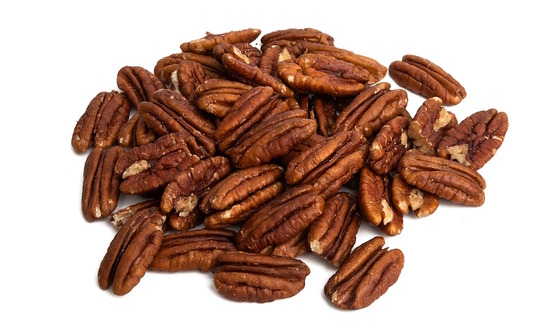
We Georgians love our pecans. In addition to cracking them open and enjoying them straight from the shell, we use them in mouth-watering dishes, including cakes, cookies, casseroles, salads and pies. I actually can’t think of a dish containing pecans that I don’t like.
That being said, many people don’t know that birds love pecans, too. Or that these nuts deserve a place alongside the traditional menu of seeds and suet we offer the feathered regulars at our backyard feeders.
Here’s why …
Read Terry’s column to learn about the draw and impact of pecans at feeders.
Terry W. Johnson is a retired DNR program manager and executive director of TERN, friends group of the Wildlife Conservation Section. Check out past columns and his blog. Permission is required to reprint a column.
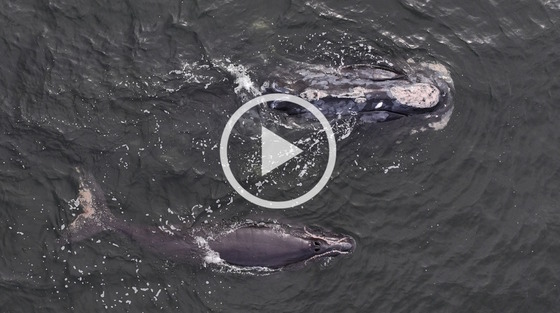 2024 video of a calf and mother (No. 2430) with dolphins off Amelia Island, Fla. (DNR/NOAA permit 26919)
They're back! Two adult right whales seen Wednesday off Hilton Head, S.C., and Savannah marked a slightly earlier-than-expected return of the endangered whales to their core calving area. DNR senior wildlife biologist Jessica Thompson called the timing “uncommon but not unheard of.” Right whales usually show up in Georgia from mid-November to early December.
Thompson encouraged boaters to be vigilant: keeping watch and slowing down. Along with entanglement in commercial fishing gear in the northeast Atlantic, vessel strikes along the Eastern Seaboard are a leading cause of right whale deaths. Despite their size, the whales can be hard to see because of their dark color and lack of a dorsal fin. Mothers and calves spend most of their time at or near the surface, putting them more at risk of being hit.
Boaters are urged to be on the lookout, slow down where right whales are present and report sightings via 877-WHALE-HELP (877-942-5343), the U.S. Coast Guard on marine VHF ch. 16 or the Whale Alert app. Reports can help avoid boat strikes. For sighting updates, check the app or whalemap.org.
There were an estimated 384 North Atlantic right whales as of 2024. That just-released estimate was up 2 percent over 2023. However, the 10 calves reported last winter fell far below the 50 a year NOAA says are needed to overcome the high rate of whales dying from vessel strikes and entanglement in fishing gear.
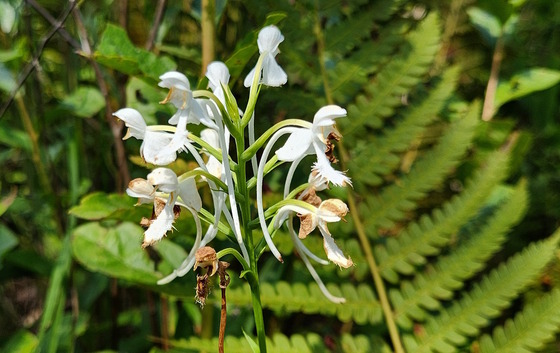 Rare orchid, rare find at River Creek WMA (Phil Spivey/DNR)
The discovery of large white-fringed orchid at River Creek, the Rolf and Alexandra Kauka Wildlife Management Area near Thomasville marks only the fifth known site in Georgia for the rare orchid. Wildlife Conservation Section biologist Phil Spivey found Platanthera conspicua on a wet seepage slope in a regularly burned longleaf pine stand.
Teamwork between the DNR Stream Team and professor Dr. Pete Sakaris and his students at Georgia Gwinnett College netted and removed 17 weather loach from the lake at Club Drive Park in Lawrenceville. A population of the invasive east-Asian fish was documented in 2022 in a tributary that feeds the lake. (Related: “Approach of the loach,” 2020 discovery of the species in Georgia and the response.)
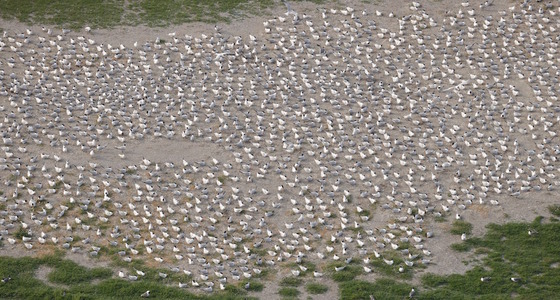 A nesting colony of mostly royal terns on Brunswick Bird Island (DNR)
DNR will hold a public hearing Nov. 12 on proposed changes to the state’s “Bird Island Rule” aimed at providing greater protection for seabirds and shorebirds. The hearing is set for 7 p.m. in the Susan Shipman Environmental Learning Center at DNR Coastal Regional Headquarters in Brunswick. Comments can also be submitted by phone, email or mail by Nov. 30. For details on the proposed amendments, see georgiawildlife.com/regulations/proposed; for commenting, georgiawildlife.com/regulations/meetings. Note: This comment period is separate from the scoping process and meetings held this summer.
Young and restless … to help care for Georgia’s natural and cultural resources? Apply by Nov. 17 for the DNR Career Academy, a week-long summer camp that allows high-schoolers to experience the work DNR does – from managing wildlife to teaching boating safety – check out career options and make connections.
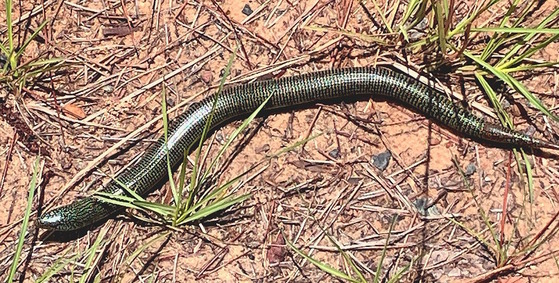 An eastern glass lizard photographed near Jesup. (Justin May)
Quick hits:
- DNR’s call for giant salamander sightings (“Searching for Salamanders,” October) has turned up some cool observations, and if not always of amphibians, such as an eastern glass lizard seen near Jesup. This legless reptile’s tail can make up two-thirds of its body length and break into pieces – as if made of glass – when the lizard sheds it to escape a predator.
- While “conservationist” can be a subjective label, about 62 percent of U.S. adults consider themselves one, says a nationwide survey from Responsive Management and the Council to Advance Hunting and the Shooting Sports.
- DNR Wildlife Resources Division posts about black witch moths, the largest moth in America, drew about 25,000 views on Facebook and Instagram.
- Georgia Wild reader Rick Krause, who responded last year to a Terry Johnson column that stirred interest in black witch moths, wrote recently to commend Johnson’s October piece on late boneset, saying the plant had popped up in his Lilburn-area yard years ago and draws a crowd of “wasps, bees, butterflies, flies, skippers and such.” (Watch: Birds Georgia tour of the Krauses’ yard.)
- An introductory-level Learn and Burn for land managers interested in prescribed fire is scheduled Dec. 3 at Sandhills Wildlife Management Area: West near Junction City. Register by Nov. 21.
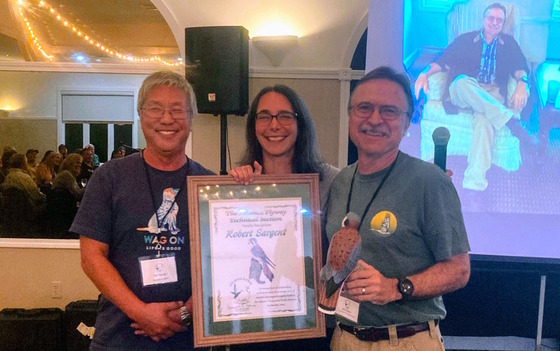 Bob Sargent (right) with Min Huang and Danielle D'Auria of the Atlantic Flyway Council (Special to DNR)
Names in the news: The Atlantic Flyway Nongame Migratory Bird Technical Section honored Dr. Bob Sargent, a DNR Wildlife Conservation Section program manager, for his almost decade-long dedication and leadership, including as chair. The group helps inform the Atlantic Flyway Council on conserving and managing migratory birds that aren’t legally hunted. DNR wildlife biologist Tony Kroeger of the Wildlife Resources Division's Private Lands Program was named the Southeastern Association of Fish and Wildlife Agencies’ Regional Wildlife Biologist of the Year, in part for his leading role in the Forest Protection and Habitat Partnership with the Georgia Forestry Commission. Wildlife Conservation biologist Anna Yellin and Dr. Lance Durden of Georgia Southern University published an article on moth diversity in a pitcherplant bog in Southern Lepidopterists’ News. Fellow Wildlife Conservation biologist Johnny Stutzman saw his study of how habitats and predators influence porcupines on the Montana prairie published in the Canadian Journal of Zoology.
WHAT YOU MISSED ...
In last month's Georgia Wild:
- An overlooked pollinator plant
- Report giant salamanders? Yes!
- Tortoise group reaches milestone
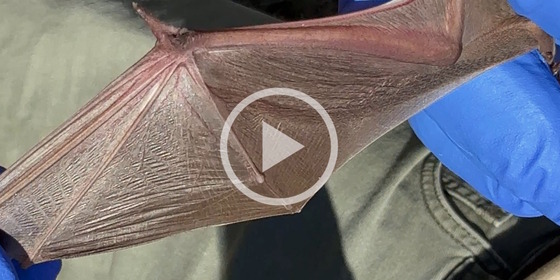 "Bat Week 2025," DNR Wildlife Resources Division
Tree stand safety, DNR Law Enforcement Division
(audio) "How Colorado Brought Wolves Back," Our Wild Lives podcast (The Wildlife Society)
"How to Build a Boat Ramp," DNR Wildlife Resources Division
"Record sea turtle nesting season in Florida," WBBH/WZVN-TV (chs. 20, Fort Myers, ch. 26, Naples, Fla.)
Biologist dad jokes: round 3, DNR Wildlife Resources Division
(+video) "Slow, steady wins the race to save Georgia’s state reptile," WSB-TV (ch. 2, Atlanta). Related: The Ledger-Enquirer (Columbus).
"Right whales seem to be having a good year; they still need help," The Post and Courier (Charleston, S.C.). Related: "One of world’s rarest whales grows in population," The Associated Press.
"Lasagna, Scorpion, Athena: Scientists unveil new right whale names," New England Aquarium
"DNR 'warns' of rare black witch moth sightings," WANF-TV (ch. 46, Atlanta)
"Third Georgia CWD case not unexpected, DNR says," Georgia Outdoor News
"Just launched: Georgia’s 2025 State Wildlife Action Plan," SaportaReport
"DNR will research diamondback terrapin but declines to require protections," Georgia Recorder
(+video) "Macon man battles feral hogs in neighborhood," WMAZ-TV (ch. 13, Macon)
"Amphibians in our American future," SaportaReport
"Researchers track manatees near Hilton Head," WJCL-TV (ch. 22, Savannah)
"Gator sightings rising north of Georgia's Fall Line," WMAZ-TV (ch. 13, Macon)
"Drivers: Watch for deer as daylight saving time ends," WSB-TV (ch. 2, Atlanta)
"How to keep deer from destroying your garden," Southern Living
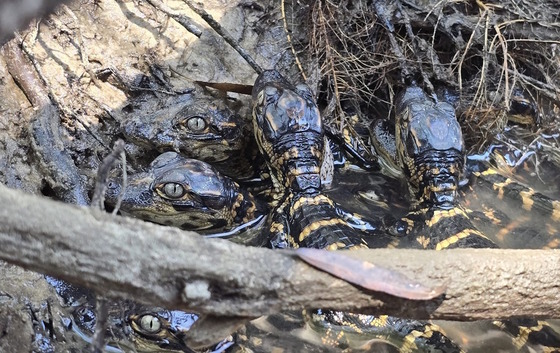 Juvenile alligators on the Ochlockonee (Matthew Rowe/DNR). Below: washboard mussel (Katy Lusk/DNR)
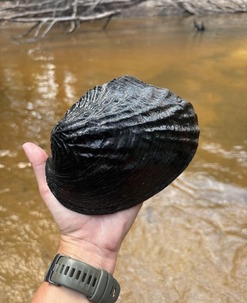
DNR Freshwater Biodiversity Program staff searched 12 miles of the Ochlockonee River south of Thomasville last month for Ochlockonee moccasinshells, endangered mussels not seen in Georgia's stretch of the river for over 35 years. The mussels were thought extinct until a small population was discovered in 2014 on the Middle Ochlockonee in Florida. What DNR staff did find was promising habitat for reintroducing moccasinshells, other mussels – including massive washboards (right) – and a surprise: hatchling alligators. Aquatic biologist Matthew Rowe and wildlife technician Zach Schumber had left their canoe to check a hard-to-reach part of the river and were kneeling about 20 feet apart, running their hands over the river bottom looking for mussels, when they heard a “chirp.” The two looked at each other and eased up to scan the bank. There was a pod of juvenile gators between them. Thankfully, mom wasn't home. They quietly took a few photographs and moved downstream. (For another close encounter, see "Don't look now," October 2022).
|
CREDIT: Georgia Wild masthead/Pumpkin Spice (Berkeley Boone/DNR)
Top
|