IN THIS ISSUE
- Mussel magic video
- Red knot's wild journey
- Plant champion stories
- Feeding tips for hummers
- Bald eagle nesting numbers
 Driving can be wild in Georgia.
But did you know driving can help Georgia stay wild, beyond our busy roads?
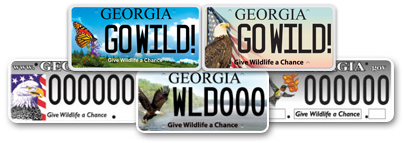
Here's how: Buy or renew a DNR wildlife license plate.
Most of the $25 annual fee for an eye-catching DNR tag goes to wildlife work. And when it comes to conserving animals and plants not hunted or fished for – about 95 percent of our wildlife – the eagle, butterfly and hummingbird plates are vital.
That’s because DNR’s Wildlife Conservation Section, charged with conserving and restoring these creatures and their habitats, receives little state funding. Instead, the agency depends on grants, donations and fundraisers. Like the nongame plates.
Buy or renew one of these tags and drive Georgia wild. In a good way.
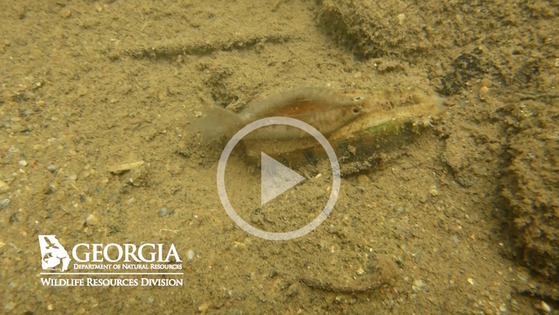 Freshwater mussels are amazing magicians.
Not convinced? Watch the video above. What you'll see is a finelined pocketbook mussel in northwest Georgia’s Holly Creek using the fleshy tissue in its shell to mimic a wounded fish. Likely a blackbanded darter – bands, eye spots and all.
Why? This rare mussel species depends on bass to carry and disperse its young, called glochidia. Bass, of course, eat darters and other small animals.
But when a bass bites this lure, the mussel – maybe with a quiet Tada! – spews out glochidia. Some of these larvae, smaller than grains of salt, clamp onto the fish’s gill filaments. They grow for a few weeks, then drop off to further the family line.
DNR malacologist Matthew Rowe said the federally threatened finelined pocket is one of the Lampsilini mussels. The group is known for using “showy mantle lures” (mantle is the tissue lining a mussel’s shell) and predatory fish to host their glochidia. Finelineds can also release eggs in a mucusy strand. Waving in stream currents, the sticky strings tempt fish to bite … and get slimed with mini-mussels.
For creatures that move at slower than a crawl and don't rate high in animal IQ, the creativity and sleight-of-shell abilities some mussels show is, well, magical.
The video was taken during annual mussel sampling focused on a section of Holly Creek where organizations and landowners have worked to restore streambanks and keep cattle out of the creek. Partners include The Nature Conservancy, Limestone Valley Resource Conservation and Development Council, Coosa River Basin Initiative, and the U.S. Fish and Wildlife Service.
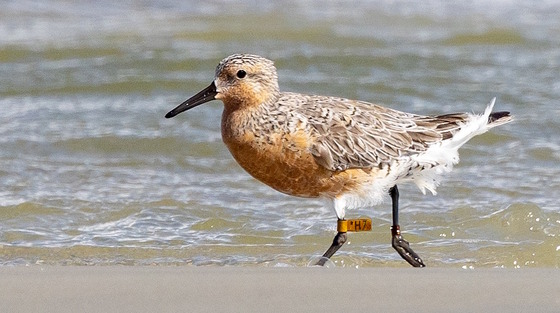 *H7 at Little Tybee Island in spring 2025 (Baxter Beamer/DNR)
*H7 is a Rocky among red knots.
After being fitted with a small transmitter on Little Tybee Island in spring 2024, this robin-sized sandpiper migrated more than 3,000 miles to breed in the Arctic, then launched that July on a 5,000-mile flight south, navigated through a category 1 hurricane and three South American countries where shorebirds are hunted, and returned to Little Tybee this April.
When it comes to beating the odds, Balboa has nuthin’ on this knot.
Yet like “Rocky,” the tale of *H7 – the bird’s leg-band code – can inspire and inform, revealing the extraordinary migrations many shorebirds make each year and the importance of stopover sites in the Southeast.
Read more about *H7 and explore how partners are monitoring other red knots.
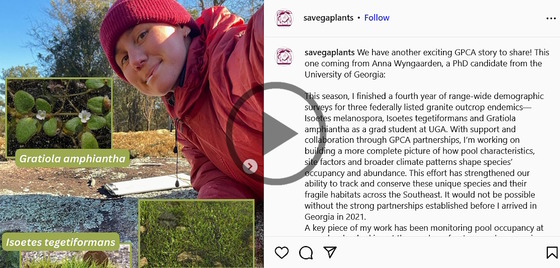 As part of its 30th birthday bash, the Georgia Plant Conservation Alliance is sharing success stories on Instagram.
Follow savegaplants for a countdown of 30 projects focused on species varying from granite outcrop specialists such as black-spored quillwort (Isoetes melanospora) to one of Georgia’s few remaining wild stands of royal catchfly (Silene regia).
The Plant Conservation Alliance is a botanical juggernaut-of-a-network including more than 75 public gardens, agencies, schools, companies and conservation organizations committed to preserving endangered flora statewide.
As noted in a 2016 Georgia Wild story, the alliance's strength is rooted in its members and their willingness to join forces for conservation. “The result: more resources, more collaboration and more effective conservation.”
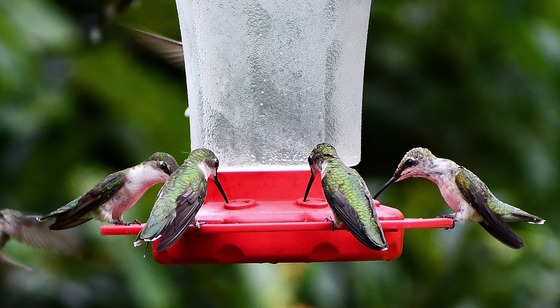 Ruby-throated hummingbirds crowd a feeder (Terry W. Johnson)
By TERRY W. JOHNSON
Ruby-throated hummingbirds have captivated humans' imagination for ages.
The Cherokees called hummingbirds walela, which speaks of grace, agility and beauty. To Spanish explorers, hummers were flying jewels. Early colonists named them the King’s birds. John James Audubon described them as “glittering fragments of the rainbow.”
Today, we still hold hummingbirds in high regard. Especially in summer, when they can swarm our feeders.
Want to make your yard a haven for these flying jewels? Here are feeder tips that can help. ...
Read Terry’s column for insights to attract hungry hummers.
Terry W. Johnson is a retired DNR program manager and executive director of TERN, friends group of the Wildlife Conservation Section. Check out past columns and his blog. Permission is required to reprint a column.
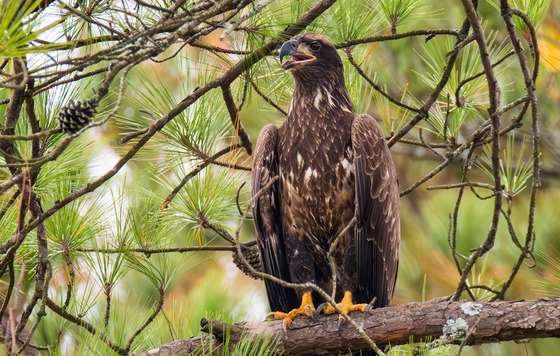 One of this year's juvenile bald eagles -- note the large beak and yellow feet -- in north Georgia (Ron Goldfarb)
Bald eagle nesting remains strong in Georgia. This year’s survey by DNR found the iconic raptors nesting at average to just below average levels in the southern part of the state, with totals – 127 successful nests in 176 checked – suggesting there were more than 200 nest territories statewide. Report a nest.
Watch the Atlanta Braves take on the Mets and support wildlife at the same time during Hunting and Fishing Night at Truist Park Aug. 23. Before the Bravos battle New York, DNR will engage fans with live animals, touch tanks, a game warden boat and archery booth. Part of the proceeds from tickets sold here will go to the Georgia Natural Resources Foundation.
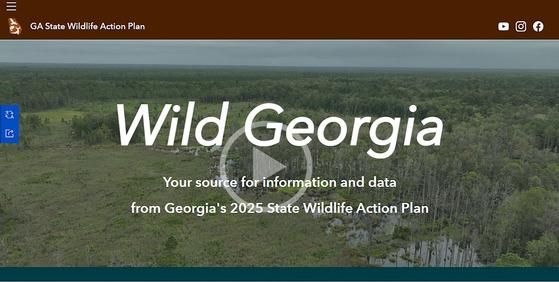 Georgia’s revised State Wildlife Action Plan is in place and in use. Shaped by agency staff, conservation organizations and public feedback, the overhauled conservation strategy has been sent for federal review but is already available online to start guiding wildlife work by DNR and partners for the next 10 years.
DNR wants public input on proposed changes to Georgia’s “Bird Island Rule” aimed at better protecting seabirds and shorebirds. Three scoping meetings are scheduled, while the Wildlife Conservation Section is also collecting comments by email, phone and in writing.
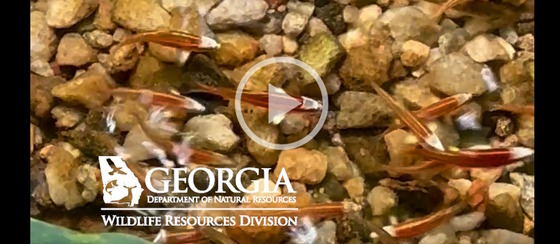 A video taken recently by metro resident Mark Rosseter captures yellowfin shiners spawning in a Decatur creek over a gravel nest made by either bluehead chubs (the bigger fish shown) or bluefin stonerollers (also larger but with a black band on their dorsal fin). Yellowfins -- the smaller, flashier minnows -- are "nest associates" that primarily spawn over nests built by bluehead chubs.
Quick hits:
WHAT YOU MISSED ...
In the previous Georgia Wild:
- A raven nest conspiracy
- Our super-sized squirrels
- Join the search for scurfpea
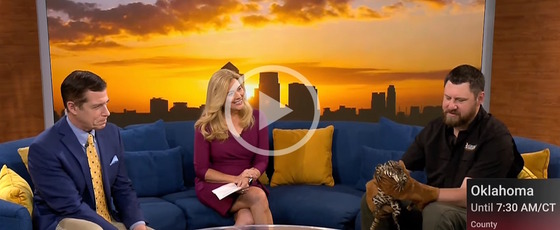 DNR wildlife biologist Daniel Sollenberger, right, with a tegu and Weather Channel staff
DNR's Daniel Sollenberger discusses invasive tegus, The Weather Channel
"Biologist Jokes" (Why did the woodpecker go to the gym?), DNR
"Swim by a right whale and her calf," Woods Hole Oceanographic Institution
(audio) "Meet hungry caterpillar's punk cousin — 'bone collector,'" NPR
"Great white bites Novia Scotia fisherman's boat," Canadian Broadcasting Co.
"Historic land deal halts mine near Okefenokee," The Atlanta Journal-Constitution. Related: "Buyers credit public advocacy," Columbus Ledger-Enquirer.
"Georgia plan could help conserve 1,000+ species," The (Macon) Telegraph. Related: WSB-TV (ch. 2, Atlanta), The Citizens (Rockdale, Newton) and others.
"Looking to keep wildlife out of ‘emergency room,’ states expand role," Stateline
"Georgia's bald eagle population takes flight as rebound continues," Georgia Recorder. Related: WSB-TV (ch. 2, Atlanta), WABE-FM (90.1, Atlanta).
"Inside the 16-state mission to save American oystercatchers," Audubon
"Input sought on proposed Bird Island Rule changes," WSAV-TV (ch. 3, Savannah).
"Headstarting gopher tortoises," U.S. Fish and Wildlife Instagram post
(+video) "DNR wants your help reining in feral hogs," WMAZ-TV (ch. 13, Macon)
(+audio) "Rare ravens return to Georgia to nest," WABE-FM (90.1, Atlanta)
"Boater alert: 400-pound green sea turtle killed by strike," The Brunswick News
(+video) "How to help Georgia's sea turtles thrive," Savannah Morning News
"Early detection and rapid response tools for invasive tegus," USGS
"Five myths about copperheads debunked," The State (Columbia, S.C.)
"Mercer and Longleaf distillery restore rare ecosystem," Mercer University
"How Canada, U.S. have tried to save right whales," The Globe and Mail (Toronto)
"Favorite park is little-known paradise for wildlife viewing," OnlyinGeorgia
"Anglers encouraged to compete in grand slams," WRDW-TV (ch. 12, Augusta)
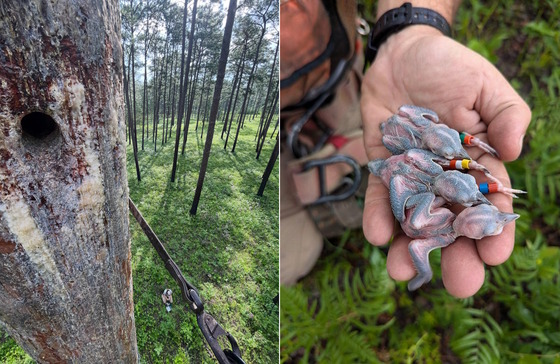 The view from a nest cavity, left, and three red-cockaded woodpecker nestlings after banding (Joe Burnam/DNR)
Red-cockaded woodpeckers had a super nesting season. DNR Wildlife Conservation Section staff monitored over 70 nests and banded 84 nestlings of the federally listed birds. Here are some highlights. After being skewered by Hurricane Helene, Moody Forest Wildlife Management Area near Baxley maintained its pre-storm total of 11 woodpecker family groups and recorded 10 nests this spring. The 2023 reintroduction of the birds at Sprewell Bluff WMA near Thomaston led this year to five family groups, four nests and banding seven nestlings. Southwest Georgia’s Silver Lake and River Creek WMAs posted record nest numbers, 40 and six respectively. Also, DNR and Tall Timbers Research Station completed a third year of cross-fostering woodpeckers. In all, 28 nestlings have been swapped between nests on different properties to boost genetic diversity in small, isolated populations.
CREDIT
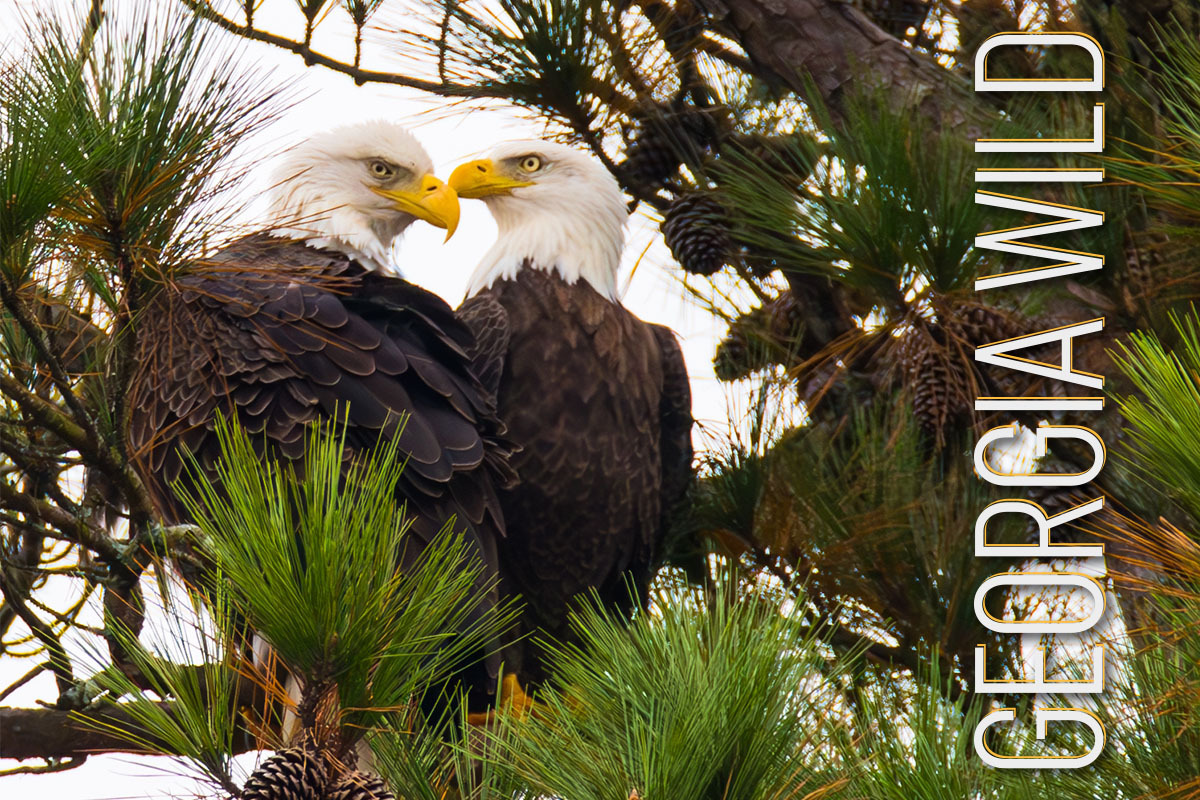
Masthead: Love is in the air -- or at least on the limb -- as the heads of this bald eagle pair form a heart in a fall 2024 image from Lake Allatoona. (Ron Goldfarb/Special to DNR)
Top
|