IN THIS ISSUE
- Is that scurfpea?
- Raven nest conspiracy
- Our super-sized squirrels
- Whale's end; dolphin's rescue
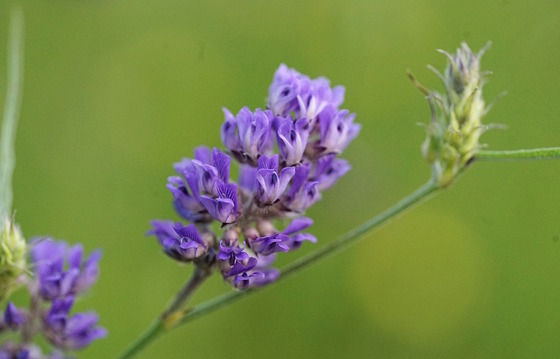 Pineland scurfpea hasn't been documented in Georgia for decades (Emily Bell/Florida Wildflower Foundation)
By CARLEE STEPPE
The latest rare plant search in Georgia is aimed at rediscovering one of the state's rarest wildflowers – pineland scurfpea (Orbexilum virgatum).
Last documented in the 1930s in the sandhills of southeast Georgia, this slender knee-high plant features purple, pea-like blooms and narrow, hairy leaves.
Its preferred home? Sun-soaked longleaf pine-wiregrass habitats, especially those that sport sand ridges and have been treated recently with prescribed fire.
Pineland scurfpea is a species of high conservation concern in Georgia’s draft 2025 State Wildlife Action Plan. But there's a catch: We don’t know if it still exists in the wild here. This is where you come in.
- Best time to search: May through June, during peak flowering.
- Where to look: open pine flatwoods and savannas in southeast Georgia sandhills.
- What to look for: hairy stems, tiny purple flowers and leaves dotted with dark glands.
- Tip: Focus on recently burned areas – these habitats offer the best conditions for the plant.
If you think you've seen pineland scurfpea in Georgia (it's called pineland leather-root in Florida) or would like help planning a search, email carlee.steppe@dnr.ga.gov. You can also send GPS locations and clear images to gabiodata@dnr.ga.gov or upload observations to iNaturalist.
Carlee Steppe is a botanist with DNR’s Wildlife Conservation Section.
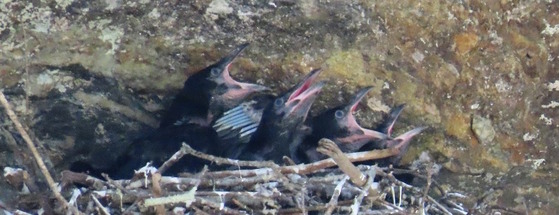 Raven chicks beg to be fed in a nest north of Tallulah Gorge (DNR)
Common ravens are having an uncommonly good nesting season in Georgia.
This spring, DNR staff found three thriving nests of the big and rare black birds in northeast Georgia and a fourth nest just across the South Carolina line. The lineup includes chicks at the same cliff-side spot in Tallulah Gorge State Park where ravens nested last year, a first for Rabun County, as well as nests on reservoir dams at lower elevations than ravens typically prefer.
Considering that it is unusual to find more than one raven nest in the state, “It’s quite a banner year,” said Dr. Bob Sargent of DNR’s Wildlife Conservation Section.
Although widespread in the Northern Hemisphere and exceptionally smart – using gunshots as queues for scavenging opportunities and young ones calling for help with hard-to-reach food – ravens were ravaged by hunting, poisoning and habitat loss in the eastern U.S. They are state-listed as rare in Georgia and are considered a species of greatest conservation need in the latest State Wildlife Action Plan.
In the 1900s, ravens were confirmed nesting only at Brasstown Bald, the state’s highest point. Other suspected breeding areas also involved cliff ledges at least 1,000 meters (3,280 feet) above sea level.
That changed this decade. A falconer spotted a nest on Lake Nottely dam in 2021. It was Georgia’s first raven nest on a humanmade structure and less than 2,000 feet above sea level. 2023 featured a nest at the Lake Blue Ridge dam. Last year, DNR’s Liz Morata documented a nest on the main cliff wall at Tallulah Gorge, only about 1,300 feet above sea level. The nest at the park fledged two young.
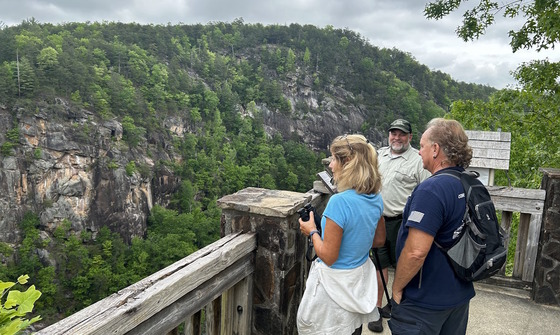 Tallulah Gorge Ranger West Malenke points park visitors to the raven nest on the far rock wall (Kim Hatcher/DNR)
Sargent and Morata saw adults tending the Tallulah Gorge nest again this April – chicks have since been confirmed – and found a nest with young on the Chattooga River just north of the gorge. (DNR’s Shan Cammack initially reported the latter site last year.) Raven chicks were also spotted in nests at lakes Nottely and Blue Ridge.
A flock of ravens is sometimes called a conspiracy. Sargent has a word for this year’s nesting uptick in Georgia, including the use of lower heights and humanmade structures.
He calls it encouraging.
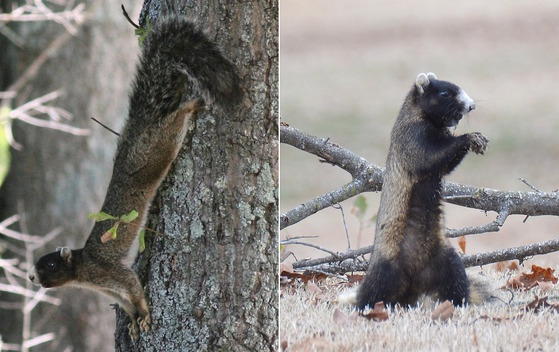 Fox squirrels come in a range of color phases. (Steve Kyles/DNR; Terry W. Johnson)
By TERRY W. JOHNSON
For most Georgians, whenever the subject of squirrels finds its way into a conversation, gray squirrels immediately come to mind. This is understandable since it is the squirrel most commonly seen throughout our state.
However, Georgia is also home to North America’s largest tree squirrel species. Of course, I am referring to the fox squirrel (Sciurus niger).
Compared to gray squirrels, fox squirrels are bigger – by as much as 20 percent – and more varied in color, ranging from gray and rust to black and white. In Georgia, we see more predominantly black squirrels with white-tipped tails and white blazes on their faces than anywhere else in the country.
But that’s not all that’s different – and I’d say, impressive – about fox squirrels. …
Read Terry’s column for cool insights into these super-sized squirrels.
Terry W. Johnson is a retired DNR program manager and executive director of TERN, friends group of the Wildlife Conservation Section. Check out past columns and his blog. Permission is required to reprint a column.
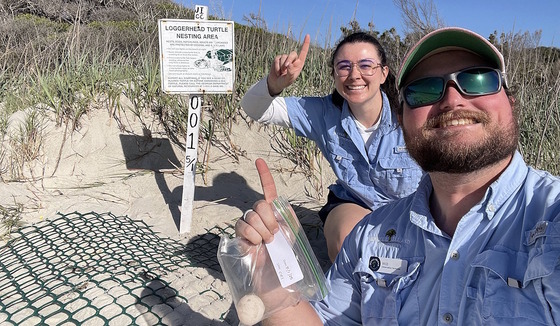 Jekyll Island's Will Hicks and Bailey Yarborough celebrate the season's first nest. (Jekyll Island Authority)
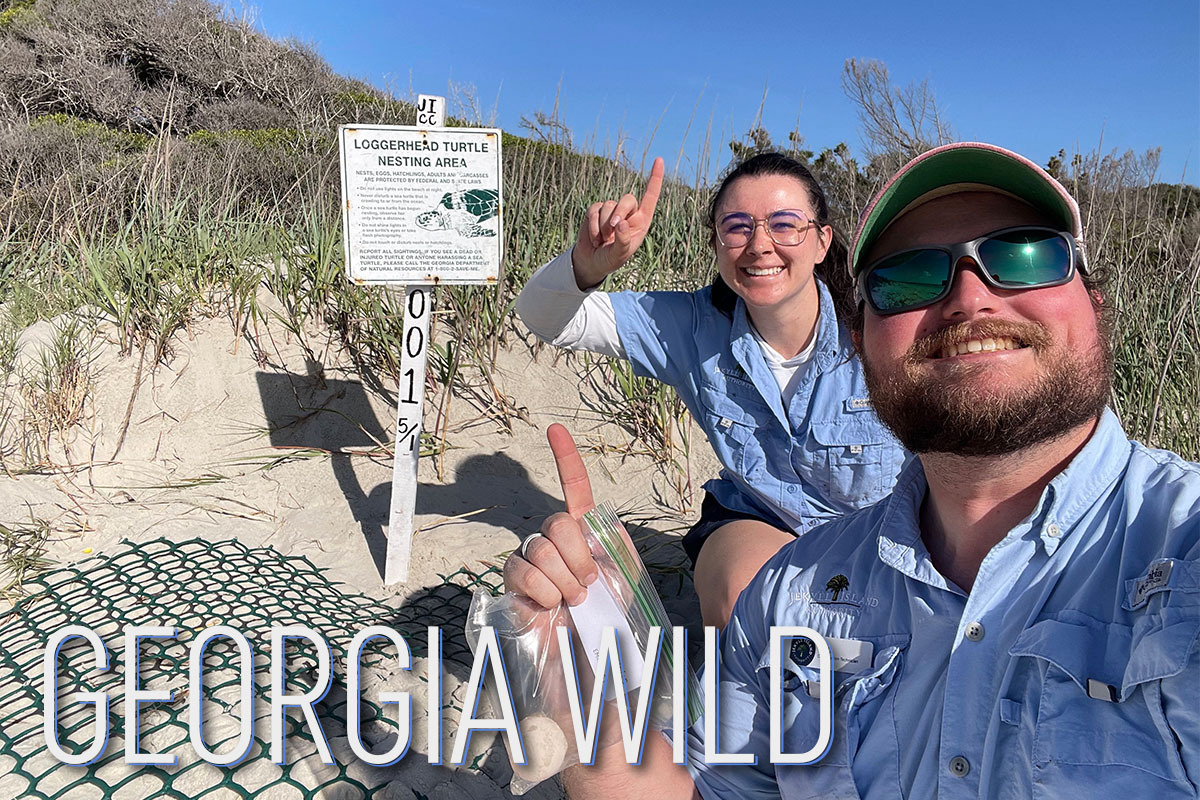
Although sea turtle nesting began on cue in Georgia – with a first nest May 1 on Jekyll Island – the season start was slower than expected. The 535 loggerhead nests documented by Georgia Sea Turtle Cooperative members in the first month fell just below the 10-year average of 561 and far shy of the 900-plus nests per May in 2022 and 2019, the last two high-nesting seasons. But DNR Sea Turtle Program Coordinator Mark Dodd says May is not always a good gauge. “Some years, nesting activity is delayed and turtles hit the beaches in earnest in June.” Daily updates.
Flashing signs along U.S. 80 to Tybee Island and the Jekyll Island Causeway are warning drivers to watch for diamondback terrapins. During high tides from May till mid-July, the terps leave saltwater marshes for high ground to lay eggs, often crossing busy roads (“Sign of Times,” May 2023). A Jekyll Island Authority website reports about 100 hit on the causeway this year. Did you see Mission: Eggpossible?
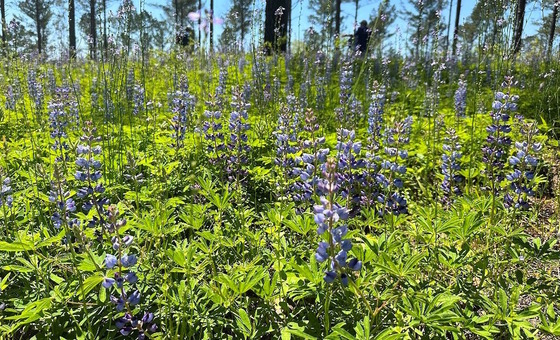 A healthy stand of sundial lupine on private land in Georgia's Piedmont region (DNR)
A Pike County tract is proving a goldmine for sundial lupine, a key host plant for rare frosted elfin butterflies. Alerted to the plants by Quail Forever biologist Mike Sisson and given the landowner’s OK, more than 3,000 seeds were collected for the Georgia Native Seed Network to outplant at other sites and help raise and reintroduce the butterflies, a candidate for federal listing. (Also see: Frosted elfin returns to north Florida.)
Following ideal spring rainfall and temperatures, DNR technician Nate Thomas discovered thousands of dwarf ginseng (Nanopanax trifolius) in Fannin County, while biologist Amaad Blades and volunteers documented in Carrol County what turned out to be – at 6,000-plus plants – the state’s largest stand of pink lady’s slipper orchids (Cypripedium acaules). Both plants are species of greatest conservation need in Georgia's 2025 State Wildlife Action Plan.
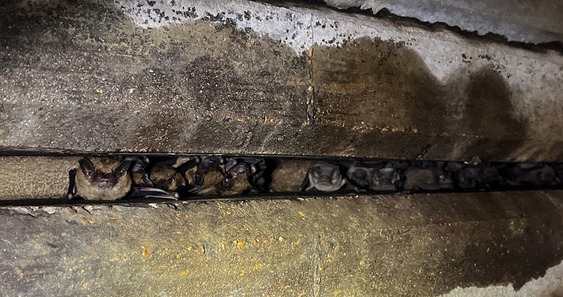 Big brown and Brazilian free-tailed bats in a bridge expansion joint (DNR)
More than 50 people, from Georgia Department of Transportation employees to private contractors, completed this year’s Bats in Bridges training led by DNR's Wildlife Conservation Section and the U.S. Fish and Wildlife Service. The instruction centers on conducting thorough surveys for bats in bridges and culverts. (For more: "Bat crossing" blog post.)
Boaters are again being urged to watch for zebra mussels after about a gallon of the invasive mollusks were found on a boat at Lake Lanier that had been in the Tennessee River. This mussel species native to eastern Europe has spread into many U.S. waterways, wreaking ecological and economic damage.
So far, so good for spring sampling of robust redhorse. After catching and releasing only 10 of the large, state-endangered suckers last year, in three trips on the Broad River this spring the DNR Freshwater Diversity Program tagged 17 redhorse never caught before, plus another five fish that had been.
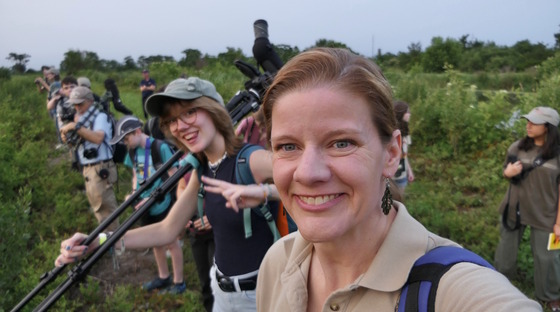 DNR's Linda May, a TALON leader, snaps a selfie with campers. (DNR)
Quick hits:
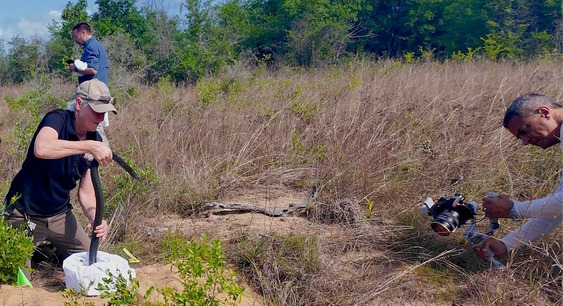 DNR's Shan Cammack releases an indigo as Zickie Allgrove videos (Laura Albritton/Magic Kumquat Productions)
Names in the news: Fire Management Officer Shan Cammack of DNR’s Wildlife Conservation Section helped with the release of more than 40 eastern indigo snakes at The Nature Conservancy’s Apalachicola Bluffs and Ravines. Reintroducing the federally threatened snakes to the north Florida preserve is part of a long-running, multi-partner effort. (For more: Listen to WFSU Public Media's "Coast to Canopy.") South Carolina DNR coastal bird biologist Felicia Sanders has received that state’s highest civilian honor, the Order of the Palmetto. Granted by the governor’s office, the award recognizes a lifetime of achievement and service: in Sanders’ case, leading coastal bird conservation for the agency since 2001.
WHAT YOU MISSED ...
In the previous Georgia Wild:
- I see, I conserve
- Catch the dawn chorus
- Report lantern flies, tegus
- Allatoona ospreys in action
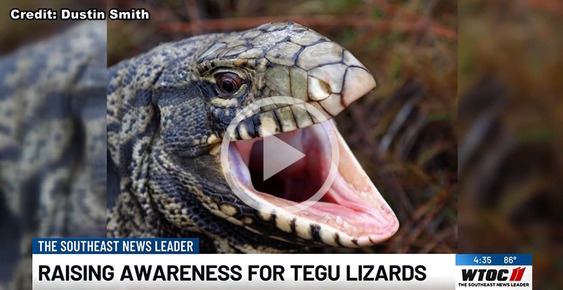 "Be on lookout for giant invasive lizards in Georgia," WTOC-TV (ch. 11, Savannah)
Wayward loggerhead helped back to ocean on St. Catherines, Georgia Sea Turtle Cooperative
"Froggin' by Ear: Wildlife 101 webinar with Ranger Jen," featuring DNR 's Linda May (City of Milton Parks and Recreation)
"AI equipment extends impact of Athens Urban Wildlife Project," UGA
(+audio) "Back-country nature reserve near Columbus set to open in fall," The (Columbus) Ledger-Enquirer
"Georgia’s first sea turtle nest of 2025 season confirmed," WSAV-TV (ch. 3, Savannah) and others
"10M birds soar across Georgia nightly, but not for long," Atlanta Journal-Constitution
"From prehistoric resident to runaway pet: first tegu fossil found in U.S.," Florida Museum (study in Journal of Paleontology)
"New Joe Tanner Discovery Center at Charlie Elliott," Georgia Outdoor News
"Proposed rule change on endangered species triggers alarm for environmentalists," Associated Press. Related: Federal Register record; U.S. House Committee on Natural Resources news release; Wildlife Society response.
"Florida-to-Georgia superhighway for animals," Ft. Myers (Fla.) News-Press
"Fla. looks to take out more iguanas," The Floridian (Ft. Lauderdale, Fla.)
"Climate change fuels Southeast rise in invasive plants," The Augusta Chronicle
"NASA data helps map tiny plankton that feed right whales," NASA
"Right whale gal pals Curlew and Koala spotted in Canada," USA Today
"Study: Wild bees crucial to blueberry success," UGA Cooperative Extension
"How electrofishing helps keep Georgia lakes thriving," WMAZ-TV (ch. 13, Macon)
"Up close and personal, cicadas display Nature’s artwork," The Associated Press
"Study: Georgia's artificial reefs contributed $8.2M to coastal economy," Georgia Public Broadcasting
"Airport on front lines of wildlife trafficking crisis," Atlanta Journal-Constitution
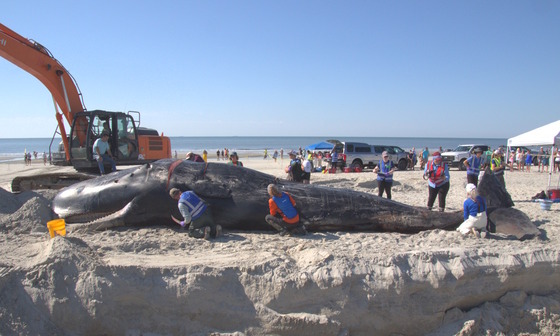 DNR staff and others begin necropsy of the sperm whale on Hilton Head beach (DNR/NOAA permit 24359)
An emaciated sperm whale that stranded on the beach at Hilton Head Island, S.C., made headlines for days in early May. The 31-foot-long juvenile male was in too poor of condition to save and was humanely euthanized. The response and necropsy led by NOAA and the Lowcountry Marine Mammal Network involved DNR and many other partners, including local government agencies.
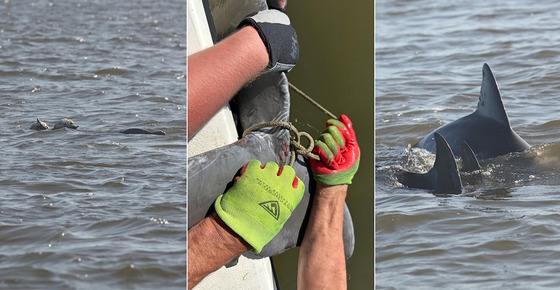 From left, entangled dolphin near trap floats; removing line; swimming free with others (DNR/NOAA permit 24359)
The story ended differently for a bottlenose dolphin entangled in the line of a crab trap near Cumberland Island April 30. Alerted by a boater, DNR and Jekyll Island Authority staff found the dolphin tired and barely able to surface and breathe. They removed the line knotted around its peduncle and it swam off, later joining other dolphins. Since 2014, this male dolphin had been seen 14 times in Georgia. (For more: October 2021 account and video of a similar rescue)
Top
|