|
|
California Artificial Reef Program
December 9, 2025
|
|
California Artificial Reef Program Plan
Gears up for 2026 Listening Sessions
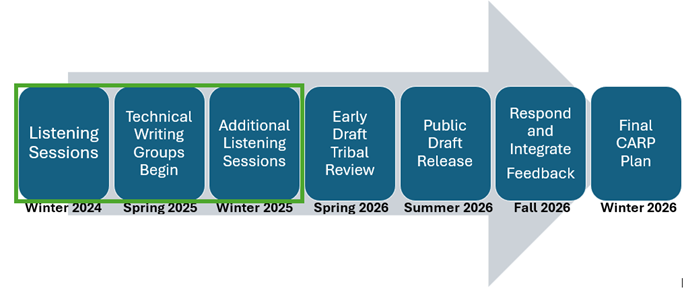
The California Artificial Reef Program (CARP) Plan development process is approaching the halfway point. To mark this important milestone the CARP Plan Project Team, which includes the California Department of Fish and Wildlife, California Sea Grant and the Ocean Protection Council, have scheduled another round of Listening Sessions at the beginning of 2026. The 2026 CARP Plan Listening Sessions build off of the Pre-Project Listening Sessions held in January and February 2025 where California Native American tribes and stakeholders provided critical input that has guided the content development of the CARP Plan (see 2025 Listening Sessions Summary).
The 2026 Listening Sessions will present an early summary of the key concepts being developed in the CARP Plan by the Technical Working Group made up of eleven scientific and technical experts. The 2026 Listening Sessions will provide another opportunity for California Native American tribes, scientists, experts, and stakeholders to provide input and feedback that will help to shape the final Draft CARP Plan.
-
2026 Online Listening Sessions – Sessions for CA Native American tribes will be held in January. Open listening sessions will be held in February and can be attended by anyone. All sessions will have the same agenda, so attendees only need to attend one session. The bulk of each session will be reserved for answering questions and to receive input from attendees. Sign up at links below.
The remainder of the CARP Plan development process will include integrating the input received at the 2026 Listening Sessions and completing the Draft CARP Plan (Draft) in late spring 2026. The Draft will be made available to California Native American tribes for an extended review, which will overlap with the 45-day public comment period. A third-party scientific peer review will occur concurrently during that time. After the close of the comment period and completion of the peer review the Technical Working Group and Project Team will update the Draft based on the feedback received with a Final CARP Plan scheduled for release at the end of 2026.
Consultation is available for California Native American tribes on the CARP Plan at any time by contacting Tribal.Liaison@wildlife.ca.gov.
We look forward to your continued participation in the CARP Plan development. Please contact ArtificialReefs@wildlife.ca.gov with any questions or comments. You can also always get the latest updates at the CARP web page.
|
|
Artificial Reefs and Ecosystem Services
Ecosystem services are benefits the natural environment provides to society. For nearshore temperate rocky reefs this can include a wide range of benefits including but not limited to nutrient cycling, fisheries support, recreational opportunities, and climate change mitigation. There is a strong positive relationship between biological productivity, biodiversity and ecosystem services.
In California to meet existing legislative mandates, policy directives and to align with the best available science, future artificial reefs should prioritize ecosystem productivity and biodiversity of native reef-associated species. Artificial reef material, design and siting decisions should center the goal of maximizing productivity and biodiversity. This holistic approach can create ecosystem structure and function that mimics productive and diverse natural reefs. By centering biological productivity and biodiversity additional design decisions can be made to add on ecosystem services where feasible.
Applying this thinking to artificial reef project design, an apt metaphor is a “layer cake” approach. Artificial reef projects should have a foundational layer focused on materials, design and siting decisions that will maximize biological productivity and biodiversity. Layering on additional ecosystem services as feasible while still maintaining the critical base layer.
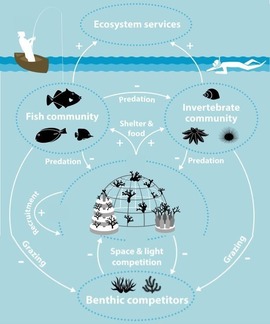
Image at the top of the article from Knoester et al. 2023 showing the socio-ecological setting of a artificial reef in a coral system in Kenya. Work is underway to develop a similar schematic based on temperate artificial reefs in CA.
|
Wheeler North Mitigation Artificial Reef
In 1974, the California Coastal Zone Conservation Commission issued a permit (CDP 6-81-330-A, formerly 183-73) to Southern California Edison (SCE) for the construction of Units 2 and 3 of the San Onofre Nuclear Generating Station (SONGS). A study by an independent panel of scientists found the SONGS cooling water system caused substantial losses to the nearby San Onofre Kelp forest and its associated community. To compensate for these losses, SCE was required to build an artificial reef as in-kind mitigation that would be large enough to support 28 tons of reef fish and a minimum of 150 acres (60.7 ha) of functioning giant kelp (Macrocystis pyrifera) forest habitat.
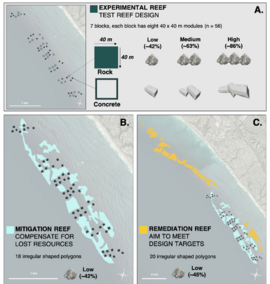
The artificial reef, named Wheeler North Reef (WNR), was built in three phases (see figure at top of article): A) a 10.1 ha experimental reef built in 1999 to test elements of reef design, B) a 60.7 ha mitigation reef built in 2008 that applied the results from the experimental reef to address mitigation requirements, and C) a 80.1 ha remediation reef built in 2019-2020 to address project underperformance related to fish standing stock and kelp acreage requirements.
|
|
|
|