|
|
California Artificial Reef Program
May 1, 2025
|
|
California Artificial Reef Program Plan
Pre-Project Listening Sessions Summary
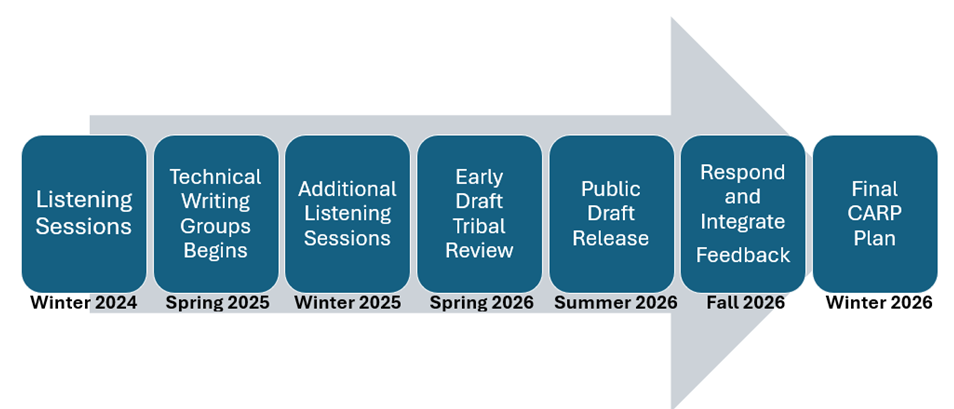
Over 100 people attended Tribal listening sessions, held January 22 and 23 and open listening sessions, held on February 26 and March 20, 2025, to learn about the California Artificial Reef Program (CARP) Plan development process. The bulk of the sessions were reserved for answering questions and to receive input from attendees. All sessions included active participation from attendees with important input gathered to guide the development of the CARP Plan.
Some important information was shared by the CARP Plan Project Team about the scope of the document:
- The CARP Plan will be high level to be able to apply to diverse contexts and will create a shared understanding of best practices to build effective artificial reefs.
- Selecting artificial reef locations will not be included in the CARP Plan.
- The CARP Plan will not include specifics on rigs-to-reef but will build on the National Artificial Reef Plan and the National Fisheries Enhancement Act, which is required for Rigs-to-Reefs to proceed in California.
Below is a selected summary of input from attendees:
- Tribal perspectives and input will be critical to include.
- Include a clear definition of what is and isn’t an artificial reef.
- Support was expressed for small scale pilot projects.
- Clarify who the CARP Plan is for and how it should be used.
- Include detailed information about the permitting process.
- Address the adaptive management process.
- Include direction on environmental and human dimensions monitoring to assess performance.
- Discuss current regulatory framework and potential ways to improve the efficiency of permitting.
All input received from attendees was documented and will be used to help ensure the CARP Plan is a useful and accessible resource for regulators, Tribes, and stakeholders.
You can view a recording of the information presented at the beginning of each listening session and view the slides.
We look forward to your continued participation in the CARP Plan development. Please contact ArtificialReefs@wildlife.ca.gov with any questions or comments. You can also always get the latest updates at the CARP web page.
|
|
Rigs-to-Reef and the CARP Plan
Man-made structures in the marine environment come in a variety of shapes and sizes that reflect a wide range of intended uses. This includes waterfront infrastructure like piers and pilings to objects further offshore like pipes, outfalls, and platforms associated with oil and gas extraction or renewable energy.
There is an important distinction to be made between artificial structures placed in the marine environment that were not designed specifically to create high-quality habitat and an “artificial reef”. Man-made structures can produce positive ecological impacts, but they are different from an artificial reef.
In California, “artificial reef” means manmade or natural objects intentionally placed in selected areas of the marine environment to duplicate those conditions that induce production of fish and invertebrates on natural reefs and rough bottoms, and that stimulate the growth of kelp or other midwater plant life which creates natural habitat for those species (Fish and G. Code §6421(a)).
The CARP Plan will not include specifics on the process to convert existing oil and gas infrastructure to artificial reefs (aka Rigs-to-Reefs). However, the CARP Plan will build on the requirements of the National Fisheries Enhancement Act and the National Artificial Reef Plan, which is required for Rigs-to-Reefs to proceed. If Rigs-to-Reefs does proceed in California, the CARP Plan could be updated with an addendum as resources allow.
|
Purpose of Artificial Reefs
The purpose, or goal of an artificial reef (AR) is the foundational piece of information needed to ensure a successful project. Traditionally, ARs were more singly focused on things like improving fishing or diving opportunities. As our understanding of the marine environment has increased, there is an increasing trend to design ARs to provide as broad a range of benefits as possible.
This is reflected in the proliferation of ARs with goals spanning across ecological and economic objectives. These projects often take a holistic approach to improving ecosystem structure and function while also providing improved recreational opportunities.
The California Artificial Reef Program Plan will establish clear terminology and definitions related to the different purposes of ARs. Development is underway and currently the types under consideration include ARs to improve:
- Production/biodiversity
- Recreational opportunities
- Multi-benefit/Multi-purpose
- Mitigation
Developing a shared understanding of the types of ARs will assist developers and regulators in developing successful projects. The categories are broad by design to encompass the diversity of projects that may be proposed. The typology developed will be detailed in providing guidance on key features and considerations for successful ARs in each category.
|
|
|
|