|
|
California Artificial Reef Program
February 11, 2025
|
|
California Artificial Reef Plan Development
Pre-Project Listening Sessions Feb. 26 & 27
Funded by a grant from the Ocean Protection Council the Department of Fish and Wildlife (Department) has begun the process to create a California Artificial Reef Program (CARP) Plan in partnership with California Sea Grant. The CARP Plan will be a programmatic guidance document that will create a shared understanding among regulators, Tribes, project developers and stakeholders of best practices for materials, design, siting and performance monitoring for artificial reefs in California. The CARP Plan will not be a siting plan or constructability guidance and will not identify new artificial reef locations or projects.
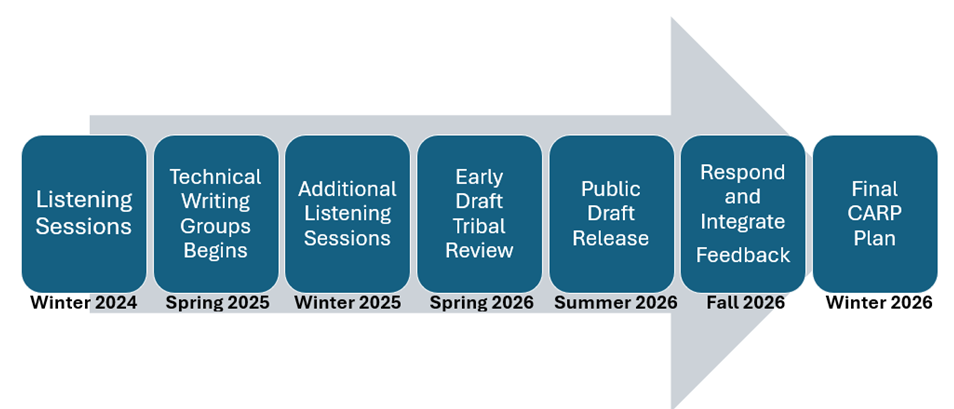
The CARP Plan development process will focus on providing multiple opportunities for Tribes, scientists, experts, and stakeholders to provide input and feedback that will help to shape the CARP Plan. Pre-Project Tribal listening sessions were held in January. You can get more details on the timeline and process in December's Bulletin.
Please spread the word and sign up for our upcoming listening sessions to learn more about existing artificial reefs in California, the Department's role in administering the CARP and the process over the next two years to create the CARP Plan. The bulk of the pre-project listening sessions will be reserved to receive feedback from attendees and answer questions. We hope you will come and join us to share your knowledge and thoughts about what should be included in the CARP Plan.
We look forward to your participation in the CARP Plan development. Please contact ArtificialReefs@wildlife.ca.gov with any questions or comments. You can also always get the latest updates at the CARP web page.
|
|
Living Shoreline Projects and Artificial Reefs
Living shoreline projects use nature-based solutions to address loss of biodiversity, habitat loss and shoreline erosion. These types of projects are becoming more common often spanning from the subtidal to the uplands containing artificial reef elements as well as native plantings. Living shoreline projects provide wildlife habitat in addition to key services like buffering against flooding and reducing erosion.
After a pilot project in 2012 showed success, the California Coastal Conservancy in partnership with scientists from San Francisco State University’s Estuary & Ocean Science Center, the Smithsonian Environmental Research Center, UC Davis and others scaled up with the creation of the living shoreline Giant Marsh project off Point Pinole. The Giant Marsh project focuses on restoring native oysters and eelgrass, which as foundation species provide habitat and functions that benefit other species and the system broadly.
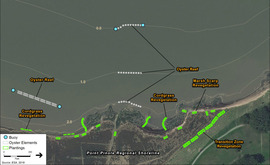
The Giant Marsh project extends from the subtidal zone where they have installed new hard substrate artificial reefs all the way to the edge of the uplands encompassing the tidal marshes in between. Seven habitat treatments with a footprint of about two acres are scattered across this shoreline over an area totaling 350 acres. Learn more about the project here.
The more complex approach of the Giant Marsh project reflects the increasing trend of focusing artificial projects on multiple benefits versus a focus on a single species or species group. The California Artificial Reef Program Plan will incorporate the learning from Giant Marsh and other living shorelines projects to define best practices for materials, design, siting and performance monitoring for future projects.
|
National Artificial Reef Plan
The first National Artificial Reef Plan (NARP) was published in 1985 under the direction of the National Fisheries Enhancement Act of
1984 which was focused on promoting and facilitating responsible and effective efforts
to establish artificial reefs to enhance sportfish populations. The plan was required to include (33 USC 2103)
(1) geographic, hydrographic, geologic, biological, ecological, social, economic, and other criteria for siting artificial reefs; 2) design, material, and other criteria for constructing artificial reefs; (3) mechanisms and methodologies for monitoring the compliance of artificial reefs with the requirements of permits issued under section 2104 of this title; (4) mechanisms and methodologies for managing the use of artificial reefs; (5) a synopsis of existing information on artificial reefs and needs for further research on artificial reef technology and management strategies; and (6) an evaluation of alternatives for facilitating the transfer of artificial reef construction materials to persons holding permits issued pursuant to section 2104 of this title, including, but not limited to, credits for environmental mitigation and modified tax obligations.
The original NARP was amended in 2007 and included new information from state artificial reefs programs including updated information of artificial reef material criteria. The California Artificial Reef Program (CARP) Plan must include the required elements of the NARP and additionally will include California specific information. Although the NARP as amended will be the foundation of the CARP Plan we are partnering with California regulators, Tribes, stakeholders, practitioners and scientists to ensure we create a document that meets California's needs.
|
|
|
|