|
|
California Artificial Reef Program
December 6, 2024
|
|
California Artificial Reef Plan Development Gets Underway
On Sept. 10, 2024, the California Ocean Protection Council agreed to disburse funds to California Sea Grant to create a California Artificial Reef Program (CARP) Plan in partnership with the California Department of Fish and Wildlife (CDFW). The CARP was created in 1985, but never fully implemented due to a lack of allocated resources. The CARP Plan will include guidance on artificial reef materials, design, siting, function, and general performance standards, building on feedback received from stakeholder outreach conducted between 2017 and 2020. The CARP Plan will aggregate the best available science to develop guidance on project development that maximizes the benefits and minimizes the negative impacts of artificial reefs.
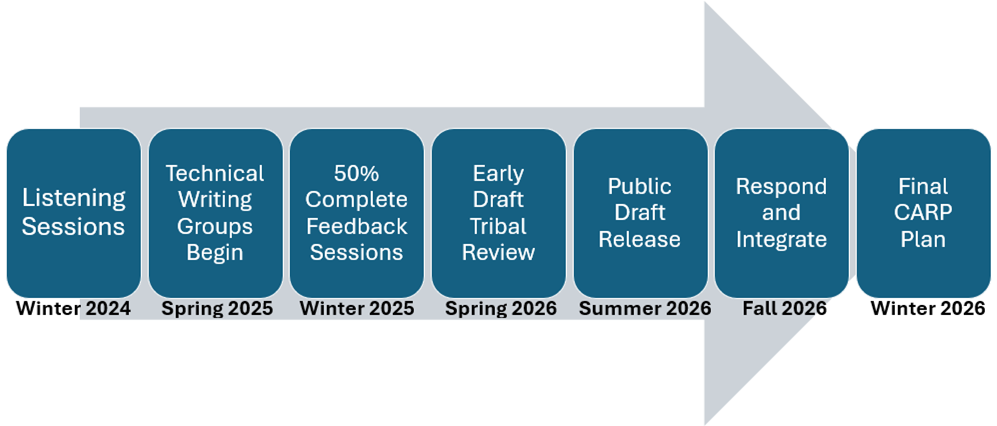
The development process will focus on providing multiple opportunities for California Native American tribes, scientists, experts, and stakeholders to provide input and feedback that will help to shape the CARP Plan.
-
Online Listening Sessions – Sessions for California Native American tribes will be held in January. Open listening sessions will be held in February and can be attended by anyone. Sessions will be held pre-project and at the 50 percent completion stage to receive feedback and report on progress. All sessions will have the same agenda, so attendees only need to attend one session. Sign up by clicking link below.
-
Technical Writing Groups (TWGs) – Scientific experts in California nearshore marine ecology, artificial reef construction and monitoring, compensatory mitigation, and other relevant disciplines will come together to create key sections of the CARP Plan. Experts will be selected by the project team to ensure diverse scientific perspectives that are supported by active research related to artificial reefs in California. Scientists and Traditional Ecological Knowledge experts interested in participating can contact ArtificialReefs@wildlife.ca.gov. The four TWGs will focus on:
- Design, materials, siting/connectivity and habitat conversion
- Function-specific definitions and requirements
- Compensatory mitigation
- Potential impacts/risks/benefits and monitoring recommendations
-
Scientific Peer Review – California Sea Grant will administer a formal scientific peer review of the draft CARP Plan. The results of the review will be made available to the public.
-
Early CA Native American Tribe Review & Comment – An extended comment period will be provided to Tribes beginning prior to the public review.
-
Public Review & Comment – There will be a formal 45-day comment period of the draft CARP Plan. This process requires the CDFW to record and respond to all public comments in writing. All public comments and the responses will be included in the final document as an Appendix.
We look forward to your participation in the CARP Plan development. Please contact ArtificialReefs@wildlife.ca.gov with any questions or comments. You can also always get the latest updates at the CARP web page.
|
|
Chalk Cove Artificial Reef
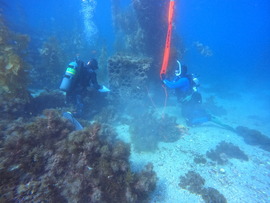
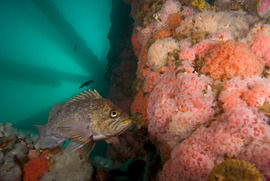
In October 2024, California Department of Fish and Wildlife scientific divers participating in their annual recertification training visited Chalk Cove Artificial Reef, on the west end of Santa Catalina Island. This reef was constructed as an experimental artificial reef in 10 m (~33 ft) of water, as described in Zahary and Harman (1985). Divers found very well-developed reef communities similar to local natural reefs. Divers observed giant kelp (Macrocystis pyrifera) and green abalone (Haliotis fulgens) on the artificial reef. Data are currently being processed and results will be integrated into the CARP Plan.
|
Will Rigs-to-Reefs be in the CARP Plan?
The CARP Plan will not include specifics on the process to convert existing oil and gas infrastructure to artificial reefs (aka Rigs-to-Reefs). The California Marine Resources Legacy Act (CMRLA, AB 2503), passed in 2010, allows for considering partial removal of infrastructure if there is a net environmental benefit. In 2016, California Senate Bill 233 attempted to better clarify the process but ultimately didn't pass. A recent decision by the Bureau of Safety and Environmental Enforcement selecting partial removal as their environmentally preferred alternative maintains this as an option in CA. If Rigs-to-Reef does become a viable option, the CARP Plan will be updated with an addendum as resources allow.
|
|
|
|