Grants Management & Innovation (GMI) Department
Welcome to the March 2026 edition of GrantsNews from Pima County’s Grants Management & Innovation (GMI) Department. Every other month we will share important information and tips to help all Pima County grant recipients and subrecipients maintain compliance with federal rules and regulations. Compliance is key to successful fundraising!
FY26 Subrecipient Desk Monitoring
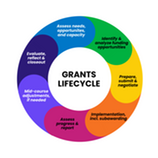
The January edition of GrantsNews provided tips on preparing for monitoring, including a checklist. Today, GMI is happy to announce a new webpage that explains Pima County Subrecipient Monitoring in more detail.
The webpage offers a clear, step-by-step guide to the monitoring process, along with a rubric to facilitate the reviewing and evaluation of subrecipients' Core Documents.
Visit the GMI Subrecipient Monitoring webpage to prepare effectively for monitoring.
|
Get on board the Euna train, you must!

Okay, that was our best Yoda impression, but please keep reading. All Pima County subrecipients are required to use the Euna Grants platform to manage their grant funds.
To gain access to the system, subrecipients complete three online training sessions to activate their Euna credentials. Our trainer, James Clements, is a master at preparing subrecipients to take advantage of this real-time, online resource. Some of the benefits of Euna Grants:
- Information on your organization’s total grant budget and spending to date.
- A place to enter and review progress on your grant objectives (in compliance with your award).
- A one-stop location for you to submit all invoices and payment requests.
- Access to your fully executed agreements and amendments.
Additionally, Euna Grants is now used by Pima County to receive applications for competitive federal sub-awards, such as CDBG, and non-federal funding, such as Pima County Outside Agency.
The three online Pima County Euna Training sessions are: Overview (1.5 hours), Performance Reporting and Amendments (1.0 hours), and Budgets (1.0 hours).
Don’t get left behind: go to Access for Pima County’s Grant Management System today to find out more and to pick your training dates from a list of upcoming scheduled training sessions listed there. Training sessions are scheduled at least monthly.
You must RSVP to gmitraining@pima.gov by 4 p.m. on the Monday prior to the training session(s) you plan to attend. In your email, please include which session(s) you will be attending.
|
Highlights of a
Pima County Subrecipient
The Heart of Arivaca: Pumping Life and Resources into the Arivaca Community
All shown Arivaca photos were taken by Jon Kammerman
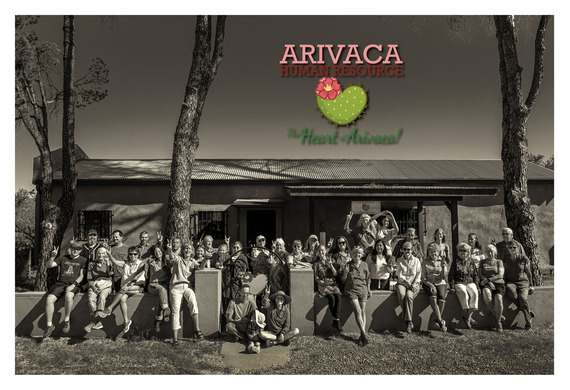 (Above image: Arivaca Human Resources - AHR)
(Below image: FoodPREP - a volunteer in the AHR kitchen)
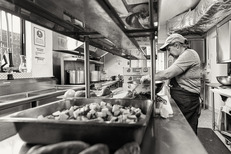
About 50 miles south of Tucson, nestled between the Tumacácori and Cerro Colorado Mountains near the southern border of Pima County, lies Arivaca. Initially operating out of the historic adobe Arivaca Schoolhouse built in 1879, Arivaca Human Resources (AHR) was founded in 1988. For more than 36 years, AHR has served Arivaca area residents with important human services such as mobile meals and a food pantry, emergency financial assistance (Helping H.E.A.R.T.S.), a program for seniors (S.T.A.R.) - 65% of Arivaca residents are seniors, and transportation supports. Additionally, AHR operates a thrift store and is actively working on other community building projects. Visit their website at Arivaca Human Resource. (www.arivacahr.com)
Today, we are going to focus on the work AHR continues doing to mitigate food insecurity, the programs that started AHR.
Delicious and Nutritious Meals
AHR combats food insecurity experienced by the residents of this rural area of Pima County with grant funding awarded through the Pima County Community & Workforce Development (CWD) Department and others and through its partnerships with organizations such as the Community Food Bank of Southern Arizona and the Sahuarita Food Bank.
AHR’s Mobile Meal Program delivers hot, nutritious meals and food boxes directly to isolated rural households that have limited access to transportation and lack other food resources.
In partnership with the Feeding America network, of which the Community Food Bank of Southern Arizona is a member, and Sahuarita Food Bank, AHR’s Food Pantry provides commodity boxes and emergency food to families in need at their Arivaca town site. Since AHR’s Food Pantry operates independently, it can supplement food assistance beyond the two boxes per family limit imposed by food banks when other support is not available.
AHR serves nearly 16% of Arivaca’s population every week, ensuring that seniors, families, and other residents have reliable access to five nutritious meals each week.
AHR’s Mobile Meal Program and Food Pantry are supported, in part, by federal Community Services Block Grant1 (CSBG), funds sub-awarded to AHR through Pima County.
Building upgrades to meet the need
AHR is committed to maintaining its building’s historic value while also ensuring that its commercial kitchen is compliant with consumer health and food safety standards. Five freezers, five refrigerators, and a walk-in unit at the site were purchased with past CDBG funds and now a backup generator is being procured. The new generator is vital for food security in case of electricity outages and is an important component of Arivaca’s newly reformed Emergency Response Team, which is the group that takes responsibility for Arivaca’s continuity of operations instigated by crises.
The back-up generator is being purchased using federal Community Development Block Grant (CDBG)2 - Facility Improvement Project funds, which were sub-awarded to AHR by Pima County.
|
 |
(Above image: Dotti volunteering in the AHR Kitchen)
(Below image: Chef Daniel, AHR Kitchen Supervisor)

Dedicated Volunteers - the Heart of Arivaca
AHR Executive Director, Suzanne, joined Arivaca HR three years ago after a chance visit turned into a forever home. She shares: "This is a community where everyone is valued and supported." Suzanne is quoted on the AHR website saying, “Just like the heart in a body, we pump resources into our community and bring in resources from our donors and partner agencies, creating a 'body' that is able to thrive and live a quality life.”
Annually, AHR volunteers contribute more than 300 hours per month, and each volunteer has a unique and inspiring story. For example, Dotti, recognized as the oldest volunteer at 83 years young, continues to give her time in the kitchen, drawing on her many years of service (she jokes she has lost count). Some current staff, like the Kitchen Supervisor, Chef Daniel, were once recipients of the same food boxes he now helps prepare for distribution. Each volunteer, regardless of their background, actively pays it forward to the community. Their shared dedication is made possible through partnerships with external organizations, donations, and grant funding.
If you would like to learn more about Arivaca Human Resource, visit their website at https://www.arivacahr.com/, or follow them on social media @Arivaca HR.
Visit Community Development Block Grant (CDBG) or CLICK HERE for the Pima County Community & Workforce Development (CWD) website for more information about available community assistance and services.
1Community Service Block Grant (CSBG), (ALN 93.529) U.S. Department of Health and Human Services via Arizona Department of Economic Security.
2Community Development Block Grant (CDBG) (ALN 14.218) U.S. Department of Housing and Urban Development.
|
Other resources to help you stay connected
The GrantsNews newsletter will arrive in your inbox every other month. If you know of other people who might want to get these updates, have them CLICK HERE and add their email address. If you’ve seen enough, you can click the unsubscribe link at the bottom of the page.
|