|
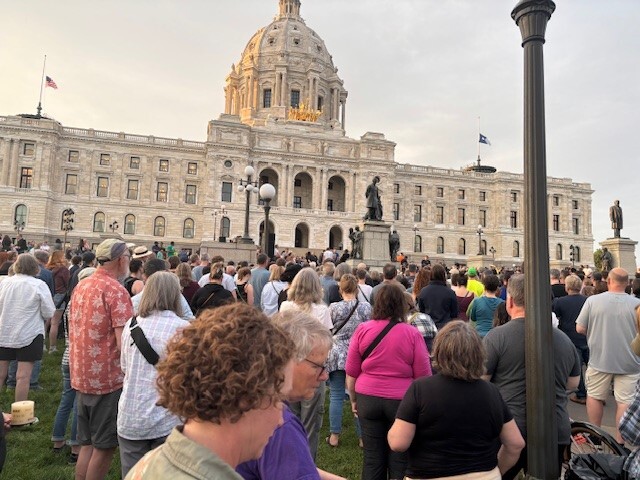
I attended a vigil to memorialize Melissa and Mark Hortman and to honor John and Yvette Hoffman at the Minnesota State Capitol. It was beautiful to be in community at this time of intense sadness.
At the vigil for Melissa and Mark Hortman at the Minnesota State Capitol.
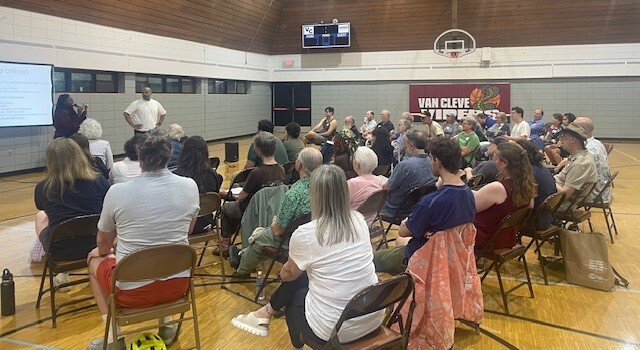
I attended the Meeting of the East Bank Neighborhoods hosted by the City’s newest neighborhood association, the East Bank Neighborhoods Partnership. EBNP has done a great job bringing together five neighborhoods around shared goals of creating vibrant, connected, sustainable and equitable communities. This meeting brought neighbors together to share food, learn about upcoming events, participate in upcoming neighborhood board elections, and hear updates from Senator Doron Clark and Council President Elliott Payne.
Council Member Wonsley speaking alongside Council President Payne at the East Bank Neighborhoods Partnership Meeting.
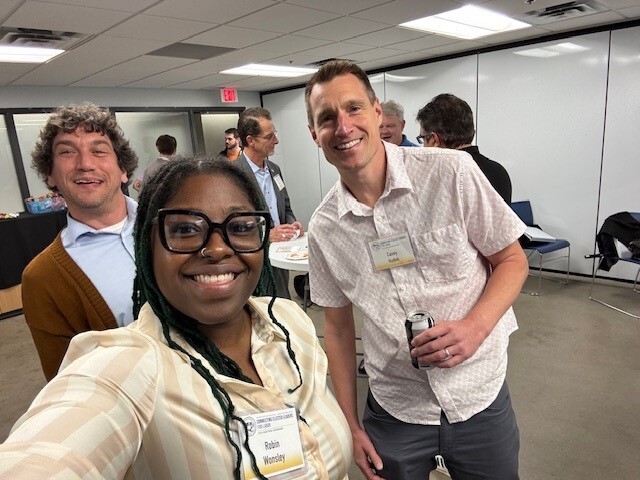
I attended a convening for local elected officials hosted by the Minneapolis Regional Labor Federation (MRLF). Thank you to the MRLF for creating this opportunity for elected leaders to learn from workers and reaffirm our shared commitment to the labor movement.
Council Member Wonsley with labor leaders at the MRLF Convening.
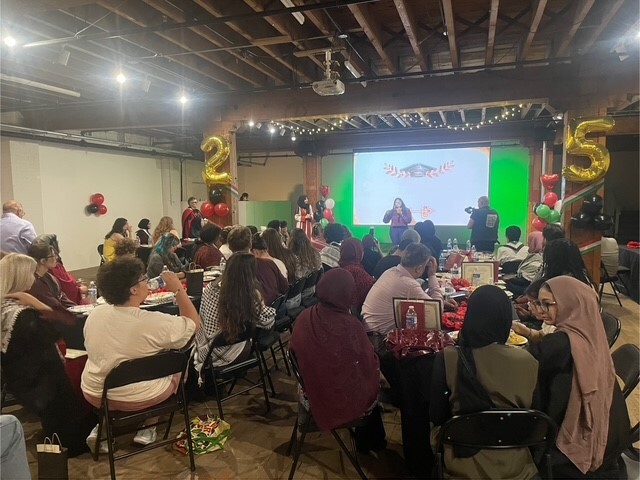
I was invited to a graduation celebration for Palestinian undergraduate and graduate students at the University of Minnesota and their supporters. Thank you for inviting me to this joyful community event.
Council Member Wonsley speaking at the Palestine Graduation Celebration.
Summary: I and many of my colleagues are taking legislative action to ensure that the police reforms from the federal consent decree are still legally binding requirements for the City, despite the Trump administration’s dismissal of the case.
Background: In May, the Trump administration moved to dismiss the federal consent decree over the City of Minneapolis and MPD for a confirmed pattern or practice of violating Constitutional law for discriminatory policing. The case has now been dismissed, meaning hundreds of police reforms that the City was supposed to be required to implement are now no longer legally binding.
Mayor Frey and several other key leaders have publicly stated support for enacting the provisions of the federal consent decree regardless of the Trump administration’s dismissal of the case. The reality is, the findings from the Minnesota Department of Human Rights demonstrate that previous promises of reform have throughout the years never materialized. It also explicitly stated that the lack of political will by city leaders was the barrier to implementing change to policing. It is within this context that I felt it was necessary to fold the previously agreed upon federal provisions into our current state agreement. I believe that Minneapolis residents deserve a legal commitment that will outlast this administration and remain in continuity until the City of Minneapolis has met all the terms we initially agreed to.
The City’s current settlement agreement with the Minnesota Department of Human Rights (MDHR) over racially discriminatory policing includes a provision that allows the parties to jointly amend the agreement for court consideration. This provision was touted numerous times by the City Attorney as a tool that could be activated if necessary. Several of my colleagues and myself see the failure to finalize the federal consent decree as a significant change in circumstances that warrant activation of this provision.
I co-authored a staff directive with Council Member Chowdhury to the City Attorney requesting they take all necessary actions to modify the City’s current legal settlement with MDHR to incorporate the provisions from the federal consent decree. I want to note that I have been in communication with the City Attorney and fellow Council Members about this intention since January. This action would align the Council with the Mayor’s recent comments and Executive Order to implement the terms of the federal consent decree.
Shortly before the meeting when this directive was going to be taken up, the City Attorney’s Office released an attorney-client privileged memo about the directive. The content of the memo raised many questions for me and for several of my colleagues. In addition, the City Attorney recently made public comments that contradicted information that had been given in closed sessions and additional meetings.
Police reform is a top priority for the public and the Council. This is why I believe there needs to be a public conversation about what actions the City is or is not taking to protect the reforms and why. If the Mayor and Council share a desire to see these reforms implemented, and we need to have a transparent conversation with the City Attorney’s Office about the pathway to ensure that the City is in a legally binding agreement to hold us accountable to implementation, both now and for future Mayors and Councils.
In order to allow us to have this conversation, I worked with the Clerks and City Attorneys to author a resolution to waive the attorney-client privilege on the memo. It mirrors an action Council took in 2021 when there was also a Council vote to waive attorney-client privilege to allow a more transparent conversation about a matter of public interest. Council approved this item.
I also brought forward an action directing the City Attorneys to write a public memo explaining what internal process the City needs to take to activate the joint modification provision in the settlement agreement.
This motion asks the City Attorneys to explain what the procedural process is to activate this provision in the context of our government structure. The directive is not asking for a memorandum about the federal consent decree specifically, it is asking for an explanation of the process to use this provision in general. Since the City signed on to this agreement over a year ago, I assume that the City Attorney’s Office has a general understanding of how the provision is used. Council approved this directive and the City Attorneys should present a response on July 8th. This will ensure there is a shared understanding between Council, the Mayor, the City Attorney, and the public of how, when, and why this provision can be activated.
I believe there is widespread agreement that a modification of the MDHR agreement to include the dismissed federal reforms is the desired outcome. Council is continuing to use our full authority to ensure that residents receive not only verbal commitments around police reform, but legally binding ones.
Key votes: Council voted 8-4 to waive attorney-client privilege on the memo from the City Attorney’s Office about incorporating the federal consent decree provisions into the MDHR settlement. Council voted 8-4 to direct the City Attorneys to write a public memo explaining the process to use the joint modification provision in the settlement agreement. Council Members Rainville, Vetaw, Jenkins and Palmisano voted in opposition to both and Council Member Koski was absent.
Summary: Council received a presentation by the independent evaluator for the settlement agreement with the Minnesota Department of Human Rights in response to the City’s pattern or practice of racial discrimination in policing.
Background: In June of 2022, the Minnesota Department of Human Rights (MDHR) published the findings from their Investigation into the City of Minneapolis and the Minneapolis Police Department (MPD). MDHR found that the City of Minneapolis and MPD engage in a pattern or practice of race discrimination in violation of the Minnesota Human Rights Act. The City of Minneapolis and MHDR negotiated a settlement agreement to address these findings. In March of 2023, the City Council approved and Mayor signed the settlement agreement with MDHR. The settlement agreement lists hundreds of reforms that the City is required to implement, and is overseen by an independent evaluator, Effective Law Enforcement 4 All, or ELEFA.
ELEFA has published two progress reports on the City of Minneapolis’ implementation of settlement agreement terms. This week, Council received a presentation by ELEFA and Council discussed the contents of the presentation with ELEFA leadership. ELEFA shared that disruptive or counterproductive behavior by MPD members is contributing to delayed progress on implementing some of the crucial reforms and training. This included a lack of professionalism by some of the MPD, including questioning the need for ELEFA or the MDHR. ELEFA spoke about the crucial role that MPD upper leadership plays in implementing the needed culture shift throughout the department, and expressed that they are prioritizing this going forward.
While I am troubled by much of the contents of the progress report, I am extremely grateful to have an evaluator that is independently verifying the City’s progress. The City’s history has been full of empty promises around police reform, and an independent evaluator helps ensure that residents don’t just receive words, they receive real change. Council Member Chowdhury correctly named that while ELEFA and Mayor Frey published press statements that the City is making exceptionally good progress on the settlement agreement, three of the major accomplishments listed in the report were completed by ELEFA, not by MPD.
ELEFA will publish regular reports throughout the duration of the settlement agreement. I remain committed to using Council’s full authority to support the implementation of the consent decree through policy changes, funding reform efforts, and most significantly through oversight of the Mayor’s sole executive authority over MPD policy and operations.
Key votes: No votes taken.
Summary: Council received a report on all the contracts that the Mayor’s administration has entered into since 2015 that were below the threshold requiring Council approval.
Background: According to the city’s current policies, the Mayor’s administration must receive Council approval on any contracts over $175,000, but may enter into contracts below that threshold without a Council vote. After a number of situations in which Council and the public learned about concerning contracting choices by the Frey administration, Council Member Koski authored a legislative directive requesting the administration disclose all contracts that have been entered into without Council approval. Council approved this legislative directive in February and this week, the reports were published and presented to the Budget Committee.
I appreciate this legislative directive for ensuring transparency in contracts of all sizes. In order to ensure that this transparency becomes the new standard going forward, I am authoring an ordinance change to require regular disclosures of all contracts under $175,000 that are entered into without Council approval. This will mean that instead of receiving 10 years of retroactive reporting at once, Council and the public will be able to review the contracting choices made by the Mayor’s administration on a quarterly basis throughout the year. The City’s Procurement staff included this ordinance change in the list of recommended actions that the City can take to improve accountability and transparency.
Key votes: No votes taken.
Below is information the Communications Department has shared regarding the City’s view on free speech and protests:
The City of Minneapolis recognizes the constitutional rights of free expression and peaceful assembly of all residents and visitors of Minneapolis.
Public gatherings are an important part of our democracy. It is also important to keep everyone safe and protect our communities. Together, we can help make sure that public gatherings remain safe, while amplifying the voices of our community members.
Peaceful, lawful gathering is encouraged and protected
You can:
- Participate in peaceful protests
- March safely, but not on freeways or in other ways that create a safety hazard
- Carry signs and use other peaceful forms of expression
- Gather and speak in areas where free speech activities are allowed
Private property
- Private property can only be used for free speech activities with the consent of the owner.
- Property owners can ask law enforcement to require that unauthorized people leave private property.
Government property
- Free speech activities can only take place on government property where the general public is welcome.
- Secured areas or employee-only areas are not considered open for expression.
Unlawful behavior poses a risk to public safety
You cannot:
- Enter or protest on a freeway as a pedestrian or in a way that obstructs freeway traffic
- Throw objects or set fires
- Damage property or create graffiti
- Use fireworks or weapons
- Drive recklessly, especially near pedestrians
You cannot act violently or engage in riotous behavior
Violent behavior
- This includes anything that intends to hurt someone
Riotous behavior
- Any behavior in a group setting (more than three people) that disturbs the peace by either:
- Using force or violence
- Threatening to use force or violence against people or property
Read more about safe gatherings.
Contact Ward 2
Visit: minneapolismn.gov/ward2
Email: ward2@minneapolismn.gov
Phone: 612-673-2202
We've moved while work is being done in City Hall. Our office is in:
Room 100, Public Service Center
250 South 4th St.
Get directions
For reasonable accommodations or alternative format please contact 311. People who are deaf or hard of hearing can use a relay service to call 311 at 612-673-3000. TTY users call 612-263-6850. Para ayuda, llame al 311. Rau kev pab, hu 311. Hadii aad caawimaad u baahantahay, wac 311. |