|
The University of Minnesota has released a recommended operating budget for the 2026 fiscal year. The proposal includes increasing the undergraduate resident rate on the Twin Cities campuses by 6.5% and the undergraduate nonresident rates by 7.5%. General graduate rates increases would be 6.5% and 7.5% for residents and nonresidents, respectively. These are the largest tuition hikes in 14 years, and come after a 1.5%-4.5% hike in fiscal year 2024. The proposal also includes a 7% cut to academic program budgets.
The fiscal pressures on all universities are intense as the Trump administration attacks higher education and cuts federal research funding. That said, I am opposed to balancing the University’s books on massive tuition hikes on working class students. I urge the University of Minnesota leadership to reconsider this proposal and find equitable way to reduce costs without significant tuition increases.
The Board will accept in-person public comments on the budget proposal during the annual public forum scheduled to begin at 4:15 p.m. on Thursday, June 12. Speakers can sign up for a timeslot beginning at 3:45 p.m. in the lobby on the sixth floor, McNamara Alumni Center. Available speaking slots of three minutes each will be assigned on a first-come, first-served basis.
Feedback may also be submitted online at any time using the Board’s Virtual Forum. Comments received by 10:00 a.m. on June 17th and that meet the Board’s guidelines will become part of the public record included in the June 18th Special Meeting docket materials.
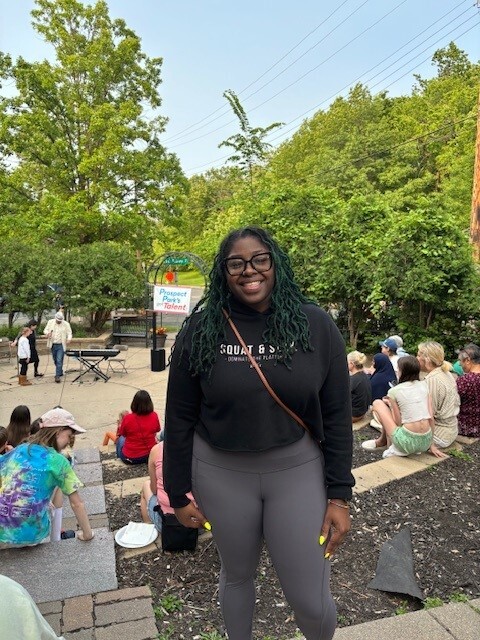
I had a wonderful time at the annual Pratt Elementary Ice Cream Social. Thank you to all the neighbors who help make this Prospect Park tradition possible!
Council Member Wonsley at the Pratt Elementary Ice Cream Social.
National Night Out is a time for city residents to come together and celebrate with neighbors. Many blocks in Minneapolis take this opportunity to reconnect, eat, and build relationships while kids play and bike freely in the closed street. Have you attended NNO on your block in the past? We encourage you to check in with the organizer to see if they need any help! If your block doesn't organize an event for NNO, we encourage you to start the tradition for your neighbors!
Register your block event for National Night Out today using the online form.
Summary: Council approved a request for an independent after action review of the City’s actions related to the federal operation involving ICE agents on East Lake and Bloomington.
Background: Council Members Chavez, Chughtai, Chowdhury, Osman and myself authored a request for the City Auditor to conduct an independent after action review of the City’s actions related to the federal operation involving ICE agents on East Lake and Bloomington.
The events that took place on June 3rd on Lake Street left the community extremely frightened and left many council members with questions about the city’s participation in the federal operation that took place. In addition, with limited information from the administration, there have been contradictory and conflicting statements from the Mayor and Chief that are fueling concerns that the city is not currently prepared or has full mechanisms in place to enforce its Separation Ordinance. It’s important that we take this opportunity to independently evaluate the City’s involvement and response to the events that took place this past Tuesday.
Minneapolis residents do not support federal agents conducting militarized operations in our neighborhoods, especially in communities that are most prone to be attacked by the federal administration. Many of our residents also do not want to see the City of Minneapolis or MPD have any role in these types of frightening, right-wing operations that we know are being led to evoke fear and terror in communities that have immigrant populations with allies who are loudly supportive of them. Even the perception that MPD may have supported or collaborated with Tuesday’s operation is incredibly damaging. Poor public communication by MPD and the Frey administration before, during, and after Tuesday’s operation contributed to that perception.
There are still many unanswered questions about the City’s actions. I look forward to reading the results of the audit. I also encourage residents to watch the recording of Council’s discussion of this item, as it shows the deep commitment that some Council Members have to protecting our communities and resisting the Trump administration.
In addition to the independent audit, community members can engage on this topic at the end of this month. In response to community concerns after Trump was inaugurated, Council Member Chavez and I authored a legislative directive asking MPD to present on how the separation ordinance is implemented and enforced. Council unanimously approved this directive and MPD will be coming to present their response at the Administration and Enterprise Oversight meeting on June 23rd at 1:30pm. I invite all my colleagues to join us at that committee meeting if you’re interested in this topic, and of course I also invite the community to attend or watch the livestream.
Key votes: After action review of the City’s action related to the federal operation on East Lake and Bloomington on June 3rd passes unanimously, with a requested return date of July 30th. The City Auditor has discretion about whether to accept the request.
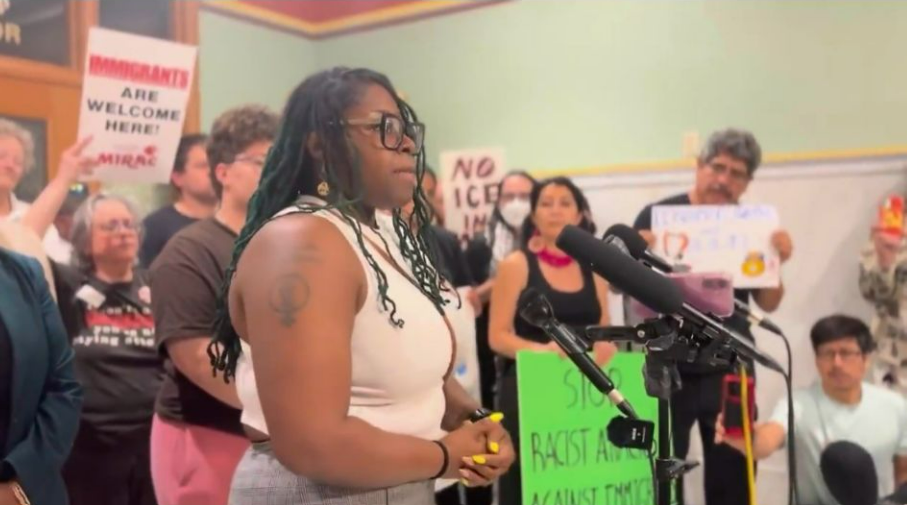
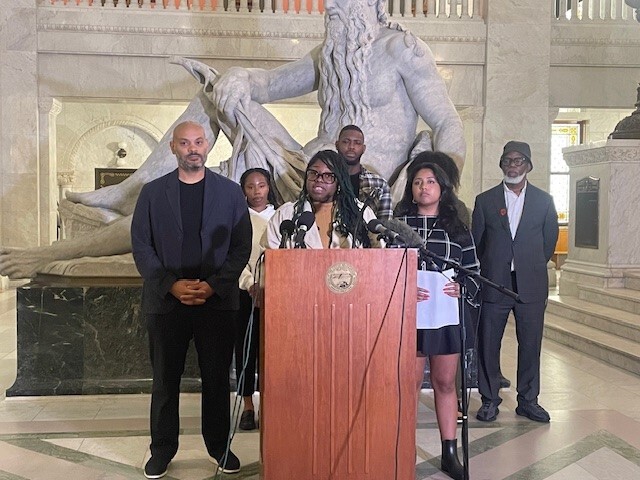
Council Member Wonsley speaking at a press conference with Council Members and community leaders standing against ICE in our community.
Summary: I and Council Member Chowdhury brought forward a motion to incorporate the police reforms from the federal consent decree into the MDHR settlement agreement. The City Attorney’s Office issued a last-minute memo expressing a variety of new oppositional opinions.
Background: In February, the Trump administration paused the federal consent decree and has extended the pause multiple times. On May 21st, the Department of Justice moved to end the federal consent decree and a final decision will be made by the presiding judge in the coming weeks.
The findings from the Department of Justice were supposed to lead to a federal consent decree, a binding legal agreement that mandated about 400 individual reforms to address MPD’s practice of violating Constitution and federal law through excessive force, racial discrimination against Black and Native residents, discrimination against people with behavioral health disabilities, and violations of free speech protections.
A few examples of the provisions in the consent decree include:
- Restrictions on pursuits and chases, which have led to the death of civilians by MPD, including Leneal Fraizer.
- Mandatory changes to MPD’s policies around engaging with minors, which is significant in light of some of the city’s young people engaging in activities that have put them more in contact with MPD.
- Provisions to maintain our behavioral health initiatives like the city’s Behavioral Crisis Response program which has provided thousands of our residents with the high quality and equitable mental health services.
Mayor Frey has publicly stated support for enacting the provisions of the federal consent decree. While this is encouraging, I believe that Minneapolis residents deserve not only a verbal commitment, but a legally binding one too.
Since January, I have made great efforts to work with the Mayor’s administration, the City Attorney, and my colleagues to initiate a formal process to work with the Minnesota Department of Human Rights (MDHR) to modify our existing settlement agreement to incorporate the federal consent decree provisions. I had these conversations because there was a widespread concern that the Trump administration would move to dismiss the consent decree and the city would lose this crucial accountability mechanism.
The City Attorney’s Office does not have anything to demonstrate that progress has been made over the last six months to integrate the federal provisions into the state settlement agreement. That’s why Council Member Chowdhury and I decided to bring forward a motion directing the City Attorney’s Office to take all necessary actions to incorporate the consent decree provisions into the MDHR settlement agreement. This motion was intended to demonstrate this Council's commitment to use every tool we have to hold this Mayor and future Mayors accountable to ensuring that MPD provides Minneapolis residents public safety services that respects their human and Constitutional rights.
Less than 24 hours before Council took up the motion, the City Attorney’s Office sent Council Members a memo raising a number of new opinions about why Council should not proceed with the motion. I and my colleagues have many questions about this memo, so I made a motion to postpone the item to the next Committee of the Whole on June 16th, which passed unanimously. I have already requested that the City Attorney make the memo public and present the analysis at the next Committee of the Whole meeting on June 16th. I was disturbed by some of the claims in the memo, and believe the public should be aware of the internal barriers the Council faces when trying to exercise our authority.
I am ready to work to overcome these barriers and remain committed to making sure the City does not only make verbal commitments about the reforms in the consent decree, but makes legally binding commitments. I will provide updates on this as things move within City Hall.
Key votes: Committee of the Whole votes unanimously to continue consideration of the MDHR settlement agreement update motion to the next meeting on June 16th at 1:30pm.
Council Member Wonsley speaking alongside Council Member Chowdhury, Council President Payne, and community members with the New Justice Project about the legislative action to codify the provisions of the consent decree in the state settlement agreement.
Summary: Council voted to refer the historic designation of Glendale Townhomes back to Committee, pausing consideration of the item.
Background: Council was scheduled to vote on the historic designation of Glendale Townhomes this week. There has been persistent misinformation about what historic designation does, namely an inaccurate idea that historic designation prevents all redevelopment. In fact, areas including the Warehouse District and St Anthony waterfront have been historic districts for decades, which has protected the historic integrity of these areas without preventing development.
Council Member Ellison made a motion to refer the designation vote back to Committee based on unresolved questions about what the Minneapolis Public Housing Authority (MPHA) is planning with regards to redevelopment. Council Member Jenkins noted that while MPHA has demonstrated some meaningful success at anti-displacement protections for public housing residents, there are still understandable concerns from Glendale residents around displacement in the context of redevelopment.
From the outset, the effort to secure historic designation for Glendale has been led by residents. I formally nominated Glendale last year at their request, and I remain committed to following the leadership of those most directly impacted. At this time, those residents have asked to postpone the item.
This referral also gives MPHA the opportunity to present a long-awaited redevelopment proposal for Glendale—something the community has been asking for over many years, and which MPHA has communicated is currently in development to my residents as of last week. It provides time for MPHA to clearly communicate and implement an anti-displacement plan—one that will ensure residents can remain in the community they have made their home.
Additionally, this referral allows the Council to continue pushing for the resources needed to preserve and expand public housing not just at Glendale but also citywide. That includes advancing a fully funded public housing levy this year, which would help address MPHA’s over $250 million capital backlog—more than $20 million of which is tied to Glendale alone.
I also want to reaffirm that regardless of the outcome from this process, I remain committed to working with Glendale residents to get needed repairs and maintenance, resist displacement, preserve Glendale’s history, and amplify tenant demands.
Key votes: Council voted 10-2-1 to refer the item back to Committee for more consideration and discussion. Council Members Cashman and Vetaw voted in opposition. I recused myself per the recommendation of the City Attorneys.
Summary: City Council approved an ordinance creating a Tourism Improvement District in Minneapolis that will help support our hospitality industry.
Background: Meet Minneapolis, the city’s tourism advocacy and promotional organization, brought together stakeholders to create a Tourism Improvement District in Minneapolis.
The Minneapolis Tourism Improvement District MTID would allow for the collection of a service charge of 2% on hotel room rates for all hotels with 50 or more rooms in the city of Minneapolis. The collected funds would be managed by a nine person committee of hoteliers, who could use it on projects that support hotels in initiatives that support the industry. The MTID would be established for five years with an annual report and public hearing at the Minneapolis City Council.
The University area has the largest concentration of hotels outside of downtown. I was honored to co-author this ordinance.
Thanks to the advocacy of UNITE HERE Local 17, this ordinance strategically supports workforce development by expanding access to meaningful, well-paying careers in hospitality and tourism throughout Minneapolis.
Thanks to the advocacy of University-area hospitality leaders, we also included language to ensure that the benefits of this ordinance are distributed equitably to benefit hotels outside downtown. That means the benefits won’t stop at downtown– they’ll reach neighborhoods near the University of Minnesota and beyond, bringing more visitors, more spending, and more opportunity to every corner of Minneapolis. This is how we build an inclusive, resilient economy. Thank you to all the partners who contributed to this exciting and innovative policy.
Key votes: Minneapolis Tourism Improvement District Ordinance that I co-authored with Council Members Rainville and Cashman passes unanimously.
Summary: The Council received a presentation on the ways that the City of Minneapolis and MPD are failing to protect victims of domestic violence, and what changes need to be made.
Background: In 2024, a 47-year-old Indigenous woman named Allison Lussier was found dead in her apartment. Allison Lussier had made many calls to MPD regarding domestic violence and threats to her life made by her partner, but her family and community allege that MPD did not take the appropriate actions to prevent or investigate her death.
In response to community requests, the City Council approved a request for an independent after action review of Allison Lussier’s case request authored by myself and Council Member Chavez.
Allison Lussier’s case also put renewed focus on MPD’s response to domestic violence, which has been an identified shortcoming for many years that is known to disproportionately impact Native and Black women. To continue the public conversation on this crucial area of need, Council Members requested a presentation on An Institutional Analysis of the Minneapolis Police Response to Domestic Violence.
This week, Global Rights for Women presented on their report, including many powerful and disturbing statistics, including:
- One-third of the 11,645 incidents of aggravated assaults in Minneapolis were classified as domestic assaults by police.
- The vast majority of victims — nearly 80% — were female.
- Women of color were at greater risk of not being helped, and some felt they needed to carry weapons to defend themselves rather than call the police.
-
A 2017 report from the Minneapolis Police Conduct Oversight Commission found only 20% of more than 43,000 domestic violence calls led to reports or arrests. That puts Minneapolis in stark contrast with similar data reported the same year by the Justice Department, which found police throughout the country took a report in 78% of those types of calls on average and 39% led to arrest or charges.
Following this presentation, there was an update by the Domestic Violence Working Group comprised of Hennepin County Attorney’s Office, Hennepin County Probation, Domestic Abuse Service Center, Minneapolis Police Department, Minneapolis Navigator Program, Cornerstone, Tubman, Domestic Abuse Project, and the Minneapolis City Attorney’s Office. This presentation included the action steps that have been taken and that are planned to address MPD’s systemic failures to protect victims of domestic violence.
These presentations demonstrated that there’s been minimal progress made on this critical issue by the Mayor’s administration and MPD. I remain committed to working closely with the Mayor’s administration, the Council, and community advocates to use Council’s authority to support all efforts to improve the City’s domestic violence prevention and response. The Domestic Violence Working Group will be publishing an update before the end of 2025.
Key votes: No votes taken.
Summary: Council voted unanimously to approve designating the Dinkytown Marcy Holmes area for increased pedestrian-level lighting.
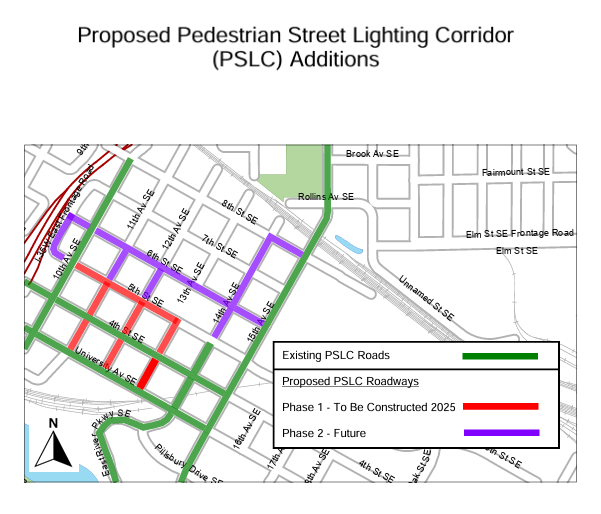
Background: Improved pedestrian level lighting in the Dinkytown Marcy Holmes area has been a high priority for local residents for years. I worked with residents and the Public Works department to add the entire Dinkytown Marcy Holmes area to the City’s Pedestrian Street Lighting Corridor map, which means the area is now eligible for improved pedestrian level lighting. This designation builds off the Dinky After Dark funding that Council approved last year, which allocates $500,000 towards pedestrian level lighting in this area.
Council has made significant strides in the expansion of street lighting across the city. Ward 2 residents have been very vocal about the need to not only light our streets for cars and bikes, but also our sidewalks for pedestrians and those using public transit. Well-lit sidewalks are part of public safety, it’s part of supporting public transit, pedestrians and bike usage, and it’s part of livability. This pedestrian street lighting corridor designation helps us expand what our lighting program looks like to best meet the needs of residents.
Communities should never be pitted against one another when it comes to lighting. I recently raised this point with the Mayor’s executive team, and shortly afterwards they decided to direct $1 million from their contingency funds to address street lighting outages caused by copper wire theft. The funding will allow the City to hire more seasonal electricians, use more rental equipment and buy more material for repairs. Several Council Members including myself questioned why this funding source was not offered as a solution in the last several years that lights have been out. This highlighted the importance of our City’s financial policies, which Council will be discussing that more in the Budget Committee in the upcoming months.
I am proud that this year, Council is both addressing streetlights that have remained out for far too long and adding new sidewalk lighting in areas with well-documented safety concerns and high pedestrian activity.
These lighting improvements will significantly enhance public safety and finally respond to a community demand that has gone unmet for years.
I look forward to further engagement on this issue as well as more collaboration with residents, students and the University of Minnesota on how to continue to make the Dinkytown area safer for pedestrians.
Key votes: Council voted unanimously to add the Dinkytown Marcy Holmes area east of I-35 to the Pedestrian Street Lighting Corridor map, making it eligible for brighter sidewalk lighting which will begin to be installed this year.
Map of new pedestrian lighting in Dinkytown Marcy Holmes.
Summary: After a discussion about the role of charter schools, Council voted 9-4 to enter into a $25,000 contract with the Advancing Equity Coalition for academic support and leadership for the community.
Background: A few weeks ago, Council approved a slate of contracts with community groups under the Partnership Engagement Fund. These contracts range from $15,000 to $25,000 and support equity focused initiatives being carried out by trusted community groups. However, Council voted 9-4 against one of the proposed contracts with a group called Advancing Equity Coalition, due to their advocacy around charter schools which weaken public education. Council Members Rainville, Vetaw, Osman and Jenkins voted in support of funding AEC, but the remaining 9 Council Members voted in opposition.
This week, however, Council Member Cashman motioned to reconsider that same item, and despite my opposition, it ultimately passed. Throughout my time in office, I’ve been a consistent champion for public schools. Just two weeks ago, I was proud to stand with the Council in voting down a contract linked to an organization with ties to efforts that have worked to undermine public education.
While I’m disappointed in the outcome, my commitment to advancing public education and strengthening our city’s public schools remains unwavering.
Key votes: Council voted 9-4 to approve the contract with Advancing Equity Coalition. Council President Payne, Vice President Chughtai, Council Member Chavez and I voted in opposition.
Background: The City Council is the budgetary authority for the City of Minneapolis. This is an important part of the checks and balances in our government structure. Over the last few years, the Council’s Budget Committee has significantly improved Council’s role in budget development to make sure that resident priorities are better represented.
This week, Council received a presentation on a report overviewing the relationship between Council priorities and the Mayor’s recommended budget. Key takeaways include:
- The Mayor included 16% of the unique budget priorities submitted by the City Council. The Mayor did not include 84% of Council’s Budget Priorities.
- A significant disconnect between Council Budget Priorities and the Mayor’s Recommended Budget prompted Council engagement through amendments to address gaps.
- City Council Members wrote and discussed amendments that would address 65% of the priorities that the Mayor did not include.
- No individual Council Member had all their priorities included by the Mayor. Some Council Members had a few of their priorities included, others had none. Some Council Members chose to author amendments to advance their priorities, while others deferred to the Mayor’s recommendations and did not have their priorities funded.
Council offices are in communication with residents on a daily basis and understand what our communities and neighborhoods need to be safe, healthy, and equitable. This information is extremely valuable for allocating resources within our City’s larger frameworks and goals. Every year that I’ve been on Council, I and many of my colleagues have publicly shared our communities’ budget priorities with the hope that the Mayor will use this information to shape his recommended budget, but every year I have seen the Mayor fail to do so. This leaves Council with no choice but to conduct extremely long budget markups so that the priorities that we hear from residents can receive the funding they deserve. This is a real area of weakness from our current Mayor.
There have been attempts to put a narrative spin on the Council’s budget markup, such as characterizing ward-specific needs as “pet projects,” but this presentation broke it down by the numbers. I know the Budget Committee leadership will continue to provide clarity on the dynamics at play in the municipal budget. I also want to assure Ward 2 residents that I will continue to advance your needs and priorities through budget amendments to ensure we have adequate resources for traffic calming, street lighting, and other basic city services and community needs.
Following our review of the 2025 Budget Process, Council voted on our priorities for the 2026 Budget. My priorities are:
-
Data-backed public safety initiatives: I am interested in funding an investigation initiative that’s currently finding great success in St. Paul, to address and lower homicide rates. Last year, while national homicides trends were lowered, Minneapolis was a noted exception which is deeply troubling considering the amount of funding that is devoted to public safety. This signals that the issue is not funding, but operational. Resources that are allocated to public safety should be utilized using national best practices and backed by data. MPD continues to have issues with clearing cases which ultimately leaves victims without justice. The St. Paul Police department formulated a non-fatal shooting taskforce in January of 2024. In 2023, before the unit was established, St. Paul Police reported a clearance rate of 38.3% on non-fatal shootings. By the end of 2024, it nearly doubled to 70%. This is evidence that investigative resources can provide measurable success in enhancing public safety. This initiative has been proven to be successful in St. Paul, as well as other cities around the nation, and aligns with the city’s current needs which is a focus on clearing cases related to gun violence.
-
Neighborhood Traffic Calming: In July 2024, the Public Works Department estimated that there would be over 850 eligible applications for traffic calming entering the 2025 construction season. Each application presents an opportunity for the City to address immediate safety issues impacting residents across the city. Last year, my office led the Council to invest an additional $1.5 million into the Neighborhood Traffic Calming program to address its outstanding backlog so that our streets are safer for usage. Additional city investments that I intend to advocate for, coupled with potential funding from the state this year, could help the city reduce this backlog for this program and fund additional projects that will make our streets safer.
-
Fully funded public housing levy and additional supportive housing programs: The public housing levy is an important tool for protecting and expanding publicly owned, permanently affordable housing. As of now, the Minneapolis Public Housing Authority (MPHA) has an over $250 million capital backlog–with $20+ million of those dollars belonging to Glendale Townhomes in Ward 2. This backlog has compromised MPHA’s ability to both preserve thousands of public housing units and to develop more public housing to address their 3,000+ person waitlist. Two years ago, my office was successful in getting the Mayor to adopt a partial public housing levy to address this backlog. Since then, the backlog has continued to grow while federal funding has been severely reduced for public housing. This means the City must continue to step up and lead investments into our public housing stock. A fully funded public housing levy will enable us to do that and I will be championing this request this budget cycle.
-
Southside Community Safety Center: Fully funding the alternative public safety pilots at the Southside Community Safety Center. Earlier this year, Council appropriated $500,000 from the South Minneapolis Safety Center reserve fund to support the preservation of a MinneapolUS program in Cedar Riverside. Council Members agreed to work together to ensure that this unexpected cut to the South Minneapolis Community Safety Center reserve funding would be replenished to ensure that this site has the necessary funding to have comprehensive safety service in addition to the precinct.
Key votes: Council voted unanimously to authorize the Council President and Vice-President to transmit the Council's 2026 Budget Priorities to the Mayor for inclusion in the Mayor's 2026 Recommended Budget.
The Minneapolis Health Department is launching a first-of-its-kind pilot program to help community members struggling with opioid addiction. The new Opioid Treatment Project will offer free Brixadi®, a long-lasting prescription injection used to treat Opioid Use Disorder (OUD).
Through the program, eligible individuals can receive treatment, free medication and connections to services and support. This includes getting insurance coverage help for longer-term treatment. Brixadi® is a long-acting medication used to treat Opioid Use Disorder. A healthcare provider must administer it, as it’s not available at a pharmacy.
Learn More: Interview about the Program
Watch a New Hope in the Opioid Crisis – a conversation with Minneapolis Health Commissioner Damōn Chaplin and Deputy Commissioner Heidi Ritchie, spotlighting the program.
How to Sign Up
- Email the Minneapolis Health Department Mobile Medical Unit team at mmumpls@minneapolismn.gov.
-
Native American Community Clinic: 612-843-5981
-
MHealth Fairview Recovery Services: 2450 Riverside Ave., Minneapolis. Walk-in hours available from 8 am to 5 pm.
Join us for a Caring Careers job fair at the Cedar Riverside Opportunity Center June 18. There’s a critical need for workers in health care and social assistance. Find out more about jobs to help elders and people with disabilities living in our community.
11 a.m.-2 p.m. Wednesday, June 18
Cedar Riverside Opportunity Center -- 505 15th Ave. S.
Contact Ward 2
Visit: minneapolismn.gov/ward2
Email: ward2@minneapolismn.gov
Phone: 612-673-2202
We've moved while work is being done in City Hall. Our office is in:
Room 100, Public Service Center
250 South 4th St.
Get directions
For reasonable accommodations or alternative format please contact 311. People who are deaf or hard of hearing can use a relay service to call 311 at 612-673-3000. TTY users call 612-263-6850. Para ayuda, llame al 311. Rau kev pab, hu 311. Hadii aad caawimaad u baahantahay, wac 311. |