Kokanee Netting Yields New Information
Wyoming Game & Fish Department sent this bulletin at 09/04/2014 02:45 PM MDT 
|
|
Having trouble viewing this email? View it as a Web page.
|

KOKANEE NETTING YIELDS NEW INFORMATION
Contact: Lucy Wold lucy.diggins@wyo.gov or travis.neebling@wyo.gov
GREEN RIVER—Thanks to a little detective work and perseverance, fisheries biologists are learning new information about the kokanee population in Flaming Gorge Reservoir.
Fisheries biologists with the Wyoming Game and Fish Department (WGFD) and Utah Division of Wildlife Resources (UDWR) completed mid-water netting on the Gorge. The Gorge is surveyed annually by UDWR with hydroacoustics to estimate the population of kokanee. Hydoracoustics are under water sound waves and this particular survey is conducted overnight on the night of the August new moon.
Biologists focus their netting efforts in the lake’s thermocline. A thermocline is the layer of water separating an upper, warmer layer of water from a lower, cooler layer of water. There is more oxygen in the upper, warmer layer of water than the lower, cooler layer of water. It has long been assumed by fisheries biologists that kokanee are found exclusively in the Gorge’s thermocline during this time of year. However, work done by Casper Fisheries Biologist Travis Neebling on other Wyoming waters has indicated that this is not the case.
Neebling, along with Green River Fisheries Biologist Joe Skorupski and UDWR Dutch John Fisheries Biologist Ryan Mosely, completed mid-water netting on the Gorge using 20 feet-tall gill nets. Fish species composition of the Gorge was analyzed in three distinct regions, including the inflow, rolling hills, and the canyon. Five nets were set each night at sunset and pulled before sunrise. Nets sampled fish populations from the surface down to 100 feet. Neebling said this differs from the regional fisheries management crew’s standardized sampling, which uses floating and sinking gill nets to sample fish close to the surface or bottom.
“Our netting results showed that kokanee are occupying waters from the surface all the way down to 100 feet,” Neebling said. “However, most kokanee were sampled from the surface down to 60 feet. Rainbow trout were sampled in smaller numbers and found from the surface down to 40 ft. Lake trout were sampled at depths greater than 40 feet down to 100 feet. All the fish that were sampled were found to be healthy and well feed.”
“The kokanee population estimate is used to predict the number of spawning fish and the number of fish available to anglers in future years,” Neebling added. “More accurate estimates will allow both departments to better allocate resources when spawning fish and also allows fisheries managers to better manage the Gorge’s kokanee resource.”
“This is a good example of how a lake, managed in two neighboring states by two different wildlife agencies, can work together to benefit the resource and the anglers. The results of this sampling will likely impact how the results of Utah’s hydroacoustic estimates are analyzed. “
~WGFD~

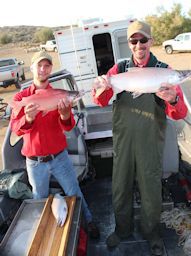
Photo Credit: Lucy Wold, WGFD Wyoming and Utah fisheries biologists hold up some of the kokanee netted on Flaming Gorge. (left) WGFD fisheries biologist Joe Skorupski (left) and Travis Neebling (right) hold up a couple of kokanee.
You are receiving this email because you signed up for Wyoming Game and Fish Department's updates.

|
Wyoming Game and Fish Department lucy.diggins@wyo.gov |
| STAY CONNECTED: | |||||||
 |
 |
 |
 |
||||
|
SUBSCRIBER SERVICES: Manage Subscriptions | Unsubscribe All | Subscriber Help You are receiving this email because you signed up for Wyoming Game and Fish Department's updates. Update your subscriptions, modify your password or email address, or stop subscriptions at any time on your Subscriber Preferences Page. You will need to use your email address to log in. If you have questions or problems with the subscription service, please contact subscriberhelp.govdelivery.com. This service is provided to you at no charge by Wyoming Game & Fish Department. |