|
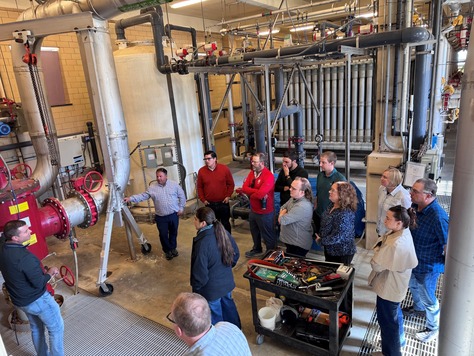
PSC Water staff on a recent visit to South Milwaukee Water Utility.
In this edition:
Ask Staff: How often do I need to test in-use meters?
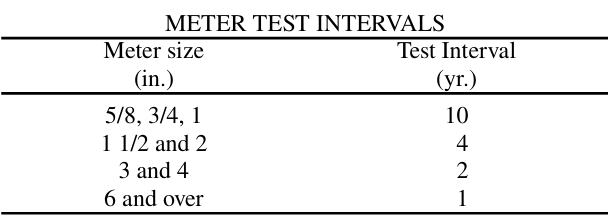
Although many circumstances (such as a bill dispute) may trigger an individual meter test, utilities are required to test all in-use meters “periodically to insure accuracy.” The Commission requires that the time between periodic accuracy tests for all in-use meters do not exceed any of the following intervals, established by meter size:
See PSC 185.76(1). There are, however, some ways in which utilities can seek to adjust these intervals. Utilities looking to lengthen these intervals must and demonstrate that meter accuracy is retained during the longer testing interval:
- For 1-inch and smaller meters, the Commission has the discretion to consider any reasonable interval supported by the application. PSC 185.76(3).
- For 3- and 4-inch meters, the Commission may consider extending the interval only up to 4 years. PSC 185.76(4).
But what about the 20-year-meter?
Commission staff understands that some utilities have purchased “20-year-meters" with the understanding that they are not required to test meter accuracy over the life of these meters. These utilities maintain a new meter replacement program which ensures that all meters are replaced within 20 years of the original date of installation. However, this option is only available for meters 1-inch and smaller, and only to those utilities which achieve the non-revenue water (NRW) and water loss (WL) thresholds established by law. PSC 185.76(6). These thresholds are: < 30% NRW for all utilities; WL of < 25% for Class D utilities, and < 15% for Class AB and C utilities. PSC 185.85(4). Utilities relying on the 20-year replacement program that do not qualify because of high NRW or WL should implement meter testing programs to test the accuracy of all in-use meters consistent with the intervals set forth in the table above.
If I’m trying to understand our meter testing program, where should I look?
Take a minute to confirm your utility periodic in-use meter testing intervals, reporting, and recordkeeping:
- First, check Schedule W-23 of your utility’s PSC Annual Report:
- This schedule will list all meters owned by the utility, by size so you can check your meter testing program against the intervals required for each size.
- For residential meters (1-inch and smaller) confirm whether your utility is reporting a 10-year testing interval or a 20-year replacement program. (This is a check box under the inventory table.)
- If you are checking the box for “other testing as approved by the PSC”, review the requirements of your approval to ensure compliance.
- Confirm whether your utility is eligible to use a 20-year replacement program because it meets the thresholds established for NRW and WL reported on Schedule W-15 of the PSC Annual Report. Located in lines 21 and 22, respectively, NRW must be below 30%, and WL must be below 15% for Class AB or C utilities, and 25% for Class D utilities.
- Confirm that you are testing all of your larger meters (> 1 inch) within the specified intervals for that meter size.
- Maintain meter test records demonstrating the compliance with these testing intervals consistent with the requirements in PSC 185.46 and PSC 185.19.
For more information on meter testing, reach out to our Utility Inquiry line: File Utility Inquiry Online.
Consumer Affairs Corner: Backbill Basics!
Q: When is it appropriate for a utility to offer a goodwill credit to a customer?
A: Never! Wis. Stat. § 196.635 requires utilities to bill all utility service consumed within the last 24‑months and Wis. Stat. § 196.22 prohibits a public utility from forgiving amounts owed for utility service that has been provided. Unfortunately, this even includes situations that are out of the customer’s control, such as:
- Clerical/billing system errors
- Using the wrong rate
- Meter malfunctions/errors
- Meter tampering to bypass the meter
- Water used by an occupant prior to applying for service
In instances when the backbill is not the customer’s fault, a deferred payment agreement (DPA) with installment payments lasting as long as the backbill period is encouraged.
Q: When does the back billing period start?
A: The two-year back billing period is calculated based on the date the backbill is issued. For example, if the last known accurate read was 1/1/2023 and your next billing date is 10/20/2026, the utility could only back bill between 10/20/2024-10/20/2026.
Q: How should a utility display the backbill in the billing statement?
A: Wis. Admin. Code § PSC 185.33(14)(b) requires all adjustments to past bills to be identified and shown separately from current charges.
Q: Should a utility charge a late fee for unbilled usage?
A: No. The utility cannot begin to charge a late payment fee on any backbilled amount until the backbill has been issued and the due date to pay the backbill has passed. Once the due date is passed, the utility must follow its tariff in assessing a late fee.
Q: What information does the PSC need from the utility when it investigates a customer complaint regarding a backbill?
A: When investigating a backbill complaint, Consumer Affairs staff will ask for:
- Copy of the backbill
- Amount of backbill and dates covered by the backbill
- Reasons for backbill
- Documentation of how the backbill was calculated
- Usage history for at least one year prior to the backbill period*
- Meter installation date and tests, if applicable
- Any other questions that may apply to the specific customer complaint
* For utilities that bill quarterly, the PSC will likely request more usage history than just 1 year prior to the backbill period, especially if the utility is prorating/reallocating usage as part of its backbill calculations.
Next quarter’s newsletter will tackle “how to calculate a backbill,” however, in the meantime reach out to Consumer Affairs and we would be happy to assist you! File Utility Inquiry Online.
Utility Interconnection: Prepare with Tariffs
On July 27, 2026, a Category 3 tornado struck Menasha, causing devastation along its 12-mile path. When the City of Menasha Electric and Water Utility discovered it was unable to safely supply water to its customers, it was able to rely on earlier preparation for an emergency like this. It activated its emergency interconnection with the neighboring City of Neenah Water Utility. Since the tornado, Neenah has been supplying safe drinking water to its neighbor as Menasha rebuilds its distribution system.
While Menasha and Neenah had prepared to supply each other with clean water in the event of an emergency, neither utility had a tariff on file with the Commission for what they would pay for this water. Neenah reached out to establish a PSC-approved tariff to set these rates and give certainty to both utilities’ customers on how this emergency would affect their water bills. The Commission worked with staff from both utilities to quickly create a new municipal interconnection tariff (Schedule MI-1) for Neenah. This tariff clarifies and formalizes Neenah’s billing for Menasha. [See final approval letter in docket 4030-TW-100 here.] Having a municipal interconnection tariff on file allows all parties to understand the financial implications of one utility supplying water to another during an emergency.
While emergencies grab headlines, utilities often rely on interconnections in other, less attention-grabbing operational scenarios. Many water utility systems throughout the state are either already interconnected, or have the capacity to be interconnected, but not all have developed tariffs to guide billing if the interconnection is used. In addition to causing financial issues, disagreements, and misunderstandings when the water is flowing between utilities, it may also create uncertainty and challenges at times when the community is already dealing with operational emergencies.
If your utility interconnects with another utility, please review your tariffs at the following link: PSC - Utility Tariffs. If you do not have a tariff related to your interconnection, please reach out to PSC staff at PSCWaterGeneral@wisconsin.gov to learn more about your options. Having a tariff in place means one less thing to worry about in the event of a tornado or other disaster.
Spring Training Announcement
Although we have some very serious Brewers fans here at the PSC, we’re not talking about baseball! Instead, we wanted to give you a sneak peek at webinars we will be offering in the spring! Beginning in March, PSC water regulatory staff will be offering a series of webinars on the following topics:
- March 16th When PSC Authorization is Required for Utility Construction
- April 7th Expense Depreciation to Fund Water Utility Infrastructure
- April 21st Update on Accounting & Cost Determination in LSL Replacement
- May 5th Public Fire Protection (PFP) Overview
- And more!
All webinars will be recorded and available on the PSC Website and YouTube channel. We encourage you to sign up for the webinar even if you are not sure you’re able to attend. Following the live event, we will provide links to the recordings to everyone who registers.
Are we missing something? Request training here: PSCWaterGeneral@wisconsin.gov or contact Angela.James@wisconsin.gov.
Watch For: Getting Ready for the PSC Annual Report
We may just be entering winter, but before you know it spring will be here. The PSC expects to open the PSC Annual Report portal in January. In the meantime, here are some housekeeping tips to help streamline your submittal in the spring:
- If you need to make an audit adjustment to the 2025 PSC Annual Report, please do so before starting on the 2026 report. To amend a report, please contact us at PSCWaterAnnualReports@wisconsin.gov.
- If your utility plans to use an outside consultant to prepare the report, consider contacting them early to confirm their capacity to prepare your report on time.
- Please confirm that your utility’s primary email address on file with the Commission is up to date:
Deadlines, Events, and Activities:
- November 2026:
- November 1, 2026: Statewide Utility Disconnection Moratorium Begins. Reminder that this moratorium also applies to water utilities and prohibits disconnection of any residential water service to an occupied dwelling until April 15 if the water service is a necessary part of a dwelling’s heating system. See Admin. Code PSC 185.37(9).
- November 2026: The Department of Natural Resources (DNR) intends to publish the state fiscal year 2027 Safe Drinking Water Loan Program final funding list.
-
Reminder: There’s just one more year until utilities are required to submit their baseline inventory to the DNR on or before November 1, 2027. See this flyer for instructions to access the Service Line Submittal Portal (SLISP). Check the DNR’s webpage for additional information on items which may be due by November 1, 2027.
- December 2026:
- December 11, 2026: Requests for disbursements are due to the DNR at noon on Friday, December 11 to be paid on the disbursement date of Wednesday, December 23. Note: No loan closings will occur on December 23.
- December 23, 2026: Disbursements will occur for those who submitted complete requests for disbursement by noon on Friday, December 11. Note: No loan closings will occur on December 23.
- January 2027:
- PSC Annual Report questionnaire portal opens.
- PSC Training Registration will open.
Recent Commission Cases: July 1-September 30, 2026
Conventional Rate Cases: Rate adjustments depend on a range of factors presented in each request. Click on the rate change to access the Final Decision for details.
|
|
|
|
|
|
|
|
|
|
|
|
|
|
|
Village of Allouez Water Dept.
|
|
|
|
|
|
|
|
|
|
|
|
|
|
Gillett Water & Sewer Comm.
|
|
|
|
|
|
|
|
|
Stevens Point Muni. Water1
|
|
|
|
|
|
|
|
|
|
|
Construction Authorizations: The Commission issued the following construction authorizations. Click on the project description to read the Final Decision.
|
|
|
|
|
|
|
|
|
|
|
Construct Wellhouse No. 6 Power Improvements
|
|
|
|
|
|
Construct a Water Service Expansion to Service the Cardinal Ridge Development Located in the Village of Vernon
|
|
|
|
|
|
|
Simplified Rate Cases: the Commission approved each of the following utilities for a 3% increase through the SRC process:
|
Allenton Sanitary District No 1
|
Kenosha Water
|
|
Augusta (C) Muni. Water & Sewer Utility
|
Lawrence (T) Water
|
|
Belgium Muni. Water
|
Lone Rock Utilities
|
|
Belmont Muni. Water & Electric
|
Nekoosa Muni. Water
|
|
Birnamwood Muni. Water
|
New Holstein Public
|
|
Black River Falls Muni. Electric & Water
|
New London Electric & Water
|
|
Blair Muni. Water
|
Nichols Muni. Water
|
|
Bonduel Water & Sewer
|
North Freedom Muni. Water
|
|
Boscobel Muni. Utilities
|
Oostburg Muni. Water
|
|
Boyd Muni. Water & Sewer
|
Platteville Water & Sewer
|
|
Brandon Sewer & Water
|
Port Edwards Water
|
|
Coleman Water
|
Portage Water
|
|
Cross Plains Water
|
Princeton Muni. Water & Electric
|
|
Darien Water Works & Sewer System
|
Reedsburg Utility Comm
|
|
Elkhorn Light & Water
|
Ridgeway (V) Muni. Water
|
|
Fall Creek Muni. Water
|
Rockland Muni. Water & Sewer
|
|
Fitchburg Water
|
Schofield Muni. Water & Sewer
|
|
Fort Atkinson (C) Water
|
Seymour Muni. Water
|
|
Hartland Muni. Water
|
Siren Muni. Water
|
|
Hawkins Muni. Water & Sewer
|
St Joseph Sanitary District #1
|
|
Hayward (C) Waterworks & Sewer
|
Washburn Muni. Water & Sewer
|
|
Hazel Green Muni. Water
|
Weyauwega (C) Water & Sewer
|
|