
Press Release: Gov. Evers Signs Executive Orders Restoring Commutations Process in Wisconsin
State of Wisconsin sent this bulletin at 04/03/2026 12:00 PM CDT |
| FOR IMMEDIATE RELEASE: April 3, 2026 |
| Contact: GovPress@wisconsin.gov |
| Gov. Evers Signs Executive Orders Restoring Commutations Process in Wisconsin |
| Evers to become first Wisconsin governor since former Gov. Thompson to issue commutations, announces first Commutation Advisory Board appointments |
|
MADISON — Gov. Tony Evers today signed two executive orders to reinstate Wisconsin’s process for issuing commutations, including creating a new Commutation Advisory Board. The governor, who reinstated Wisconsin’s pardon process after taking office and has since issued a record-breaking 2,000 pardons—more than any governor in modern Wisconsin state history—today signed two executive orders to continue building upon his efforts to reform Wisconsin’s justice system in the absence of the Wisconsin State Legislature’s efforts to reform the state’s criminal justice system. Governors as recent as former Gov. Tommy Thompson have commuted sentences to address incarceration rates and recognize the importance of rehabilitating Wisconsinites. More information about executive clemency powers and their use by past governors is available in a memo prepared by the nonpartisan Legislative Reference Bureau. The governor today also created a commutation process that is specifically designed for youth offenders. Additional information about both orders is available below. “It’s time for Wisconsin to join red and blue states across our country and finally move our justice system into the 21st Century by reforming our criminal justice and corrections systems to improve public safety, reduce the likelihood that individuals will reoffend when they enter our communities, and save taxpayer dollars in the long run. Issuing official grants of forgiveness through pardons has been one of the most rewarding parts of my job as governor, and I’m looking forward to restoring the commutations process in Wisconsin for the first time since Tommy Thompson was governor,” said Gov. Evers. “Wisconsin cannot wait for criminal justice reforms,” Gov. Evers continued. “As our prison population continues to skyrocket, increasing costs to taxpayers on overtime and other resource needs, the Legislature must start working toward making long-term justice and corrections reforms a priority, including efforts to help stabilize our state’s prison population that our institutions already are struggling to accommodate. For years, I’ve asked the Legislature to work with me to invest in behavioral and mental health services, treatment and diversion, and reentry programming—these are evidence-based and data-driven policies we know will help keep our communities safer while continuing to ensure dangerous individuals remain in our institutions. My administration will continue doing what we can as long as I am governor, but we cannot do it alone—the Legislature must get serious about this issue.” 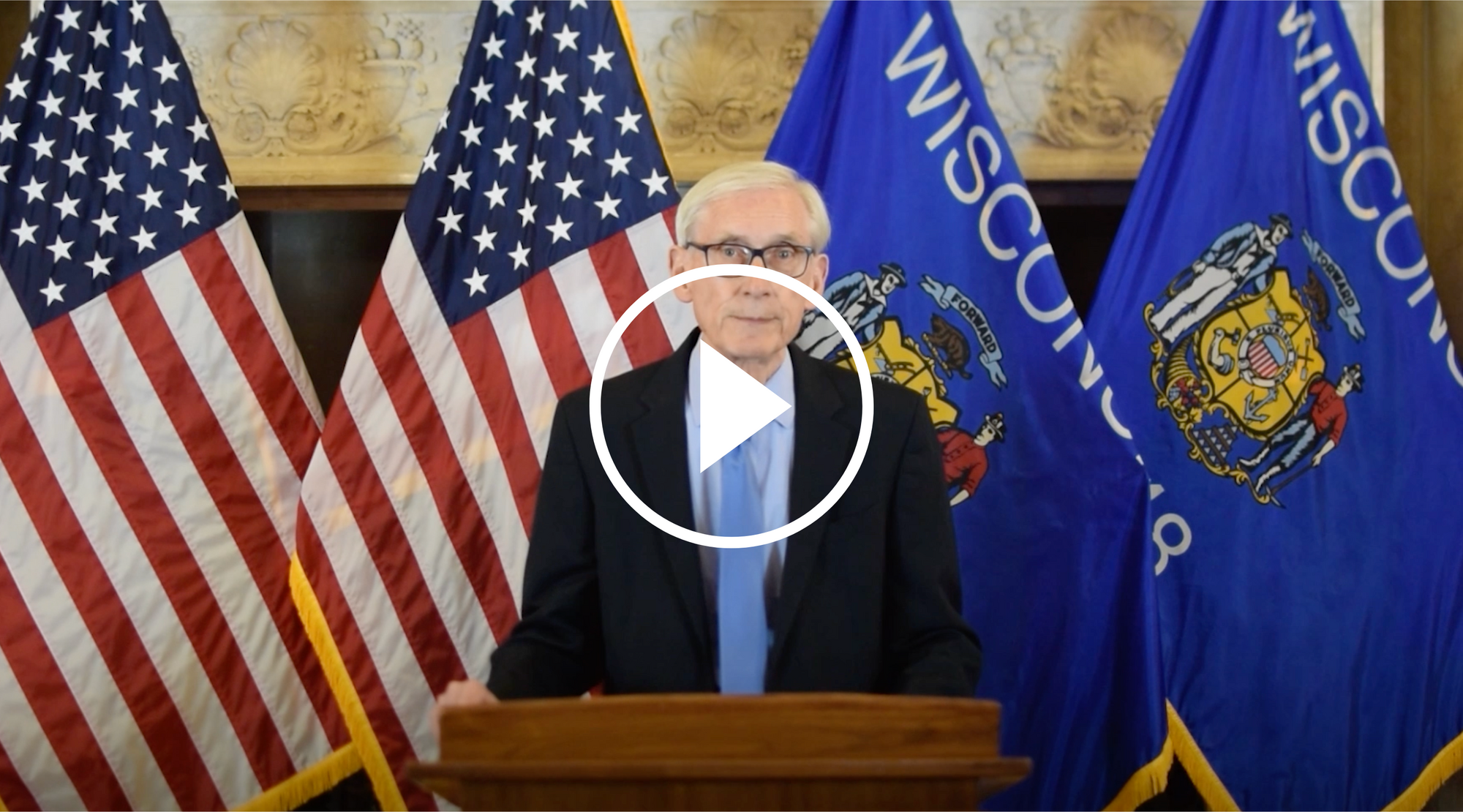 Gov. Evers made the announcement in a video to Wisconsinites available here. A pardon restores certain civil rights and offers forgiveness, and individuals are currently only eligible to receive a pardon from Gov. Evers only after they have completed their entire sentence and the individual has been “off paper” for at least five years. Individuals are also not eligible for a pardon if they are a registered sex offender or have any pending criminal cases or charges in any jurisdiction. More information about pardons in Wisconsin is available here. Unlike a pardon, a commutation may reduce a sentence an individual is currently serving. According to Executive Order #287, the granting of commutations “promotes rehabilitation by providing a system that rewards the positive efforts of incarcerated individuals who demonstrate personal growth and a commitment to change with the possibility of a second chance to contribute to society, become productive members of their communities, make amends, and improve their lives and those of the people around them.” Additionally, the order notes, “the granting of commutations can also encourage incarcerated individuals to be accountable, take responsibility, make amends, and seek forgiveness for their actions that have harmed other individuals and the community.” Additional information about the different types of executive clemency in Wisconsin here. Under Gov. Evers’ criteria, individuals will not be eligible for a commutation for a conviction of any of the following crimes:
Under Executive Order #287, in order to be considered for a grant of commutation, applicants cannot be currently serving an incarceration term for a sex offense or be required to register as a sex offender (either currently or upon release). Individuals will not be eligible for a commutation if they have any unresolved criminal charges or outstanding warrants in any jurisdiction, and they may not have any incidents of violent misconduct within the last five years of the current incarceration term. Additionally, the individual must have served at least half of their incarceration term, or at least 20 years of a life sentence, and have a record of rehabilitation and good behavior during their time in prison. Further, under Executive Order #287, applicants will be required to “provide notice of the application to the circuit court and district attorney’s office that oversaw their conviction, if they can be found,” to ensure the circuit court and district attorney’s office may provide feedback to the Commutation Advisory board on the individual’s application for a commutation. To ensure survivors and victims and their families have the opportunity to provide input, Executive Order #287 also requires that victims registered with the state Office of Victim Services and Programs receive notice to facilitate feedback from registered victims on the commutation application. The Commutation Advisory Board will also have access to records of an applicant’s programming, work history, and conduct in prison from the Department of Corrections. In evaluating applications for commutations, under the governor’s directives in Executive Order #287, the board must consider:
Gov. Evers today also announced his first appointments to the Commutation Advisory Board, appointing his chief legal counsel, Mel Barnes, as chair of the board, and corrections veteran, Cindy O’Donnell, as vice chair of the board. Barnes graduated from the University of Wisconsin Law School and joined the Office of the Governor in 2023, where she has been the governor’s close advisor and chief legal counsel since then. In her role as chief legal counsel, Barnes also chairs the governor’s Pardon Advisory Board. Cindy O’Donnell served as deputy secretary of the Department of Corrections under former Govs. Thompson, McCallum, and Doyle. She also served as a division administrator under Attorneys General Lautenschlager and Van Hollen. Operating similarly to the governor’s Pardon Advisory Board, the Commutation Advisory Board will hold hearings to review applications and make non-binding recommendations to the governor. Their first meeting is set to occur in June 2026. The governor will announce additional board members in the coming weeks, as well as a date for the board’s first meeting. In addition to Barnes and O’Donnell, the board will consist of members with experience and expertise in a diverse cross-section of criminal justice, including victims’ advocates, law enforcement, corrections, and former members of the judiciary, among others. Executive Order #287 can be found here. Gov. Evers today also signed Executive Order #288, which specifically creates a commutation process designed for youth offenders who are sentenced to life in prison. Executive Order #288 recognizes that, “a growing body of neuroscientific and psychological research has demonstrated that an individual’s brain, behavior, and personality undergo significant changes throughout their teen years and into their twenties.” Research indicates, as the order further notes, that until brains are fully formed, individuals are “more susceptible to external pressures from peers, and [are] less capable of understanding the consequences of criminal actions.” The U.S. Supreme Court has recognized these scientific developments in Miller v. Alabama, holding that regardless of the offense committed, mandatory life sentences without the possibility of parole are unconstitutional with respect to juvenile defendants.” Indeed, as the governor’s order notes, “individuals who commit crimes in their youth therefore possess increased potential for rehabilitation, a diminished degree of culpability, and a lower chance of reoffending once they have reached maturity.” Under Gov. Evers’ Executive Order #288, much like the criteria under Executive Order #287, youth convicted of a life sentence who are seeking a commutation will be required to “provide notice of the application to the circuit court and district attorney’s office that oversaw their conviction, if they can be found,” to ensure the circuit court and district attorney’s office may provide feedback to the Commutation Advisory Board on the individual’s application for a commutation. Similarly, Executive Order #288 also requires that victims registered with the state Office of Victim Services and Programs receive notice to facilitate feedback from registered victims on the commutation application to ensure survivors and victims and their families have the opportunity to provide input. The Commutation Advisory Board will also have access to records of an applicant’s programming, work history, and conduct in prison from the Department of Corrections. In evaluating applications for commutations for youth, under the governor’s directives in Executive Order #288, the Commutation Advisory Board must consider:
Executive Order #288 is available here. More information about the commutations process is available here. Over a year ago, Gov. Evers unveiled a comprehensive corrections reform plan to improve public safety across Wisconsin, reduce short and long-term costs to taxpayers, lower rates of recidivism, support corrections staff, and stabilize the state’s skyrocketing prison population. The governor’s plan included a “domino” series of facility changes, improvements, and modernization efforts across Wisconsin’s correctional institutions, including ultimately closing Green Bay Correctional Institution (GBCI) in 2029 and wholly rehabilitating and transforming Waupun Correctional Institution (WCI), facilities that were both built in the 1800s. To date, now well beyond a year after the governor introduced his proposal, Republican lawmakers have thus far introduced virtually no real or meaningful plan to close GBCI, reform WCI, or otherwise address the state’s burgeoning prison population, which continues to drive new and exorbitant costs for Wisconsin taxpayers due to chronic overcrowding well beyond the build capacity of Wisconsin’s correctional institutions. Gov. Evers’ corrections reform plan remains the safest, fastest, and cheapest plan to reform Wisconsin’s correctional justice system—just as it was now nearly a year and a half ago when it was first introduced. Republican lawmakers, who have insisted for the last year that they would introduce a version of their own corrections reform plan to accomplish the same goals, have yet to do so. |
| An online version of this release is available here. |
| ### |
 |
|
| Office of the Governor • 115 East Capitol, Madison, WI 53702 | |
| Press Office Email: GovPress@wisconsin.gov | |
   |
|
| Unsubscribe |