What's New
Tom Puchalski is retiring after 14 years with the Private Water Section. Tom served both the central office and field, contributing to code revisions, fact sheets and technical guidance for staff and well professionals. For the last seven years, Tom covered the south-central portion of the state as a Water Supply Specialist. Tom’s last day was Feb. 17. Congratulations Tom!
Many of you have likely interacted with Dave Johnson over the years. Dave helped Private Water staff, well drillers, pump installers and well owners with difficult geology and groundwater quality issues. His contributions were many and we will miss his experience and knowledge. After 30 years with the DNR, Dave’s last day was Dec. 4, 2025. Congratulations to Dave on his retirement!
New Roles for Ben Degner and Moses Jatta

On May 4, 2026, Ben Degner transitioned from the Private Water Field Team to a Hydrogeologist position within the Private Water Section. Working out of the Eau Claire office, Ben will coordinate the creation, review and revision of special well casing areas, landfill variance applications, anode drillholes and heat exchange systems. He will also provide hydrogeologic analysis to internal and external partners and customers. Ben has been the Private Water Supply Specialist for northeast Wisconsin since 2023. Prior to that, he was the Environmental Project Coordinator for the Menominee Indian Tribe and a consultant hydrogeologist for an engineering firm.
|

Moses Jatta has been hired to fill the newly created Emerging Contaminants Hydrogeologist position within the Private Water Section. Moses joined the Private Water Section in March 2025 as both a limited term employee (LTE) and a Project Hydrogeologist, where he conducted ARPA well grant application technical reviews. In his new role, Moses will conduct well compensation grant application technical reviews and provide hydrogeologic analysis for PFAS and other emerging contaminants in private water supplies to support the implementation of the recently enacted PFAS legislation. Moses began his new position on June 14 and will be based in the Madison central office.
|
|
Sara Fry Leaves Private Water
Sara Fry accepted a position with the DNR’s Environmental Enforcement Program. Her last day with the Private Water Section was May 29. Sara joined the Section in 2022, replacing Sandy Hershberger as Reporting and Enforcement Coordinator. During her time with the Private Water Section, she helped improve compliance review processes and operating procedures, making reviews more efficient. We will miss Sara’s dedication to customer service and wish her well in her new role within the DNR.
|
|
 |

Groundwater Section Welcomes Stephen Bartlett
Stephen Bartlett joined the Groundwater Section as a hydrogeologist, filling the position previously held by Dave Johnson. Stephen will contribute to key initiatives like casing recommendations and working with internal and external customers to address groundwater contamination issues.
Below is a brief bio of Stephen:
Stephen holds a master’s degree in hydrogeology from Simon Fraser University in Vancouver, British Columbia. His thesis focused on modeling coastal inundation from tsunamis in the Cascadia subduction zone and their infiltration into coastal groundwater. He has worked as an exploration geologist across Canada and most recently in a biogeography lab at UW-Madison where he focused on soil mineralogy and soil moisture.
|
From The Field
Vacancies
The Private Water Field Team currently has two vacant positions following recent staff transitions.
Ben Degner accepted a new position as a Hydrogeologist Program Coordinator within the Private Water Section in May. Tom Puchalski retired in February. Any inquiry that would have gone to Ben or Tom can be directed to Jared Niewoehner, Private Water Field Supervisor.
We anticipate filling both vacancies later this summer or early fall. View the county contract map to find your current Private Water Supply Field Representative.
Field Reminder To Review Grouting Requirements
Field staff have noticed an uptick in grouting violations across the state. Please take a moment to review NR812.20: Grouting and Sealing and ensure current practices meet code requirements. Properly grouting a well is one of the most important steps a driller can take to ensure a contaminant-free well.
Additionally, Private Water Field staff have been equipped with chlorine test strips to test chlorine residual in drilling water. As a reminder, NR812.11(14) requires drilling water to be disinfected with chlorine with a residual of 100 mg/L. The drilling fluid shall be maintained with a free chlorine residual of 10 mg/L during drilling.
Code Revisions
NR 812 Revisions
Revisions to NR 812 took effect on March 1, 2026. The revisions focus on pump installation requirements, but they also include changes to approval requirements for wellhead equipment and pitless adapters and create minimum standards for dewatering well construction. The NR 812 Revisions are available for download.
Pump Installation Requirements
- Pitless adapters no longer need prior DNR approval if the adapter or unit meets NR 812.31, which requires that subsurface connections be watertight and pitless adapters be properly sized and installed according to the manufacturer’s instructions.
- Potable non-pressure storage vessels only need approval when the reservoir or tank is installed below ground surface or if it will be installed before entry into a non-community public water system.
- Requirements for pump heads and well connections have been clarified. Hand pumps now only require a concrete pump platform if it is used for a public non-community well. Emergency hand pumps can be installed on wells with submersible pumps if the wellhead remains vermin-proof.
- A former well or pressure tank pit can remain in use as a valve pit (valve pits are regulated by the Department of Safety and Professional Services as plumbing).
- Separation distance requirements between buried discharge lines, sanitary and storm sewers and private onside wastewater treatment system components have been revised to align with plumbing requirements.
Dewatering Wells
- Minimum standards include separation distance requirements for permanent dewatering wells, sanitary protection of wellheads and a prohibition on connecting a dewatering well to a potable water supply.
Grouting Requirements
- Clarifies requirements for the use of drilling mud and grouts.
- Expands the use of bentonite chips in fractured bedrock.
Existing Installations
- Allows an existing well that is less than six inches in diameter in a limestone formation to remain in use.
NR 146 Revisions
Revisions to NR 146 went into effect on March 1, 2026. While revisions have gone into effect, new requirements related to continuing education attendance and license renewal will not be applicable until 2027. Starting in March of 2027, all credentials must be renewed online unless the DNR grants an exemption from the online renewal process. A grace period for completing required 2027 continuing education attendance is allowed. The grace period provides an additional six months following license expiration for an individual to complete continuing education requirements for 2027. The license remains expired until continuing education is completed and the license is renewed with a late fee of $15. This chart shows what changes have gone into effect and when they apply.
Licensing
About 1,250 individuals hold an active Wisconsin license or rig operator registration. Each year, some individuals retire or do not renew, and newly licensed individuals are added. The table below shows the number of license holders at the end of 2025.
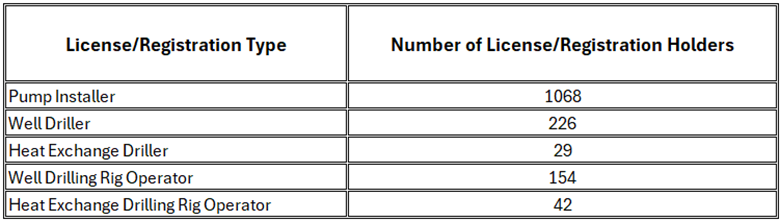 Figure 1 below shows that the total number of Wisconsin licensed well drillers has declined from 277 to 226 over the past 10 years, while the number of registered rig operators has seen a general increase.
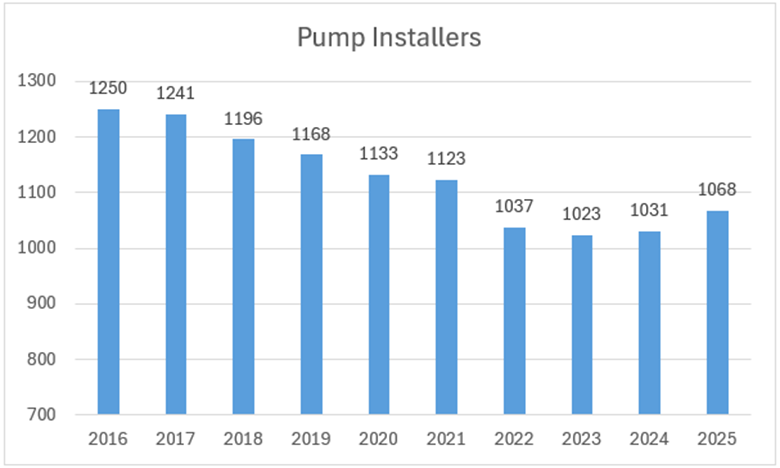
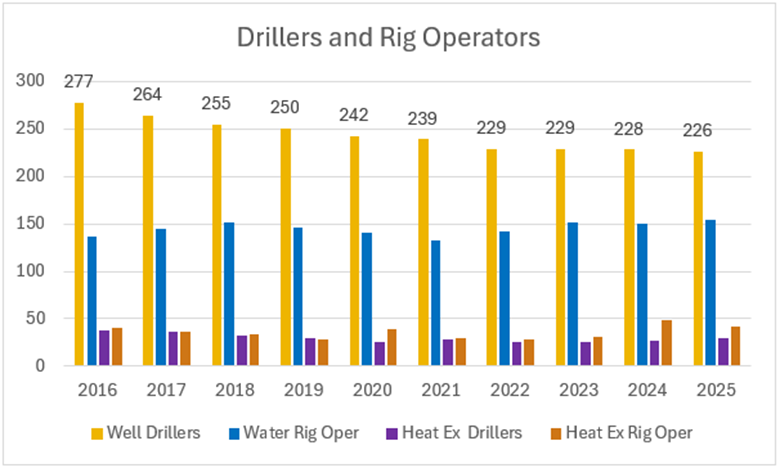 Figure 2 below shows a decrease in the total number of licensed pump installers from 1,250 in 2016 to 1,023 in 2023. The negative trend has reversed over the past three years.
Compliance
Floodplain Reminders
Spring brought heavy precipitation to the state, with some areas in northeast Wisconsin exceeding previous record precipitation. At times, the heavy rain produced flashflood watches and warnings. Record flooding occurred along the Wolf River at Shiocton and New London, and some areas remained under flood river warnings for nearly a month. One of the many residential impacts has been standing water around wells and, in some cases, floodwaters overtopping well casings, which can have serious health impacts.
NR 812.08(3), NR 812.(12), and NR 812.29(3) require wells constructed in a floodplain to have casing extend at least 2 feet above the base flood elevation. This base flood elevation is the computed water surface elevation of a flood that has a 1% chance of occurring.
Wells located in a floodplain must be identified as such on its well construction report. The desktop version of the Well Driller Viewer includes FEMA Floodplain Layers that show base flood elevations and elevation cross sections in FEMA-studied areas. The ability to add the FEMA layer is not yet in the mobile version of the driller viewer but is expected soon. Drillers should verify whether a well is in a floodplain by using the Well Driller Viewer or county zoning websites. If a well is in a floodplain, the appropriate casing height must be added. Questions regarding base flood elevations in a specific area should be directed to your Private Water Field Supply Specialist or county floodplain administrator.
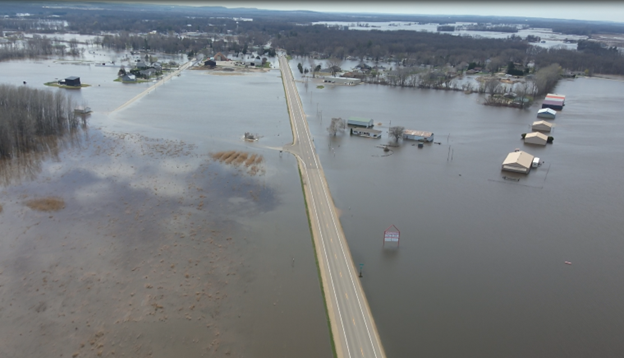 Flooding at Shiocton Airport during the April 27, 2026 flood event. / Photo Credit: Outagamie County Emergency Management
Revised Forms And Fact Sheets Now Available
To reflect NR 812 revisions the Private Water Section has updated several forms and fact sheets, including:
All revised forms and fact sheets are available on our Information for Drillers and Pump Installers webpage.
Reminder That Daycare Facility Wells Are Now Considered School Wells
Following the change to NR 812.07 (94), Wisconsin Administrative Code, which took effect in July 2020, the existing definition of schools was expanded to include daycare facilities. As a result, well drillers should be aware that school well approval shall be obtained before starting work on a new well being installed for an upstart business, a replacement well being drilled for an existing daycare facility or the reconstruction of an existing well at a daycare facility. This requirement applies even if the business has other prominent functions, such as serving as a community center, senior dining facility or other uses.
The details of the well construction provided on the approval request will be reviewed in relation to the requirements provided in section NR 812.152, Wisconsin Administrative Code, to maximize protections against contamination for the vulnerable population being served. This is comparable to obtaining a high capacity or wastewater treatment plant well approval before the well project begins. Although specific requirements may vary depending on the drilling site, school wells (including daycares) that terminate in bedrock, require 3-inch upper enlarged drillhole to casing required depth, steel well casing 60 ft or to the top of bedrock, and neat cement grout sealing.
Ask detailed questions of general contractors, project managers, consulting engineers and owners about the intended use of the building. Be specific. In addition, please keep your Private Water or Public Water Supply Specialist informed on the construction details and your progress. The application fee for school wells (including day care wells) is the same as the notification fee for private and other non-community wells (currently $50), unless the well is considered a high capacity well.
Before submitting a school well approval request, determine whether the proposed project may trigger high capacity well requirements, which may require a $500 application fee.
The high capacity application fee is required whenever a change is made to an existing high capacity property or when a new well will cause a property to exceed the 70 gpm total threshold. For example, a new 20 gpm well on a property with two existing 30 gpm wells would require a $500 fee and application. Likewise, a new 10 gpm well on a property with an existing 200 gpm well would require a new application and $500 fee. Pump increases or approved withdrawal increases may also trigger an application and fee. The only changes to a high capacity property that do not require an application are adding residential or fire suppression wells, modest well reconstructions, or like-for-like well replacements that meet Act 10 requirements.
School well approval requests can be submitted to the DNR using both form 3300-295 and form 3300-295a.
Technology
Well Driller Viewer Mobile Application (old ArcGIS Explorer App)
The ArcGIS Explorer mobile application has been officially retired by Esri and removed from major app stores. While it may still load data on devices where it was previously installed, it is unsupported and cannot be downloaded on any new or reset mobile devices. If you have this application on your mobile device, your icon will look like this:
The DNR officially requires moving away from the old app to ensure you have uninterrupted access to critical field data.
How To Access The Mobile Well Driller Viewer Now
To view setbacks, landfill buffers, special casing areas and remediation sites on your mobile device, follow the official transition provided by the department on April 21, 2025 via email:
Use The Mobile-Friendly Web Browser Map
You do not need to install an app to use the map in the field. You can access it directly via your smartphone or tablet's web browser:
Key Contacts for Drillers and Pump Installers
We'll See You At Farm Technology Days, July 14-16, 2026
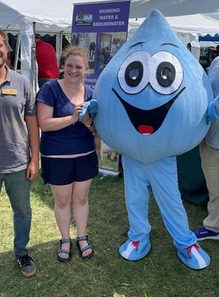
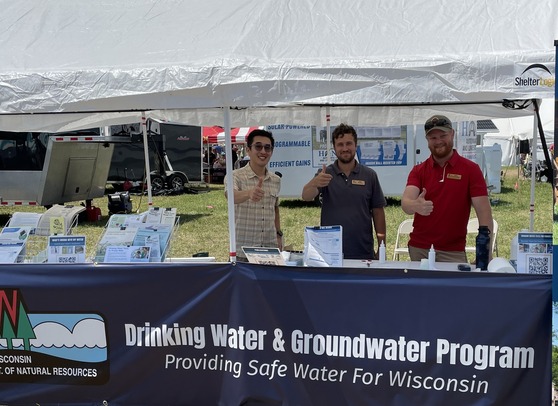 DNR Private Water Supply staff will be conducting free on-site nitrate screenings for any private well owners who bring a sample of their well water in a clean container to Farm Technology Days in Marathon County July 14-16, 2026.
Anyone is encouraged to bring a water sample from home or come to meet our Drinking Water and Groundwater staff and ask questions.
Farm Technology Days is one of Wisconsin’s premier agricultural events, bringing together farmers, landowners, industry professionals and families to explore the latest developments in agriculture, conservation and natural resource management.
Don't Miss Important Private Water Supply Updates
Are you receiving the latest updates from the Private Water Supply Section?
The Wisconsin DNR uses GovDelivery email subscriptions to share important information with well drillers, pump installers, heat exchange drillers, rig operators and other industry professionals. These emails are the fastest way to learn about code changes, training opportunities, forms updates, reminders, compliance information and other important news. If you're not subscribed, you will likely miss important updates.
We encourage all industry professionals to subscribe to the GovDelivery topics below:
To subscribe, visit the DNR email subscription webpage and enter your email and click submit. From there, choose the topics mentioned above and any other topics of interest.
|