|
Welcome to the Wisconsin Department of Natural Resources (DNR)'s Forest Management, Ecology and Research Newsletter, where we spotlight the work of the Division of Forestry’s Forest Economics and Ecology (FEE) section and the experts that make it happen.
This dedicated team of forest ecologists, hydrologists, silviculturists, geneticists and researchers applies their expertise to inform and support the sustainable management of Wisconsin’s urban and rural forests. From remote field research studies to tree nurseries to outreach and education opportunities, it’s all in a day’s work for the FEE section. Read on to learn more about the exciting work we do and remember to subscribe to receive email updates on the newsletter!
In this month’s newsletter:
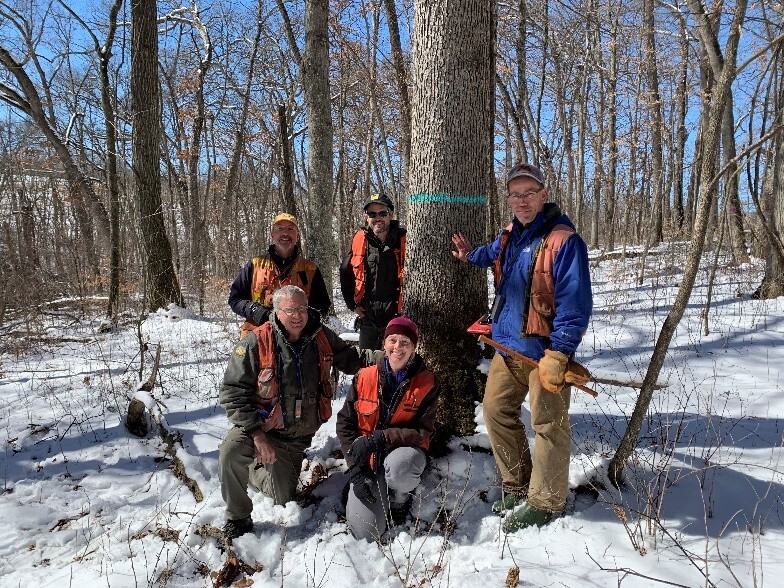
In the rolling hills of southwestern Wisconsin lies a special place called the Driftless Area. Unlike most of the Midwest, this land was untouched by glaciers, leaving behind steep slopes and rolling hills, fertile valleys and unique forests. Today, it’s the site of an important scientific project called the Adaptive Silviculture for Climate Change Network, or ASCC. Brad Hutnik and Greg Edge of the Wisconsin Department of Natural Resources’ Bureau of Applied Forestry are helping to facilitate this research, along with Dr. Miranda Curzon at Iowa State University and other collaborators in Iowa and Minnesota.
The Driftless ASCC project is part of a larger research effort across the U.S. and Canada. Scientists, forest managers and local experts are working together to find the best ways to help forests survive and thrive in a changing climate. In the Driftless Area, the focus is on oak and hickory forests that commonly grow on the rich hillsides. These forests may face big challenges from weather extremes.
Warmer winters, heavier rainstorms and longer droughts are all expected in the region. These changes could harm native trees and give invasive plants, including many not yet found in the Driftless Area, a better chance to spread. Pests and diseases are also expected to increase. That’s why the ASCC team is testing three different strategies to manage the forest: resistance, resilience and transition.
|
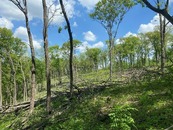
In the resistance treatment, the goal is to keep the forest as it is for as long as possible. Resilience focuses on helping the forest bounce back after stress, like a storm or drought. Transition means helping the forest slowly change into something new that will do better in the future climate. Each active treatment potentially involves carefully removing some trees, prescribed burning, regenerating and/or planting seedlings and keeping track of how everything responds.
Scientists are watching how trees and understory plants grow, how animals use the area and how much carbon the forest stores. They want to learn which actions give the forest the best chance to stay healthy. These lessons won’t just help Wisconsin forest landowners. The results will be shared with forest managers all over North America.
The Driftless ASCC project began in 2020 and is expected to continue in this quiet corner of Wisconsin for a long time. Here, the forest is teaching us how to adapt, grow and prepare for a changing world. For the Driftless Area, it’s more than just an experiment. It’s a hopeful plan to protect the forests we depend on — for clean air, wildlife and beauty — for many years to come. To learn more about the Driftless ASCC project and other research being conducted within the Division of Forestry, please visit the DNR’s Forestry Research webpage.
|
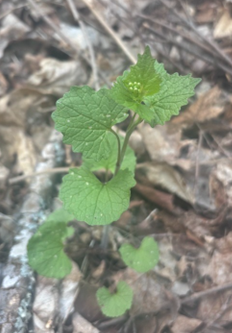
Garlic mustard might make a good pesto, but its high seed production and ability to suppress competing vegetation with allelopathic chemicals make it a nasty invasive that can take over forest understories. Garlic mustard produces glucosinolates, which are compounds that reduce the growth of nearby plants, helping garlic mustard to invade woodlands and outcompete native vegetation. Some studies have shown that these allelochemicals may also harm fungal communities in the soil.
Garlic mustard is non-mycorrhizal, meaning it does not form the types of symbiotic relationships that many native plants have with mycorrhizal fungi, which help plants take up more nutrients and water from the soil. Disrupting these mutualistic relationships may be one way that garlic mustard’s allelopathic chemicals help it gain a competitive advantage. Garlic mustard is commonly treated with broad-spectrum herbicides such as glyphosate (e.g., RoundUp) and Oust XP. However, because these herbicides are broad spectrum, they can also harm nearby native vegetation and their associated fungal communities. This leads us to question, which is worse? In treating garlic mustard, are we actually causing more harm than good?
|
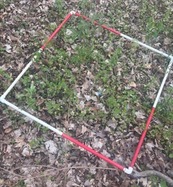
We set up a study to test this question after a blowdown event caused a new invasion of garlic mustard in Langlade County Forest. We established plots with three different treatments; controls (no herbicide), applying glyphosate and applying a glyphosate-oust mixture. Each spring, we count garlic mustard plants and estimate percent cover of garlic mustard within the plots before applying herbicide treatment. Then, we return to the plots each summer to measure the coverage of native vegetation species, count seedlings and collect soil samples to look at fungal communities. Soil samples are sent to the University of Wisconsin Biotechnology Center for metabarcoding analysis, allowing us to compare fungal communities between treatments. Initiated in 2022, this project is ongoing, and we look forward to returning to our plots this spring and summer for the final round of herbicide treatments and data collection. Stay tuned for our findings, which will be posted to the DNR’s Forest Health Research webpage.
|
SilviCast is a podcast about silviculture — the science and art of managing forests. Hosted by Wisconsin DNR silviculturists Greg Edge and Brad Hutnik, SilviCast is produced by the University of Wisconsin-Stevens Point’s Wisconsin Forestry Center and is available on Apple Podcasts, Spotify, YouTube Music and many other platforms. The show covers current topics in forest management, interviews experts and discusses practical ways to solve problems faced by those who care for forests.
Now in its seventh season, SilviCast covers many subjects. Episodes have investigated the “wood wide web,” explored new research on saving ash trees, explained how controlled fires help oak forests and even shown how goats can promote healthy forests. With over 100,000 downloads, the podcast reaches foresters and landowners in Wisconsin and in more than 70 countries, all in a fun and easy-to-understand way. Greg Edge says the podcast is a great way to share scientific ideas with busy practitioners in the field. Brad Hutnik explained that before the COVID-19 pandemic, they often had long, interesting discussions in hotel rooms while on the road. This inspired them to start the podcast in early 2020. They originally called it “Silviculture Matters,” but later changed the name to SilviCast.
The podcast also makes it easy for the hosts to connect with top experts around the world, and they receive plenty of feedback from listeners who use the advice in their daily work. Brad notes that podcasts allow for deeper discussions than traditional lectures. The conversation can wander down interesting paths and answer questions in detail, keeping the audience engaged. Listeners can learn while traveling or marking trees and get continuing education credits at the same time.
SilviCast is also cost-effective. Unlike conferences, which have travel and venue costs, each podcast episode can reach thousands of listeners with minimum expense. Some professors even use episodes in their classes.
Season 7 has already started! Come learn about the “wood wide web” and some fascinating new subjects in silviculture.
Pictured: Greg Edge and Brad Hutnik
|
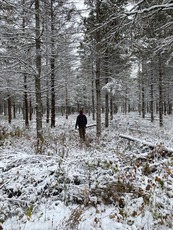
Have you ever been driving down a county road and wondered about those Wisconsin Department of Natural Resources (DNR) seed orchard signs? They mark the locations where seeds are produced and harvested to supply the DNR with the large quantities of seed necessary to run the Forestry Division’s State Nursery Program. The trees produced from this seed serve reforestation efforts on public and private lands throughout Wisconsin. The four conifer species, for example, white spruce, red pine, jack pine and white pine, are usually at the top of the list for seedling demand at our State Nurseries. The DNR manages multiple seed orchards throughout the state for each of these species to meet the goals of the Wisconsin State Nursery System in several ways.
First, collections from these orchards have been used to directly supplement seed supply to meet the ever-growing demand for seedlings. Red and white pine seed production orchards are designed to produce large quantities of genetically diverse seed to help meet nursery demand. Seed production in wild tree populations, especially conifers, can vary year to year, so having easily accessible and well-maintained orchards to collect from during good seed crop years can help to develop surplus seed quantities and supply the State Nursery system for its future needs.
Second, these orchards serve to collect and maintain a breeding population of individuals to establish what is known as tree improvement programs. By monitoring and selecting the best-growing individuals within each orchard, it may be possible to produce seedlings that grow faster, taller or have greater biomass than you would expect in any wild populations. Through several generations of selective breeding for the best-performing families, it is possible to produce this improved seed. Our white spruce and jack pine orchards are currently on the third and fourth generation of selective breeding, respectively, and are producing improved seeds. These seedlings consequently are providing better fiber/material for timber products in shorter time frames than could be expected for wild-collected seeds.
Finally, these orchards serve as living archives. Many of these trees have been producing seeds for the State Nursery system for decades. The trees from these orchards represent historical collections from populations of all four species throughout the western Great Lakes region of the U.S. and Canada, and they capture a variety of growth patterns and habitat preferences. These diverse stands of trees make it likely that seedlings produced from these orchards will be well suited to be planted anywhere in the native range of the various species throughout the state. In maintaining the production of these varieties, the seeds and vegetative tissues from the orchards are used in the replication and development of similar orchards elsewhere in the state to increase seed production capacities for these species.
So, remember, the next time you pass by one of these orchards, those trees that you see are hard at work producing the foundation of the next generation of Wisconsin forests!
|
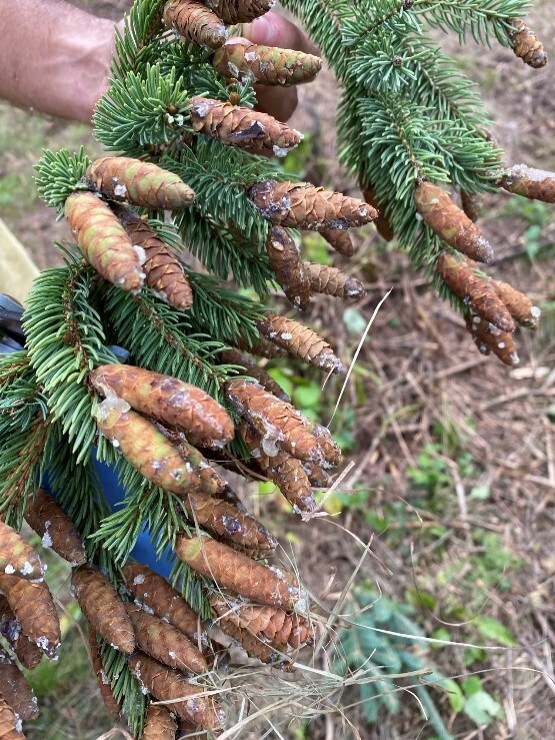 Collecting white spruce cones from our best-performing trees to replace ones that are reaching the end of their productive lives; conserving the genetics of those highly functioning trees.
Photo credits: Wisconsin DNR unless otherwise noted.
More DNR Forestry News
Division of Forestry News
Forest Health News
Forest Products News
Private Forestry News
Reforestation News
Urban Forestry News
Wildland Forestry News
Love this newsletter? Forward it to a friend! To subscribe for the newsletters, visit our sign-up page.
|