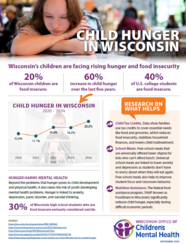
Children in Wisconsin are facing rising hunger and food insecurity – 20% of Wisconsin’s children are food insecure. That means 1 in 5 children are in households where they could not always afford to buy the food they need. That is a 60% increase in child hunger over the last five years.
Beyond the problems hunger poses to child development and physical health, hunger also raises the risk of youth developing mental health problems. 30% of high school students who are food insecure seriously considered suicide.
Child hunger in Wisconsin is the latest OCMH Data Bite. See it here.
See all OCMH Data Bites here.
|
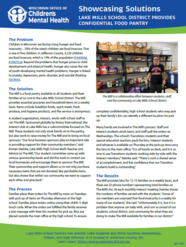
A student organization at Lake Mills School District teams up with staff to run The Mill, a confidential and free food pantry available to all district students and their families. The pantry provides essential food items including fresh produce and hygiene products on a weekly basis. Learn their process and the number of families they help in our newest Showcasing Solutions – Lake Mills School District Provides Confidential Food Pantry.
Showcasing Solutions highlights innovative programs Wisconsin organizations are doing to improve children’s mental health and well-being. See all our Showcasing Solutions here.
|
It is important to take time in September to raise awareness of suicide, share mental health resources, and break the stigma surrounding suicide. The facts are alarming:
- 24% of Girls seriously considered suicide.
- 40% of LGBTQ kids say they seriously considered suicide.
- 72% of Wisconsin youth who died by suicide were boys.
- Seasonal spikes in suicide among youth are in October and May.
Equipping young people with coping skills, modeling open conversations on mental health, and promoting help-seeking can all help. NAMI (National Alliance on Mental Illness) encourages individuals to not only talk openly about suicide prevention, but also to recognize the warning signs. With one conversation, asking someone how they’re really doing and being ready to truly listen can save lives. See NAMI’s resources. Additionally, Prevent Suicide Wisconsin has a number of resources, including graphics to educate others on Wisconsin’s suicide data and prevention strategies. The Suicide Prevention Resource Center provides a helpful suicide intervention guide for schools.
OCMH also provides informative pieces related to suicide prevention. See data and research:
See Showcasing Solutions sharing stories of innovative suicide prevention programs:
DPI Peer-to-Peer Suicide Prevention Grant Application Open
The Department of Public Instruction (DPI) announces that the DPI Peer-to-Peer Suicide Prevention grant application is now available to Wisconsin high schools. Priorities for funding include implementing a new or existing evidence-based or best practice peer-to-peer suicide prevention program and geographic distribution of funds. The funding application is up to $1,000 per high school and applications are due September 30, 2026. Learn more here.
|

On August 26th the Wisconsin Department of Justice (DOJ) announced an historic multistate settlement with Meta Platforms, Inc. Wisconsin is expected to receive an estimated $219 million from the lawsuit that could rise to up to $313 million if other agreements are met with Tik Tok and YouTube.
The lawsuit was filed by 47 states and claimed that Meta, the parent company of Facebook and Instagram, knowingly added features in their platforms to promote social media addiction among children and made false claims about the safety of its products. The entire settlement is $17 billion with different amounts going to the individual states.
In addition to the financial award, the settlement requires Meta to implement a series of safety features on Instagram and Facebook including:
- Strict daily time limits and productive pauses for children. Instagram and Facebook would impose a combined two-hour daily time limit with mandatory pauses after 15 minutes of continuous use and again at 60 and 90 minutes to interrupt extended periods of scrolling. These limits remain in effect for five years. If Snapchat, TikTok, and YouTube adopt comparable terms, the daily limit on each platform would drop to 60 minutes for 10 years.
- Nighttime blocks restricting children’s access from 12-6 am.
- Limited school-time access for children, eliminating push notifications on weekdays from 8 am-3 pm during the school year.
- Robust age assurance measures to more effectively verify the age of young users.
- Safer, age-appropriate content controls, including stronger safeguards against bullying, content promoting eating disorders, and content related to suicide and self-harm.
- Stronger, more user-friendly parental controls.
- Limits on social comparison features, including certain beauty filters and visible “like” counts (which have been linked to poor mental health outcomes in kids and teens).
- Both the implementation and efficacy of the features would be regularly assessed by an independent auditor and a committee of settling states.
These restrictions could lead to better mental health and wellness for children in Wisconsin and across the nation.
|
What do you think of when it comes to children’s mental health prevention? It is a vast topic and OCMH will explore it in the next Children’s Mental Health Network meeting on Friday, November 6, 2026. These quarterly learning meetings are virtual and take place 10 am-12 pm. If you are not on the distribution list to be notified of these meetings, sign up here. The meeting link will be emailed approximately one month prior to the meeting.
|

By Amy Marsman, Senior Research Analyst – Wisconsin Office of Children’s Mental Health
Experts agree: sleep is vital to mental health. Getting sufficient sleep is especially critical for children and young people because their brains are still developing. Sleep impacts emotional health, the ability to learn, and proper development. Yet, a large majority (74%) of Wisconsin teens do not get sufficient sleep. And more than half of teens (53%) report being on a screen after midnight.
We know that babies and toddlers need a lot of sleep. We can all relate to the parent dealing with a toddler who missed their nap. But it’s less common to apply the same empathy to older kids. When kids don’t get sufficient sleep – regardless of age – their ability to cope with emotions and stress is deeply impacted.
Teens (ages 14-17) should get 8-10 hours of sleep every night. Tweens (ages 10-12) and school age kids (ages 6-9) should get 9-11 hours of sleep each night.
These doctor-recommended ranges, highlighted by the National Sleep Foundation, have been consistent for years. However, average sleep has been declining and our young people are busier than ever. Their schedules are packed with school, extracurriculars, jobs, caregiving and, if they are lucky, some free time with friends.
So how can we help the children in our lives get sufficient sleep? Here are some suggestions:
-
Explain Why: Explain that our brains repair and restore during sleep. While your body rests, the brain is organizing what was learned during the day. This solidifies memory, which strengthens learning. That’s why well-rested kids tend to do better in school.
-
Create the Routine: Prioritize family sleep routines with relaxing, screen-free activities an hour before bed and consistent bedtimes (even on weekends, whenever possible) for all family members. This normalizes healthy sleep behaviors.
-
Keep Healthy Boundaries: Always keep screens out of your child’s bedroom at night. This tech boundary works best when adults follow the same rule. Teens who are sleep-deprived are more at risk for anxiety and depression. That’s why well-rested kids tend to feel better.
To learn more, the Child Mind Institute has a great resource on healthy sleep habits, common sleep disorders, and ways to support kids’ well-being.
Another suggestion is to look outside the home – to examine how schools impact children’s sleep routines. In response to research showing 1) the detrimental impacts of sleep deficiencies in adolescents and 2) a teen’s internal clock (their circadian rhythm) shifts later in adolescence as a biological fact, not a behavioral choice, many schools have moved their start times back to 8:30 am for high school and middle school students.
With each of these suggestions, it works best when youth themselves are involved in developing the rules and routines that impact their lives. Have discussions, create routines, and craft boundaries together. Students can be especially powerful when advocating for change within their school community. Include their voices in your family, in your community, and in your decisions.
Lastly, don’t forget to tend to your own sleep health. Adults who are under slept suffer from the same effects as kids – they are less able to regulate their emotions. They are less equipped to help young people. As a busy parent, I remind myself of a favorite quote: “The times are urgent; let us slow down.”
|
Articles on Children’s Mental Health for Your Newsletters and Communications
Would you like to receive children’s mental health articles like the one above to publish in your organization’s newsletter or communications? Sign up for OCMH’s Building Mental Wellness Copy & Drop (select “OCMH – Building Mental Wellness Copy & Drop”). You’ll receive a ready-to-use article the third Tuesday of each month. Just “copy and drop” it into your publications. Learn more about OCMH’s Building Mental Wellness Copy & Drop.
|

Internet Crimes Against Children (ICAC) – Parent Resources
The Office of School Safety within the Wisconsin Department of Justice (DOJ) shared resources for parents on Navigating the Digital World: Understanding Apps, Features, and Safety Risks. These resources come from the Wisconsin ICAC Task Force, which provides a monthly bulletin with valuable information about keeping children safe online. Anyone can sign up to receive these bulletins.
DOJ has also published modules on online safety for parents in both English and Spanish. The modules cover Basic Online Safety, Oversharing, and Encouraging Healthy Online Behaviors and were created in conjunction with the Department of Public Instruction.
|
988 Day – September 8
The 988 Suicide & Crisis Lifeline provides free and confidential support for people experiencing mental health and substance use concerns. People of all ages who need help for themselves or another can call, text, or chat 24/7 (chat feature is at 988lifeline.org).
988 Day is September 8th and serves to raise awareness of 988. The theme for 2026 is "988 Reasons: Your Reason is Reason Enough," and reminds us that you don’t have to be in crisis to reach out to 988. Visit the 988 Day webpage for more information. Check out the 988 Day Toolkit for social media content and other downloadable materials and use #988Day to help get the word out.
Want more ways to get involved in Suicide Prevention Month in September? Check out ideas for action!
|
Share Feedback on Future Opioid Settlement Funds
The Wisconsin Department of Health Services (DHS) is seeking feedback on how to save more lives with future Opioid Settlement Funds. Towards that end, DHS has an online survey for anyone interested in submitting ideas for how the state should allocate its share of opioid settlement funds.
Wisconsin expects to receive more than $874 million in total funding from 2022 through 2038 as a result of litigation against the pharmaceutical industry. Next year, the state anticipates receiving $11.6 million for strategies to support prevention programming, reduce overdose deaths and spread of infectious disease, increase access to treatment, and invest in recovery services in communities across Wisconsin. The survey is open through September 30th. Learn more.

Play While You Wait Toolkit Now Available in Spanish
Supporting kids and families in public spaces is what the Play While You Wait Toolkit is all about, and it is now available in Spanish. It provides easy‑to‑use materials for clinics, offices, and locations where families wait to help parents and caregivers engage with their children while waiting for appointments rather than turning to technology and media. Access both the Spanish and English toolkits here.
|
|