 Harnessing innovation and strengthening partnerships to
build a healthier future for rural Wisconsin
Program updates
The Wisconsin Department of Health Services (DHS) will share email updates about Wisconsin's Rural Health Transformation Program as new information becomes available.
This update includes:
- Advisory council appointees
- Timeline update
- Budget update
- Electronic health records system proposals due April 20
- Upcoming grant funding opportunities
Advisory council appointees
DHS announces the appointment of 23 members to Wisconsin’s Rural Health Transformation Program Advisory Council. DHS received 194 applications from 62 counties and Tribal nations.
The advisory council will provide strategic guidance and input to DHS as a part of the state’s implementation. The council offers an opportunity to contribute to shaping how rural health priorities are addressed, bringing diverse provider, community, and lived experience perspectives to the table.
Appointees to the advisory council are:
- Tiffany Allen, lived experience with rural health care, Grant County
- Julie Bulin, Oconto Hospital and Medical Center, Marinette County
- Jessica Coburn, lived experience with rural health care, Jefferson County
- Sara Cook, Scenic Bluffs Community Health Center, Monroe County
- Kandyce Dunlap, Ho-Chunk Nation Department of Health, Ho-Chunk Nation
- Sarah Endicott, individual provider, Green County
- Kimberly Lansing, individual provider, La Crosse County
- Andrew Miller, Stockbridge-Munsee Community, Stockbridge-Munsee Band of Mohican Tribe
- Tiffany Palecek, Price County Health and Human Services, Public Health Unit, Price County
- Eilidh Pederson, Western Wisconsin Health, St. Croix County
- Gustavo Perna, individual provider, Marathon County
- Sarah Pouzar, Children's Wisconsin, Winnebago County
- Andromana (Ann) Price, Florence County Human Services, Florence County
- Bridget Ray, lived experience with rural health care, Kewaunee County
- John Russell, Prairie Ridge Health, Dodge County
- Tracy Schlegel, lived experience with rural health care, Marathon County
- James Small, individual provider, Waukesha County
- Eric Stader, individual provider, Grant County
- Ana Tochterman, NorthLakes Community Clinic, Ashland County
- Chelsea Van Gundy, lived experience with rural health care, Monroe County
- Robert VanMeeteren, Wisconsin High Value Network, Sauk County
- Sara Wajek, individual provider, Langlade County
- Kristin Weiler-Nytes, individual provider, Clark County
DHS thanks all applicants who took the time to apply and although there were a limited number of seats available for the council, we look forward to working with all of our partners on this important work.
The advisory councils’ first meeting will take place on April 23. Meetings are open to the public and information will be available on the public meetings notices webpage prior.
Timeline update
In the graphic below, is an overview of where we have been, where we are, and where we are going for Wisconsin’s Rural Health Transformation Program, including the milestones we are working toward to achieve project goals. DHS will update this timeline periodically to keep you informed about progress and next steps.
Click on the image to view a PDF version.
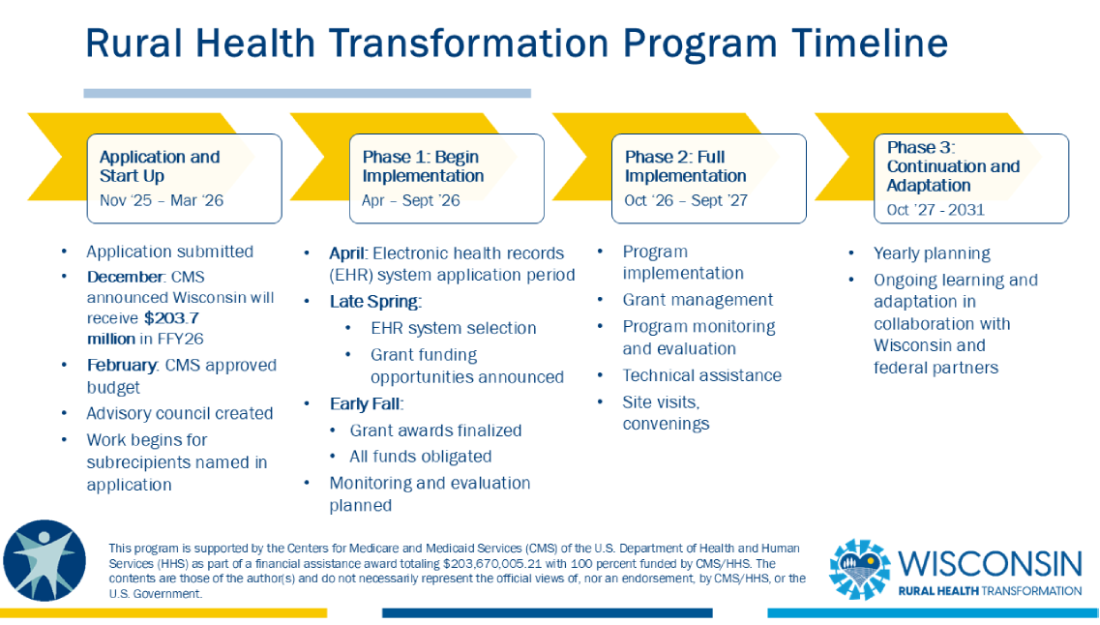 Rural Health Transformation Program Timeline
Budget update
On November 4, 2025, DHS applied for $1 billion for five years (or $200 million per year) as part of the Centers for Medicare and Medicaid Services (CMS) opportunity to participate in the Rural Health Transformation Program.
On December 29, 2025, CMS notified DHS it had been awarded $203,670,005.21.
Since this amount was more than what DHS had applied for, we submitted a revised budget proposal to CMS that was approved on February 5. The project narrative has not changed as a result.
Electronic health records system proposals due April 20
DHS is seeking proposals for a statewide electronic health records (EHR) system. The selected vendor will build a system to transform how providers interact with each other and with patients. The goal is to facilitate high-quality care for patients in rural Wisconsin. The selected vendor will design, implement, maintain, host, and manage a full-service EHR system in partnership with DHS and participating providers. The system will give providers the option to join a shared system with appropriate facility and provider-specific customizations, privacy, and security. The system will enable provider organizations to upgrade existing clinical and revenue systems and achieve economies of scale through a single statewide procurement.
To view the request for services, visit the eSupplier portal and search for S-FMF1944 OGM-26 or Event Number 14009.
 Upcoming grant funding opportunities
Listed below are several grant funding opportunities DHS plans to release in late spring or early summer, which will be open for a 10-week window. In addition to the list below, subrecipients will announce their funding opportunities over the course of the year. We will share those and related announcements with those signed up to receive these email updates, on the program webpage, and other forms of outreach.
Care coordination grants
These competitive grants will innovate care delivery in the state’s seven Healthcare Emergency Readiness Coalitions regions, and will improve access to preventive services, primary and specialty care, dental services, and/or behavioral health services through team-based models of care delivered in trusted sites close to home.
Successful grantees will implement multidisciplinary strategies that address health needs, increase the use of preventive care, provide care in lower-cost settings such as homes, and reduce preventable hospital admissions and emergency room visits. Applications should reflect collaborations between partners.
Community health worker grants
These competitive grants will seek to boost adoption of community health workers as an evidence-based model to improve outcomes for people with chronic health conditions, especially those who are low-income or underserved.
Dental provider grants
DHS will provide competitive grants to dental clinics to adopt efficient cleaning technologies and expand routine dental services for rural Medicaid beneficiaries. Wisconsin aims to increase the efficiency of current Medicaid providers and incentivize dentists to enroll as Medicaid providers by subsidizing the purchase of these efficient technologies. The competitive grant will be available to dental clinics in rural areas that agree to serve a certain quota of Medicaid members proportional to the community. Beyond Medicaid, this technology will increase dental service quality and availability for all rural patients at participating clinics.
Rural technology transformation fund
Wisconsin will allocate funds to rural facilities to purchase technology that removes barriers to care, maximizes provider productivity, and ensures patients benefit from modern digital health tools. This will be based on a formula-based or standardized allocation to a broad base of rural providers to ensure that technological advancements reach every corner of Wisconsin. Facilities can leverage this one-time investment to adopt emerging health tech innovation focused on rural populations to promote consumer-facing, technology-driven solutions.
Get ready to apply for grant funding
Anyone interested in applying for a grant should register now with the Wisconsin Department of Administration to become a registered bidder to see when opportunities are posted.
The State of Wisconsin is required to use existing state contracts as the result of a procurement and/or to conduct new procurement activity when considering purchases to meet our business needs. For reference, we cannot share business information, specifications, either verbally or in writing, that may be pertinent to a procurement under development or in process.
Learn more
For more information and updates, visit the Wisconsin Rural Health Transformation Program webpage.
This program is supported by CMS of the U.S. Department of Health and Human Services (HHS) as part of a financial assistance award totaling $203,670,005.21 with 100 percent funded by CMS/HHS. The contents are those of the author(s) and do not necessarily represent the official views of, nor an endorsement, by CMS/HHS, or the U.S. Government.
|