|
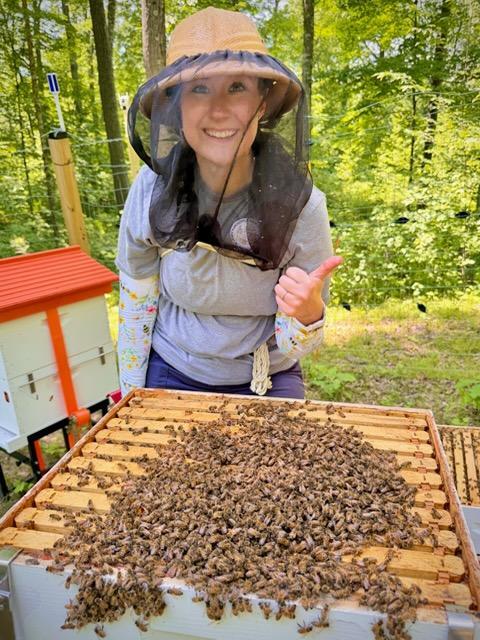
Brooke Nikkila-Sommerfeldt giving a "thumbs-up" to a honey bee colony.
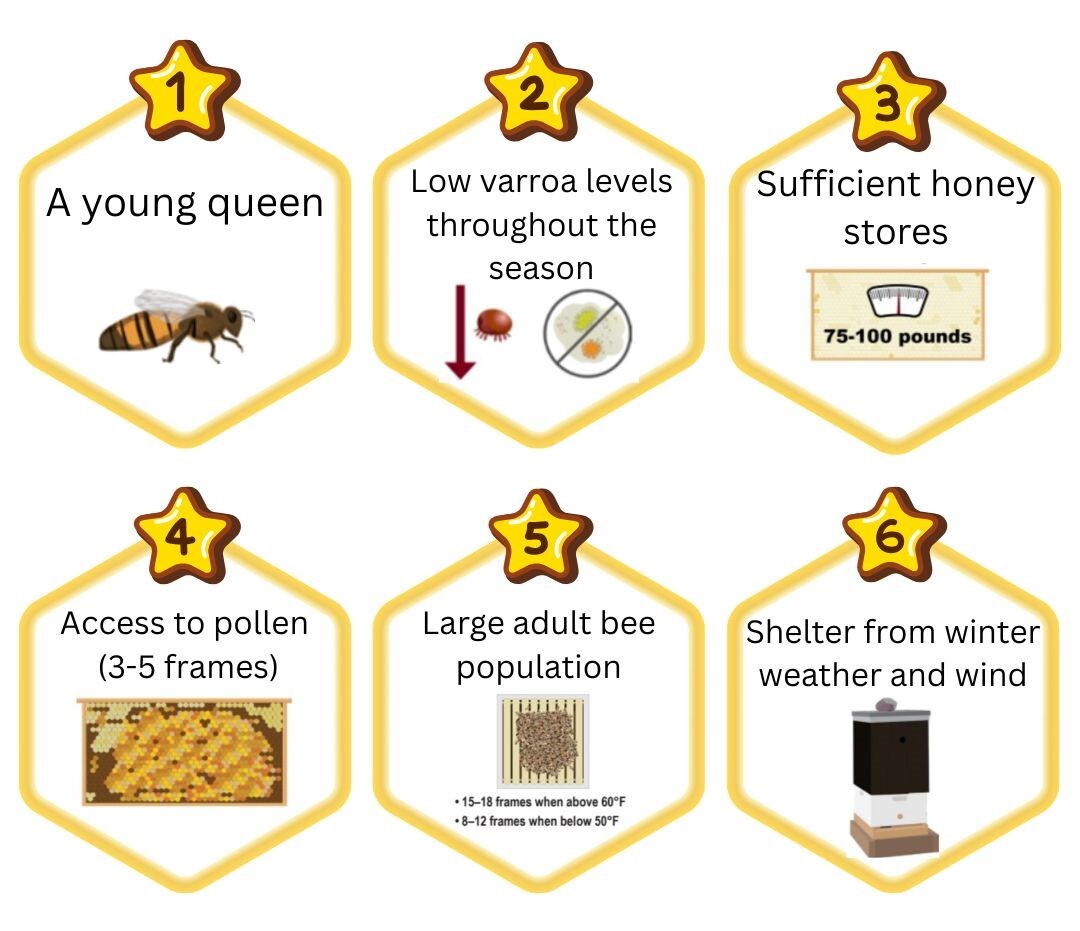
As the temperatures cool, days shorten, and summer forage fades, a honey bee colony's priorities shift from growing and gathering to conserving resources and preparing for the long winter ahead. So, what exactly are Wisconsin honey bees up to this time of year? They're preparing for winter - not hibernating!
1. The queen is slowing down brood rearing. Declining daylight, cooler temperatures, and a lack of incoming food resources all lead to a natural slow-down and eventual end to the season's brood production. Some lines of bees, such as Carniolans and Russians, tend to stop laying as soon as foraging declines while Italians may continue raising brood long into October.
2. They're raising winter bees. Winter bees are physiologically different than the summer bees and have larger fat bodies and higher levels of vitellogenin (a protein that regulates nutrition, lifespan, and behavior). This allows them to live six or more months while enduring the freezing weather.
3. The drones are getting kicked out. As the colony nears closer to winter, the worker bees evict any remaining drones because they no longer provide any reproductive benefit to the colony and consume valuable resources.
4. They are battling Varroa and thieves. Varroa weaken bees and damage the developing winter bee population, affecting their ability to survive until spring. As a colony weakens and population declines, the hive becomes suspectable to robbing. Once robbing starts, it's hard to get it to stop. If you notice bees fighting in front of the hive, take action immediately by adding a robbing screen or damp sheet completely over the colony and its entrances until the sheet dries.
5. Worker bees are preparing to cluster. As temperatures continue to fall, the bees will increasingly gather together in a cluster, with the queen in the middle and the worker bees around her vibrating their flight muscles to generate heat. The cluster tightens with colder temperatures and loosens when temperatures climb, but don't rely on them to leave this cluster to find supplemental feed or perform colony duties.
6. The colony is relying on stored food. With few to no forage available, colonies depend on food stores collected throughout the season. Bees continue to forage when weather and floral resources allow, but the colony is in transition from active food collection to conserving their remaining resources.
October means coming up for air after a busy inspection season. The bees may be settling into their winter routine, but the Wisconsin Apiary Program is still buzzing! October looks a little different for each member of our team as we wrap up the bee season, shift into other program work, and start planning for next year.
A photo of DATCP's three apiary inspectors: Patrick on the left, Brooke in the middle, and Zac on the right.
State Apiarist and Apiary Program Coordinator
Brooke is focused on finalizing field inspections and sampling, reviewing the season's inspection findings, answering beekeeper questions, and tackling all those projects that are difficult to squeeze in during the height of summer. Looking ahead to next season, she also plans routes, updates resources, works on outreach and education pieces, and figures out what can be improved for next season. This fall, Brooke will be planning out travel details for an interactive Yellow-Legged Hornet training in Savannah, Georgia.
Western Apiary Inspector and Communications Specialist
Patrick is wrapping up apiary work while also preparing to put on his other hat as a Communications Specialist LTE. October is a time for finishing apiary inspections, sampling, and helping keep communication and outreach efforts moving. As the apiary seasons winds down, the focus shifts toward preparing outreach and education materials, updating and prepping for presentations, and supporting other program needs.
Eastern Apiary Inspector
Zac has traded his bee veil for a different kind of fieldwork! While apiary inspections wind down, the fall brings potato field and Christmas tree inspections. Different crops, different equipment, and definitely different scenery, but still plenty of time spent in the field.
So, while we impatiently wait for bees again next spring, there's plenty to keep us busy. We will also look forward to seeing many of you at the Wisconsin Honey Producers Association meeting in November!
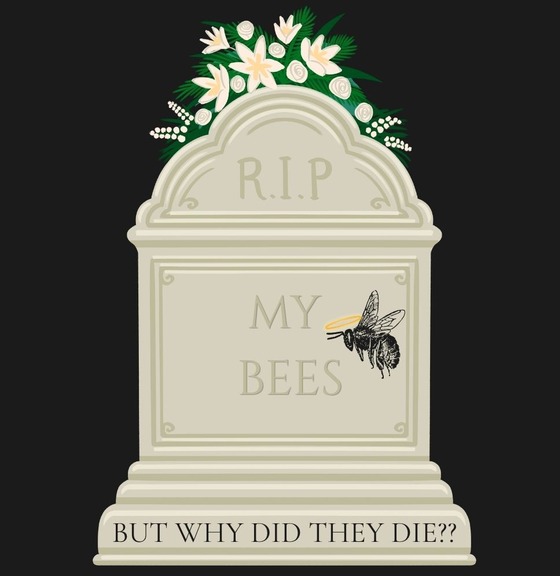
A gravestone graphic saying "RIP my bees. But why did they die??"
Finding a dead hive in late fall or spring is one of the saddest parts of beekeeping. After investing a season's worth of time, labor, and love into a colony, discovering an empty hive and dead bees can be discouraging. However, a dead colony can also provide something valuable: information about your unique apiary conditions.
Every hive tells a story. By taking the time to examine the colony and review inspection records/notes from the previous season, we can often learn what happened and identify changes that may improve colony health and management in the future.
Start with the Inspection Notes
Good records turn a dead hive from a mystery into a case study. Notes made throughout the season can provide clues that may not be obvious when looking at the dead bees or empty equipment.
Review population strength during the season. Or, if there was a queen event (swarm, supercedure, or emergency cells), review brood pattern, signs of disease, treatments applied, and lack of food stores or supplemental feed added. Also review weather and forage conditions. A colony may enter winter with a strong population but experience challenges with poor nectar and pollen availability, prolonged wet weather, or drought.
If forage is not adequate enough for the apiary, conditions with moisture don't improve, robbing is occurring, or reinfestation with mites happens after we've managed them all season, it may be an indication that we need to move our apiary somewhere else.
What was the Mite Management Plan?
One of the first questions to ask: what were the mite levels and what treatments were used to manage those levels?
Varroa monitoring records should tell us when we preformed mite tests, what those mite counts were, what miticide we used, and when we used it. Focus on what mite levels were at the end of summer going into fall. A colony can appear strong while battling a significant mite and virus infestation.
Assess whether mite monitoring was done regularly enough to detect infestation level changes and whether treatments were applied at an appropriate time, temperature, and according to the product label.
If colony records show increasing mite levels late in the season, or if monitoring was inconsistent, this may indicate that we need to adjust our mite management plan, including when or how we monitor mites, the use of chemical and non-chemical controls, and timing of mite treatments.
How Did the Queen Perform?
Observations of brood production throughout the season can tell a lot. Was the brood pattern consistently rated 3 or above? Did the colony maintain a proper colony population as the season progressed? Was there a queen event due to swarming, supercedure, or emergency replacement?
A colony that struggled to build-up population, had a poor brood pattern, or repeatedly required queen replacement may point to a queen-related problem.
When examining a deadout, look for evidence that might support those observations. The age, condition, and type of brood (worker vs. drone) remaining in the hive may be clues to late season queen failure or disease.
It is important, however, not to assume that every weak colony had a poor queen. Queen performance can be affected by nutrition, disease, mites, weather, and other stressors.
Look for Signs of Disease
Disease observations in your apiary are diagnostic clues and decision-making tools for next season.
Were there signs of abnormal-looking brood, such as discolored or sunken brood, unusual odor, uncapped pupae, or signs of mite frass (poop)?
Examining equipment and records from a deadout allow us to make management decisions about what hive equipment to reuse the next year. Avoid moving potentially contaminated material into healthy colonies until the cause of death is better understood. If you suspect a serious brood disease, follow appropriate diagnostic and reporting guidance before reusing equipment and introducing new bees.
Consistent disease monitoring helps you anticipate needs such as adjusting feeding, strengthening weak colonies, or preventing outbreaks, which supports stronger brood, better queen performance, and higher honey yields.
Honey Production
A colony that produced surplus honey likely demonstrated a good population, strong foraging activity, and access to adequate forage for at least part of the season. Poor honey production may have been associated with a small population, a late swarm, queen problems, disease, mites and viruses, or limited access to forage.
Compare honey production among colonies in the same apiary and/or across apiaries. If one under or over performed the others, figure out what was different about that colony.
Honey production should not be viewed as the only measure of colony health, but it can be another piece of the puzzle.
Turn Losses into Lessons
A dead hive is never the outcome we want, but it doesn't have to be the end of the story. By carefully evaluating colony inspection notes and examining remaining clues in the deadout, we can learn about what caused the colony death.
Perhaps the lesson is the importance of more frequent mite monitoring, queen performance needing to be evaluated earlier, nutrition and forage being limited factors, or several stressors combined to weaken the colony. Every season gives us another opportunity to improve our management. The dead hives can be some of our best teachers if we take the time to pay attention to what they are telling us.
The goal isn't simply to simply figure out a colony loss but to learn from it and adjust management strategies the next season.
|