|
 Field Notes July 16, 2026
|
|
|
Sweltering temperatures prevailed this week as another summer heat wave gripped Wisconsin and much of the Midwest. Daytime highs soared to the upper 90s and peaked in intensity July 13-14, with scattered northern and eastern locations reporting temperatures of 99-101 degrees Fahrenheit. The muggy conditions were accompanied by dense smoke from wildfires in northern Minnesota and Canada that drifted south across the state and pushed Air Quality Index (AQI) values for particle pollution into unprecedented territory. Readings reached as high as 710 in Superior and 704 in Ashland on July 15, more than double the 300 AQI threshold indicating hazardous air quality. The combination of extreme heat and heavy smoke triggered widespread heat advisories and statewide air quality alerts while creating dangerous conditions for farmers and anyone working outdoors.
Survey activities for the week ending July 16 included scouting for mid-season field crop pests, monitoring western bean cutworm pheromone traps, and checking corn earworm Hartstack traps. In addition, the Plant Industry Bureau Lab began survey work to look for symptoms of soybean red crown rot, an emerging disease threat to Wisconsin soybeans.
__________________________________
|
|
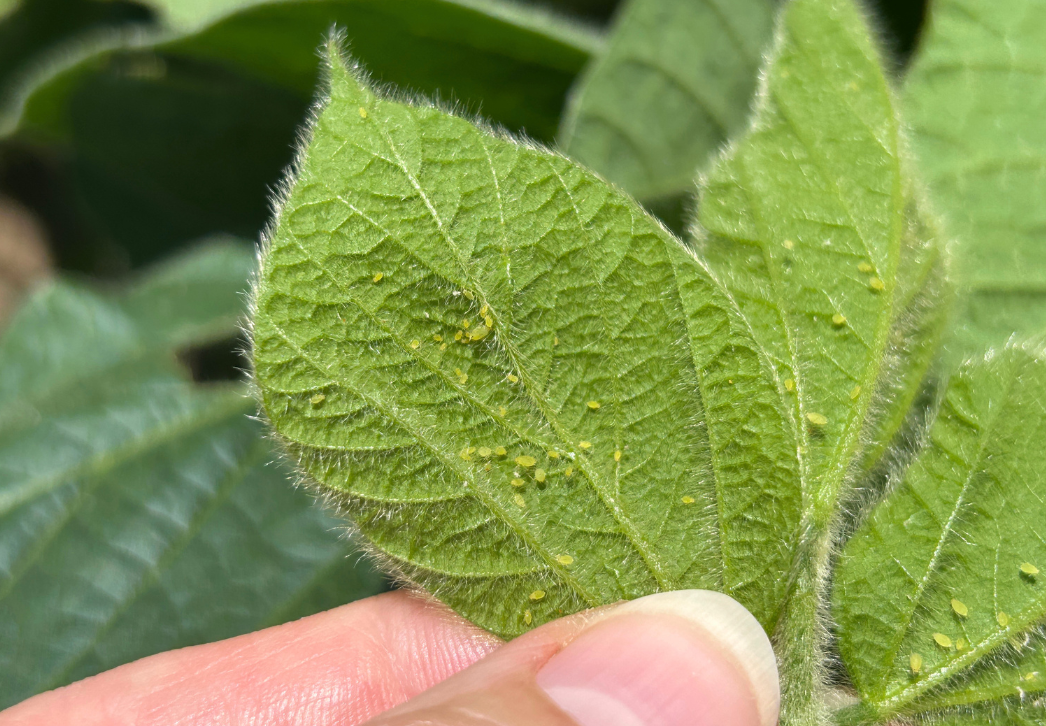
The annual soybean aphid survey now underway suggests populations are unusually low for mid-July. All 75 soybean fields (R2-R3) sampled July 7-15 had fieldwide average counts of less than five aphids per plant. One Grant County field had individual plants along the field edge that were infested with up to 150 aphids per trifoliate, which suggests that newly established aphid colonies are just beginning the annual buildup that coincides with the R2-R6 reproductive stages of soybean growth.
Soybean aphid populations are expected to begin multiplying quickly before the end of the month and into early August, and control may be warranted for some fields. Soybean producers and crop advisors are reminded that insecticide treatment is not economical until the threshold of 250 aphids per plant on 80% of the plants throughout the field has been exceeded. Treatment of this pest, if required, is most advantageous when applied during the R2-R4 (full bloom to full pod) stages.
In addition to aphids, Japanese beetles are also becoming more common in Wisconsin soybean fields. Recent surveys found beetles in 75% (56 of 75) of the sites sampled, although leaf feeding was minor and mostly below 10%. The economic threshold for Japanese beetle and other leaf feeding soybean pests is 20% defoliation between the bloom and pod fill growth stages. When estimating defoliation, it is important to examine the entire plant by selecting a trifoliate from the upper, middle and lower canopy of 10 plants, for a sample size of 30 trifoliate leaves. It is also critical to obtain a representative sample from several spots across the field since the heaviest feeding injury is most often concentrated along the edges. |
|
|
Western bean cutworm activity increased sharply this week with the capture of 1,072 moths in 69 pheromone traps. The cumulative state count to date is 1,486 moths, which is well above the 330 moths in 63 traps at the same time last year. The highest count for the monitoring period ending July 15 was 250 moths in the trap near Lake Mills in Jefferson County, while all other trap sites reported fewer than 70 moths.
Based on the degree day model for this insect, 25% of the annual moth population has emerged across southern Wisconsin. This event coincides with the accumulation of 2,577 degree days (modified base 38 degrees Fahrenheit) and will occur in the central and northern areas of the state in the week ahead. Scouting for western bean cutworm larvae and egg masses is most critical now through next week in corn fields at 90-95% tassel emergence.
Corn earworm migration flights were registered for the second week. DATCP’s network of pheromone traps captured 122 moths July 9-15, with catches recorded at 10 of the 15 sites. The high individual trap count of 34 moths was reported from Williams Bay in Walworth County. While numbers were not particularly high at most sites this week, the continuation of moth captures signals that scouting of silking sweet corn is in order. Protective treatment of sweet corn fields with green silks is recommended once Hartstack pheromone traps begin registering 10 moths per night for three consecutive nights. Corn Earworm Network participants are reminded to replace lures on a weekly basis.
Light infestations of Japanese beetles have been observed since early July in the perimeter rows in southern Wisconsin corn fields. The greatest threat to corn at this time of year is when large numbers of beetles converge and feed on the silks, potentially impairing pollination. It is especially important to scout for silk clipping during the first five days of silking. As is the case with soybeans, Japanese beetles show an edge effect in corn and obtaining a representative field-wide sample is required before making control decisions. A foliar insecticide is justified if all three of the following conditions are met:
- Three or more beetles are present per ear
- Silks have been clipped to less than ½ inch
- Pollination is less than 50% complete
Spot treatment may be sufficient if damage is confined to edge areas. As a reminder, scouting should continue until pollination is complete since Japanese beetles are highly mobile and can continue to reinfest fields even after an insecticide application.
|
|
 __________________________________
|
|
In 2025, red crown rot (RCR) of soybean, caused by the fungus Calonectria ilicicola, was confirmed for the first time in Wisconsin. In response to this first state detection (in a Columbia County field), DATCP is conducting a survey of soybean fields in Columbia, Dane, and Dodge counties for this disease.
While RCR has been present in peanut production in the southern United States for decades, more recently it has been moving through Midwest soybean production, with the first case reported in Illinois in 2018, followed by finds in Indiana, Kentucky, Michigan, Minnesota, Missouri, and Ohio.
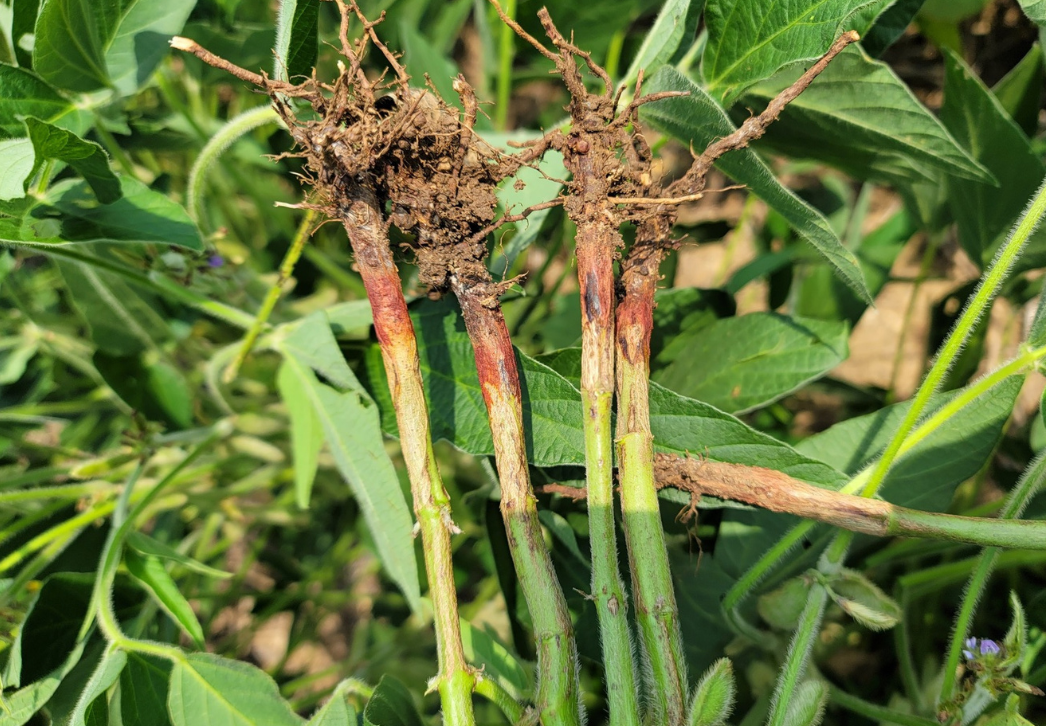
Plants with RCR generally show symptoms after the R3 stage, which include light green to yellow blotches on leaves, interveinal necrosis, premature leaf senescence, stunting, reddish discoloration on the lower stem with white hyphae and/or red sclerotia, a gray pith, root discoloration, and root rot. Red crown rot foliar symptoms may be confused with soybean sudden death syndrome, brown stem rot, or southern stem canker. Stem symptoms of RCR may be mistaken for charcoal rot, Rhizoctonia root rot, or Phytophthora stem rot.
The microsclerotia produced by the fungus can survive in the soil for multiple years, providing a long-term inoculum source to future host crops. In addition to soybeans, this pathogen may cause disease in over 113 different host species, including alfalfa, blueberry, clover, ginger, and peanut. |
|
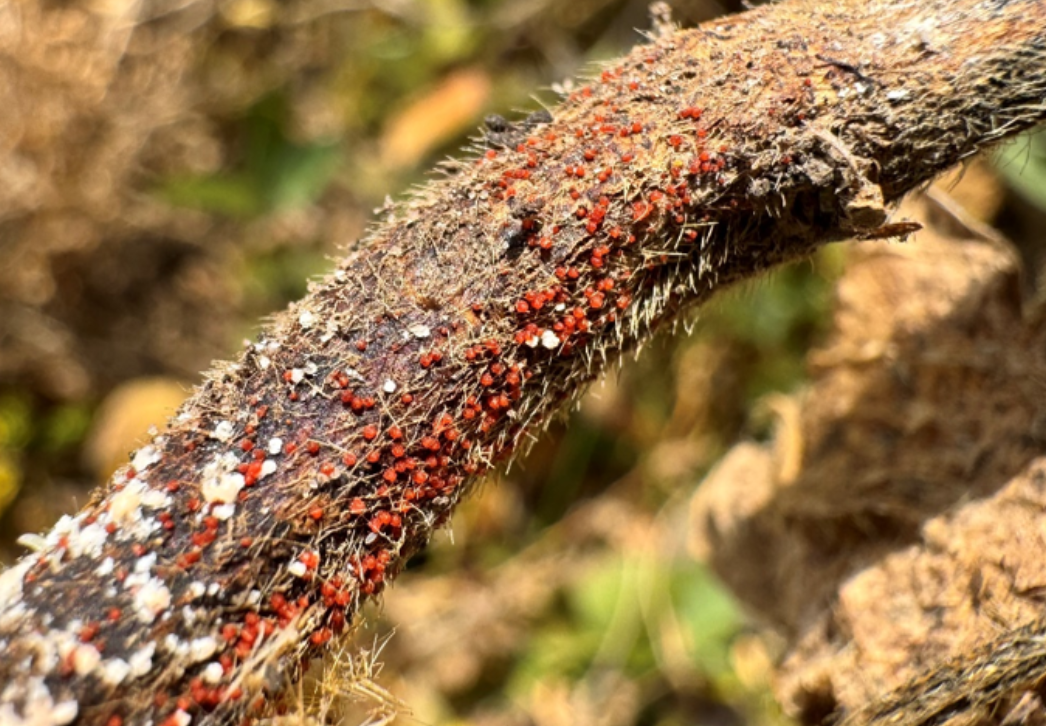 Red crown rot fungal stuctures | Dr. Damon Smith UW-Madison
|
|
Red crown rot spreads through contaminated soil, crop residue, water, and with farm equipment. Infection leads to reduced yields and farmers do not currently have RCR rescue or treatment options. Red crown rot is an emerging threat to Wisconsin soybeans that growers are encouraged to understand and prepare for by following DATCP and Badger Crop Network reporting. DATCP’s 2026 survey efforts aim to help understand and document the distribution of RCR in Wisconsin.
Soybean growers or advisors who suspect red crown rot should submit samples to the UW-Madison Plant Disease Diagnostic Clinic for accurate diagnosis. |
|
 __________________________________
|
|
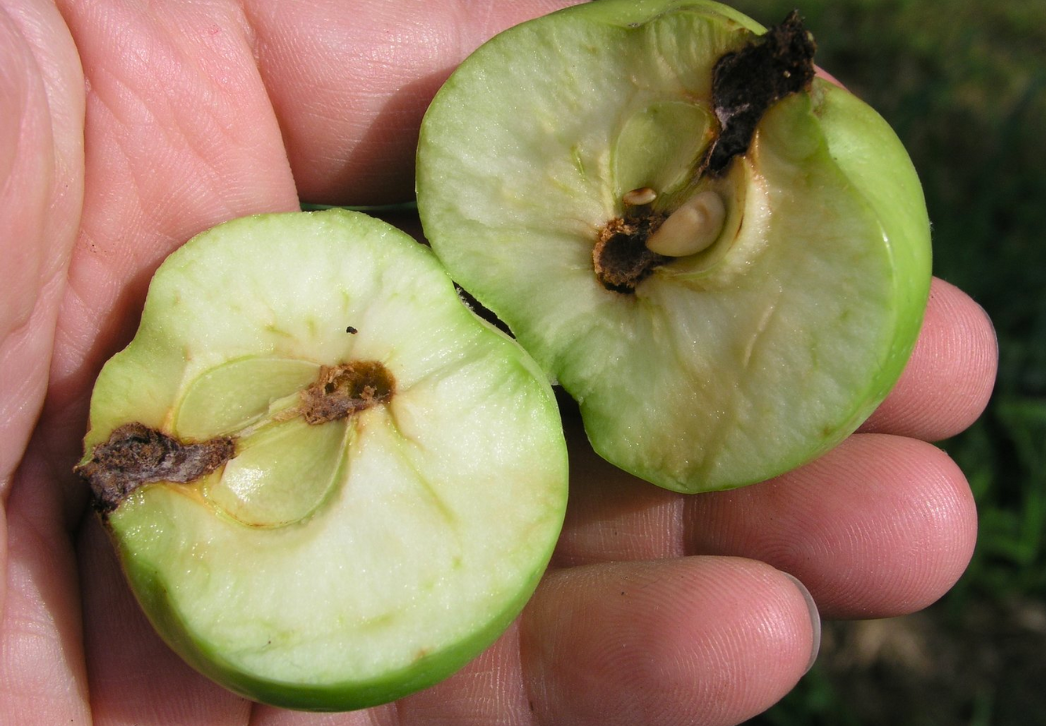
The spring codling moth flight extended longer than usual, into early July this season. Apple orchards with higher pressure may not see a distinct pause in trap activity between the first and second moth flights. The end of the first generation occurs when 1,000 degree days (base 50 degrees Fahrenheit) are reached from the spring biofix. In most southern and central orchards, the moths now appearing in traps reflect the start of the summer flight. For this second codling moth flight of the season, growers should reset degree days to zero after establishing the second generation biofix.
Monitoring traps more frequently in the next two weeks will be important for determining a precise summer biofix and treatment window. The earliest treatment would be timed for 250 degree days from the biofix, and this window applies to non-mating disruption (non-MD) orchards seeing high counts of 10-20 moths per trap per week and MD orchards catching 2-3 moths per trap. In contrast, orchards recording low weekly moth counts as the second flight begins (i.e., less than five moths per trap for non-MD and 0-1 moth per trap for MD orchards) can delay treatment until 350-400 degree days from the summer biofix.
Codling moth counts this week ranged as high as 35 moths per trap, with four locations—Burlington, Malone, Merrimac, and Rochester—reporting above-threshold counts. Cooperators are reminded that pheromone lures lose efficacy more quickly in the heat of summer and should be replaced after three weeks. The longer-lasting CM L2 lures rated for eight to 12 weeks should be replaced after eight weeks. |
|
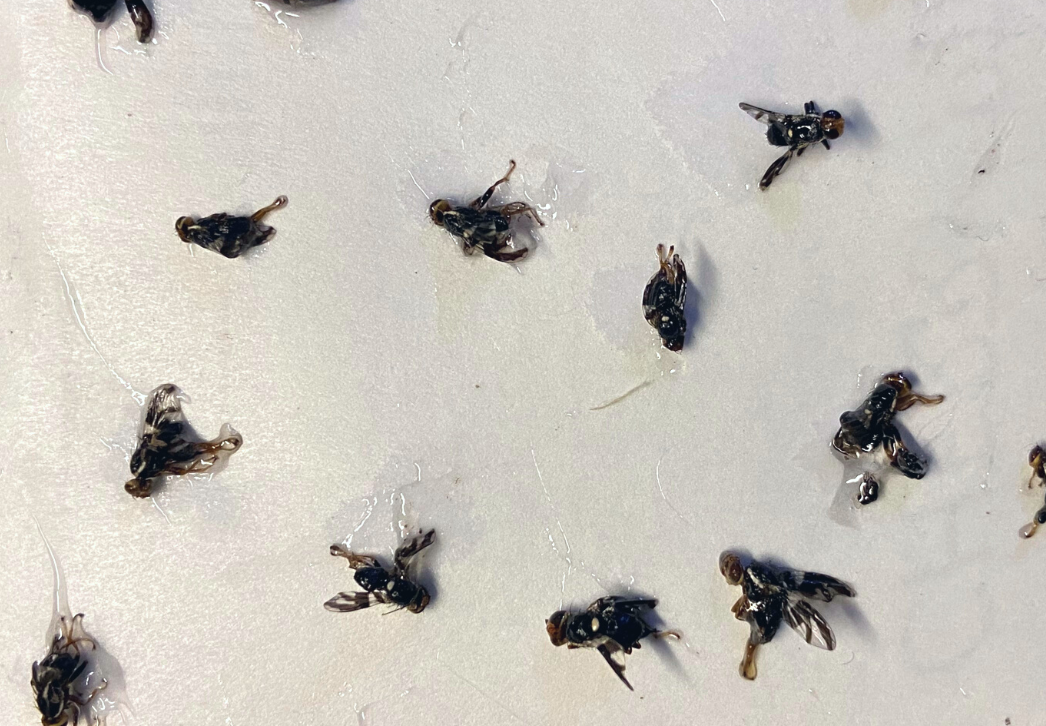 Apple maggot flies | The Little Farmer Orchard
|
|
|
Apple maggot fly emergence increased this week at several orchard monitoring sites. Economic counts were recorded at 10 of 18 cooperating locations and a very high catch of 24 flies on an unbaited red sphere trap was reported from Richland County. Emergence has been variable so far, which is typical of this pest, but is expected to pick up throughout the month and into August. Apple growers should continue to apply sticky coating to traps each week (or as needed) and maintain apple maggot controls as long as counts exceed the following economic thresholds:
- One fly per trap per week for unbaited traps
- Five flies per trap per week for baited traps
|
|
 __________________________________
|
|
|
|
|