|
 What's Growing On? newsletter header, July 2026
Dear Wisconsin nurseries, Christmas tree growers, and gardeners:
Growing degree days (GDD) (simple B50) as of July 13 were 871 in Bayfield; 1039 in Cumberland; 1006 in Medford; 1194 in Hancock; 1202 in Green Bay; 1277 in Racine; 1401 in Madison; 1415 in La Crosse; and 1632 in Dubuque, IA.
A few pests in vulnerable-to-treatment stages include woolly apple aphid at 800-900 GDDs, black vine weevil, European pine shoot moth, oak spider mite and boxwood psyllid at 900-1000 GDDs; two-spotted spider mite at 900-1100; and cottony maple scale, European elm scale, fletcher scale, lecanium scale and Japanese beetle at 900-1200 GDDs. Other pests soon to be in vulnerable stages include flat-headed and round-headed apple tree borer, oystershell scale (brown), and pine needle scale at 1600-1700, and locust borer and fall webworm at 1800-2100 GDDs.
Take a moment to read through a few updates from the DATCP Nursery Program and send any feedback, questions, or ideas for future e-news updates to datcpnursery@wisconsin.gov.
Having trouble viewing this email? View it as a Web page.
_____________________________________
|
|
|
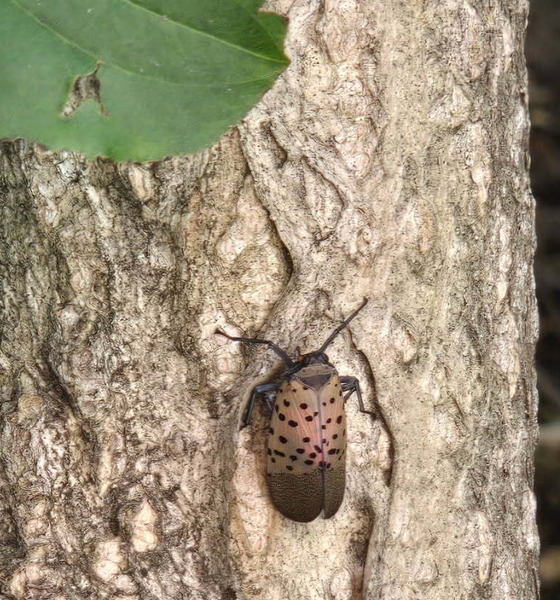
Spotted Lanternfly adult observed in Chicago, IL | DATCP M. Lannan
Spotted lanternfly (SLF) is a non-native species in North America that continues to spread closer to Wisconsin every year. The first infestation was reported in Pennsylvania in 2014, which is thought to have been transported on a stone shipment from overseas in 2012. Since then, this nuisance plant pest has spread to several other eastern and midwestern states, with recent infestations as close as the Chicago area.
Preventing the introduction of this insect into the state requires monitoring its favorite host plants in high-risk areas. This sap-sucking insect prefers the non-native tree-of-heaven, though it will also feed on grapevine, walnut, maple, and other plants. Locations are deemed high-risk based on their proximity to out-of-state traffic and shipments. Some examples of these locations include garden centers, travel plazas, malls, college campuses, ports, and campgrounds.
DATCP staff conduct visual surveys for SLF in high-risk areas every summer. However, these are snapshots in time, and locations are usually just surveyed once a year. That is why the first sightings of a non-native species are often made by long-term residents of a given area. If you visit any high-risk areas in Wisconsin this summer, you can help by looking for adult SLF, too! If you find anything you suspect may be SLF, take a photo and report your suspected find to: Report a Sighting of Spotted Lanternfly in Wisconsin.
Even if you are not sure if your find is actually SLF, a photo and your report will allow DATCP experts to make a determination. In the meantime, if you know you are going to be visiting a high-risk area, you can learn more about how to identify this pest ahead of time at slf.wi.gov.
_____________________________________
|
|

On June 30, 2026, the Wisconsin Department of Natural Resources (DNR) announced the opening of the public comment period for the draft rule language associated with proposed revisions to ch. NR 40, Wisconsin’s Invasive Species Rule. The department will also be holding a virtual public hearing on the proposed rule on Wednesday, August 5 at 5 p.m.
Visit the DNR's website to access the draft rule, an updated economic impact analysis, and supplemental Rule Revision Guide. Details on the hearing and how to submit comments can be found in the hearing notice.
The DNR will be accepting public comments through August 7, 2026.
Image: Wisconsin Department of Natural Resources logo
|
_____________________________________
|
|
|
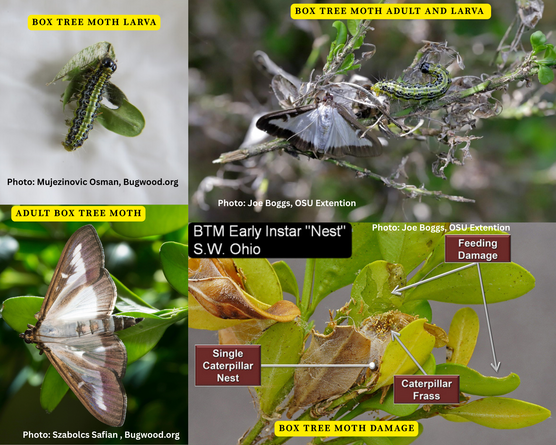
Box tree moth life stages
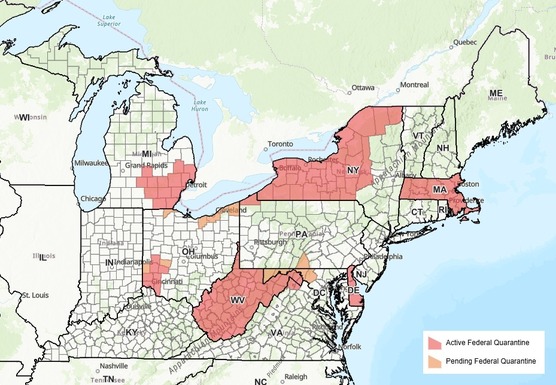
Box Tree Moth (BTM), or Cydalima perspectalis, is a federally regulated invasive insect pest that feeds on ornamental boxwood (Buxus spp.), rapidly weakening hedges, topiary, and landscape plantings through defoliation. Native to China, Japan, and Korea, it reached North America in 2018 in Ontario, Canada, and has since been confirmed in New York (2021), Michigan (2022), Massachusetts (2023), Ohio (2023), Delaware (2024), Pennsylvania (2024), Maryland (2025), Virginia (2025), and West Virginia (2025), along with the most recent detection in New Jersey (2026). The USDA BTM quarantine map below does not include New Jersey yet, but it does include a number of additional counties in orange that will soon be added to the federal quarantine. Wisconsin has not yet detected BTM, but continued vigilance is important because nearby infestations and interstate movement of boxwood increase the risk of introduction.
USDA BTM quarantine map
BTM females can lay more than 30 eggs in a single clutch. When the caterpillars hatch, they quickly begin eating leaves and can, in large numbers, consume all the leaves of a boxwood plant. Once they consume all the boxwood foliage, BTM caterpillars then move to consume the outer bark of the boxwood stems, which can girdle and kill even mature boxwood plants. The life cycle can include one to five generations per year depending on conditions. Based on its behavior in other locations, BTM is likely to have two to three generations in Wisconsin. BTM overwinters as larvae, emerging to resume feeding in spring. BTM spreads quickly because of its high reproductive rate, the lack of natural predators in its introduced range, human-assisted movement of infested boxwood, and strong adult flight, which is estimated to be about 3-6 miles per year. Refer to the SAFARIS BTM predictive phenology model to see current BTM development.
Suspected Wisconsin sightings should be reported immediately to the Pest Hotline at (866) 440-7523 or datcppesthotline@wisconsin.gov. Be sure to include clear, close-up photos of the pest, webbing, and other signs along with the exact location of the siting. Wisconsin nursery growers and dealers should also contact their local nursery inspector.
_____________________________________
|
|
|
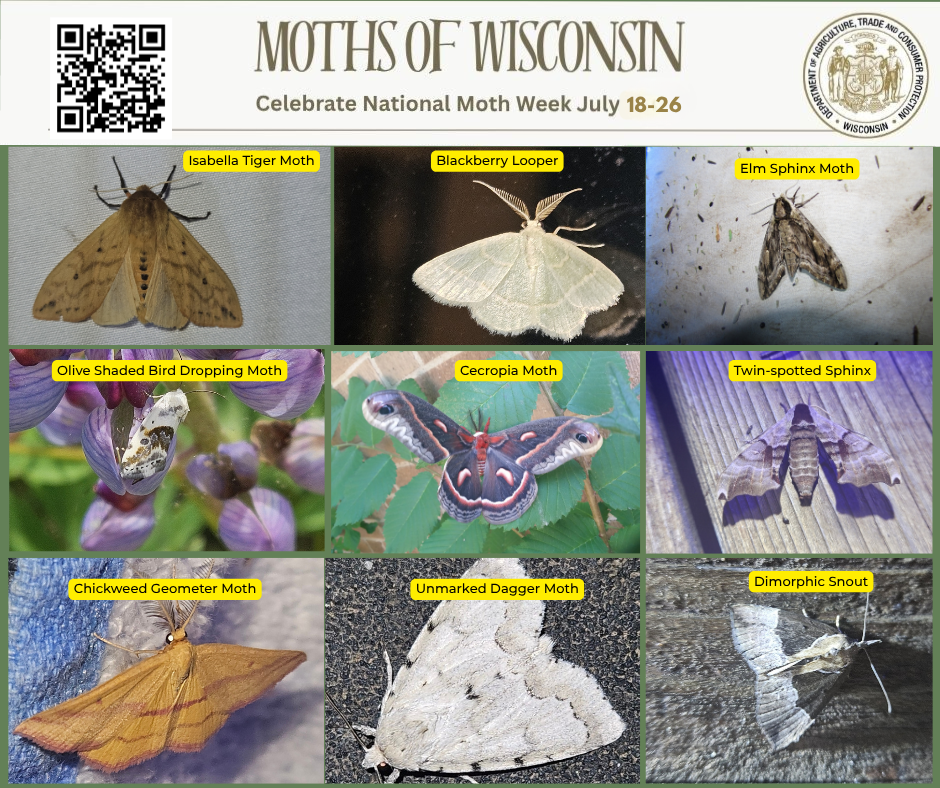
Twelve moths commonly found in Wisconsin - the Isabella Tiger Moth, Blackberry Looper, Elm Sphinx Moth, Olive Shaded Bird Dropping Moth, Cecropia Moth, Twin-spotted Sphinx, Chickweed Geometer Moth, Unmarked Dagger Moth, and Dimorphic Snout| DATCP S. Werner
National Moth Week July 18-26 is an annual, global event that invites people of all ages and backgrounds to participate in the “mothing” hobby. Moths, which along with butterflies and skippers, are in the insect Order Lepidoptera, named for the colorful scales that make up the patterns on their wings. The hobby of mothing is the practice of attracting, observing, photographing, identifying, and documenting moths for enjoyment or scientific study, including participation in citizen science projects to help document moth populations. Most moths are nocturnal or active at night, and many are attracted to light. When taking photos, it is best to cast bright lights or black lights onto bedsheets hung over flat surfaces to achieve a clear, identifiable photo, often using your flash. Photos can be uploaded to apps like iNaturalist. You can also learn more about moth anatomy and identification on the Moths of Wisconsin website created by Marquette University and the Milwaukee Field Museum.
This year, people in Wisconsin can celebrate moth week by attending local events such as the Insect Fest at Olbrich Botanical Gardens July 24 from 3 p.m.–midnight. In addition to welcoming guests to participate in a Bioblitz that includes backlighting for moths in the garden late into the night, this year’s event also features UW-Madison emeritus professor Dan Young talking about fireflies, a walk to see a rare damselfly in the gardens, UW Extension Entomologist and Insect Diagnostic Lab Director PJ Liesch providing highlights of insect reports from the past decade, insect cuisine, a pollinator talk, a caterpillar documentary, and more. Some of the events do require advanced RSVP, so check out the details and sign up for this free community event at https://www.olbrich.org/calendar/wi-insect-fest.
While a small number of species such as the introduced invasive spongy moth can be plant pests, moths are crucial to ecosystems worldwide, serving as pollinators, food sources, and environmental indicators. Moths feed using their proboscis, a long tube-like tongue that is ideal for sipping nectar, while their body picks up pollen, allowing them to easily pollinate flowering plants. Moths are an important food source for many animals such as birds, bats, frogs, mice, bears, and skunks. Moth health and populations can be important indicators of plant diversity, air quality, farming practices, pesticide use, and climate change on the Earth.
The United States has more than 11,000 moth species, and it is estimated that there are 150,000–500,000 species worldwide. Wisconsin has over 1,600 species of moths. Celebrate “Moth Week” by sharing photos on social nationalmothweek.org.
_____________________________________
|
|
|
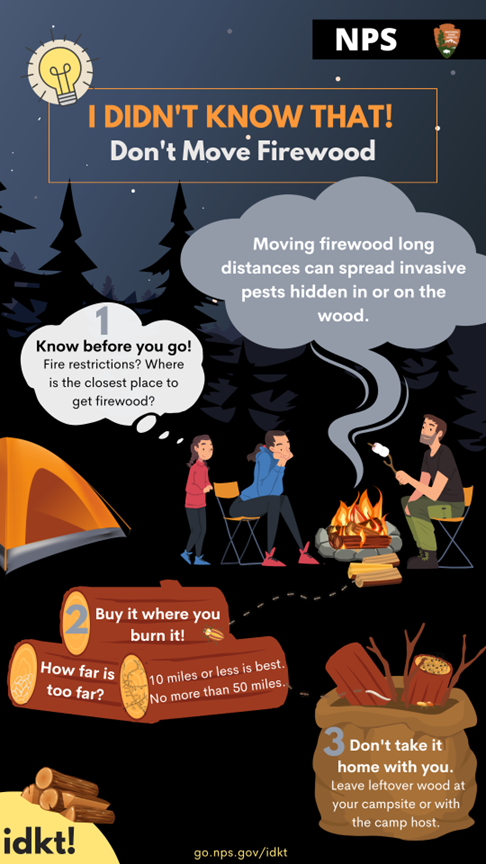
An illustrated graphic depicting things to know about moving firewod and preventing the spread of insasive pests | NPS.gov image
Going camping this summer? Before heading out, do nature a favor: don’t move uncertified firewood long distances. Your firewood choice matters, and uncertified firewood can harbor destructive tree-killers. Just one firewood log can easily hide harmful insects and diseases such as emerald ash borer (EAB), Asian longhorned beetle (ALB), mountain pine beetle (MPB), balsam woolly adelgid (BWA), spongy moth, beech bark disease, or oak wilt. When introduced to new areas, these organisms can cause significant damage to our forests that have little to no defenses against novel invasive pests and disease threats. Do the right thing for forest health and help protect Wisconsin’s invaluable natural resources.
Tips on how to prevent the spread of invasive species in or on firewood:
- Leave uncertified firewood at home.
- Gather firewood on-site when permitted.
- Buy local or certified firewood.
- When you can, burn all firewood before leaving your campsite.
- Don’t take uncertified firewood home with you.
Remember to check the firewood rules for your destination. When in doubt, buy it where you burn it!
Resources for planning your trip:
Contact DATCP’s Forest Pest Regulatory Coordinator, Meg Sanders, with your firewood questions. Call or text (715) 891-8158 or email MeganT.Sanders@wisconsin.gov.
_____________________________________
|
|
|
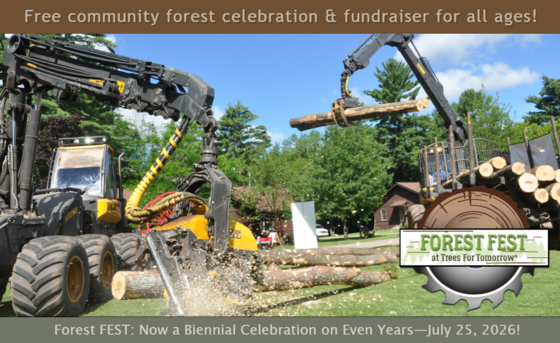
A promotional image for Forest Fest featuring logging machinery and equipment
Explore, learn, and celebrate Wisconsin's forests at Trees for Tomorrow's Forest Fest in Eagle River, WI! Spend the day exploring interactive activities, meeting industry experts, watching equipment demos, and discovering the many ways forests support our communities. From kids' adventure stations to educational programs, there's something for every age and interest.
Visit the DATCP Plant Industry Bureau booth to learn about invasive forest pests and diseases, how to identify them, and what to do if you find them.
_____________________________________
|
|
|
Viburnum leaf beetle adult on assorted viburnums in southern and southeastern Wisconsin | DATCP L. Meils
|
|
Japanese beetle adult on assorted stock throughout Wisconsin | DATCP B. Sanneh
|
|
|
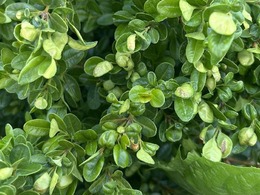
Leaf cupping caused from boxwood psyllid feeding in Ozaukee Co. | DATCP G. Meysembourg
|
|
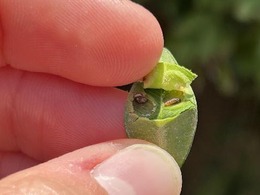
Boxwood leafminer larva in Ozukee Co. | DATCP G. Meysembourg
|
|
|
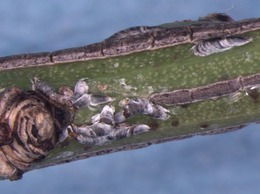
Fire bush scale on burning bush in Kenosha Co. | DATCP M. Lannan
|
|
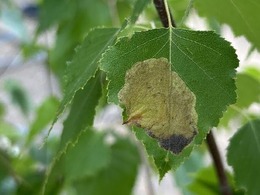
Blotch mines from birch leafminer on birch in Oneida Co. | DATCP M. Sanders
|
|
|
_____________________________________
|
|
|
For more information about Wisconsin's Nursery and Christmas Tree Programs, visit DATCP's Nursery and Christmas Tree Program webpage.
Read past issues of What's Growing On?
If you haven't yet, please take this brief feedback survey for our monthly What's Growing On? e-newsletter. With this survey, we aim to measure your satisfaction regarding the format, frequency, and quality of the content provided. Please give us your most transparent feedback. The survey is anonymous.
For current counts during the growing season from our insect monitoring networks around the state, visit our Pest Survey webpage. To read articles on economically important plant pests affecting Wisconsin's field crops, fruits, and vegetables, read our Field Notes publication put out weekly during the growing season.
|
|
|
|
|