|
 Field Notes June 18, 2026
|
|
|
Cooler-than-normal conditions dominated the state as intermittent rain brought varying moisture. At the start of the week, highs generally ranged from the upper 50s in northern and eastern Wisconsin to the upper 60s and low 70s in the western and southern regions, roughly 5-10 degrees below the typical mid-June historical averages. Weekly rainfall tallied 0.25-3.0 inches, with pockets of heavy precipitation (2.0 inches or more) noted in the southern counties along the Illinois border. The moisture was timely for vegetative row crops and reduced emerging areas of moderate (D1) drought coverage, but periods of rain disrupted fieldwork and survey plans for DATCP field staff.
At the June halfway marker, strong early-season crop development continues across Wisconsin. Corn and soybean emergence have reached 93% and 91% respectively, pacing ahead of last year and the five-year averages. The USDA NASS reports that 80% of the state’s corn crop and 79% of soybeans are currently in “good-to-excellent” condition, better than the 71% and 72% ratings from the same period in 2025 and well above the 68% mid-June national average for both crops.
__________________________________
|
|
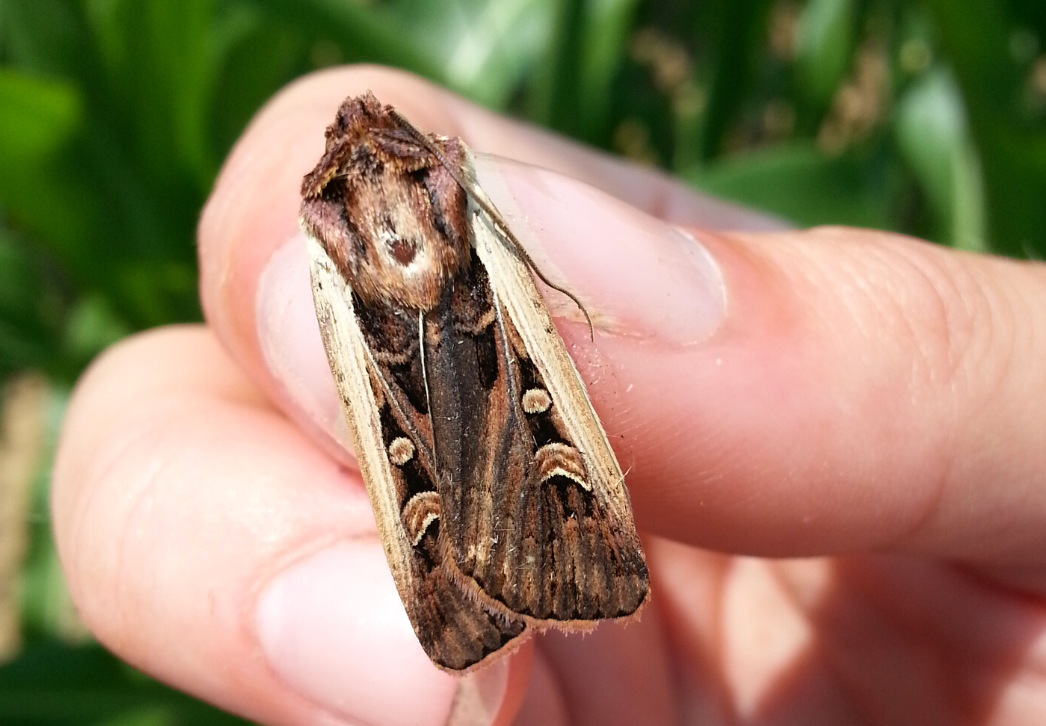
Cooperators participating in the 2026 Western Bean Cutworm (WBC) Trap Network began setting traps last week in advance of the start of the annual moth flight. Currently, 55 of the expected 80 traps are up and running from Clinton north to Chetek. The season’s first WBC moths were captured June 11-17 at sites in Columbia, Fond du Lac, Grant, Oconto, Rock, Sauk, and Walworth counties. Counts so far have been very low, at one to eight moths per trap in 13 of the 55 traps.
In combination with the trap network data, DATCP uses a WBC degree-day model to forecast the timing of moth flights and the onset of eggs and larvae in the field. The key degree-day threshold for trappers to anticipate is 25% moth emergence, which is when scouting for eggs and small larvae should begin in late-whorl and pre-tassel corn fields. The eggs are laid on the upper surface of the top three to four leaves, often on the flag leaf, and the larvae can be found in developing tassels. The window for 25% emergence is typically from mid-to late July in Wisconsin and is still several weeks away. Until then, weekly trap checks will keep cooperators apprised of the start of the flight in their areas of the state.
Moth counts will be available through mid-August on DATCP's Crop Pest Trap Networks page. In addition, WBC degree days are provided in the modified base 38°F column in our degree days table. Note that the lower threshold for WBC is 38 degrees and the upper threshold is 75 degrees Fahrenheit. |
|
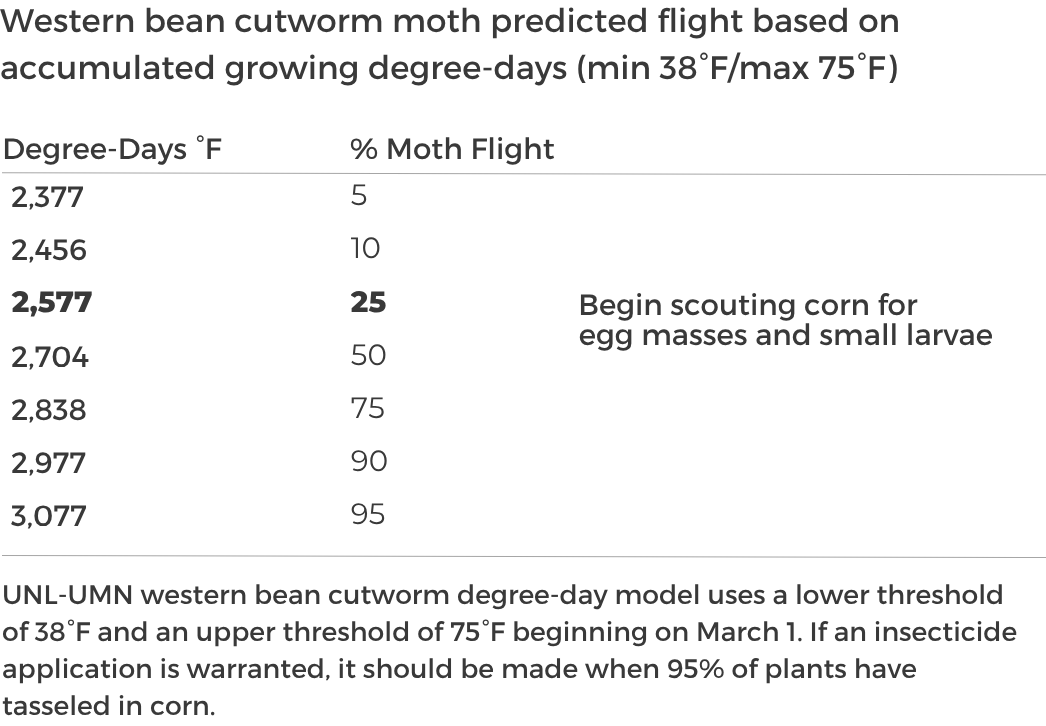 Table shows estimated percent of western bean cutworm moth flight and accumulated degree-days. The model predicts 25% flight when 2,577 degree days are reached.
|
|
 __________________________________
|
|
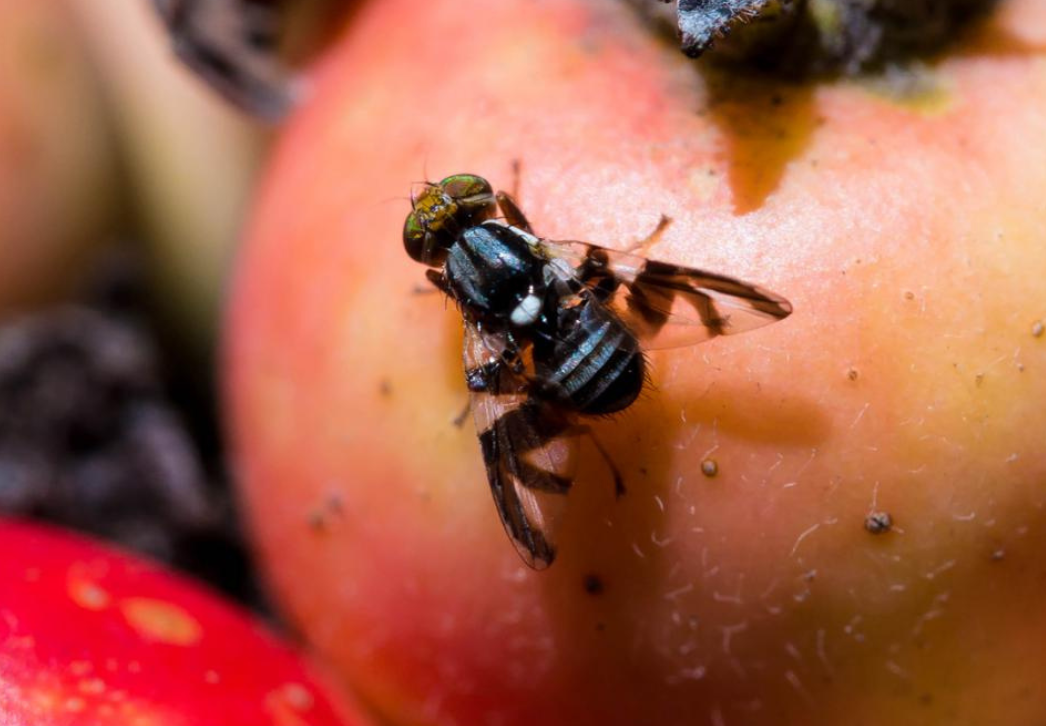
Frequent rain this month has helped correct soil moisture deficits after a historically dry May and has also improved emergence conditions for apple maggot flies, one of the top three insect pests in Wisconsin apple orchards. Degree-day accumulations as of June 17 have exceeded the 900-unit threshold required for fly emergence throughout much of the southern half of the state (using modified base 50 degrees Fahrenheit) and the earliest apple maggot fly captures on orchard traps are expected next week (June 18-24).
At this time, DATCP apple pest monitoring network cooperators should set out sticky red sphere traps in trees along the orchard perimeter, especially next to wooded edges, since the source of apple maggot flies is often nearby wild hosts. A perimeter trapping density of six to 12 unbaited red spheres per acre is suggested. The density can be reduced to one trap every 20 trees along the perimeter if the traps are baited with an enhancer. Orchards with a history of apple maggot problems should also place a few traps in orchard interior blocks with the earliest ripening apple varieties. The red visual traps mimic a ripe apple and attract mated female flies ready to lay eggs. |
|
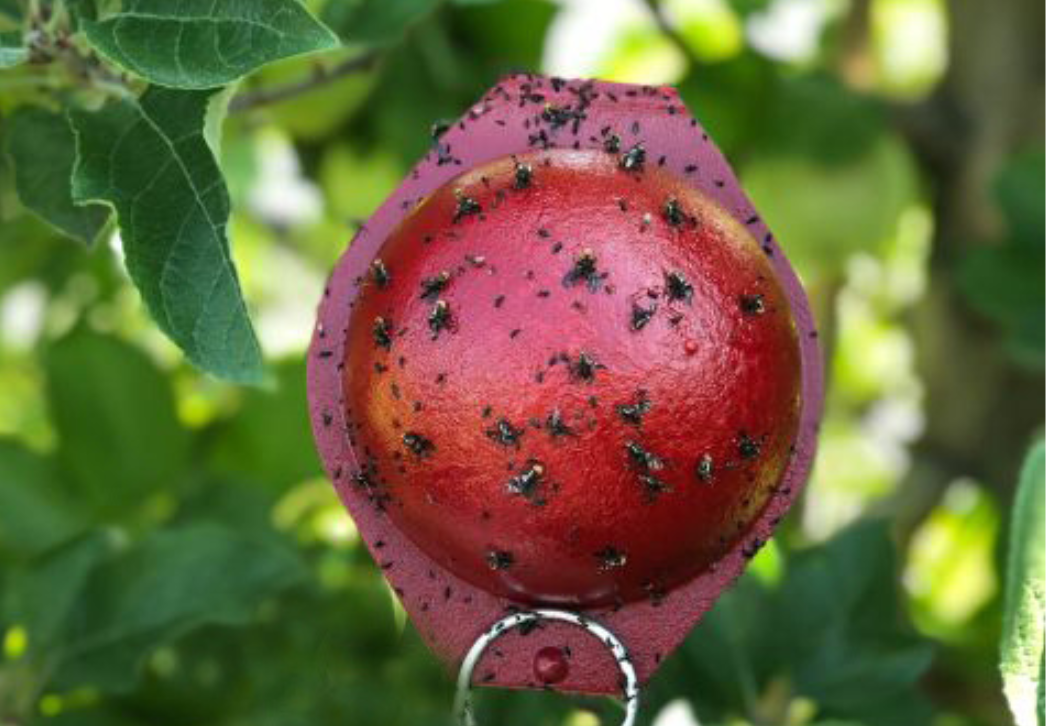 Apple maggot red sphere trap | Amy Irish-Brown MSU Extension
|
|
Weekly trap catches can directly inform management decisions. Orchards following a conventional apple maggot control program will begin applications immediately after the first fly appears on a red sphere, continuing as needed every 10-14 days as long as counts exceed one fly per unbaited trap per week or five flies per baited trap per week. Baits commonly used with apple maggot traps are ammonium acetate, ammonium carbonate (food odor), and butyl hexanoate (fruit odor). The traps supplied by DATCP do not include bait.
Home fruit growers can also use the red sphere traps to reduce apple maggot pressure in backyard apple trees or in very small orchards. UW-Extension recommends a trap density of one trap per small tree, two to four traps per medium-sized tree, and six to eight traps for a large apple tree for apple maggot control. Additional guidelines are to position the traps at eye-level in the tree canopy where they are not obstructed by foliage and to clean and reapply the sticky coating weekly. Disposable and reusable versions of the red traps are available online through Great Lakes IPM and Gemplers. |
|
 __________________________________
|
|
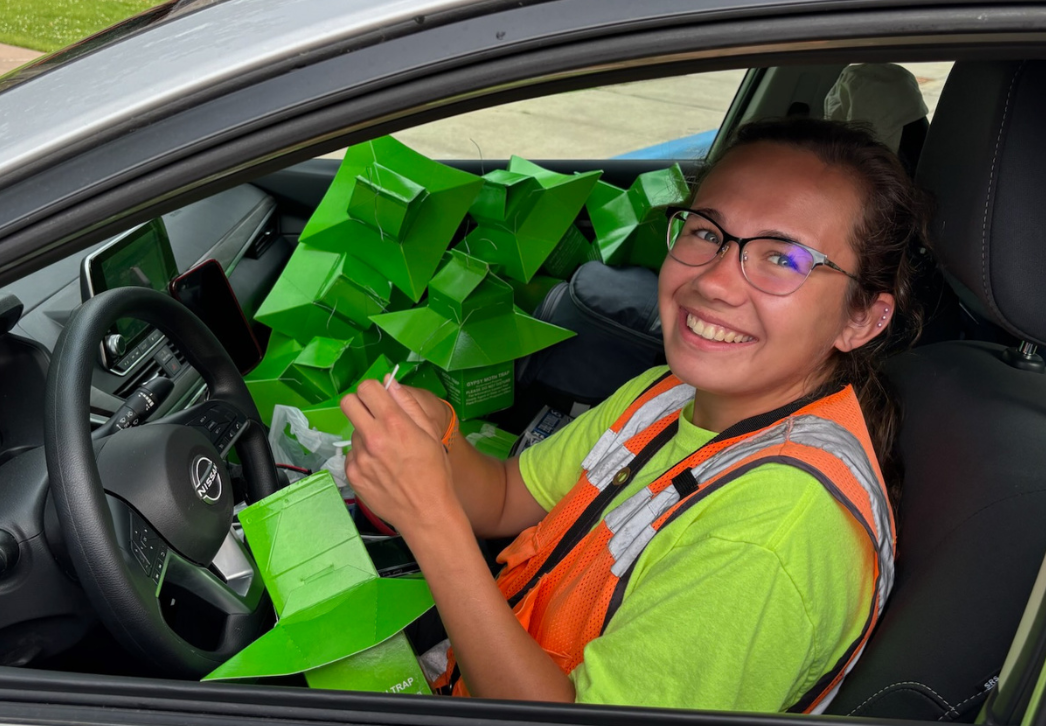
DATCP’s Spongy Moth program is setting approximately 6,700 pheromone traps in 2026. The familiar green triangular traps are being placed in 36 counties in western and central Wisconsin. Most traps have been set along public roadside rights-of-way, but some may need to be set on private property when there is evidence of a new spongy moth population nearby. DATCP requests that all traps remain undisturbed once they are in place.
“Traps are used both to monitor known spongy moth populations and to identify new populations in previously uninfested areas,” says Amanda Miller, DATCP Spongy Moth Trapping Coordinator. “Even though spongy moth populations drastically decreased across the state again last season, there are still new outlier populations developing in western Wisconsin. Data collected from traps this season will be crucial in the program’s effort to pinpoint these new populations and limit their spread before infestations become large enough to cause damage to trees.”
Program staff have so far set 3,184 traps and expect to complete trap set-up by early July. Once all traps are deployed, a round of spot-checking is conducted in mid-summer, and removal occurs by the end of September. Each trap is labeled with a phone number and QR code that property owners can use if they have questions or would like to report a damaged trap.
For more information on spongy moth trapping, visit the DATCP Spongy Moth Traps and Egg Mass Surveys webpage (click button below), call the hotline at (800) 642-6684 or email spongymoth@wisconsin.gov. |
|
 __________________________________
|
|
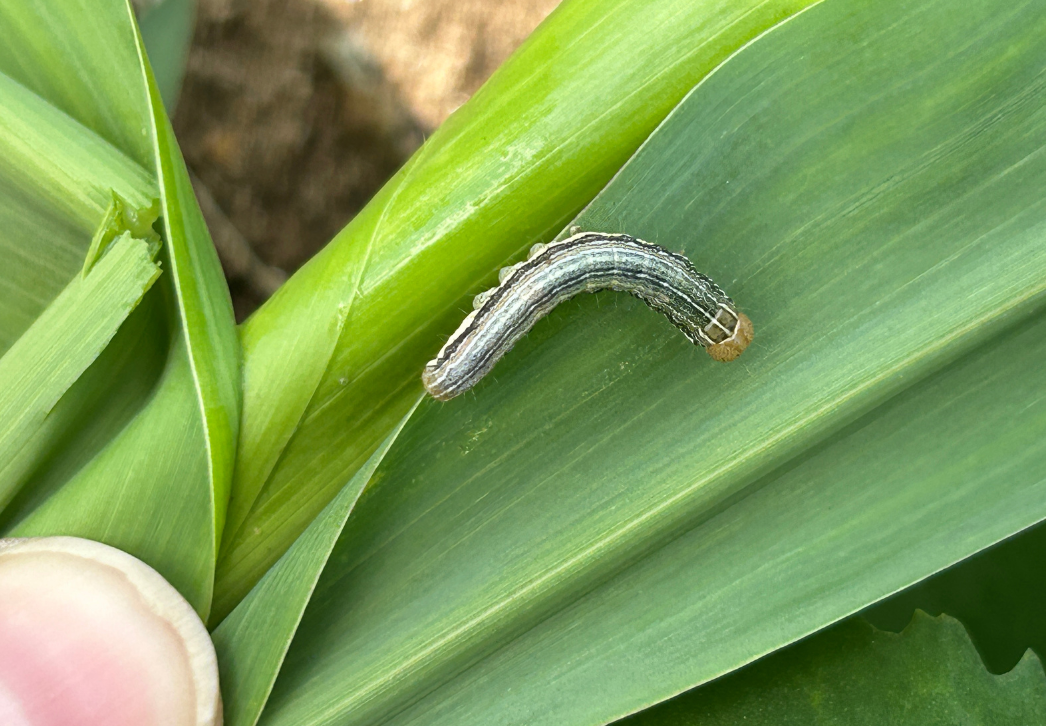
DATCP’s True Armyworm Trap Network has captured a cumulative total of 10,351 moths in 61 traps as of June 17, for a 12-week average of 170 moths per trap. Over the three-month monitoring period, the largest trap catches occurred April 22-29 and counts have trended downward each subsequent week. Armyworm numbers have fallen to the lowest levels of the season, with trappers reporting network-wide averages of less than 8.0 moths per trap during weeks 10-12 (June 3-17).
The pause in moth activity signals armyworm populations are in the larval feeding stages. Although a few reports of locally high caterpillar populations have been received, widespread problems have not been reported or observed to date. Once the first generation of larvae matures by late June, the second generation appearing in mid-July will be especially important to watch for.
Network cooperators who have been diligently checking traps each week are encouraged to keep up with trap checks because a marked increase in moths later this month will define the end of the first generation and the start of the summer armyworm flight, which gives rise to the potentially more damaging second larval generation. Heavy mid-June armyworm flights, in years when they occur, can foreshadow second-generation problems. In short, while TAW trap counts have been low for several weeks, activity could pick up again soon and routine checks will be important to stay ahead of second-generation outbreaks. |
|
 __________________________________
|
|
Apple orchards in DATCP’s trap network are seeing a shift in overall insect pressure as mid-season pests begin emerging. First-generation codling moth treatments have been made in southern and central orchards where the spring biofix was set in late May, while northern apple growers that recorded an early June biofix will apply initial larvicide treatments next week. Finding a rain-free spray window has been a challenge this month. Reapplication is likely needed if heavy rainfall (2.0 inches or more) occurs shortly after spraying and trap counts remain above five moths per trap per week for orchards not using codling moth mating disruption (non-MD) and two to three or more moths per trap for orchards using mating disruption (MD).
Obliquebanded leafroller (OBLR) flights began three weeks ago. Several orchards have reported large weekly flights of 20-30 moths per trap and one or two exceptional sites have captured 40-49 moths per trap. Heavy spring flights such as these suggest last season’s second-generation larvae (the overwintering generation) were not well controlled. For orchards that are seeing large flights or have a history of obliquebanded leafroller fruit damage, a course of one or two treatments targeting the first hatch of larvae around 350 degree days (base 43 degrees Fahrenheit) after biofix, followed by a second application 10-14 days later is recommended by the Orchard IPM Specialist John Aue to fully control the first summer generation over its extended flight period.
Afterwards, scouting terminals for first-generation obliquebanded leafroller larvae at 600-700 degree days from the first moth catch will help to determine if sprays were effective and the potential for second-generation OBLR fruit damage in August. Counts averaging three or more larvae per tree suggest a high population is active. |
|
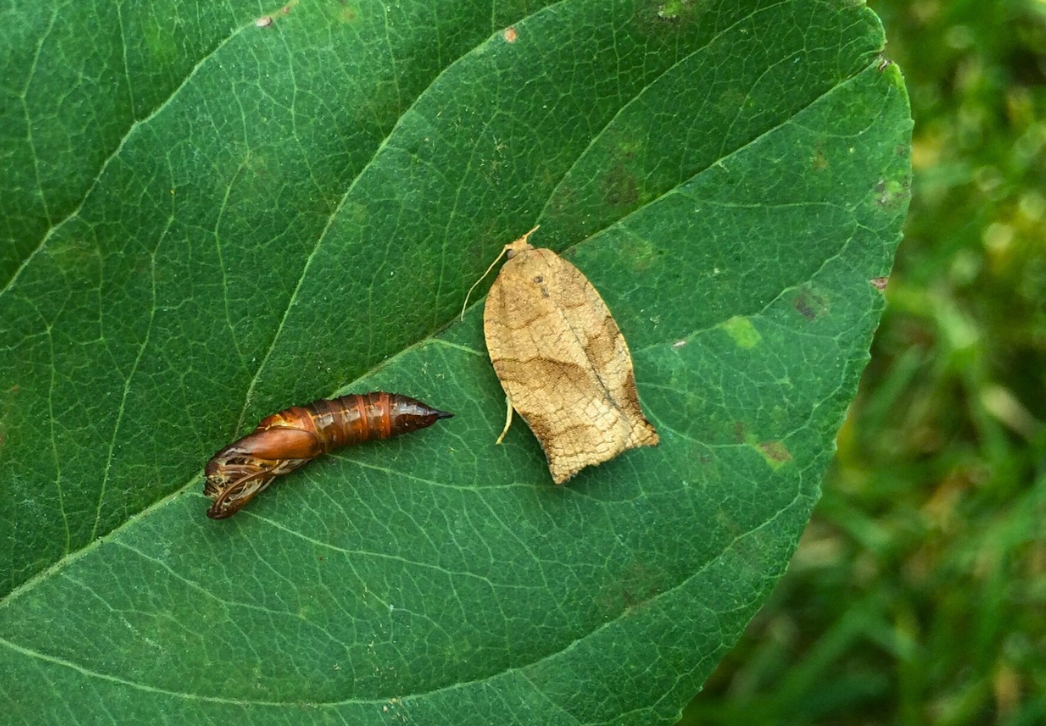 Obliquebanded leafroller moth and pupa | K. Hamilton DATCP
|
|
|
Emergence of dogwood borer moths began during the last week of May. The traps do not indicate the need for control but instead are used to estimate peak adult flight and when to begin scouting for frass around the graft union of trees and other evidence of larval feeding. The dogwood borer has one generation per year in Wisconsin and trunk sprays labeled for borer control (e.g., Assail) are applied in spring, by mid-June. However, if fresh borer feeding is observed in early July, a second course of the product can be applied before early August. Orchards that consistently experience dogwood borer pressure should consider use of mating disruption with Isomate-DWB in addition to standard trunk sprays. Scouting for this pest is especially critical for orchards with new trees planted in the last five years.
Maps for the five apple pests monitored by DATCP’s Apple Orchard Pest Trap Network are available at the links below:
|
|
__________________________________ |
|
|
|
|