|
|
Unsettled weather prevailed for much of the week in Wisconsin. After a warm, dry window May 3-17 allowed farmers to plant approximately half of this year’s intended corn, oat, and soybean crops, fieldwork was interrupted as widespread rain fell throughout the state. Daytime highs in the 70s and 80s over the weekend were replaced by below normal temperatures in the 50s to low 60s starting May 18. Overnight lows in the upper 20s to around 50 brought frost advisories to the northern areas. Weekly precipitation amounts of 0.5 to 2.0 inches were common statewide.
Prior to the rain, planting of the 2026 corn crop had reached 62% complete, an increase of 52 percentage points in two weeks, and three points ahead of the five-year average. Soybean planting was four points ahead of the average before the rain started, at 54% complete (USDA NASS).
The return of a dry pattern and warmer temperatures next week should allow Wisconsin farmers to approach the finish line for planting corn, oats, and soybeans, and to gain momentum in harvesting the first alfalfa crop.
__________________________________
|
|
The alfalfa weevil damage season is underway in southern Wisconsin. Estimates of leaf tip feeding recorded during this week’s alfalfa surveys mostly ranged from 10-20%, though scattered fields in the southwestern and south-central areas had higher larval pressure. In the 36 fields sampled by DATCP May 18-20, counts varied from 0.0-6.4 per sweep and averaged 1.6 per sweep. Leaf tip feeding ranged from less than 5% in Columbia, La Crosse, and Vernon counties, where weevil feeding is just becoming noticeable, to above-threshold at 40-50% in a few fields in Grant and Green counties along the Illinois border.
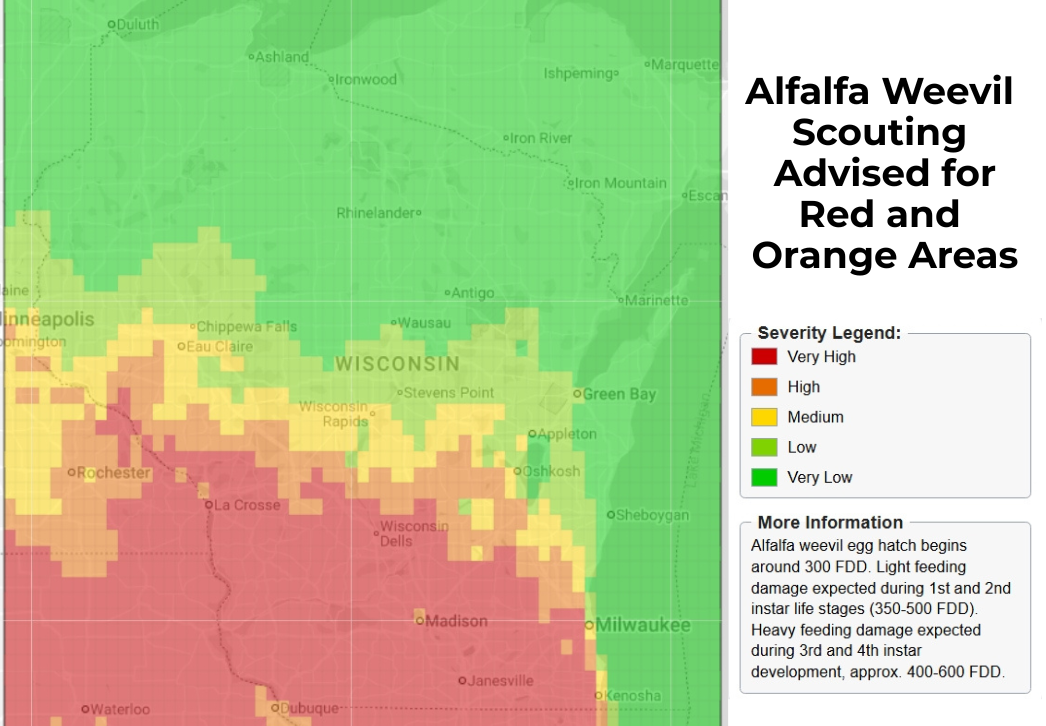
The alfalfa weevil forecast tool developed by the UW-Madison Vegetable Disease and Insect Forecasting Network (VDIFN) illustrates where scouting for larvae and damage is most critical at this time. Red and orange shaded areas, namely the counties south of Interstate-90, are where scouting is advised. Degree day accumulations in these high-risk areas range from approximately 400-625 units and, as DATCP’s sampling confirmed this week, weevil larvae are reaching the third and fourth instars when feeding damage is heaviest. Note that a red “very high” risk rating on the map does not necessarily mean severe alfalfa weevil feeding is occurring. It simply indicates larvae are in the development stage where heavy feeding may occur if the weevil population is high in a field. The only way to determine actual alfalfa weevil feeding pressure is to scout fields. |
|
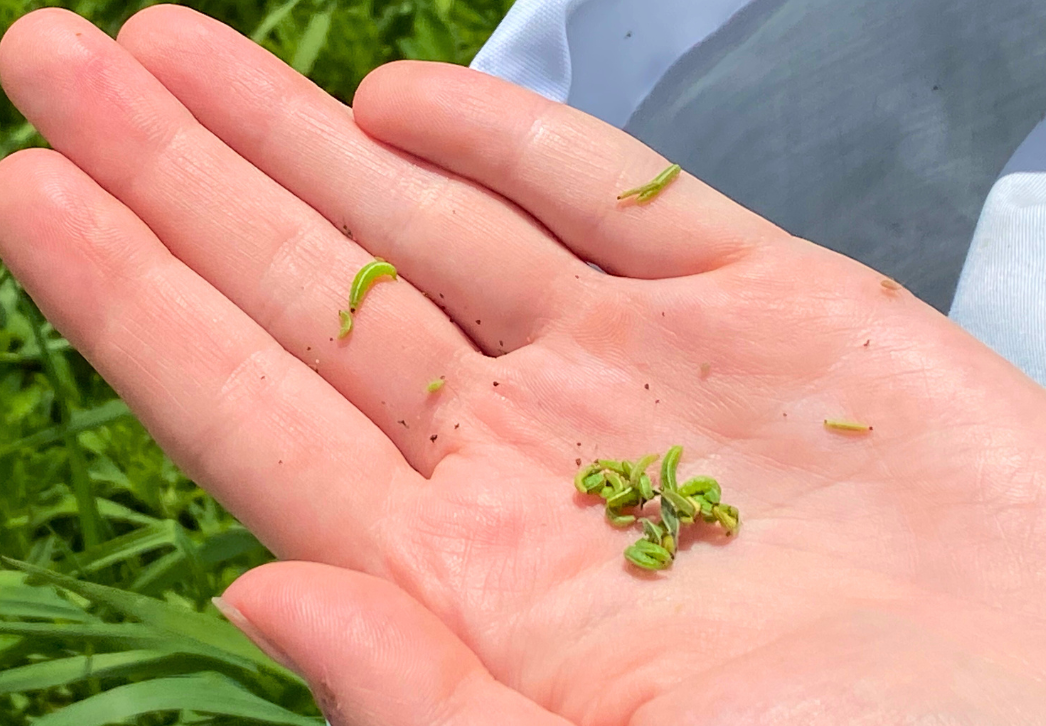
In the week ahead (May 22-28), the central and southeastern areas of the state will also enter the orange and red high to very high categories and scouting will be particularly important. Scouting a field to determine whether to cut or spray can take less than 15 minutes. The method for assessing alfalfa weevil damage is to collect the top six inches of 50 stems at random from throughout the field, checking each stem for weevil leaf feeding (as shown in the image below), and estimating the percent of stems showing defoliation. For example, if 27 of 50 pulled stems show tiny holes and leaf feeding, then the tip feeding estimate is above-threshold at 54%. Management is recommended when 40% of the alfalfa stems have alfalfa weevil feeding and the field is more than seven days from the scheduled harvest date.
|
|
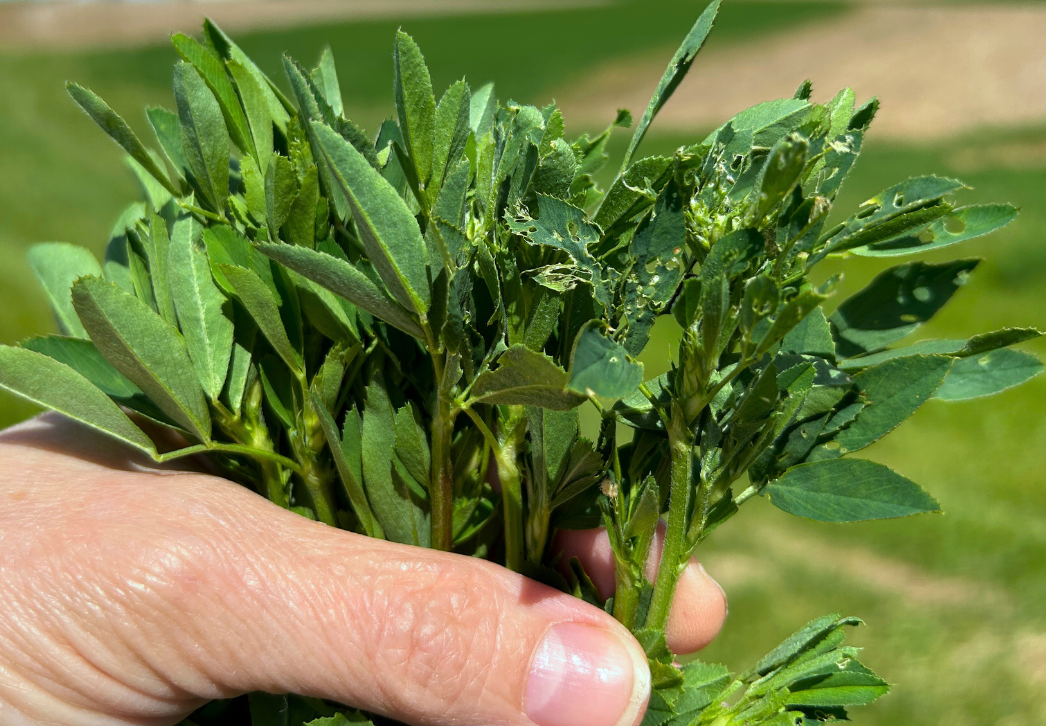 Alfalfa sample: Stems on right show weevil feeding while plants on left show no feeding
K. Hamilton DATCP
|
|
 __________________________________
|
|
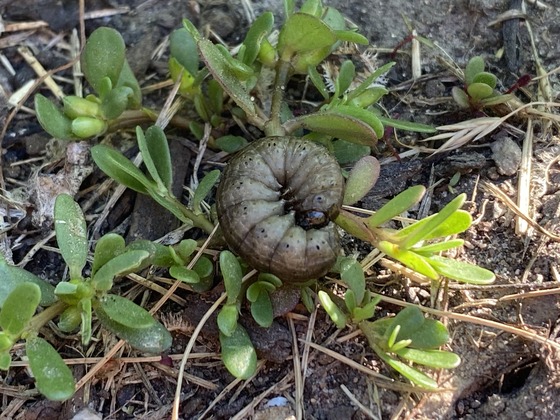
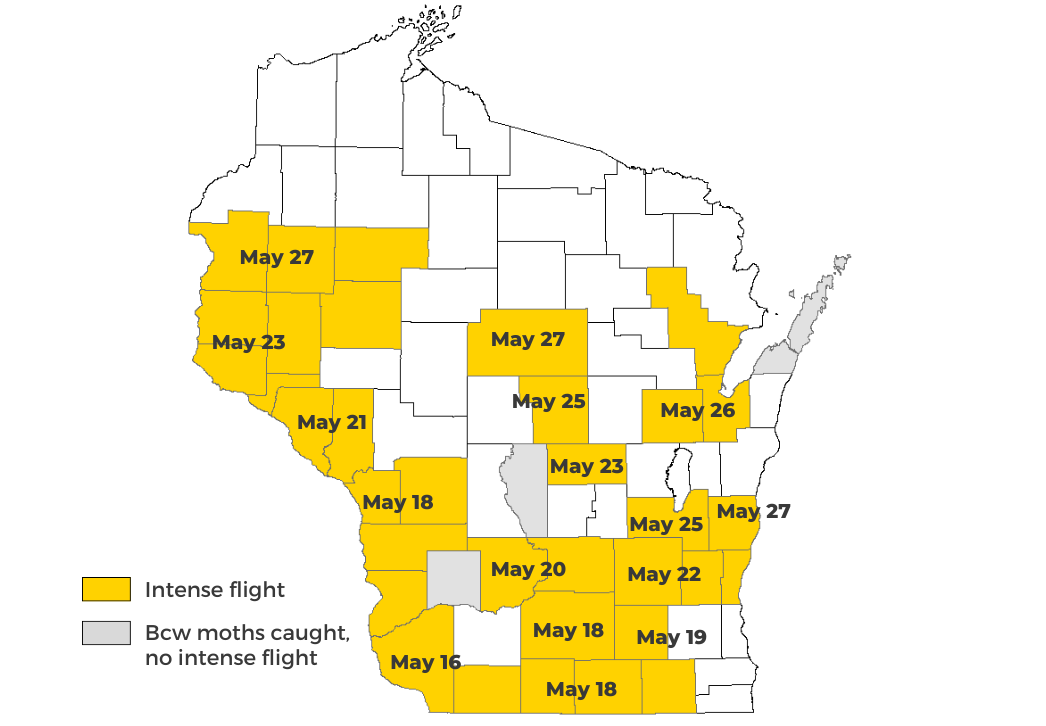
Black cutworm larvae from mid-April flights have grown large enough to cut emerging corn plants. A moderate risk of localized black cutworm infestations is forecast through early to mid-June based on the timing of moth arrivals this spring relative to the start of corn planting, favorable field conditions, and the locally heavy moth counts reported by the Black Cutworm Trap Network. As more corn acreage emerges across the state, scouting for signs of black cutworm infestation is strongly advised.
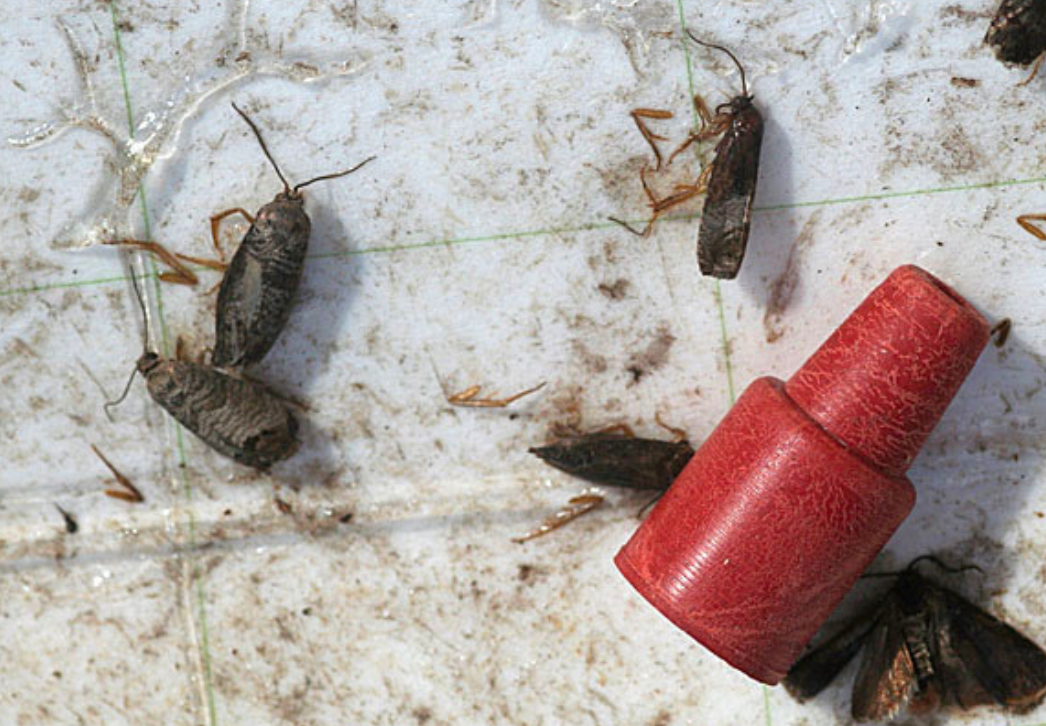
During the week ending May 21, DATCP’s network recorded another wave of black cutworm moths. The 92 reporting trap locations collected 1,388 moths, for a cumulative total of 4,910 moths since March 25. This spring’s average count of 50 moths per trap has surpassed the 10-year average of 37 moths per trap, but is still below the 72-per-trap average recorded in 2017, the last time serious black cutworm infestations were documented in the state. |
|
Corn acreage that had dense broadleaf weed infestation prior to planting, fields with cover crops that were terminated late, and sites with heavy crop residue—especially corn planted into soybean residue—are at greater risk of infestation and should be routinely checked from emergence though the five-leaf V5 stage. A threshold of 3% cutting of plants (with a range of 2-5%) has traditionally been used as the point at which growers should consider a rescue treatment. Early and timely detection of cutworm infestations is critical for controls to be effective.
|
|
 __________________________________
|
|
Emergence of spring codling moths is picking up in southern and central Wisconsin apple orchards. Eleven of DATCP’s 27 monitoring locations recorded a flight between May 15 and 19 as weekly counts ranged from 1-27 moths per trap (refer to codling moth map). Significant captures of five or more moths were reported from Columbia, Dane, Racine, and Kenosha counties.
Weather conditions conducive to codling moth mating flights include dusk temperatures above 62°F, no rain, and winds below five miles per hour. When these conditions are met, codling moth activity may occur between 6:00 pm and 11:00 pm. In central and northern orchards where moth flight has not started and the above-mentioned conditions are expected in the next few days, frequent trap monitoring is advised until the biofix has been established.
Orchards with high codling moth pressure or a large first flight of more than 10 moths per week traditionally apply the first larvicide spray at 250 degree days (simple base 50°F) after the biofix. For example, if the biofix was set on May 19, and an average of 15 degree days accumulate daily, the first treatment would be applied 17 days after the biofix (250/15 = 17), or on June 5. Treatments applied at this threshold coincide with early hatch of first-generation larvae.
However, if the initial flight is light or inconsistent due to cool temperatures or rain (as is often the case for northern orchards), a stronger flight can occur after the earliest moths appear in traps. In this scenario, the first larvicide spray applied 350 degree days from the initial biofix will better coincide with larval hatch. Apple growers have approximately two weeks after the biofix is set to make preparations for initial codling moth treatments.
Questions about timing the codling moth biofix and first-generation control window can be directed to DATCP Entomologist Krista Hamilton at Krista.Hamilton@wisconsin.gov. |
|
__________________________________ |
|
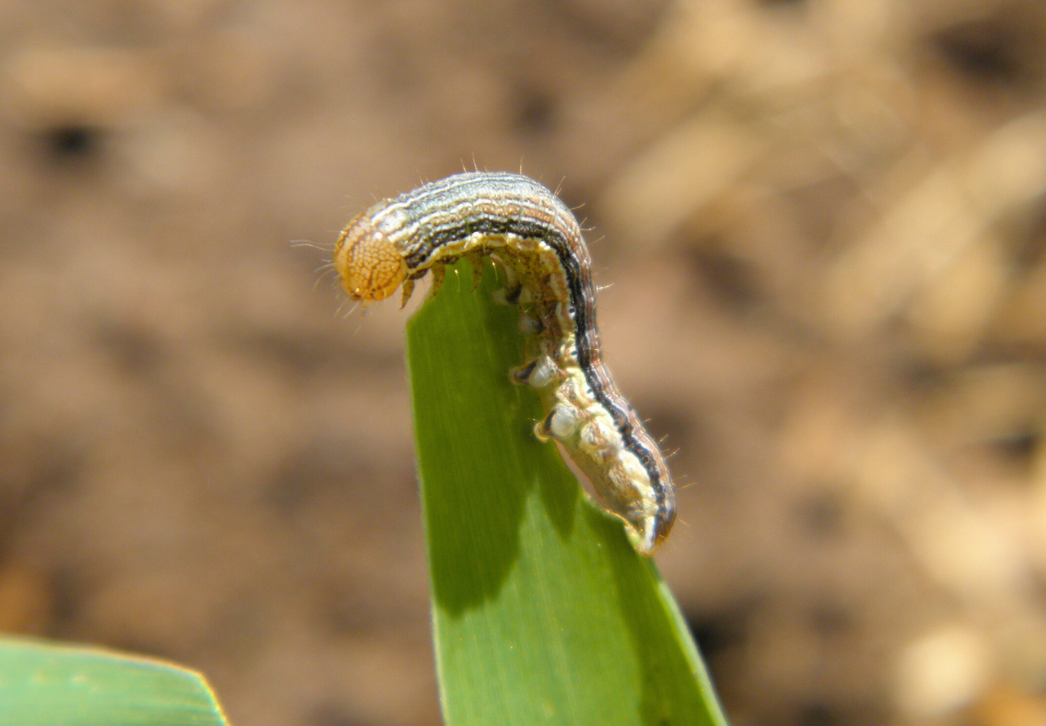
After eight weeks of true armyworm trap monitoring, cooperators are curious to know if April moth flights will produce spring armyworm problems. The short answer is: it is still too early to tell. The variables considered when assessing risk, such as moth flights, wet spring weather, and weedy field conditions, indicate that conditions are favorable for armyworm activity, but it remains unclear if or where local infestations will develop.
DATCP’s True Armyworm Network recorded three consecutive weeks of moderate to large migration flights April 9 to 29. The heaviest flights occurred April 23 to 29, when the network’s average count was 81 moths per trap, and five sites reported 250-550 moths per trap. Average counts for the other two weeks were much lower at 36 and 45 moths per trap. First-generation larvae resulting from these flights are just starting to turn up in alfalfa, grasses, and small grains and will become more noticeable in the next two weeks.
Corn following winter rye and fields with residue, weeds, or dead grass are at higher risk and should be scouted through early to mid-June, as well as wheat and other small grains. Armyworm economic thresholds for corn are met if 25% of plants are infested with two larvae (0.75 inch or smaller) or one larva (0.75 inch or smaller) is found on 75% of plants. Scout several areas in the field, checking five sets of 20 plants. In small grains, counts of three larvae per square foot justify treatment. |
|
 __________________________________
|
|
|
|
|