|
|
A warming trend spurred fieldwork, gardening, and plant development in Wisconsin during the week ending May 14. Most of the state experienced several days of open weather for spring tillage and planting. Wisconsin farmers capitalized on the favorable conditions and made significant planting increases, led by corn (up 21 percentage points), oats (up 18 points), and soybeans (up 18 points). According to the USDA NASS, 31% of the state’s corn, 47% of oats, and 28% of soybeans have been planted. Despite recent gains, statewide planting progress is still generally behind the five-year average pace.
The week’s field activities included monitoring insect survey traps and finalizing preparations for the annual spongy moth treatment program. Aerial treatments targeting early-stage spongy moth caterpillars started May 13 in western Wisconsin. Residents in Grant, Lafayette, and Trempealeau counties may have observed the yellow crop duster planes overhead this week as the aircraft applied Bacillus thuringiensis kurstaki (Btk) to protect trees and forests from defoliation. The 2026 treatment program is focusing on 18 sites in eight western Wisconsin counties: Barron, Buffalo, Dunn, Grant, Lafayette, Pepin, Trempealeau, and Washburn. The strategy is part of the National Slow the Spread program framework that prioritizes high risk sites across 11 states with well-timed aerial controls against isolated or emerging spongy moth populations.
__________________________________
|
|
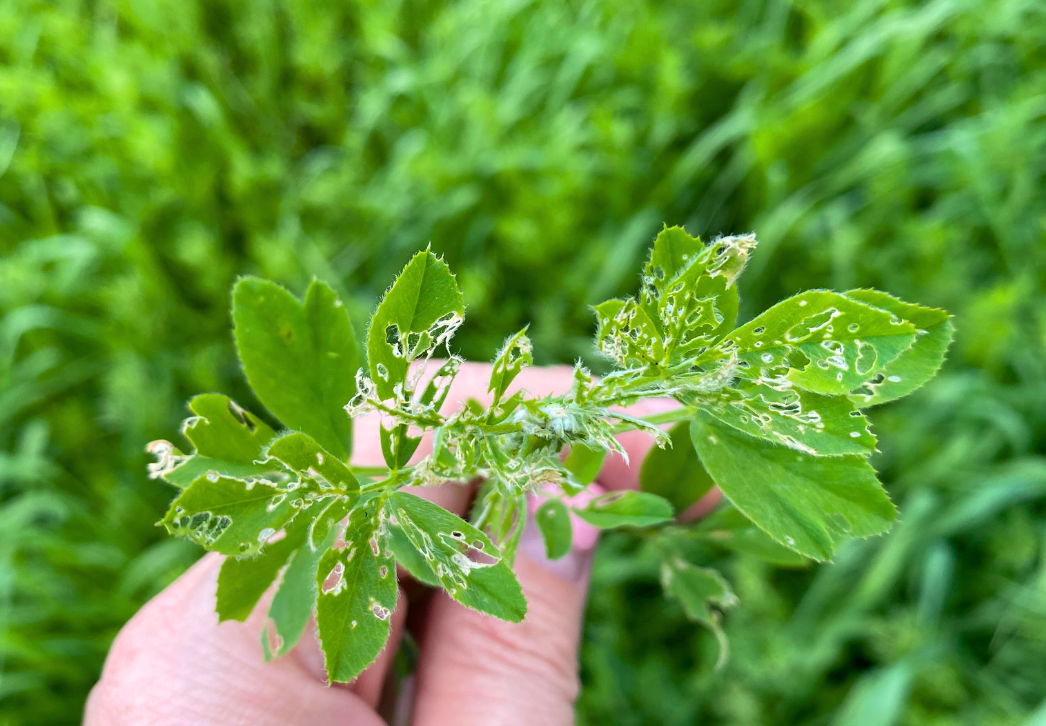
Alfalfa weevil larvae and their distinctive tip feeding injury are appearing as expected in southwestern Wisconsin alfalfa fields. This early-season alfalfa pest characteristically hatches in May, develops through four larval stages (or instars), and completes the damaging larval phase of its life cycle by early June. The weevil feeding season in Wisconsin is brief and only extends for about four to five weeks, depending on spring temperatures.
As shown in the alfalfa weevil degree-day tool on the UW-Extension Vegetable Disease and Insect Forecasting Network (VDIFN) site, heat unit accumulations (sine base 48°F) across much of southern Wisconsin are adequate for larvae to have reached the intermediate second and third instars. Alfalfa tip feeding damage is becoming visible in southern fields and will be more pronounced next week as a greater proportion of the larvae reach the later third and fourth instars. In contrast, egg hatch has not yet started in central and northern Wisconsin.
Peak alfalfa weevil populations and tip feeding damage customarily occur in Wisconsin between 600 and 800 degree days. For the 2026 season, the three weeks from May 17-June 6 will be the most effective window for alfalfa weevil scouting and decision-making. A defoliation level of 40% of stems with weevil feeding in the first crop signals the larval population is high and an early harvest would be beneficial. Sweep net sampling for alfalfa weevil larvae should begin in areas of the state where degree-day accumulations are approaching or have exceeded 300 units. As of May 14, this includes all alfalfa acreage south of Interstate 90-94, from La Crosse south to Beloit and east to Kenosha. |
|
 __________________________________
|
|
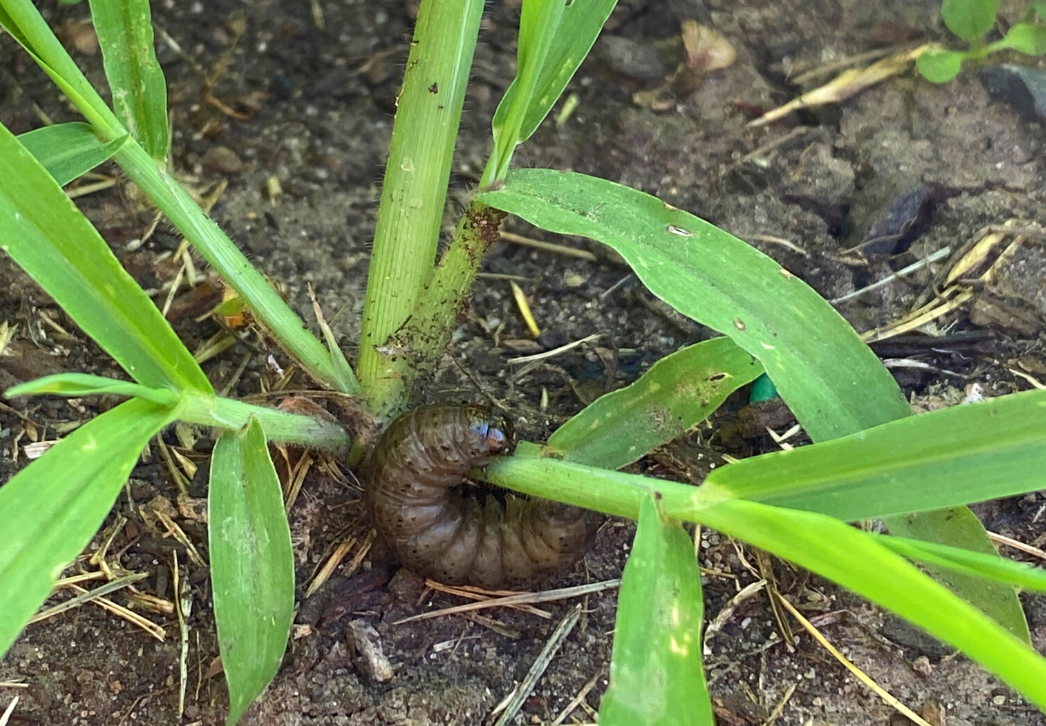
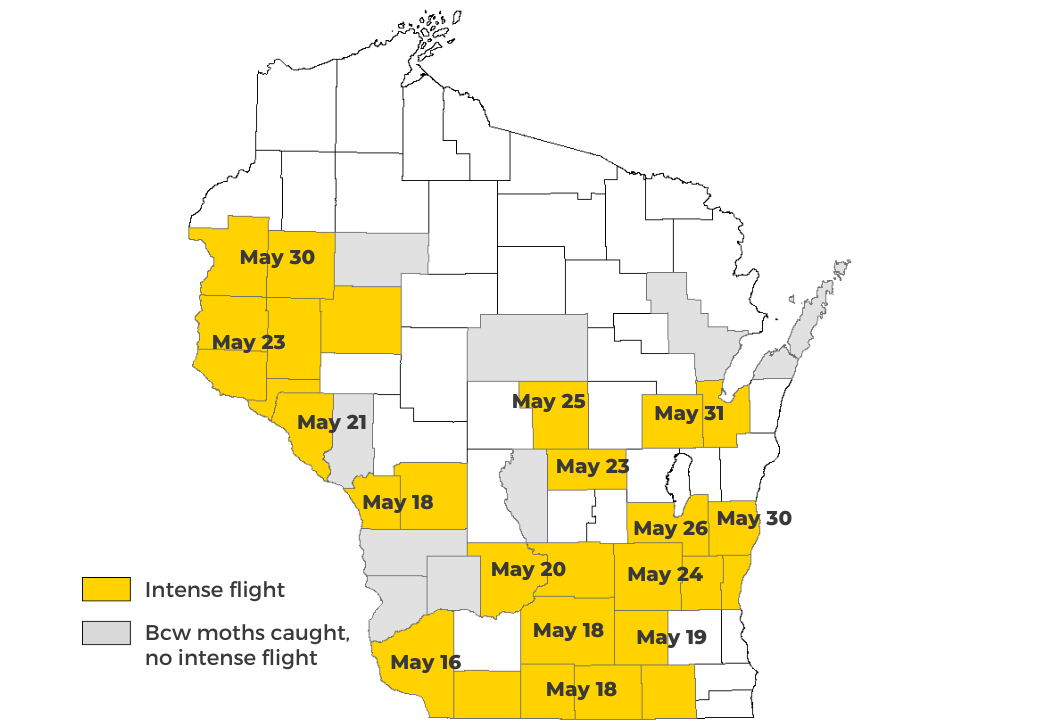
A substantial influx of moths arrived in Wisconsin May 7-13. The Black Cutworm Trap Network collected 885 individuals in 101 traps, an increase from 542 moths the previous week when activity slowed due to below-normal early May temperatures. Twenty-seven trap sites reported intense captures this week and the biofix for estimating peak seedling corn cutting dates has been set in 28 of the 37 counties where traps are monitoring the spring black cutworm migration.
Based on intense moth captures in the state on April 14-21 and accumulated degree days, larvae produced by moths arriving since mid-April will reach the destructive fourth-instar cutting stage of development in advanced areas of the state this weekend. The primary seedling corn damage window for black cutworm is expected to open May 16 across far southwestern Wisconsin, May 18 near Madison, May 23 at Hancock, May 30 at Sheboygan, and May 31 near Green Bay. |
|
Crop consultants and growers are advised to begin inspecting corn (including Bt hybrids) for leaf pinholes and other signs of cutworm feeding during early-season stand assessments. Scouting a few days before predicted cutting dates is recommended. Recall that Bt hybrids and corn treated with seed-applied insecticides are at reduced risk of cutworm damage, but the larvae are still capable of cutting young plants. The economic threshold for black cutworm is reached if 3% of plants have been cut and larvae are still present in the field.
As mentioned in the previous issue of Field Notes, severe black cutworm infestations are infrequent in Wisconsin, and trap counts are not a reliable predictor of outbreaks. Scouting emerging corn should be prioritized in the next three weeks.
|
|
 __________________________________
|
|
|
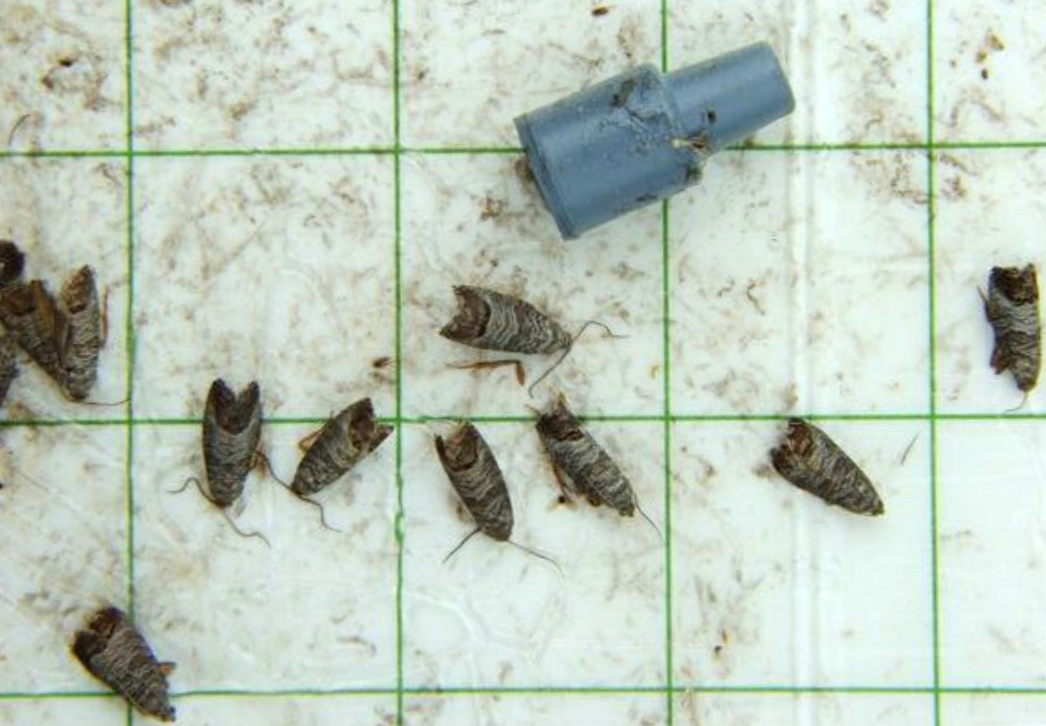
Emergence of the codling moth has started in Wisconsin apple orchards. The cooperator in Racine County reported overnight counts on May 13 ranging from one to five moths, with eight separate traps capturing specimens. Warm weekend temperatures are likely to prompt an increase in activity, and monitoring sites in southern and central Wisconsin may record the spring codling moth biofix.
As it applies to codling moth, the term “biofix” refers to the beginning of a consistent moth flight and marks the starting point for counting degree days (base 50°F) to determine the most effective treatment timing for first-generation larvae. The biofix is indicated by either:
- One or more moths caught in traps on consecutive nights or
- A count that exceeds the threshold of five moths per trap per week
For example, if a codling moth pheromone trap catches two moths May 13, four moths May 14, and three moths May 15, the biofix could be May 14 or 15. Assign the biofix date for the warmest and calmest of the two nights. Alternatively, if a heavy flight of five or more moths occurs on a single night, assign the biofix date to that night and begin counting degree days.
Codling moths fly between 6-11 p.m. on warm nights with low wind speeds (less than 5 miles per hour) and no rain. Evening temperatures above 62°F are preferred for egg laying. If these specific conditions are not met, flights will be delayed. Apple growers in the DATCP Apple Pest Trap Network are advised to begin checking their traps daily until the biofix is established. Orchards using mating disruption (MD) for codling moth management should plan to deploy MD products as soon as possible.
|
|
__________________________________ |
|
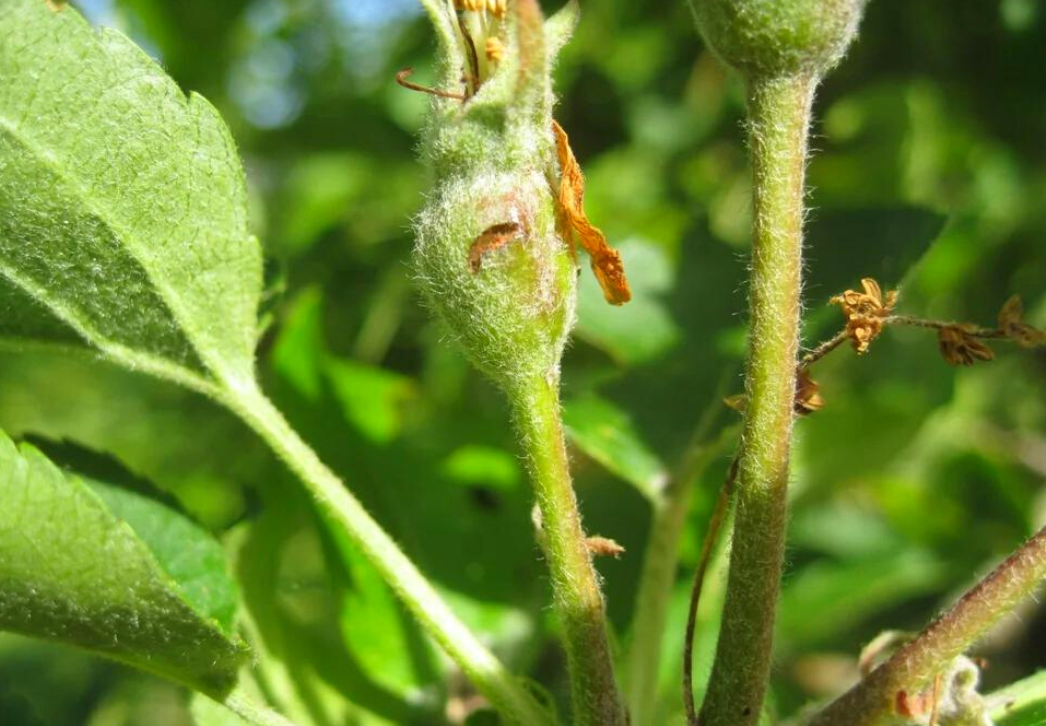
A few consecutive days of warm weather has activated plum curculio migration into apple orchards. Injury attributed to overwintered weevils has been observed on fruitlets at southern Wisconsin monitoring sites. With the weekend forecast calling for hot temperatures, growers are encouraged to begin scouting the orchard perimeter for stings and crescent-shaped egg laying scars, concentrating on blocks with past plum curculio pressure and cultivars with the largest fruits (over five mm), such as Ida red, Liberty, Paula red, and Zestar.
If scouting indicates the need for an insecticide application, options include applying either perimeter sprays or a full cover spray. Perimeter sprays are recommended for larger blocks of more than five acres if weevil injury is observed only in the border rows. In contrast, if egg laying scars are found on fruits beyond the first four to five rows of trees, a full cover spray is the better approach. Organic growers can apply Surround® (kaolin clay) to reduce plum curculio damage. Another strategy is to designate unsprayed trap rows of early varieties that are later treated with an insecticide such as PyGanic at night, when the weevils are active.
To protect bees and other pollinators, perimeter or full cover sprays should not be applied until 100% of petals have fallen from trees. Applications made between the hours of 7 p.m. and 7 a.m. will avoid peak bee activity. Spraying on overcast days when temperatures are below 50°F will also reduce risk since honey bees do not fly at temperatures below this threshold (under 50°F) or during low sunlight conditions. |
|
 __________________________________
|
|
|
|
|