|
 Dear Wisconsin nurseries, Christmas tree growers, and gardeners:
Growing degree days (GDD) (simple B50) as of May 14 were 36 in Bayfield; 96 in Cumberland; 101 in Medford; 169 in Hancock; 120 in Green Bay; 206 in Racine; 256 in Madison; 262 in La Crosse; and 356 in Dubuque, IA.
A few pests in vulnerable-to-treatment stages include fletcher scale, spongy moth, eastern tent caterpillar, boxwood psyllid, spruce spider mites, viburnum leaf beetle, and zimmerman pine moth at 100-200 GDDs; and pine needle scale and maple spider mite at 200-300 GDDs. Other pests soon to be in vulnerable stages include lilac borer, oystershell scale (brown), and euonymus caterpillar at 275-500 GDDs; and black vine weevil, bronze birch borer, oystershell scale (gray), and elm leaf beetle at 400-600 GDDs.
Aerial treatments targeting early-stage spongy moth caterpillars started May 13 in western Wisconsin as part of the National Slow the Spread Program. Read more about spongy moth aerial treatments on our website.
Take a moment to read through a few updates from the DATCP nursery program and send any feedback, questions, or ideas for future e-news updates to datcpnursery@wisconsin.gov.
Having trouble viewing this email? View it as a Web page.
_____________________________________
|
|
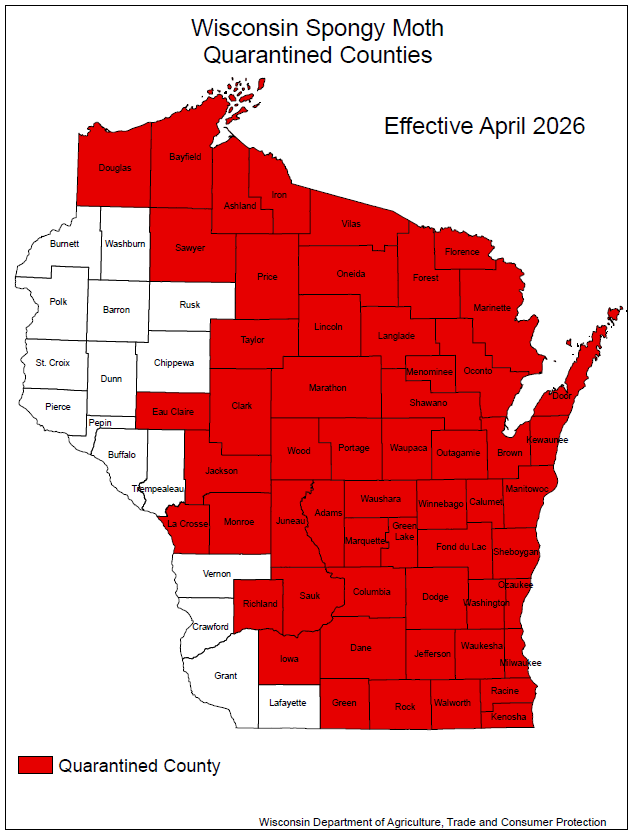
The U.S. Department of Agriculture's Animal and Plant Health Inspection Service (USDA-APHIS) and DATCP added Sawyer and Green counties to the federal and state spongy moth quarantine on April 15, 2026, joining the eastern and central three-fourths of Wisconsin already regulated for and infested with this pest. Despite spongy moth populations sharply decreasing in 2025 following an outbreak that lasted from 2022 - 2024, DATCP staff obtained steady, high male moth captures in baited pheromone traps in Sawyer and Green counties. This established infestation, coupled with new egg mass reports and forest product movement risk, all contributed to the decision to quarantine these counties, resulting in 56 counties currently quarantined for spongy moth.
A quarantine is a type of plant protection regulation to help prevent the introduction of invasive plant pests and diseases and slow their spread within the infested area. Items regulated by the spongy moth quarantine include woody nursery stock; cut Christmas trees; firewood; logs; pulpwood; wood waste such as wood chips, bark, and bark products; and household items, including outdoor patio furniture and mobile homes.
|
How do businesses comply with the quarantine?
Learn to identify spongy moth and train all employees handling regulated items to identify this insect. Watch DATCP's spongy moth ID training video on YouTube: Slow the Spread: 2026 Spongy Moth (Lymantria dispar) Identification Training.
If your business regularly transports any regulated items out of the quarantined area, but not outside of Wisconsin, contact DATCP to obtain a state spongy moth compliance agreement. If your business is within the quarantine, and ships regulated articles out of Wisconsin, contact USDA-APHIS for a federal compliance agreement. The agreement specifies risk mitigation requirements, is no cost to your business, and is renewed annually. To learn more about compliance agreements and who to contact, visit DATCP's Plant Product Compliance Agreements webpage.
Inspect regulated items prior to shipment, or request inspection by DATCP inspectors to certify shipments are free of spongy moth life stages. After inspection, utilize accurate statements, digital stamp certificates, or USDA-APHIS-PPQ forms to facilitate shipment of regulated articles.
_____________________________________
|
|
|
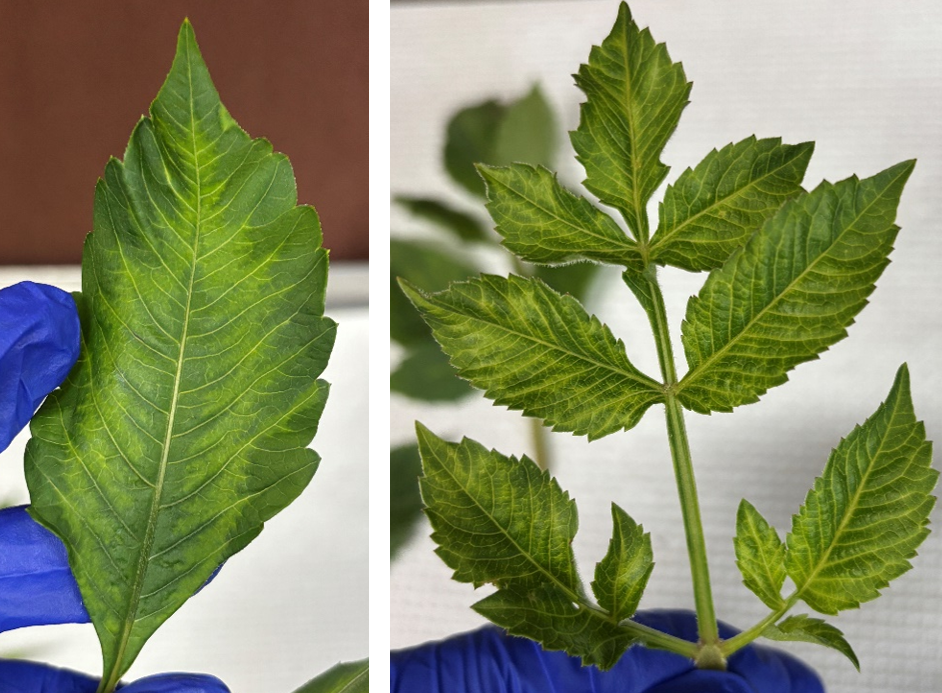
Vein clearing symptoms in Dahlias infected with DMV | DATCP image
Dahlias are beautiful and popular annuals in Wisconsin that bloom from July until the first frost. Viral issues are common in dahlias, in part because they are typically vegetatively propagated from tubers. If the original tuber is infected with a virus, the likelihood that its cuttings will also be infected is high. Insect vectors also contribute to the spread of some viral infections.
A common virus of dahlia is dahlia mosaic virus (DMV). Symptoms of DMV include mottled or mosaic patterns on leaves, stunting, reduced vigor, and color breaking on flowers. Leaves can develop pale green bands along the midribs and larger secondary veins, known as vein clearing. Some varieties show few to no symptoms.
Infection by DMV is systemic, meaning the virus spreads to all parts of the plant. Viral infections in plants are not treatable, but effective control measures include roguing infected or symptomatic plants, disinfecting tools between working on different plants, and not using infected or symptomatic plants in propagation. The peach green aphid vectors and spreads DMV viral infections, so controlling green peach aphid populations is important to prevent its spread as well.
For more photos of DMV and other types of viral infections in ornamental plants, check out the PIB’s Gallery of Ornamental Plant Virus Symptoms.
_____________________________________
|
|
|
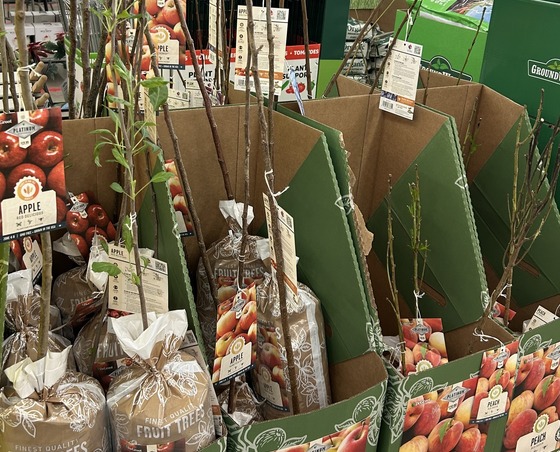
Actively growing apple trees must be potted up and maintained as actively growing plant material or returned to supplier | DATCP L. Meils
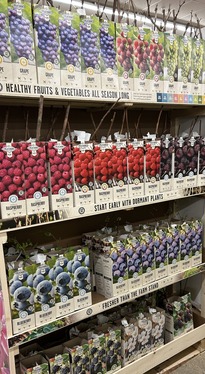
As we move into the active growing season, it is important for nursery dealers to examine what kind of stock is being held and how that stock is being treated. This is especially important for pre-packaged and bagged plant products. These products usually contain dormant rootstock that is then packed into a plastic bag with moist growing medium. In theory, this allows the plant to have a long shelf life when maintained in its dormant state.
DATCP typically finds these products offered for sale inside the stores, where they are exposed to warmth and light. This becomes a problem around mid-late spring when these plants break dormancy and start to show signs of green growth. Since these plants are often uncared for, they quickly wither and die on the shelf.
Once bagged/packaged stock start showing signs of green growth, they must then be treated like all other perennial stock, which means having ready access to sunlight and water. At this point, the retailer has a few options: clearance the stock immediately upon breaking dormancy, unpackage the plants and pot them up to be maintained as regular potted nursery stock, return them to the supplier, or the plants can simply be destroyed.
Per Wisconsin statue 94.10(6)(a), "a nursery grower or nursery dealer shall maintain facilities that are reasonably adequate for the care and keeping of nursery stock held for sale, so that the nursery grower or nursery dealer can keep the nursery stock in healthy condition pending sale"; and 94.10(7)(b)2, nursery dealers cannot “sell, offer to sell, or distribute any nursery stock that the nursery grower or nursery dealer knows, or has reason to know, will not survive or grow.”
If you still are carrying this kind of pre-packaged, "dormant" plant stock, it is likely no longer dormant and action must be taken.
|
_____________________________________
|
|
|
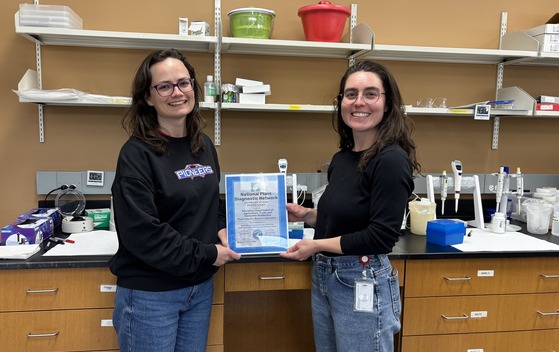
DATCP Plant Pathologists with the NPDN certificate of accreditation | DATCP image
On May 1, the Plant Industry Bureau Lab (PIB Lab) joined three other state department of agriculture labs and several land-grant university labs in achieving National Plant Diagnostic Network (NPDN) Core Accreditation. The Core Accreditation Program ensures that labs meet standards of quality and professionalism, strengthening their state of readiness in performing timely and accurate detections while reducing the risk of exotic pathogens and pest establishments. The NPDN manages the only accreditation program specialized in plant diagnostic labs in the U.S.
To become accredited, lab staff created and implemented a quality management system that met NPDN Core Accreditation Standards. Over the past three years, staff assessed current lab practices and procedures for compliance with Core Standards, updated and changed processes and procedures where needed, and created over 150 new quality management system documents. The standards developed by the NPDN cover topics such as document control, sample handling, and staff training. Implementation of the system shows the PIB Lab’s commitment to quality diagnostics, customer service, and continuous improvement.
The PIB Lab, housed in Madison, provides plant pest and disease diagnostic services to DATCP inspectors and field specialists. Samples submitted to the lab may come from nurseries, Christmas tree fields, phytosanitary inspections, and pest and disease surveys. The lab works quickly to identify both routine and new pests and diseases.
As a member laboratory in the NPDN, the PIB Lab represents Wisconsin as part of an extensive diagnostics system of labs throughout the United States. The NPDN system of more than 70 labs protects national plant health by providing accurate, rapid pest and disease identification and reporting.
_____________________________________
|
|
|
The Wisconsin Department of Natural Resources announced the public comment period for the Economic Impact Analysis (EIA) associated with proposed revisions to ch. NR 40, Wisconsin’s Invasive Species Rule. The department will be accepting public comments associated with the EIA through June 3, 2026.
Visit the department’s website to access the draft EIA, the draft rule, and a supplemental Rule Revision Guide. Review the solicitation notice for additional details on this public input opportunity. Please do not submit comments on revisions to rule language at this time.
We ask those submitting comments to please provide specific information in these areas and include any supporting economic data, studies, or reports. The department is soliciting information on the following:
- Would you, your business, your association, or your local unit of government be affected in a material economic way by the implementation of these rules?
- If yes, the department is seeking comments on the following:
- Any implementation or compliance costs that are reasonably expected to be incurred.
- Actual quantifiable benefits of the proposed rule.
- Whether the proposed rule would adversely affect in a material way the economy, a sector of the economy, productivity, jobs, or the overall economic competitiveness of the state.
- Economic impacts of specific alternatives to the proposed rule.
- Whether the proposed rule will have an economic impact (savings or increased costs) on public utilities or their ratepayers.
Comments on the draft EIA may be submitted electronically to Mackenzie.Manicki@wisconsin.gov or may be mailed to: Mackenzie Manicki, Wisconsin Dept. of Natural Resources, P.O. Box 7921, Madison, WI 53707.
_____________________________________
|
|
|
A compliance agreement is a written agreement between DATCP or USDA and a business engaged in growing, handling, importing or exporting regulated articles (e.g., plants and plant parts) outside of a plant pest quarantine. The business with the compliance agreement is granted a limited exemption to a quarantine to facilitate the movement of regulated articles, provided that risk mitigation measures are taken, such as notifying state or federal plant regulatory officials about shipments leaving a quarantine, and/or treating or inspecting regulated articles so material can be certified to prevent artificial plant pest spread to new areas. Nursery growers, nursery dealers, and Christmas tree growers are some of the businesses that may need compliance agreements. Compliance agreements are valid for one year and must be renewed annually. There is no fee to enter into a compliance agreement. Compliance agreements are generally pest-specific, so depending on what plant species you move, you may need multiple agreements.
To help you determine what compliance agreements you may need, DATCP created an interactive guide to generate a list of potential, applicable compliance agreements based on how you operate. By simply answering a series of yes/no questions, you can quickly learn what compliance agreements will help you facilitate the movement of the stock you’re bringing in or shipping out. Fill out the guide now to determine what agreements you may need.
_____________________________________
|
|
|
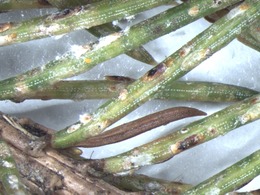
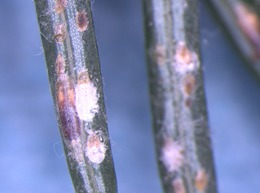
Coniferous Fiorinia Scale (CFS) females, males, and crawlers on spruce from PA | DATCP M. Lannan
|
|
Elongate Hemlock Scale (EHS) females, males, and newly settled crawlers on hemlock from NC and PA | DATCP M. Lannan
|
|
|
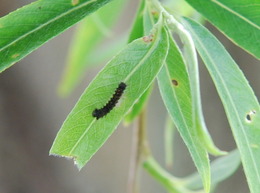
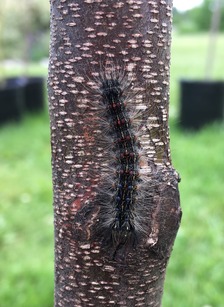
Spongy moth larva on willow in Grant Co. (taken May 12) | DATCP M. Bogden Muetzel
|
|
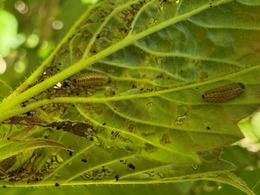
Viburnum leaf beetle larvae feeding on viburnum in Dane Co. (taken May 14) | DATCP L. Meils
|
|
|
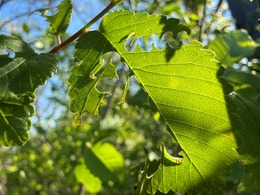
Elm zigzag sawfly larvae feeding on elm in Dane Co. | DATCP L. Meils
|
|
Magnolia scale overwintered crawlers on stock brought in from SE WI | DATCP L. Meils
|
|
|
_____________________________________
|
|
|
For more information about Wisconsin's Nursery and Christmas Tree Programs, visit DATCP's Nursery and Christmas Tree Program webpage.
Read past issues of What's Growing On?
If you haven't yet, please take this brief feedback survey for our monthly What's Growing On? e-newsletter. With this survey, we aim to measure your satisfaction regarding the format, frequency, and quality of the content provided. Please give us your most transparent feedback. The survey is anonymous.
For current counts during the growing season from our insect monitoring networks around the state, visit our Pest Survey webpage. To read articles on economically important plant pests affecting Wisconsin's field crops, fruits, and vegetables, read our Field Notes publication put out weekly during the growing season.
|
|
|
|
|