|
 Dear Wisconsin nurseries, Christmas tree growers, and gardeners:
With growing degree days now accumulating, it's time to start regular scouting for pests and diseases. Growing degree days (GDD) (simple B50) as of April 14 were 4 in Bayfield; 26 in Cumberland; 28 in Medford; 57 in Hancock; 28 in Green Bay; 87 in Madison; 88 in La Crosse; and 138 in Dubuque, IA.
A few pests in (or very soon to be in) a vulnerable-to-treatment stage include first applications for Cooley and eastern spruce gall adelgid, and spruce needle miner (50-100 GDDs). Once we hit 100 GDD(B50), some pests in vulnerable stages include fletcher scale, spongy moth, boxwood psyllid, spruce spider mites, viburnum leaf beetle, and Zimmerman pine moth (all at 100-200 GDDs), to name a few.
Take a moment to read through a few updates from the DATCP nursery program and send any feedback, questions, or ideas for future e-news updates to datcpnursery@wisconsin.gov.
Having trouble viewing this email? View it as a Web page.
_____________________________________
|
|
|
Help protect Wisconsin’s natural resources by participating in Invasive Plant Pest and Disease Awareness Month! Take the time to learn about harmful invasive pests and diseases and what you can do to help reduce their spread.
A deadly plant disease worth noting is sudden oak death, caused by the water mold Phytophthora ramorum. This pathogen can infect over 100 different plant species and is also known for causing ramorum leaf blight and ramorum dieback in non-oak foliar species such as rhododendron, viburnum, and lilac. P. ramorum is federally quarantined in areas of California and Oregon where it has devastated coastal forests after inadvertently being introduced from nursery stock. Wisconsin also has an exterior quarantine (ATCP 21.19) in place to help prevent introduction of the pathogen to our state. DATCP inspectors have intercepted P. ramorum on nursery stock over the years, but this pathogen has not been detected in Wisconsin’s landscape to date.
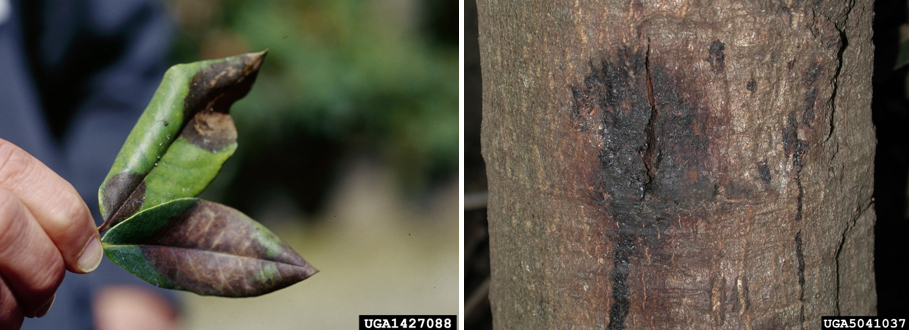
Symptoms can vary between oaks and other foliar hosts. They can include:
- Trunk and branch cankers with bleeding of dark reddish-brown sap on oaks
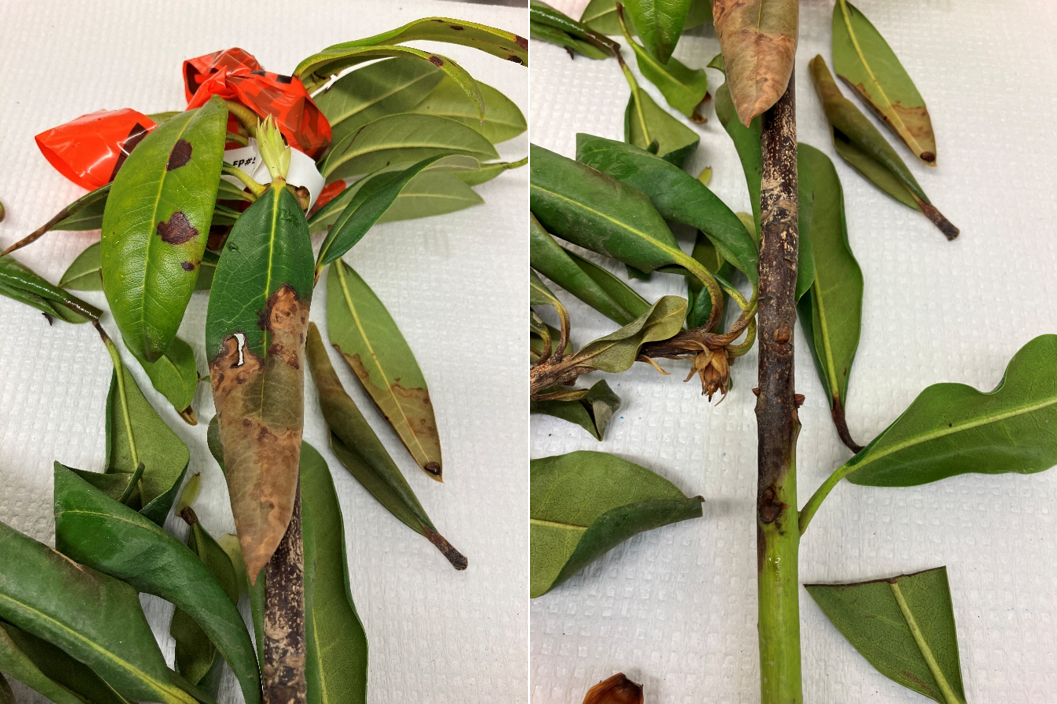
- Brown to black lesions on leaves and/or twigs
- Twig dieback and leaf loss
P. ramorum leaf symptoms on foliar hosts (left) and dark sap bleeding on oak host (right). | USDA Forest Service, J. OBrien, bugwood.org
P. ramorum thrives in cool, wet environments and is easily dispersed in water whether from irrigation or rain. Foliar host plants support abundant spore production, so ongoing nursery surveys and quarantine are vital to reduce the risk of widespread distribution on nursery stock. There are no effective treatments, so infected plants should be destroyed as soon as possible.
We encourage you to:
- Regularly inspect your plant stock
- Buy healthy plants from reputable sources
- Do not move plants that appear sick or dying
- Disinfest pruning and other gardening tools between plants
Symptoms can be difficult to distinguish from other diseases, and an official diagnosis for this pathogen must be confirmed by laboratory testing. If you believe your plant may be infected with P. ramorum, please contact your local nursery inspector or our Nursery Program Coordinator at (608) 516-7617 or DATCPnursery@wisconsin.gov.
P. ramorum leaf (left) and stem (right) lesions on rhododendron | DATCP images
To learn more about invasive plant pests and diseases regulated in Wisconsin, visit plantpests.wi.gov. To report other suspected pests or diseases not known to be present in Wisconsin, or to report one that has spread to a new area within the state, call the Pest Hotline at (866) 440-7523 or email a photo and your location to datcppesthotline@wisconsin.gov.
_____________________________________
|
|
|
Before the spring shipping season, it is always a good practice to review the laws and regulations regarding plant sales for all the states you intend to purchase from and ship into. States such as California, Florida, Louisiana, and Oregon all have exterior quarantines in place to help prevent the introduction of oak wilt into their states. These regulations often restrict the movement of any oak plant products with bark on, and this can include all species of oak whether it’s rooted trees, oak seedlings, or other propagative parts (typically does not restrict seed). States like Florida may require you to work with your home state to be added to a master permit ensuring products you seek to ship to that state are compliant with the quarantine. Plant law summaries for each state are available on the National Plant Board’s website.
Oak wilt is a fungal disease lethal to oaks caused by the pathogen Bretziella fagacearum. The fungus grows through the infected tree’s water conduction system, eventually causing the tree to wilt and die. Management for this disease can be tricky and costly, so prevention is key. Red oaks are particularly susceptible, so species such as northern red, northern pin, and black oak are most at risk for death. The white oak group has shown much slower disease progression than those in the red oak group and may even survive the infection. However, any infected tree is a potential vector for the disease to spread as spore-bearing fungal mats develop underneath the bark of infected trees. Bark beetles are attracted to these mats and can spread oak wilt overland by carrying fungal spores from infected trees to new trees as they feed on sap from fresh wounds. This disease can also spread short distances via root grafts underground between nearby trees. Oak wilt symptoms can progress quickly within a few weeks and may be most noticeable in July and August.
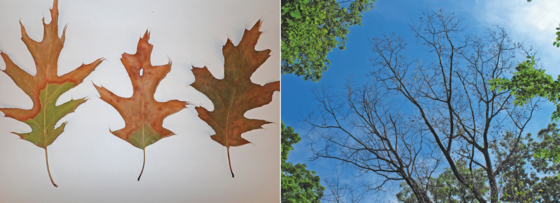
What to look for:
- Dull green and bronze colored leaves that appear wilted
- Leaf discoloration and dieback starting in the crown of the tree
- Sudden leaf drop starting in the upper canopy
Leaf discoloration (left) and leaf drop from upper canopy (right) of oak-wilt-infected tree | WDNR images
The Wisconsin Department of Natural Resources (DNR) recommends not wounding oaks from April through July each year in Wisconsin based on the vector bark beetle activity. This includes pruning, trimming, etc. If you absolutely have to or otherwise accidentally wound your oaks, immediately apply pruning sealer over the wound. It is the open, fresh tree wound that attracts bark beetles and allows introduction of the fungal pathogen.
To learn more about oak wilt, check out the U.S. Forest Service’s story map, titled "Oak Wilt in the Northeastern and Midwestern States." This resource provides a detailed overview of the disease and can help determine the most appropriate tools for prevention and treatment. You can also visit the DNR's oak wilt webpage for more Wisconsin-specific information and resources.
This is just one highlight of the various plant laws held by other states. It is the responsibility of each nursery, whether you are buying stock in, shipping it out, or both, to familiarize yourself with the plant laws in the states where you do business. If you want to ship oak nursery stock to states with oak wilt regulations, contact the receiving state’s Department of Agriculture for guidance. There may be acceptable plant safeguarding measures to allow this, and DATCP can work with you as needed.
If you think your nursery stock may have oak wilt, contact your local inspector or our Nursery Program Coordinator.
_____________________________________
|
|
The Plant Industry Bureau protects Wisconsin's agricultural and horticultural industries and native plants by overseeing and ensuring compliance with laws and regulations involving plant pests, honey bees, nursery plants, seed, Christmas trees, and firewood. The bureau implements programs designed to prevent the introduction and spread of harmful plant pests and diseases, especially regulated organisms.
Our Mission - To protect Wisconsin’s agriculture industry, plant industry, and environment from plant pests and diseases through risk-based surveys, inspections, diagnostics, regulations, and control programs, while also delivering excellent customer service to our state’s businesses, stakeholders, and citizens.
Our Programs - Plant Industry Bureau programs include inspection, export certification, quarantine, and survey activities. The bureau also facilitates interstate and international commerce of Wisconsin agricultural products and commodities by certifying plant health and pest-free status.
Our Partners - To carry out its mission, the bureau maintains partnerships with the United States Department of Agriculture Animal and Plant Health Inspection Service (USDA APHIS), the USDA Forest Service (USDA FS), the Wisconsin Department of Natural Resources (DNR), the University of Wisconsin (UW), Tribal nations, and other state and federal agencies.
|
_____________________________________
|
|
|
The Wisconsin Department of Agriculture, Trade and Consumer Protection enforces the federal Worker Protection Standard (WPS) in Wisconsin. The WPS is a regulation issued by the U.S. Environmental Protection Agency intended to use information, training, and practices to reduce the risk of pesticide exposure for pesticide handlers and other workers producing crops on farms, in forests, in nurseries and in greenhouses. Workers and handlers include employees, self-employed contractors and, in some cases, owners.
The DATCP Bureau of Agrichemical Management puts out periodic newsletters to discuss changes to the Worker Protection Standard. Check out the April 2026 newsletter here.
_____________________________________
|
|
|
Recorded Webinars:
Continuing Series:
_____________________________________
|
|
|
A compliance agreement is a written agreement between DATCP or USDA and a business engaged in growing, handling, importing, or exporting regulated articles (e.g., plants and plant parts) outside of a plant pest quarantine. The business with the compliance agreement is granted a limited exemption to a quarantine to facilitate the movement of regulated articles, provided that risk mitigation measures are taken, such as notifying state or federal plant regulatory officials about shipments leaving a quarantine, and/or treating or inspecting regulated articles so material can be certified to prevent artificial plant pest spread to new areas. Nursery growers, nursery dealers, and Christmas tree growers are some of the businesses that may need compliance agreements. Compliance agreements are valid for one year and must be renewed annually. There is no fee to enter into a compliance agreement. Compliance agreements are generally pest-specific, so depending on what plant species you move, you may need multiple agreements.
To help you determine what compliance agreements you may need, DATCP created an interactive guide to generate a list of potential, applicable compliance agreements based on how you operate. By simply answering a series of yes/no questions you can quickly learn what compliance agreements will help you facilitate the movement of the stock you’re bringing in or shipping out. Fill out the guide now to determine what agreements you may need.
_____________________________________
|
|
|
For more information about Wisconsin's Nursery and Christmas Tree Programs, visit DATCP's Nursery and Christmas Tree Program webpage.
Read past issues of What's Growing On?
If you haven't yet, please take this brief feedback survey for our monthly What's Growing On? e-newsletter. With this survey, we aim to measure your satisfaction regarding the format, frequency, and quality of the content provided. Please give us your most transparent feedback. The survey is anonymous.
For current counts during the growing season from our insect monitoring networks around the state, visit our Pest Survey webpage. To read articles on economically important plant pests affecting Wisconsin's field crops, fruits, and vegetables, read our Field Notes publication put out weekly during the growing season.
|
|
|
|
|