|
 _____________________________________
Dear Wisconsin nurseries, Christmas tree growers, and gardeners:
With spring just around the corner, take a moment to read through a few updates from the DATCP nursery program and send any feedback, questions, or ideas for future e-news updates to datcpnursery@wisconsin.gov.
Having trouble viewing this email? View it as a Web page.
_____________________________________
|
|
|
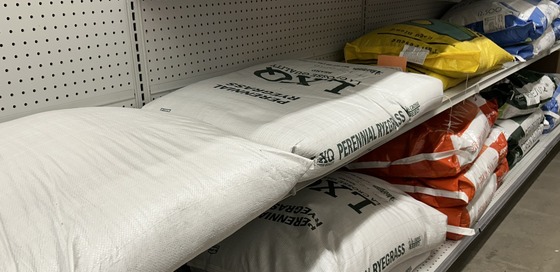
Check bags of carried over seed to make sure the labels aren't expired | DATCP image
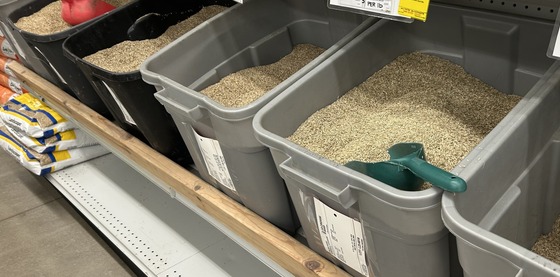
DATCP licenses seed labelers. This labeling requirement helps ensure that consumers receive good quality seed that germinates and does not contain weed seeds. A seed labeler is any business or person whose name appears on a seed label or who opens containers of agricultural, lawn, or vegetable seed to sell all or part of it. This includes anyone selling seed for planting out of bulk bins or anyone selling seed for planting that they've repackaged.
Make sure to display the current label for seed being sold out of bulk bins | DATCP image
Seed licenses are annual, effective January 1 through December 31. The cost is based on gross annual sales and ranges from $25 for sales less than $10,000, up to $2,500 for sales of $100 million or more.
Our inspectors monitor and enforce seed labeling, germination, and purity requirements to ensure quality agricultural seed is distributed and sold in Wisconsin and that labeling laws and rules are followed. Inspectors perform a range of duties, such as evaluating labels for compliance, issuing stop sale orders, and collecting samples for analysis. Seed that does not conform to state standards may be removed from the marketplace and labelers may be subject to penalties.
DATCP inspects all licensed seed labelers in the state on a three-year rotation with an average of 29 percent of the licensed labelers inspected annually over the past 10 years. The program work plan targets labelers that historically exceed the state violation average while also targeting species and mixtures that historically have higher than average violation rates. For more information on seed licensing and labeling, visit DATCP's Seed Labeling webpage.
An issue commonly encountered during seed inspections, besides not having a license if needed, is when expired seed is found being offered for sale. Retailers should regularly inspect seed being sold and if the seed label is expired, it cannot be sold until it has been retested and relabeled. Selling expired seed is a violation of the seed law under Administrative Code, ATCP 20.04 and 20.06.
You do not need a seed label license if you sell:
- Seed grown and sold exclusively on your own farm
- Seed in unopened bags or containers labeled by a licensed seed labeler
Any questions about seed inspections or licensing can be directed to DATCPseed@wisconsin.gov.
_____________________________________
|
|
|
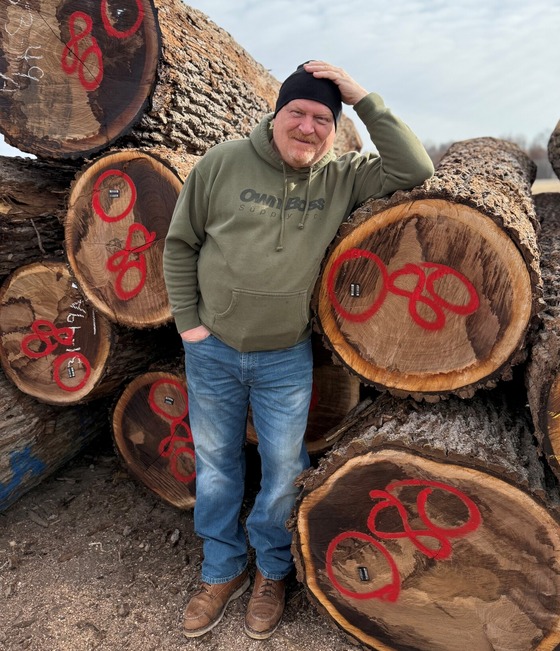
Plant Industry Bureau inspector Greg Helmbrecht retired on February 20, 2026 | DATCP L. Meils
Since 1996, Greg Helmbrecht worked tirelessly on behalf of Wisconsin’s plant industries, providing guidance to log, lumber, grain exporters, and growers to facilitate compliance with state and federal export requirements and plant protection regulations. After 29 years of state service with the Wisconsin Department of Agriculture, Trade and Consumer Protection (DATCP), Greg retired on February 20, 2026.
When Greg was hired, he served as the primary nursery inspector for the southern half of Wisconsin, covering nursery inspections and phytosanitary inspections for logs and other export commodities. As statewide plant protection efforts expanded, Greg expanded the scope of his position to include inspection of Christmas trees, seed and coordination of the seed labeler program, firewood dealer certification inspections, and coordination of DATCP's Export Certification Program. Helmbrecht was a strong leader, completing the Enterprise Management Development Academy for state employees in 2016.
Under Helmbrecht’s coordination of the Plant Export Certification Program, approximately 10,000 phytosanitary certificates were issued annually, which facilitate over $1 billion in exports of Wisconsin products, including logs, lumber, grain, seed, and nursery stock. Helmbrecht and other Plant Industry Bureau staff conduct over 350 log inspections per year in support of the phytosanitary program. They also conduct annual inspections of kiln dried lumber for producers that hold compliance agreements, allowing phytosanitary certificates to be issued for that lower risk commodity without the need for individual inspections of shipments.
Helmbrecht worked with APHIS and DATCP staff to collect thousands of cranberry samples and have them tested for Xylella fastidiosa for a northern Wisconsin grower seeking to export to the European Union, requiring the establishment of a Pest-Free Place of Production. Helmbrecht always offered exemplary customer service to exporters, establishing the department's goal to process phytosanitary applications on a 24-hour turnaround whenever possible. His work helped ensure that Wisconsin commodities meet the export requirements of international markets, particularly in Asia, which accounts for roughly 60% of the state's total certificates.
As part of his position as Export Certification Program Coordinator, Helmbrecht joined DATCP officials on high-level trade missions to Vietnam in 2015 and China in 2018 focused on expanding markets for Wisconsin's forestry and agricultural products. In Vietnam, focus was on their growing furniture manufacturing industry, which heavily imports American hardwoods. In China, the delegation focused on maintaining and expanding access for Wisconsin's red oak and other timber species amidst evolving import requirements. Helmbrecht regularly presented about the phytosanitary program and log exports in Wisconsin to groups like the Lake States Lumber Association and students at North Central Technical College.
As coordinator of the seed labeler program, Helmbrecht served as the state’s Seed Control Official; as President of the American Association of Seed Control Officials (AASCO) from 2005 to 2007; as AASCO Treasurer from 2012 to 2024, managing organizational finances and handling annual meeting registrations; and as the lead for the AASCO north central committee. Helmbrecht served as the primary point of contact for Wisconsin’s approximately 700 seed labeling licenses and managed the state's seed compliance, enforcing expired seed or seed with poor germination or purity, working with the Wisconsin Crop Improvement Association, who completes our seed testing and APHIS-AMS on serious interstate seed violation referrals.
Helmbrecht was always focused on efficiency and continuous improvement, implementing a Six Sigma project in 2017 to transition seed labeler inspections from a laborious handwritten paper process to one that was completed through electronic data entry using Access databases recorded into staff tablets in the field. Before that, he also moved seed labeler fees from statute to rule (ATCP 20), ensuring that any fee changes no longer require a law change.
Helmbrecht was instrumental in seed program compliance, helping to regulate noxious weed seed species, such as Palmer amaranth and waterhemp, under ATCP 20. He provided crucial guidance to farmers on preventing contamination from treated seeds, emphasizing the "zero tolerance" federal standards for grain intended for food or feed.
Until a new inspector is hired, nursery or Christmas tree licensees in Greg's territory can direct questions to DATCPnursery@wisconsin.gov. Seed labelers should direct questions to DATCPseed@wisconsin.gov, and those with phytosanitary inspection or certificate requests or export questions should contact DATCPphyto@wisconsin.gov or (608) 224-4574.
_____________________________________
|
|
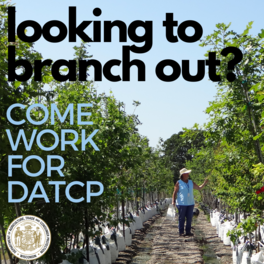
DATCP's Plant Protection Section has two open full-time Plant Pest & Disease Specialist/Nursery Inspector positions. These positions are responsible for inspecting assigned nurseries, Christmas trees, logs, and other plant products for insects, diseases, and other pests in northwestern Wisconsin and in southeastern Wisconsin.
The deadline to apply is March 16, 2026.
|
_____________________________________
|
|
|
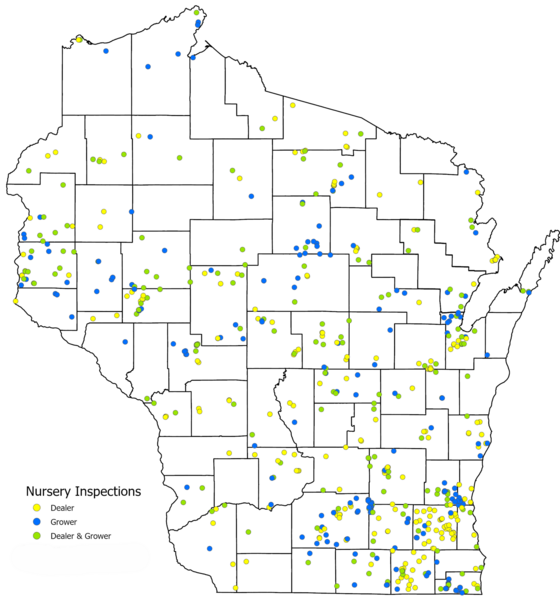
Map of 2025 nursery inspections completed | DATCP map
DATCP's Nursery Program licenses nursery growers and dealers and inspects nursery stock for regulatory pests. Nursery inspections promote the production and sale of healthy plants, help prevent the introduction of invasive pests arriving on imported stock, and facilitate interstate commerce through the issuance of Plant Health Certificates (PHCs) for exported stock. DATCP inspectors also partner with Wisconsin Department of Natural Resources (DNR) staff to ensure invasive plants regulated under the DNR Invasive Species Rule (NR 40) are not sold at nurseries.
Nursery Licensing, Inspections, Regulatory, and Compliance Actions
DATCP provides an inspection every one to three years to licensed businesses. The program licensed 661 nursery growers and 1,238 nursery dealers in 2025, with staff inspecting 422 (49%) growing field locations and 431 (20%) dealer locations statewide. Annual inspections prioritized the 141 licensed nurseries who purchased PHCs, indicating intent to ship plant stock interstate. Since 2021, all nursery inspections have been completed using the Survey123 app on mobile devices.
Inspectors continued to check for violations of the NR 40 Invasive Species Rule at licensed nurseries in 2025. Inspectors documented 49 nursery locations where restricted or prohibited invasive plants were being offered for sale, including 42 of those retail locations where restricted "Trader" white mulberry stock was received from a Minnesota supplier. Other invasive species found being offered for sale include black alder, burning bush, fiveleaf akebia or chocolate vine, Japanese honeysuckle, Japanese and Chinese wisteria, java waterdropwort, and woodland forget-me-not. Inspectors also recorded 30 nursery locations with invasive plants growing on site, including autumn olive, amur honeysuckle, black alder, black locust, buckthorn, cut-leaved teasel, Japanese knotweed, multiflora rose, and wild parsnip. Entities with multiple violations were referred to DNR for enforcement.
Inspectors issued 70 compliance documents (i.e., activity reports, orders prohibiting sale, pest abatement orders, notices of noncompliance, and releases) in 2025, including 15 licensing violations or other pest/pathogen problems, 40 invasive plant sales, one labeling violation, and 14 quarantine violations (primarily elongate hemlock scale and hemlock woolly adelgid quarantines). As a measure to increase awareness of Wisconsin’s plant pest regulations, 16 rejection notices were sent to 10 states (Connecticut, Florida, Illinois, Michigan, Minnesota, New Jersey, Ohio, Oregon, Pennsylvania, and Tennessee) following interceptions of invasive plants, virus-infected plants, invasive adelgids, and scale insects that were shipped to Wisconsin.
Nursery Inspection Pests, Diseases, and Abiotic Stressors in 2025
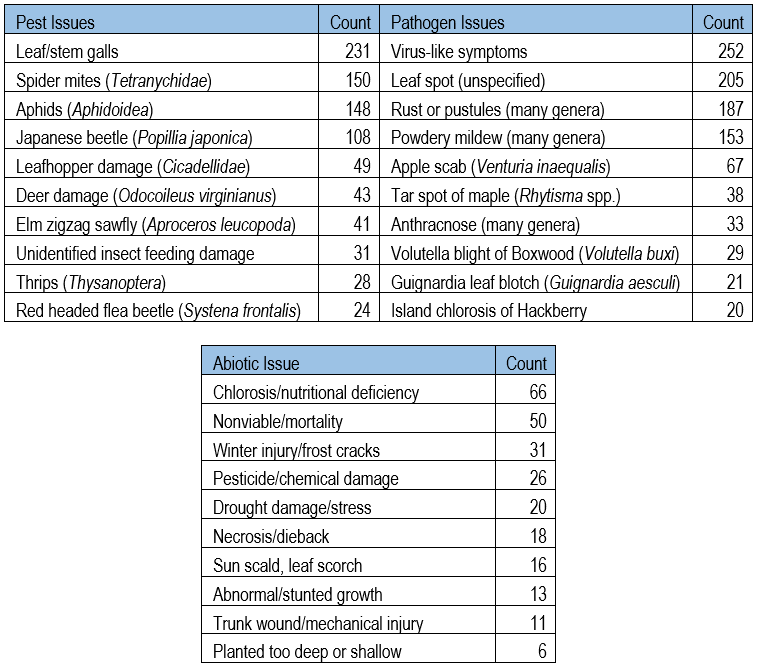
A list of the top 10 pests, pathogens and abiotic stressors observed most frequently during nursery inspections in 2025 is provided in the tables below. Most of the issues found are common from year to year. Noteworthy inspection highlights from 2025 were the general increase in pest counts (i.e., insects, mites, and nematodes) and a decrease in pathogen detections, likely influenced by a return to more average precipitation in 2025 after above average rainfall in the first half of 2024. In addition, spongy moth life stages stayed relatively low on nursery stock as the outbreak phase continued to subside in Wisconsin. Finds increased slightly from 24 growing field detections in 2024 to 30 in 2025.
_____________________________________
|
|
|
By Monika Chandler, Minnesota Department of Agriculture
The Minnesota Department of Agriculture’s Noxious Weed Advisory Committee (NWAC) assesses plant species to determine if they are a threat to Minnesota and whether regulation could reduce the threat level. Rigorous risk assessments are written for the plant species, and regulatory recommendations are provided to the commissioner of agriculture. Potential recommendations include listing a species as prohibited eradicate, prohibited control, restricted, specially regulated, or do not list. The commissioner reviews each recommendation and decides whether to accept or reject it.
In 2026, six new species were added to the Minnesota Noxious Weed List. One species changed category, and two species of poison ivy were removed from the list.
-
Prohibited Eradicate Noxious Weed – New Listing
- Stiltgrass, Microstegium vimineum
-
Restricted Noxious Weeds – New Listings
- Creeping meadow foxtail, Alopecurus arundinaceus
- Autumn olive, Elaeagnus umbellata
- Callery pear, Pyrus calleryana (Previously specially regulated for a three-year production phase out period that began in 2023.)
-
Specially Regulated Noxious Weeds – New Listings
- Specially regulated for a three-year production phase out and will be listed as a restricted noxious weed in 2029:
- Common butterbur, Petasites hybridus
- Giant butterbur, Petasites japonicus
- Rowan/European mountain ash, Sorbus aucuparia
- The species, var atropurpurea, and all Japanese barberry, Berberis thunbergii, hybrids and cultivars except for specifically exempted cultivar
-
Deregulate – Removed from Noxious Weed List
- Poison ivies, Toxicodendron radicans and rydbergii
A positive development is that plant breeders are easing the problem of invasive plants by breeding low seeding cultivars of popular landscape plants. Cultivars are plant varieties that have been produced to maintain certain genetic characteristics. There are now several cultivars of Japanese barberry and winged burning bush that produce no or very little seed. This greatly reduces the risk that these plants could spread and has allowed exemptions for their sale in Minnesota.
-
Restricted Noxious Weeds – Added Cultivar Exemptions
- Winged burning bush, Euonymus alatus: The following zero and low seed cultivars are now exempt and can be sold and planted:
- Proven Winners ® ‘NCEA1’: Fire Ball SeedlessTM
- ‘ZeroSeed’ (ZeroSeed BlazeTM)
- Japanese barberry, Berberis thunbergii: Five cultivars that have undergone research and proven to produce little or no seed have been approved for sale in Minnesota beginning January 1, 2026. Refer to the MDA’s Noxious Weed Listing webpage for the most current regulations.
- WorryFree® cultivars
- ‘UCONNBTCP4N’ (PP30,095): Crimson Cutie®
- ‘UCONNBTB039’ (PP30,128): Mr. Green Genes®
- ‘UCONNBTB048’ (PP30,127): Lemon Glow®
- ‘UCONNBTB113’ (PP30,094): Lemon Cutie®
- Proven Winners® Sunjoy® cultivar
- ‘NCBT1’ (PP30,330): Mini Maroon®
All other cultivars of Japanese barberry that were previously allowed for sale under the Noxious Weed Law will begin a three-year phase out, meaning they can be sold to deplete any remaining stock through December 31, 2028, after which they will become restricted noxious weeds. Beginning on January 1, 2029, only approved cultivars will be allowed for sale in Minnesota.
_____________________________________
|
|
|
A compliance agreement is a written agreement between DATCP or the U.S. Department of Agriculture, and a business engaged in growing, handling, importing, or exporting regulated articles (e.g., plants and plant parts) outside of a plant pest quarantine. The business with the compliance agreement is granted a limited exemption to a quarantine to facilitate the movement of regulated articles, provided that risk mitigation measures are taken, such as notifying state or federal plant regulatory officials about shipments leaving a quarantine and/or treating or inspecting regulated articles so material can be certified to prevent artificial plant pest spread to new areas. Nursery growers, nursery dealers, and Christmas tree growers are some of the businesses that may need compliance agreements. Compliance agreements are valid for one year and must be renewed annually. There is no fee to enter into a compliance agreement. Compliance agreements are generally pest-specific, so depending on what plant species you move, you may need multiple agreements.
To help you determine what compliance agreements you may need, DATCP created an interactive guide to generate a list of potential, applicable compliance agreements based on how you operate. By simply answering a series of yes/no questions, you can quickly learn what compliance agreements will help you facilitate the movement of the stock you’re bringing in or shipping out. Fill out the guide now to determine what agreements you may need.
_____________________________________
|
|
|
For more information about Wisconsin's Nursery and Christmas Tree Programs, visit DATCP's Nursery and Christmas Tree Program webpage.
Read past issues of What's Growing On?
If you haven't yet, please take this brief feedback survey for our monthly What's Growing On? e-newsletter. With this survey, we aim to measure your satisfaction regarding the format, frequency, and quality of the content provided. Please give us your most transparent feedback. The survey is anonymous.
For current counts during the growing season from our insect monitoring networks around the state, visit our Pest Survey webpage. To read articles on economically important plant pests affecting Wisconsin's field crops, fruits, and vegetables, read our Field Notes publication put out weekly during the growing season.
|
|
|
|
|