|
 _____________________________________
Dear Wisconsin nurseries, Christmas tree growers, and gardeners:
Happy 2026! Winter in Wisconsin is a great time of the year to attend conferences and tradeshows to learn about pests and diseases to be on the lookout for when the growing season starts. Take a moment to read through a few updates from the DATCP nursery program and send any feedback, questions, or ideas for future e-news updates to datcpnursery@wisconsin.gov.
Having trouble viewing this email? View it as a Web page.
_____________________________________
|
|
|
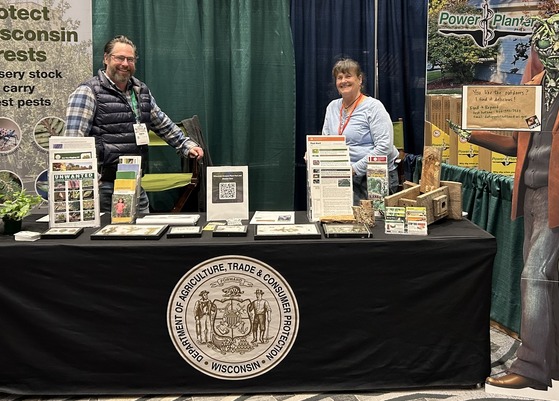
DATCP iLandscape booth jointly staffed with WI and IL inspectors | DATCP image
DATCP's Plant Industry Bureau staff will be exhibiting at some upcoming events. Stop by to visit with us; ask questions; share your insights and suggestions; and learn about the latest plant pest and diseases, pollinator protection, certified firewood, and more.
|
|
_____________________________________ |
|
|
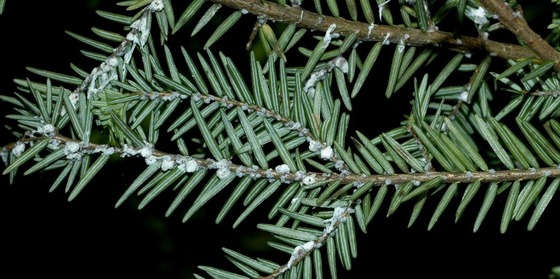
Hemlock woolly adelgid. | William M. Ciesla, Forest Health Management International, Bugwood.org
In spring of 2026, DATCP will begin eDNA surveys for the early detection of hemlock woolly adelgid (HWA), an invasive insect pest that has not yet been detected in Wisconsin. This tiny insect, found on the undersides of hemlock branches, covers itself in a cottony wax coating while it feeds on tree sap. Visual surveys for this pest’s easy to spot cottony covering occur each winter. While visual surveys are an effective strategy for detecting HWA, they can miss small populations high up in the canopy. eDNA, an emerging survey strategy for invasives, will help in areas where populations are too small to see.
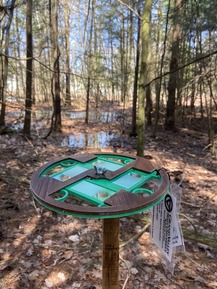
eDNA stands for Environmental DNA, which is the genetic material that is left behind in the environment by an organism as it grows, feeds, and reproduces. Traps designed to capture airborne debris are needed to survey for HWA using an eDNA strategy. (image left: eDNA trap for HWA. Image credit: https://www.partridgelabs.com/edna.) These traps contain a sticky substance, collecting debris as it comes in contact with the trap. This debris could include anything in the environment, including plant material, insects, and soil. If HWA was present in the environment, the debris could contain pieces of their cottony covering, cast exoskeletons, or even live life stages. Everything collected in the traps is then analyzed for traces of hemlock woolly adelgid DNA.
DATCP will work with the Wisconsin Department of Natural Resources this spring to complete this Specialty Crop Block Grant-funded project. eDNA traps will be placed across the state in areas with large hemlock stands or urban planted hemlocks. These surveys will help the state maintain its pest-free status and allow for timely management if HWA is detected.
|
_____________________________________
|
|
|
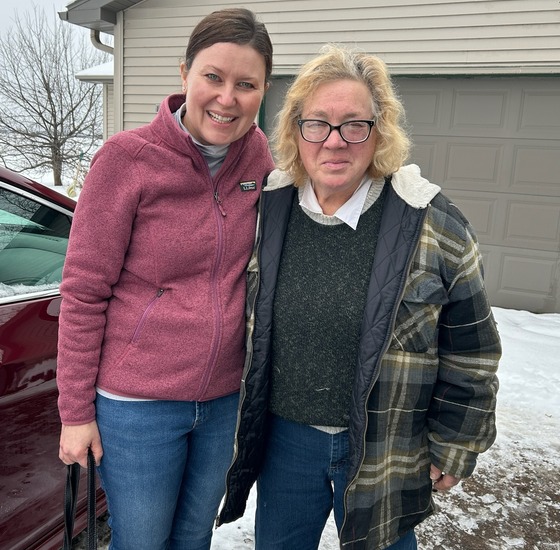
Nursery inspectors Jen Oestreich (left) and Sara Ott (right) | DATCP S. Werner
Since 1997, Sara Ott has worked tirelessly on behalf of Wisconsin’s potato producers and plant industries, conducting inspections and providing practical guidance to growers to facilitate compliance with state and federal plant protection regulations. After 28 years of state service with the Wisconsin Department of Agriculture, Trade and Consumer Protection (DATCP), Sara retired on January 5, 2026.
When Sara was hired, she served as the primary nursery inspector for the northern half of Wisconsin covering nursery dealer and grower inspections and phytosanitary inspections for logs and other export commodities. As statewide plant protection efforts expanded, Sara took on inspection of Christmas tree fields and Christmas tree lots, springtime seed sampling, firewood dealer certification inspections, and became coordinator of the DATCP Potato Program.
As Potato Program Coordinator, Sara served as the subject matter expert implementing all facets of the DATCP Potato Program, facilitating an annual audit of the UW Seed Potato Certification Program, coordinating and conducting annual fall potato rot nematode (PRN) harvest inspections, training PRN inspectors, providing regulatory outreach to growers, and compliance enforcement. She maintained a high level of knowledge of seed and commercial potato production in Wisconsin by attending industry meetings and participating in training opportunities to stay current on industry trends. She never hesitated to spend time with individual growers learning about their farm operations and sharing her own extensive knowledge of agriculture and farming.
Sara found strong value in pest surveys, advocating for their use to provide growers with information about environmental factors that could potentially impact crop production. She collected soil samples from many Christmas tree fields in Langlade, Lincoln, Marathon, and Shawano counties to test for Phytophthora root rot as part of a multi-year statewide survey from 2010 through 2014. Her participation and communication with growers greatly contributed to the success of this survey effort. Survey results were shared during the 2015 Christmas tree producer meeting, enabling growers to take prompt action to better protect their Christmas tree crop that same growing season.
In 2021, Sara helped develop a survey for potato mop top virus and the pathogen that vectors it, Spongospora subterranea f. sp. subterranea, which causes powdery scab. She was instrumental in garnering grower support and participation in this survey, and then coordinated collection of samples from fields in multiple counties over the course of the two-year survey effort. In 2023, she worked with the Plant Industry Bureau Lab to develop a potato wart sampling procedure which was provided as a resource to potato producers in January 2024.
Every growing season, she set and serviced multiple insect traps across her inspection territory as part of the Plant Industry Bureau’s annual surveillance of crop pests. Data from these surveys was provided to growers via the Pest Bulletin or Field Notes to help them proactively manage insect pests impacting their growing fields.
Collaboration and cooperation were important to Sara, who was always willing to help her coworkers in the Plant Industry Bureau. Each spring, she assisted the spongy moth Slow the Spread Program as a ground observer, playing a critical role in ensuring the safety of the pilots and all team members involved in aerial treatment operations. She also participated in group nursery inspections, and for many years, led the fall group Christmas tree field inspections in Langlade and Lincoln counties.
Sara had a strong understanding of plant protection regulations and could be counted on to regulate industry fairly and uniformly in accordance with state statutes and codes, most often providing regulatory outreach through one-on-one conversations with growers, building strong, positive relationships with these producers.
In Sara’s own words, “You have to have passion for what you do.” This was truly reflected in her deep commitment to the growers and businesses she worked with over the years. The Plant Industry Bureau thanks Sara for her exemplary service. We congratulate her on her well-deserved retirement and wish her all the best as she enters this exciting new chapter!
Until the position is filled, potato producers and licensees in Sara’s territory can direct questions to Jen Oestreich at (715) 701-1375 or Jennifer.Oestreich@Wisconsin.gov.
_____________________________________
|
|
|
In case you missed it, you can listen to the recording of the December 18 Gateway Technical College radio interview with recently retired nursery inspector Marcia Wensing. In this interview, Marcia talks about Christmas tree inspections as well as invasive pests and diseases to look out for.
_____________________________________
|
|
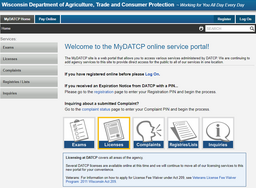
Nursery and Christmas tree licenses for this growing season (LY2026) expire on February 20, 2026. Expiration notices to renew your license for the next growing season (LY2027) were emailed and mailed out in late November. Please contact us if your email or address has changed since your last renewal.
License renewals can be completed online by using the MyDATCP portal. If you need assistance getting into your account, contact datcpnursery@wisconsin.gov or (608) 224-4574. Renewing online is an efficient way to update location information, contact information, and sources of plant materials without having to mail in a paper application.
If you are no longer in business, or if you do not plan to sell perennials next year, please let us know so we can close or suspend your license. This avoids any compliance actions, which may occur for entities who fail to contact us or renew by the February 20, 2026 deadline.
Tips and Reminders:
- Allow pop-ups from MyDATCP
- Only one tab of MyDATCP can be open at a time
- If you have multiple license types, they each need to be renewed individually; but you can pay for them all at once by accessing your invoices from the "My Invoices" tab of MyDATCP
- Watch the video tutorial to walk you through the online renewal process
- Renew your nursery license before February 20 to avoid the 20% late fee and to check this off your busy to-do list!
For more information, email DATCPnursery@wi.gov, call (608) 224-4574, or visit the Nursery and Christmas tree licensing webpage.
|
_____________________________________
|
|
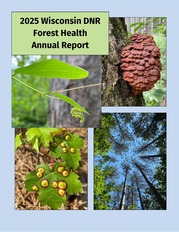
The Wisconsin Department of Natural Resources (DNR) has made its 2025 Forest Health Annual Report ready to view and download.
This year’s edition contains 55 pages of reporting on forest health issues throughout Wisconsin, detailing methods employed by the DNR and other agencies to detect and control pests, diseases, and invasive plants.
|
_____________________________________
|
|
|
A compliance agreement is a written agreement between a person engaged in growing, handling, or moving regulated articles (plants and plant parts) and either DATCP or USDA to facilitate the movement of those plants. Nursery growers, nursery dealers, and Christmas tree growers are some of the businesses that may need compliance agreements. Compliance agreements are valid for one year and must be renewed annually as needed. There is no fee to enter into a compliance agreement. Compliance agreements are generally pest-specific, so depending on what plant species you move, you may need multiple agreements.
To help you determine what compliance agreements you may need, DATCP created an interactive guide to generate a list of potential, applicable compliance agreements based on how you operate. By simply answering a series of yes/no questions, you can quickly learn what compliance agreements will help you facilitate the movement of the stock you’re buying in or selling out. Fill out the guide now to see what agreements you may need.
_____________________________________
|
|
|
For more information about Wisconsin's Nursery and Christmas Tree Programs, visit DATCP's Nursery and Christmas Tree Program webpage.
Read past issues of What's Growing On?
If you haven't yet, please take this brief feedback survey for our monthly What's Growing On? e-newsletter. With this survey, we aim to measure your satisfaction regarding the format, frequency, and quality of the content provided. Please give us your most transparent feedback. The survey is anonymous.
For current counts during the growing season from our insect monitoring networks around the state, visit our Pest Survey webpage. To read articles on economically important plant pests affecting Wisconsin's field crops, fruits, and vegetables, read our Field Notes publication put out weekly during the growing season.
|
|
|
|
|