|
 January 2026
Table of Contents
|
|
|
Counties will receive additional information about the 2025 annual survey, 2026 LWRM workplan, and 2027 SWRM grant application in January. Contact DATCPLandWater@wisconsin.gov with any questions in the meantime.

-
The Wisconsin Standards Oversight Council is seeking public comment on the Wisconsin version of the NRCS Nutrient Management (590) Conservation Practice Standard. Click here to review the draft and the companion comparison documents. Comments are due to the soc@wisconsinlandwater.org by midnight on Friday, January 16, 2026.
- Reimbursement Requests for extended 2024 funds and non-extended 2025 NMFE grant funds are due February 15, 2026 to datcpsoilwatershed@wisconsin.gov.
- 2025 NMFE final reports are due February 15, 2026 to datcpsoilwatershed@wisconsin.gov. There are different reports for Tier 1 and Tier 2 projects. Tier 1 grants also require a participant list to be submitted.
- Don’t forget to submit your survey response with your SnapPlus V3 User Group Name and associated email. You can fill out the survey here.
- The SnapPlus V3 magazine now available online! It can be found here: https://datcp.wi.gov/Documents2/SnapPlusV3Magazine.pdf.
- Are you interested in knowing when and where Nutrient Management Farmer Education (NMFE) classes are offered? Check out our new NMFE class schedule! If you have a farmer or new agronomist who is interested in learning more about nutrient management and you don’t host a NMFE class in your county, please check out this spreadsheet to look for upcoming NMFE classes nearest you!
- DATCP staff and the UW-Extension NPM team are hosting a live online Nutrient Management Farmer Education Class on March 13 from 10 a.m. to 3 p.m. This is a DATCP approved class that allows farmers to be eligible to write their own nutrient management plan. Registration is free. Register here: www.go.wisc.edu/OnlineNMTraining.
|
|

-
The pre-approval INTENT TO APPLY form was due by December 19, 2025, to monica.schauer@wisc.edu. The applications are due on January 16, 2026. Visit the NOPP website to learn more.
-
NEW THIS YEAR: there are three options for research project scenarios.
|
|

-
DATCP is hosting a series of webinars for co-op staff to learn more about our programs and ask questions so they can better serve their customers. Each webinar is scheduled from 10-11:15 a.m. and will be recorded. CEUs will be available, and registration is required to attend. The dates and topics are below:
- January 27 – Nutrient Management planning and Farmland Preservation Program – Register here
- February 3 – Soil and Water Resource Management Grant, Commercial Nitrogen Optimization Pilot Program, and Producer-Led Watershed Protection Grants – Register here
- February 10 - Manure storage ordinances, Livestock Siting, and local ordinances – Register here
|
|

-
The application is open on a first come, first served basis until January 30 at noon, or until program funding is exhausted. Eligible applicants must apply online.
- The web-based rebate application, information about eligibility, and FAQs are available on covercroprebate.wi.gov.
|
|

-
We are now accepting Reserve Fund Applications for the 2026 allocation! This year, we have $300,000 in the Reserve Fund. Please work with your engineering contacts to complete the needed materials. Applications are due by Friday, March 27, 2026.
- A friendly reminder, we are one year into our three-year cycle for Professional Development Hours (PDHs). If you carry DATCP certification or NRCS job approval, by the end of 2027 you need to have 30 Engineering PDHs in the 2025 to 2027 period. That means to be “on track,” you should have about 10 PDHs at this time. Do not count hours that you obtained early in 2025 to make up for hours missed in the last PDH period, if applicable. If you receive certification/job approval for the first time in this PDH cycle, your required PDHs will be based on the portion of the three-year period for which you had certification/job approval. As a reminder, it is easier to keep track of trainings as you go rather than trying to remember everything at the end of 2027.
|
|

-
The LWCB Advisory Committee on Research will meet January 6, 2026. Register for the meeting here.
- Crawford and Sawyer counties will present LWRM plan revisions at the February 3, 2026, meeting of the Land and Water Conservation Board.
|
|

-
Farm Bill Extended to September 30, 2026 – CREP Enrollment 2026
FSA has reported the Farm Bill was extended reauthorizing CRP until September 30, 2026 as part of the “Continuing Appropriations, Agriculture, Legislative Branch, Military Construction and Veterans Affairs, and Extensions Act, 2026.” The FSA National Office is working on a notice to provide guidance that restores CRP authority along with CREP. This means hopefully landowners will have an opportunity to sign up for CREP in 2026. We will keep you posted on details as formal guidance in posted in the coming months.
|
|

-
Wisconsin law requires that the board shall file with the Wisconsin Department of Agriculture, Trade and Consumer Protection (DATCP); the town board or town zoning committee; the city council, plan commission, or plan committee; and the county zoning administrator in which district territory is located, a separate report for the preceding fiscal year on each drainage district under the board's jurisdiction. Unless the board selects a different fiscal year and notifies DATCP of the selection, the board's fiscal year begins on September 1 and ends the following year on August 31.
Reports must include:
- A financial statement
- A statement of all bonds paid or issued during the year
- A statement of all work done during the year, specifying location and cost
- A copy of the annual inspection report
- A copy of the storm inspection report
-
All activities within drainage districts are managed and administered by a county drainage board. Contact information can be found on the Drainage Program website or by contacting Barton T. Chapman, P.E., Drainage Program Manager, at Barton.Chapman@Wisconsin.gov.
|
|

-
The Farmland Preservation Agreement application has been updated. The new application now includes an area on the form to indicate that the application is to re-enroll lands under an expiring agreement. The new form can be located here or on our website farmlandpreservation.wi.gov. All agreement applications submitted after January 1, 2026 must use the new agreement form. Agreement applications submitted on the old form after this time will be asked to resubmit on the current form.
|
|

-
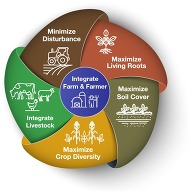
The Soil Health Graphic and our Soil Health Website was updated to recognize the importance of integrating the farm and the farmer in the soil health system. Soil Health is accomplished by implementing the Principles of Soil Health and providing the functions of a healthy soil; regulating water, cycling nutrients, sustaining plant and animal life, providing physical stability and support, and filtering and buffering potential pollutants. Check out the DATCP Soil Health website here.
- Changes to the Soil Health website will be coming this year, including new Module 4 Soil Health Implementation Videos, soil health assessment resources, workshops, and more. Be sure to check the website regularly for updates.
- How do we know our conservation efforts are improving soil health? The Soil Health Assessment kit developed by Kevin Erb with UW Extension combines portions of the NRCS Cropland In-Field Soil Health Assessment Guide (Tech Note No. 450-06) and their Soil Quality Test Kit Guide to provide a tool for in-field assessment of changes in soil health. The kit includes 6-inch metal rings to measure water infiltration; a penetrometer to measure compaction; small screens and 16-ounce cups for the slake/slump test to measure aggregate stability; a digital soil thermometer to measure soil temperature; and a square foot of PVC pipe to measure plant counts and earthworm counts for the field assessments. It also has the SARE book Building Soils for Better Crops: Ecological Management for Healthy Soils as a resource. Utilizing these assessments provides a method for monitoring improvements in soil health as we follow the soil health principles for our systems approach to conservation planning.
-
REMINDER: Soil Health User Group – Whether it’s questions about using or building your soil health assessment kit or implementing ATCP 50 practices with soil health as a resource concern, DATCP is looking for feedback on how we can better support soil health initiatives. Please contact Randy Zogbaum at randalll.zogbaum@wisconsin.gov if you have any feedback to share and/or would be interested in participating in a Soil Health User Group.
|
|
|
|
|
|