|
 December 2025
Table of Contents
|
|

-
The web-based application opened December 1, 2025 on a first come, first served basis.
- The web-based rebate application, information about eligibility, and FAQs are available on covercroprebate.wi.gov. Applicants should have a copy of their FSA-578 form available to complete the application.
|
|

-
Intent to Apply forms and applications were posted on October 30, 2025, and applications are due on January 16, 2026. Visit our website to learn more.
-
NEW THIS YEAR: there are options for research project scenarios.
-
REQUIRED: UW pre-approval requires an Intent to Apply form to be submitted by December 16, 2025, to monica.schauer@wisc.edu.
|
|

-
County CREP Annual In-Kind Cost Reporting:
Counties are asked to report their CREP administrative costs to DATCP by no later than December 5, 2025. The county contributions to administer CREP count toward Wisconsin’s overall match requirements for federal CREP funds and are important for meeting statewide CREP program requirements reported to FSA by the end of the year. The reporting form (LWR-282) is on the CREP website. Completed reports should be sent as a PDF via email to Brian Loeffelholz at Brian.Loeffelholz@wisconsin.gov.
-
Farm Bill Extended to September 30, 2026 – CREP Enrollment 2026
FSA has reported the Farm Bill was extended reauthorizing CRP until September 30, 2026 as part of the “Continuing Appropriations, Agriculture, Legislative Branch, Military Construction and Veterans Affairs, and Extensions Act, 2026.” The FSA National Office is working on a notice to provide guidance that restores CRP authority along with CREP. This means hopefully landowners will have an opportunity to sign up for CREP in 2026. We will keep you posted on details as formal guidance in posted in the coming months.
|
|

-
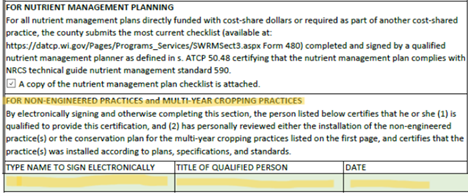
Please make sure you are certifying your non-engineered practices on your reimbursement form! This applies to cover crops, contour farming, residue management, intensive grazing management, critical area stabilization, field windbreaks, livestock fencing, and riparian buffers.
|
|

-
Extension requests for unspent 2025 Nutrient Management Farmer Education grant funds are due to datcpsoilwatershed@wisconsin.gov by December 31, 2025.
-
NEW – Are you hosting a Nutrient Management Farmer Education Class this winter or next spring? If the answer is yes, please fill out the following survey: https://forms.office.com/g/aAJ8NYC213. As an effort to share out more nutrient management (NM) training opportunities, DATCP will be taking survey responses and creating a calendar of NM training opportunities to share with farmers so that they can find classes near them if they can’t make their county class, and/or for new agronomists and conservation staff looking for NM educational opportunities! (Please note: you do not have to have a NMFE grant to enter your training information!)
- DATCP staff and the UW-Extension NPM team are hosting a live online Nutrient Management Farmer Education Class on March 13 from 10 a.m. to 3 p.m. This is a DATCP approved class that allows farmers to be eligible to write their own nutrient management plan. Registration is free. Register here: www.go.wisc.edu/OnlineNMTraining.
- Do you have new staff or agronomists that you work with that would like to learn about Nutrient Management Planning in Wisconsin? DATCP has a five-webinar series that walks through the requirements of nutrient management planning and helps prepare planners for writing plans in Wisconsin. Additionally, there is a quiz that reviews content from the five webinars! All can be found here: Resources for Wisconsin’s Qualified Nutrient Management Planners.
- SnapPlus V3 YouTube tutorials are live and available here: https://www.youtube.com/watch?v=BW-aXyCheQI&list=PLhFkw4rJA7C-J5PgpeJUrjMz42MZ_6PkQ.
|
|

-
Award letters for 2026 have been sent to all successful applicants and contract development is underway. The department will be issuing a news release in the coming weeks.
-
Extension requests for unspent 2025 grant funds are due December 31, 2025 to datcpprodled@wisconsin.gov.
|
|

-
A couple of reminders to pass along:
- If you need engineering approval of projects before the end of the year for SWRM cost share, please reach out to your engineering contact with as much notice as possible since staff often take leave over the holidays.
- As you start to work on planning and designing next year’s projects, please submit your Cultural Resources (CR) checks to your DATCP CR contact as soon as you know the extent of the project disturbance so the check can be completed well in advance of the project. As a reminder, DATCP CR contacts for state funded projects are below:
NOTE: If projects will have Federal financial assistance (EQIP, etc.), please continue to send these Cultural Resources requests through the NRCS process.
|
|

-
Wisconsin law requires that the board shall file with the Wisconsin Department of Agriculture, Trade and Consumer Protection (DATCP); the town board or town zoning committee; the city council, plan commission, or plan committee; and the county zoning administrator in which district territory is located, a separate report for the preceding fiscal year on each drainage district under the board's jurisdiction. Unless the board selects a different fiscal year and notifies DATCP of the selection, the board's fiscal year begins on September 1 and ends the following year on August 31.
Reports must include:
- A financial statement
- A statement of all bonds paid or issued during the year
- A statement of all work done during the year, specifying location and cost
- A copy of the annual inspection report
- A copy of the storm inspection report
DATCP provides an annual report form and inspection report form that may be used. They are available under "additional resources" on the Drainage Program website. An alternative format that includes the required information may be used.
- All activities within drainage districts are managed and administered by a county drainage board. Contact information can be found on the Drainage Program website or by contacting Barton T. Chapman, P.E., Drainage Program Manager, at Barton.Chapman@Wisconsin.gov.
|
|

-
The Farmland Preservation Agreement application has been updated. The new application now includes an area on the form to indicate that the application is to re-enroll lands under an expiring agreement. The new form can be located here or on our website farmlandpreservation.wi.gov. All agreement applications submitted after January 1, 2026 must use the new agreement form. Agreement applications submitted on the old form after this time will be asked to resubmit on the current form.
- We are still accepting applications for farmland preservation agreements. Agreement applications that are submitted to the department by Friday, November 7, 2025 will be prioritized for processing for 2025 tax credit eligibility. Landowners who are interested in applying for a farmland preservation agreement are encouraged to apply early. We will continue to process agreements throughout November and December, but agreements submitted to us after November 7 may not be processed before the end of the taxable year. As you work with landowners this field season, encourage them to apply early so they can claim the tax credit for 2025. Completed agreement applications should be submitted to DATCPWorkingLands@wisconsin.gov.
|
|

-
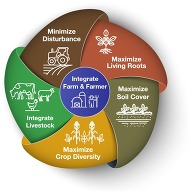
REMINDER: Soil Health User Group – Whether it’s questions about using or building your soil health assessment kit or implementing ATCP 50 practices with soil health as a resource concern, DATCP is looking for feedback on how we can better support soil health initiatives. Please contact Randy Zogbaum at randalll.zogbaum@wisconsin.gov if you have any feedback to share and/or would be interested in participating in a Soil Health User Group.
- How do we know our conservation efforts are improving soil health? The Soil Health Assessment kit developed by Kevin Erb with UW Extension combines portions of the NRCS Cropland In-Field Soil Health Assessment Guide (Tech Note No. 450-06) and their Soil Quality Test Kit Guide to provide a tool for in-field assessment of changes in soil health. The kit includes 6-inch metal rings to measure water infiltration; a penetrometer to measure compaction; small screens and 16-ounce cups for the slake/slump test to measure aggregate stability; a digital soil thermometer to measure soil temperature; and a square foot of PVC pipe to measure plant counts and earthworm counts for the field assessments. It also has the SARE book Building Soils for Better Crops: Ecological Management for Healthy Soils as a resource. Utilizing these assessments provides a method for monitoring improvements in soil health as we follow the soil health principles for our systems approach to conservation planning.
|
|
|

-
ATCP 52’s permanent rule update related to Producer-Led Watershed Protection Grants, the Commercial Nitrogen Optimization Pilot Program, and the Crop Insurance Rebates for Planting Cover Crops was approved by the Governor on November 20, 2025. Updates include general rule cleanup and the incorporation of the Commercial Nitrogen Optimization Pilot Program and Crop Insurance Premium Rebates for Planting Cover Crops Program. DATCP will ultimately transmit the final rule to the Legislative Reference Bureau for publication. Documents relating to this rule can be found here: CR 25-057.
-
Emergency Rule 2515 (EmR2515) for Providing Crop Insurance Premium Rebates for Planting Cover Crops
-
Emergency Rule 2516 (EmR2516) for Commercial Nitrogen Optimization Pilot Program
|
|

-
Abby Johnson joined DATCP as a Conservation Grants Program Manager on November 17.
Abby will be serving as the SWRM Program Manager for Adams–Manitowoc Counties, taking over Kim Carlson’s former role. Prior to joining DATCP, she most recently served as the Partnership Liaison for the USDA Natural Resources Conservation Service-Wisconsin, working with conservation partners on grant projects across the state. Her educational background includes a B.S. in Conservation & Environmental Science from the University of Wisconsin-Milwaukee.
- Janet Vosberg started as the DATCP Hydrologic & Hydraulic (H&H Engineer) on November 17.
Janet recently retired from the NRCS where she worked for 21 years as an agricultural engineer in the Southwest Area. In her new position with DATCP, she will be providing statewide engineering assistance on conservation projects that require H&H analysis and will be conducting H&H training. Janet will be working a part-time schedule, so please reach out to your DATCP engineering field contact if you have projects that need H&H assistance/modeling.
|
|
|
|
|