|
 October 2025
Table of Contents
|
|

-
NEW THIS YEAR: there are three options for research project scenarios.
-
REQUIRED: UW pre-approval requires an Intent to Apply form to be submitted by December 16, 2025, to monica.schauer@wisc.edu.
-
COMING SOON: NOPP Intent to Apply forms and applications will be available mid-October.
|
|

-
The Wisconsin Association of Drainage Boards (WADB), in cooperation with DATCP, has scheduled several statewide outreach meetings. The purpose of the meetings is to engage the drainage community; landowners, drainage boards and county officials, and provide information on drainage districts and the implementation of Wisconsin drainage law. These meetings provide affected stakeholders the opportunity to share their concerns and help develop statewide policy. There is one final meeting scheduled, to be held from 1 p.m. to 3:30 p.m. at the following location:
-
Racine County
Wednesday, October 22, 2025
Racine County, Ives Grove Complex Auditorium
14200 Washington Ave.
Sturtevant, WI
- All activities within drainage districts are managed and administered by a county drainage board. Contact information can be found on the Drainage Program website or by contacting Barton T. Chapman, P.E., Drainage Program Manager, at Barton.Chapman@Wisconsin.gov.
|
|

-
The final Joint Allocation Plan will be presented to the Land and Water Conservation Board on Tuesday, October 7. Upon the Board’s recommendation, it will be signed by the DATCP and DNR secretaries.
- The SWRM staffing grant will be part of a discussion at the second day of the County Conservation meeting on October 15 and 16. Please share any questions with DATCP staff prior to the meeting at DATCPSWRM@wisconsin.gov.
-
NEW FORMS REQUIRED! Many of the SWRM forms have been updated with new content and new numbers. Please refer to Section 3 of the SWRM Grant Resources webpage to access these forms.
|
|

-
DATCP CREP Agreement Submittal Deadline is November 14, 2025.
FSA had two rounds of signups for CREP in federal fiscal year 2025 and could approve new CREP enrollment offers up to September 30, 2025 (Sign up 63). Please contact your local FSA office to see if there are any pending CREP CRP1s that need the state/county CREP agreement (LWR-283) completed. Friday, November 14, 2025, is the deadline to submit the completed CREP state/county agreement to DATCP to ensure state payment by December 31, 2025, for the 2025 tax year.
-
Farm Bill Update: No updates are available for the Farm Bill.
With the expiration to the second extension of the 2018 Farm Bill, authority to take new CREP enrollment offers will be on hold until there is another extension or new Farm Bill.
-
County CREP Annual In-Kind Cost Reporting:
Counties are asked to report their CREP administrative costs to DATCP by no later than December 5, 2025. The county contributions to administer CREP count toward Wisconsin’s overall match requirements for federal CREP funds and are important for meeting statewide CREP program requirements reported to FSA by the end of the year. The reporting form (LWR-282) is on the CREP website. Completed reports should be sent as a PDF via email to Brian Loeffelholz at Brian.Loeffelholz@wisconsin.gov.
|
|

-
Any counties with farmland preservation plans or municipalities with farmland preservation zoning ordinances that are expiring this year should send application materials to DATCPWorkingLands@wisconsin.gov. If your final application is not ready, please still send the plan or ordinance so that we can conduct a preliminary review. Any applications received after November 14 may not be certified before the plan or ordinance expires.
- The Farmland Preservation Agreement application has been updated. The new application now includes an area on the form to indicate that the application is to re-enroll lands under an expiring agreement. The new form can be located here or on our website farmlandpreservation.wi.gov. All agreement applications submitted after January 1, 2026 must use the new agreement form. Agreement applications submitted on the old form after this time will be asked to resubmit on the current form.
- We are currently accepting applications for farmland preservation agreements. Agreement applications that are submitted to the department by Friday, November 7, 2025 will be prioritized for processing for 2025 tax credit eligibility. Landowners who are interested in applying for a farmland preservation agreement are encouraged to apply early. We will continue to process agreements throughout November and December, but agreements submitted to us after November 7 may not be processed before the end of the taxable year. As you work with landowners this field season, encourage them to apply early so they can claim the tax credit for 2025. Completed agreement applications should be submitted to DATCPWorkingLands@wisconsin.gov.
|
|

-
NEW – Nutrient Management Regional Meetings – Our regional meetings have wrapped up for the year! Thank you to everyone who attended! If you were unable to attend and would like to watch the recordings and access the slides, they can be found here: Nutrient Management Regional Trainings.
-
NEW – Are you hosting a Nutrient Management Farmer Education Class this winter or next spring? If the answer is yes, please fill out the following survey: https://forms.office.com/g/aAJ8NYC213. As an effort to share out more nutrient management (NM) training opportunities, DATCP will be taking survey responses and creating a calendar of NM training opportunities to share with farmers so that they can find classes near them if they can’t make their county class, and/or for new agronomists and conservation staff looking for NM educational opportunities! (Please note: you do not have to have a NMFE grant to enter your training information!)
-
NEW – SnapPlus V3 can be utilized to write nutrient management plans for the 2026 growing season. Guidance will be shared soon on how to submit a complete plan using SnapPlus V3 for both county LCD staff and agronomists/farmers.
-
NEW – Updates have been made to the 590 checklist to include the addition of the Targeted Silurian Bedrock Performance Standard. There are two checklists available: one for operations in Silurian and one for all other operations. SnapPlus will automatically choose which checklist is needed based on where the fields are located. New versions of the checklist can be found here:
Take note: these versions of the checklist are only built into Version 3 of SnapPlus and will not be available in Version 2.
-
NEW – Please review the attached memos for updated guidance on nutrient management plan submission deadlines. Though DATCP cannot require counties to utilize the same deadline, we strongly encourage it in hopes of gaining more consistency across the state.
|
|

-
The Conservation Engineering Section is happy to announce that Cody Overgard will start as our new Environmental Specialist in the northwest on October 20. We will share more information in that area once Cody starts.
|
|

-
The AIS Program published AIS 4632 for the North Central Wisconsin Reliability Project in Lincoln and Marathon counties.
- You can find more information about the AIS program at agimpact.wi.gov. You can also contact DATCPAgImpactStatements@wisconsin.gov with questions regarding any active AIS statement or the AIS program.
|
|

-
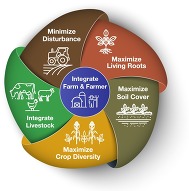
The Soil Health Graphic and our Soil Health Website was recently updated to recognize the importance of integrating the farm and the farmer in the soil health system. Soil health principles give us the guideposts to ensure our soil is a vital living ecosystem. As the Natural Resource Conservation Service (NRCS) states, soil health provides the framework to provide “the continued capacity of soil to function as a vital living ecosystem that sustains plants, animals, and humans. Healthy soil gives us clean air and water, bountiful crops and forests, productive grazing lands, diverse wildlife, and beautiful landscapes." Soil Health is accomplished by implementing the Principles of Soil Health and providing the functions of a healthy soil; regulating water; cycling nutrients; sustaining plant and animal life; providing physical stability and support; and filtering and buffering potential pollutants. Check out the DATCP Soil Health website here.
- How do we know our conservation efforts are improving soil health? The Soil Health Assessment kit developed by Kevin Erb with UW Extension combines portions of the NRCS Cropland In-Field Soil Health Assessment Guide (Tech Note No. 450-06) and their Soil Quality Test Kit Guide to provide a tool for in-field assessment of changes in soil health. The kit includes 6-inch metal rings to measure water infiltration; a penetrometer to measure compaction; small screens and 16-ounce cups for the slake/slump test to measure aggregate stability; a digital soil thermometer to measure soil temperature; and a square foot of PVC pipe to measure plant counts and earthworm counts for the field assessments. It also has the SARE book Building Soils for Better Crops: Ecological Management for Healthy Soils as a resource. Utilizing these assessments provides a method for monitoring improvements in soil health as we follow the soil health principles for our systems approach to conservation planning.
-
REMINDER: Soil Health User Group – Whether it’s questions about using or building your soil health assessment kit or implementing ATCP 50 practices with soil health as a resource concern, DATCP is looking for feedback on how we can better support soil health initiatives. Please contact Randy Zogbaum at randalll.zogbaum@wisconsin.gov if you have any feedback to share and/or would be interested in participating in a Soil Health User Group.
-
REMINDER – Soil Health Training! Randy can provide or help develop training at any length or format for the summer field season. Below are three suggested learning objectives for soil health trainings. Contact Randy Zogbaum if you would like custom trainings to meet specific needs. Randy is also available if you have questions regarding the online trainings or the soil health program, email Randy at randalll.zogbaum@wisconsin.gov.
-
Learning objective 1 is to discuss what soil health is (and isn't) by defining some basic vocabulary and concepts.
-
Learning objective 2 is to demonstrate how to assess and monitor changes and improvements in soil health on Wisconsin Farms.
-
Learning objective 3 is to demonstrate how soil health systems can be implemented on Wisconsin farms.
|
|
|

-
The 2026 application period for the Producer-Led Watershed Protection Grants has closed. The review process is underway and award decision letters will go out in November. If you have any questions, please contact Dani Heisler at dani.heisler@wisconsin.gov.
|
|

-
DATCP is revising ATCP 52’s Permanent Rule related to Producer-Led Watershed Protection Grants. Updates include general rule cleanup and the incorporation of the Commercial Nitrogen Optimization Pilot Program and Crop Insurance Premium Rebates for Planting Cover Crops Program. Documents relating to this rule can be found here: CR 25-057.
-
Emergency Rulemaking is also underway for providing Crop Insurance Premium Rebates for Planting Cover Crops and Commercial Nitrogen Optimization Pilot Program to administer the programs until a permanent rule is in effect.
|
|
|
|
|