|
 September 2025
Table of Contents
|
|

-
Nutrient Management Regional Meetings - there are two more regional meetings in September: September 9 in Eau Claire and September 10 in Appleton. These meetings are the best opportunity to hear the latest nutrient management updates from DATCP, NRCS, and UW staff. A light lunch will be provided as well as CEUs. More information and registration are available here: NPM Regional Meetings.
- SnapPlus V3 Online Tutorial is now available! The recording from our SnapPlus V3 webinar is now available along with the materials needed to follow along and participate alongside the webinar. More information can be found here: Nutrient Management Trainings. Scroll down to “Online Training” and access “SnapPlus Training: SnapPlus V3 Tutorial Webinar.”
|
|

-
The DATCP Hydrologic & Hydraulic (H&H) Engineer position has been posted. The deadline to apply is 11:59 p.m. on Monday, September 8, 2025. It is a project position with a projected end date of September 30, 2028. The selected applicant will have the ability to work 20 to 40 hours per week. The job posting and additional details can be found here. Please share this job posting with anyone you think might be interested!
|
|

-
The Wisconsin Association of Drainage Boards (WADB), in cooperation with DATCP, has scheduled several statewide outreach meetings. The purpose of the meetings is to engage the drainage community; landowners, drainage boards and county officials, and provide information on drainage districts and the implementation of Wisconsin drainage law. These meetings will provide affected stakeholders the opportunity to share their concerns and help develop statewide policy. All meetings will be held from 1 p.m. to 3:30 p.m. at the following locations:
-
Outagamie County
Wednesday, September 17, 2025
Town of Center Town Hall
N3990 State Road 47
Appleton, WI
-
Racine County
Wednesday, October 22, 2025
Racine County, Ives Grove Complex Auditorium
14200 Washington Ave.
Sturtevant, WI
- All activities within drainage districts are managed and administered by a county drainage board. Contact information can be found on the Drainage Program website or by contacting Barton T. Chapman, P.E., Drainage Program Manager, at Barton.Chapman@wisconsin.gov.
|
|

-
The 2024 Wisconsin Annual Report on Soil and Water Conservation is now available on our website. The report provides an overview of the varied conservation activities across the state. This year’s report features Ashland, Brown, Juneau, La Crosse, Manitowoc, Marathon, Outagamie, and Washington counties. Please share the report and the stories with your networks to help us spread the word about the conservation work across the state!
|
|

-
Enrollment Update FFY2025 – Check with FSA Offices There where two rounds for enrollment for CREP this year under signup 63 for FFY2025, for both new and reenrolled acres. If you have not already, please reach out to your local FSA office when you have a chance to start the county/state enrollment side of CREP with landowners. Below are the federal enrollment deadlines for this year’s sign up.
9/19/2025 - Deadline for NRCS/TSP to complete the conservation plan, sign and obtain signatures on CRP-1, and return the conservation plan to FSA.
9/30/2025 - Deadline for COC or CED to approve FSA CRP/CREP contracts (CRP-1’s).
|
|

-
Any counties with farmland preservation plans or municipalities with farmland preservation zoning ordinances that are expiring this year should send application materials to DATCPWorkingLands@wisconsin.gov by Wednesday October 1, 2025 to ensure that their materials are certified before the end of the year. If your final application is not ready, please still send the plan or ordinance so that we can conduct a preliminary review. Any applications received after November 14 may not be certified before the plan or ordinance expires.
- The Farmland Preservation Agreement application has been updated. The new application now includes an area on the form to indicate that the application is to re-enroll lands under an expiring agreement. The new form can be located here or on our website farmlandpreservation.wi.gov. All agreement applications submitted after January 1, 2026 must use the new agreement form. Agreement applications submitted on the old form after this time will be asked to resubmit on the current form.
- We are currently accepting applications for farmland preservation agreements. Agreement applications that are submitted to the department by Friday, November 7, 2025 will be prioritized for processing for 2025 tax credit eligibility. Landowners who are interested in applying for a farmland preservation agreement are encouraged to apply early. We will continue to process agreements throughout November and December, but agreements submitted to us after November 7 may not be processed before the end of the taxable year. As you work with landowners this field season, encourage them to apply early so they can claim the tax credit for 2025. Completed agreement applications should be submitted to DATCPWorkingLands@wisconsin.gov.
|
|

-
The AIS program published AIS 4653 for the ANR Heartland Project in Brown, Racine, Sheboygan, Waukesha, and Winnebago counties.
- You can find more information about the AIS program at agimpact.wi.gov. You can also contact DATCPAgImpactStatements@wisconsin.gov with questions regarding any active AIS statement or the AIS program.
|
|

-
On September 2, 2025, the LWCB Advisory Committee on Research convened.
|
|

-
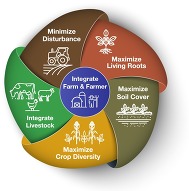
The Soil Health Graphic and our Soil Health Website was recently updated to recognize the importance of integrating the farm and the farmer in the soil health system. Soil health principles give us the guideposts to ensure our soil is a vital living ecosystem. As the Natural Resource Conservation Service (NRCS) states, soil health provides the framework to provide “the continued capacity of soil to function as a vital living ecosystem that sustains plants, animals, and humans. Healthy soil gives us clean air and water, bountiful crops and forests, productive grazing lands, diverse wildlife, and beautiful landscapes." Soil Health is accomplished by implementing the Principles of Soil Health and providing the functions of a healthy soil; regulating water; cycling nutrients; sustaining plant and animal life; providing physical stability and support; and filtering and buffering potential pollutants. Check out the DATCP Soil Health website here.
|
-
REMINDER: Soil Health User Group – It has been a year since ATCP 50 was updated - what have you discovered? How do you evaluate soil health? Does your office have a Soil Health kit? If so, how do you use these kits? There’s a growing interest in soil health benefits, and these kits are a great tool to evaluate changes to soil health with the implementation of conservation practices. DATCP is looking for feedback on how we can better support soil health initiatives. Please contact Randy Zogbaum at randalll.zogbaum@wisconsin.gov if you have any feedback to share and/or would be interested in participating in a Soil Health User Group.
-
REMINDER – Soil Health Training! Randy can provide or help develop training at any length or format for the summer field season. Below are three suggested learning objectives for soil health trainings. Contact Randy Zogbaum if you would like custom trainings to meet specific needs. Randy is also available if you have questions regarding the online trainings or the soil health program, email Randy at randalll.zogbaum@wisconsin.gov.
-
Learning objective 1 is to discuss what soil health is (and isn't) by defining some basic vocabulary and concepts.
-
Learning objective 2 is to demonstrate how to assess and monitor changes and improvements in soil health on Wisconsin Farms.
-
Learning objective 3 is to demonstrate how soil health systems can be implemented on Wisconsin farms.
|
|
|
|
|