|
|
Dangerous heat arrived in Wisconsin mid-week, replacing an otherwise cooler-than-normal weather pattern. Temperatures averaged 0-5°F below normal throughout the state until July 23, when highs peaked in the mid-90s and heat indices climbed to 100-105°F. The searing temperatures and humidity caused the National Weather Service to issue an extreme heat advisory for much of Wisconsin on Wednesday. As the haze of wildfire smoke again blanketed the state, scattered showers brought highly variable weekly rainfall totals, generally ranging from 0.1 to 5.0 inches. Most summer crops remained within one to two days of the five-year average pace of development.
In addition to advisories for heat and air quality, an armyworm advisory was issued by DATCP’s Pest Survey Program and the UW-Madison. Remarkably large populations of true armyworm larvae began emerging July 18 and reports of mass migrations of caterpillars increased throughout the week,
with sightings in at least eight counties. Continued armyworm activity is likely through late July and into August and growers should remain on alert to prevent crop damage.
__________________________________
|
|
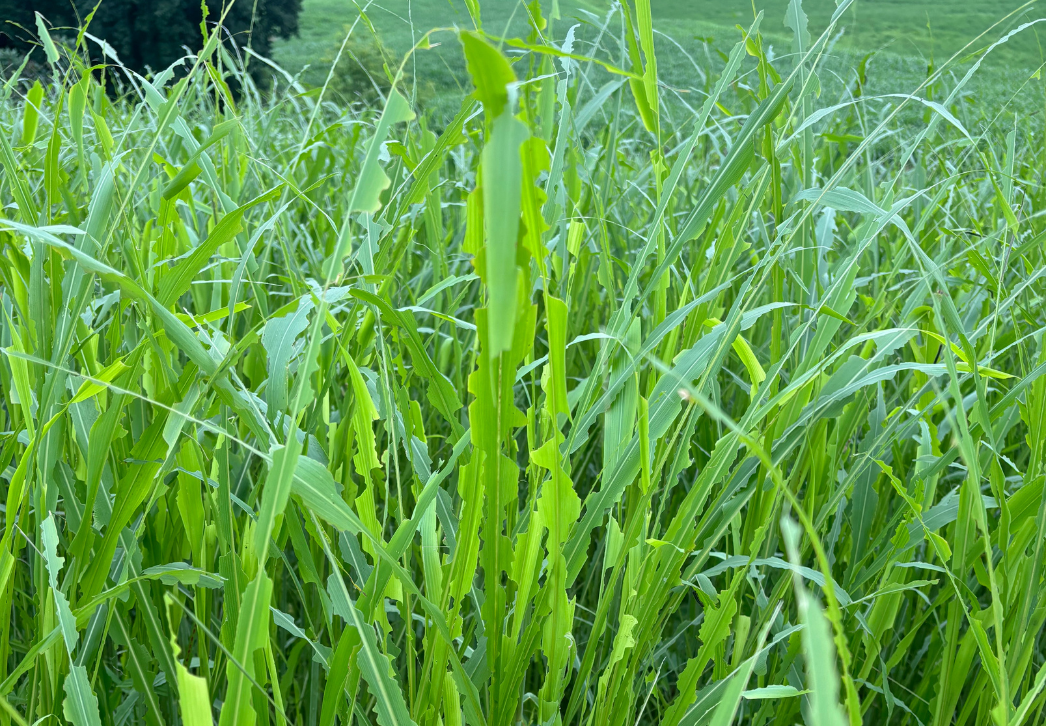
Locally heavy populations of second-generation true armyworm larvae are appearing in crops and lawns in the southern and western areas of the state. The UW-Madison Insect Diagnostic Lab and DATCP have received several reports of armyworm activity in the past seven days, most of which involved larvae migrating through residential yards to nearby crop fields. As of July 24, reports have come in from Columbia, Crawford, Dane, Dunn, Eau Claire, Iowa, Jefferson, and Taylor counties. The infestations in Eau Claire and near Boyceville in Dunn County were particularly heavy and included photos and videos of armyworm larvae migrating across driveways and roads toward corn fields.
The timing of the infestations is typical for second-generation armyworms and corresponds with significant moth flights tracked by DATCP’s True Armyworm Trap Network about three weeks ago. Additional large flights this month could lead to more larvae and feeding extending well into August. Increased scouting of corn, small grains, and other susceptible crops for armyworms should be prioritized at this time to avert potential problems. |
|
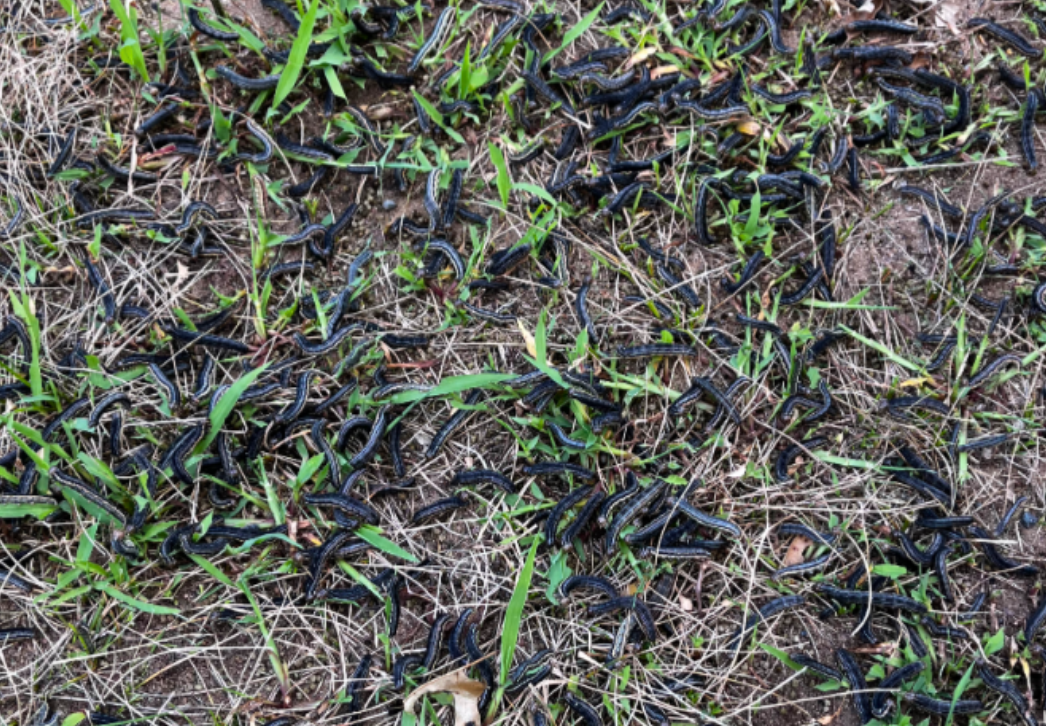 True armyworm larvae Dunn Co. July 21, 2025
|
|
Initial scouting can begin with using a sweep net to sample field edges, forage grasses, and grassy areas within crop fields, followed by a crop-specific scouting method if armyworm larvae are found. Scouting should determine the size and abundance of the larvae while also accounting for parasitized or diseased armyworms, which could signal the start of population collapse. Insecticide treatment is not likely to provide economic benefit if populations are beginning to pupate or are heavily parasitized.
Treatment thresholds are based on the size of the larvae and number of infested plants for corn, and larvae per square foot for small grains. In corn and sorghum fields, sampling five sets of 20 plants (100 total) for armyworms and signs of feeding is required. Spot treatment is acceptable for infestations of two or more armyworms (0.75 to 1.0 inch or smaller) per plant on 25% of the plants, or one caterpillar per plant on 75% of the plants. Treating small grains is warranted for levels of three or more armyworms per square foot. Producers and advisors are reminded to check pre-harvest intervals to make sure insecticide application aligns with harvest plans. Insecticides labeled for armyworm control in corn (p. 59), alfalfa (p. 175), and small grains (p. 195) are provided in UW-Extension publication A3646 Pest Management in Wisconsin Field Crops. |
|
 __________________________________
|
|
|
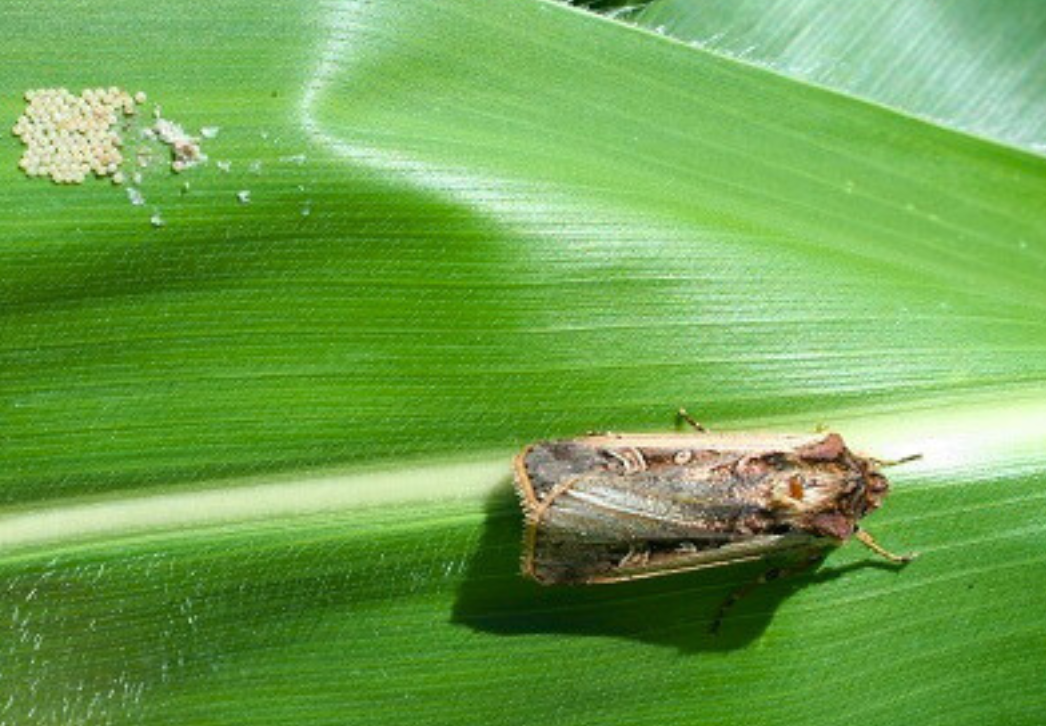
Western bean cutworm moth | Chris DiFonzo bugguide.net
 
|
|
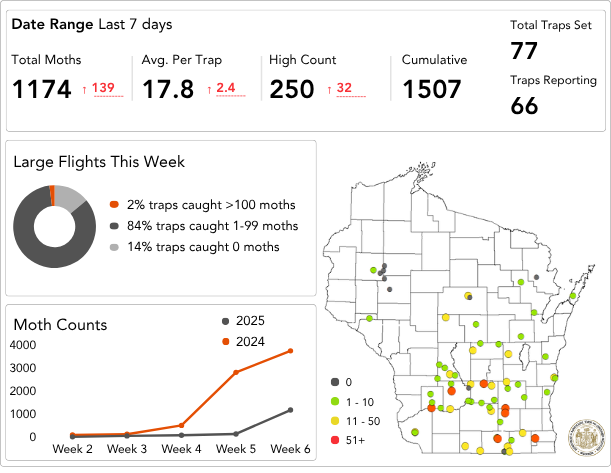
DATCP’s western bean cutworm monitoring network documented a marked increase in moth counts July 18-24. Fifty-seven of the 66 traps collected one or more moths during the week and seven traps captured over 50 moths. These elevated counts indicate the annual flight has peaked or will soon peak throughout the southern half of the state. Peak moth emergence (50% emergence) coincides with the accumulation of 2,704 degree days (modified base 38°F). Moth emergence currently ranges from 25%-50% complete across southern and central Wisconsin, while the flight is just beginning near Wausau and northward where 25% of the population should emerge July 29-August 11.
For the week ending July 24, pheromone traps captured a total of 1,174 western bean cutworm moths. This compares to 139 moths last week and 82 moths the week before. The cumulative state count is now 1,507 moths (19.1 per trap average), which is far below the 7,290 moths in 69 traps (106 per trap average) at the same time last year. The highest individual pheromone trap count for the current monitoring period was 250 moths near Lake Mills in Jefferson County. |
|
DATCP is currently participating in the Great Lakes and Maritimes Pest Monitoring Network, which provides western bean cutworm flight data for a broad geographic area extending across the northeastern US and adjacent Canadian provinces. The Great Lakes map shows similar trap counts throughout the monitoring range in the past week (less than 300 moths per trap), with the exception of Nebraska, where very heavy flights of 500-1,300 moths were registered. |
|
 __________________________________
|
|
|
The summer codling moth flight is beginning in Wisconsin apple orchards. Several cooperators reported an increase in trap counts in the past week, and pressure from second-generation larvae may be high next month following the large flights observed in spring. High codling moth pressure is indicated by a weekly count of five or more moths per trap for orchards not using mating disruption (non-MD) and two to three moths per trap for orchards using mating disruption (MD). Counts this week ranged as high as 20 moths per trap, with six monitoring locations reporting above-threshold counts.
For non-MD orchards with high codling moth counts in the range of 10-20 moths per trap, second generation pressure will likely be heavy and applying first controls at 250 degree days from the summer biofix is recommended. In contrast, orchards seeing lower moth pressure as the second flight begins (less than five moths per trap/week for non-MD and zero to one moth per trap/week for MD) can delay treatment until 350-400 degree days from the summer biofix.
Codling moth traps should be checked regularly throughout August to determine the need for late-season control. An insecticide application is not necessary if trap counts do not exceed the economic threshold of five moths per trap per week. Growers are reminded to rotate control products between generations and review pre-harvest intervals before making an application.
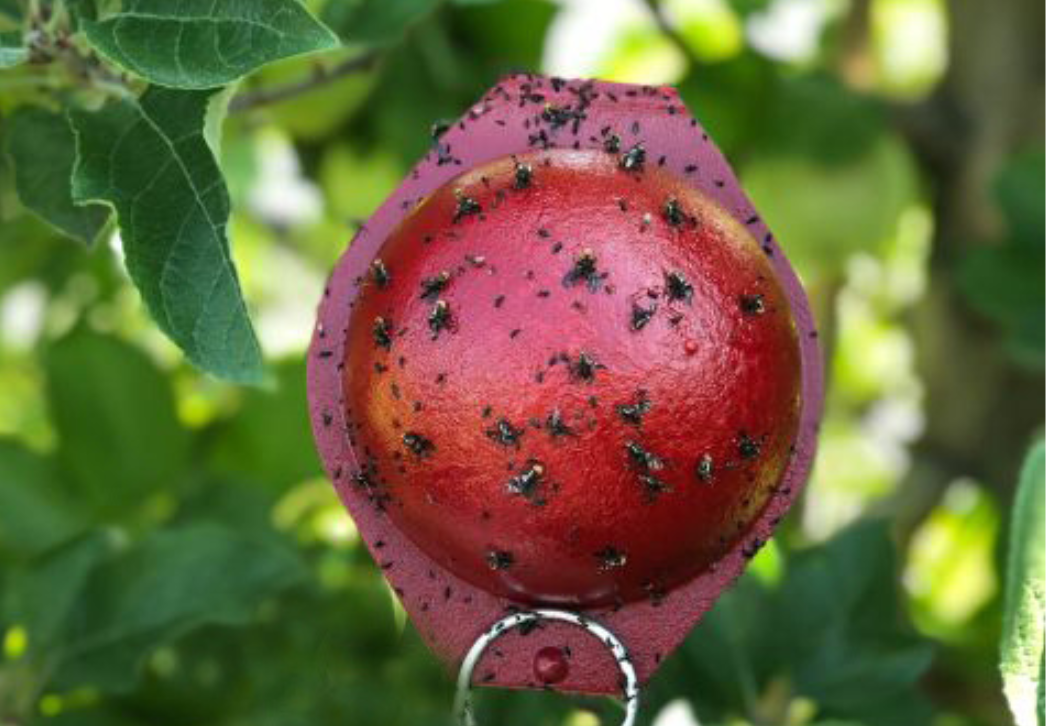
Apple maggot emergence also increased this week at several orchard monitoring sites. Economic counts were reported from five of 25 monitoring locations. Peak emergence of adult flies is approaching and oviposition on apples can be expected throughout August. Apple growers should continue to apply sticky coating to traps each week (or as needed) and maintain apple maggot controls as long as counts exceed the following economic thresholds:
- One fly per trap per week for unbaited traps
- Five flies per trap per week for baited traps
|
|
 __________________________________
|
|
|
|