|
|
Seasonably warm weather returned to Wisconsin following a hot, humid pattern leading up to Independence Day. Early July temperatures averaged 2-6°F above normal and peaked at 94°F on July 4 before lower humidity levels and more comfortable temperatures in the 70s to mid-80s arrived. Rain fell across most of the state over the weekend and was particularly heavy in the east-central region (2.0 to 4.0 inches). The City of Sturgeon Bay in Door County recorded 3.6 inches July 5, while nearby locations such as Fish Creek and Ellison Bay received over 3.3 inches.
Summer crop development continued to progress rapidly and ahead of the five-year average pace. The most advanced corn in the southern counties is silking and nearly one-third (29%) of the state’s soybeans have reached the R1 flowering stage. The latest USDA NASS report depicts overall favorable conditions for Wisconsin field crops. Ratings for both corn and soybeans were similar at 77% and 75% in the good to excellent categories, respectively, a two percentage point increase from the previous week.
Along with the noticeable boost in crop growth, pressure from mid-season insect pests such as Japanese beetles, apple maggot flies, and corn earworm moths has increased in response to the hot early July weather.
__________________________________
|
|
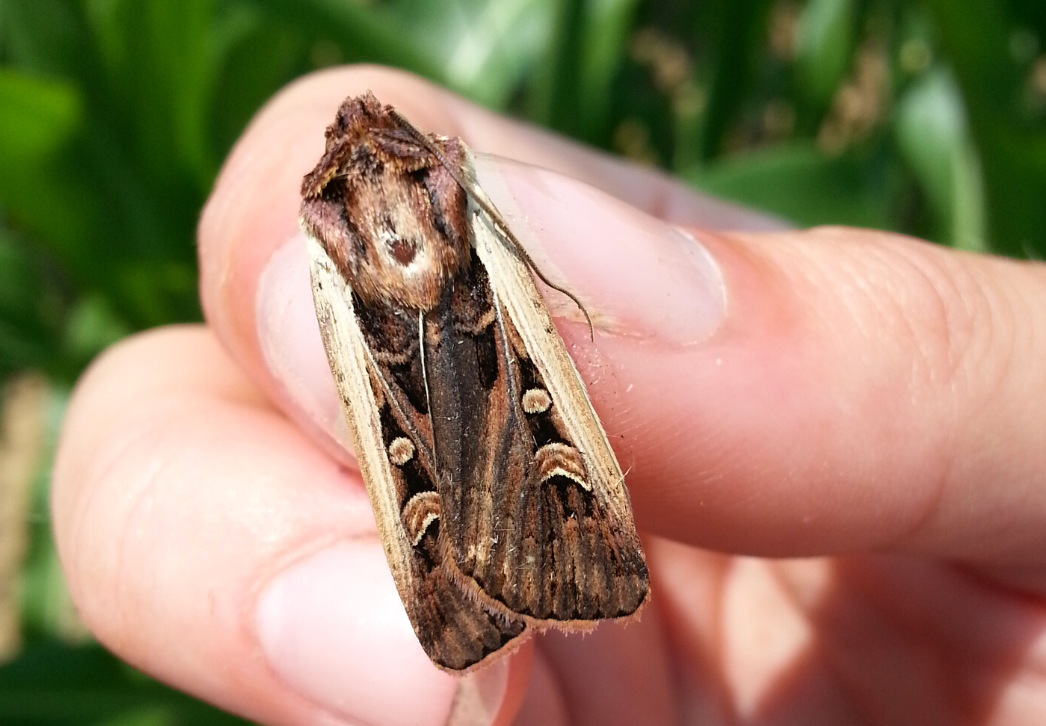
The annual western bean cutworm moth flight continued for the third week. Counts have been very low as of July 10, with 31 of 68 monitoring sites reporting 1-9 moths per trap. The DATCP network of pheromone traps registered a total of 82 moths this week, compared to 54 moths during the previous week. The state cumulative count thus far is 161 moths in 68 traps, or 2.4 moths per trap. Moth activity is likely to increase markedly in the next two weeks (July 11-24) as 25% emergence of this year’s population occurs across southern and central Wisconsin.
Scouting corn plants should coincide with the late-whorl and pre-tassel stages. If egg masses and small larvae are found on 5% or more of the plants and control is warranted, the optimal timing for insecticide treatment is at 90-95% tassel emergence. This application timing increases the chance that the small newly-hatched caterpillars will be exposed to the insecticide.
Moth counts will be available for the next six weeks on DATCP's Western Bean Cutworm Network page and on the Great Lakes and Maritimes Pest Monitoring Network site. Current degree day accumulations for WBC are provided in the modified base 38°F column in our degree day table. The lower threshold for WBC is 38°F while the upper threshold is 75°F. Once 2,577 degree-days are reached, 25% of the WBC flight has occurred and scouting should begin. |
|
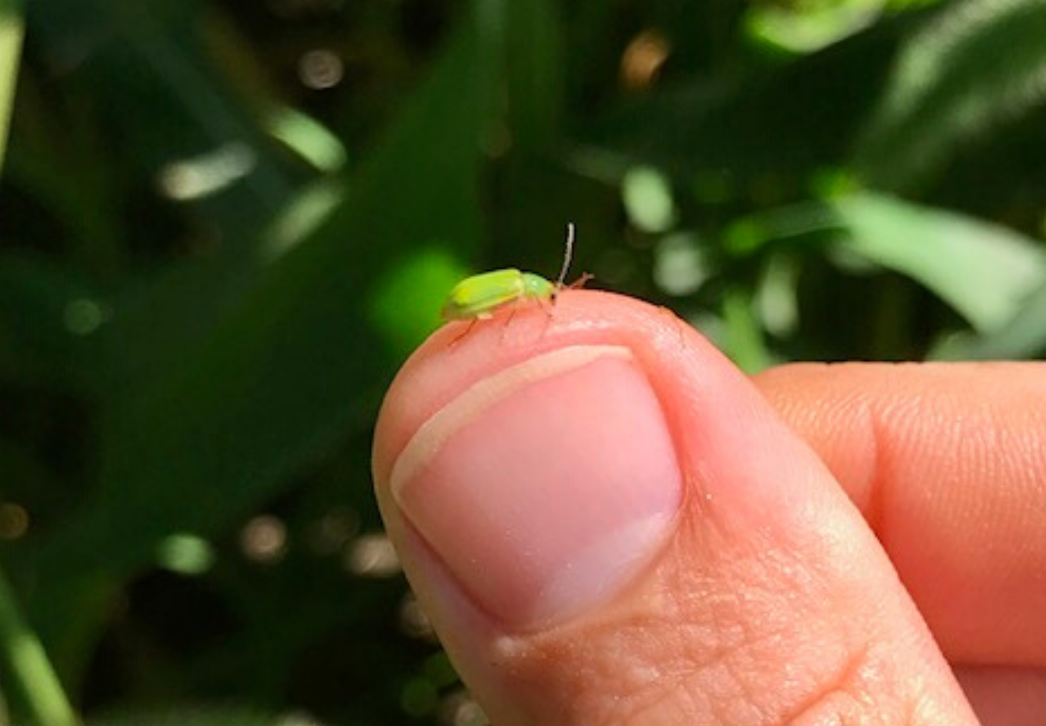 Northern corn rootworm beetle | DATCP Pest Survey
|
|
In addition to the western bean cutworm flight, corn rootworm beetle emergence is also starting. Beetles of the northern species were observed on July 7 in Grant County. These insects will become increasingly common in corn this month, with peak beetle emergence occurring by mid-August. According to DATCP’s 2024 corn rootworm survey results, areas of the state most at risk of larval rootworm damage to corn are the southwestern, south-central, east-central, and northwestern crop districts, where beetle populations were highest last season. Larvae from eggs laid last summer are now feeding on corn roots and mid-July is the most effective time of year to evaluate rootworm pruning damage. |
|
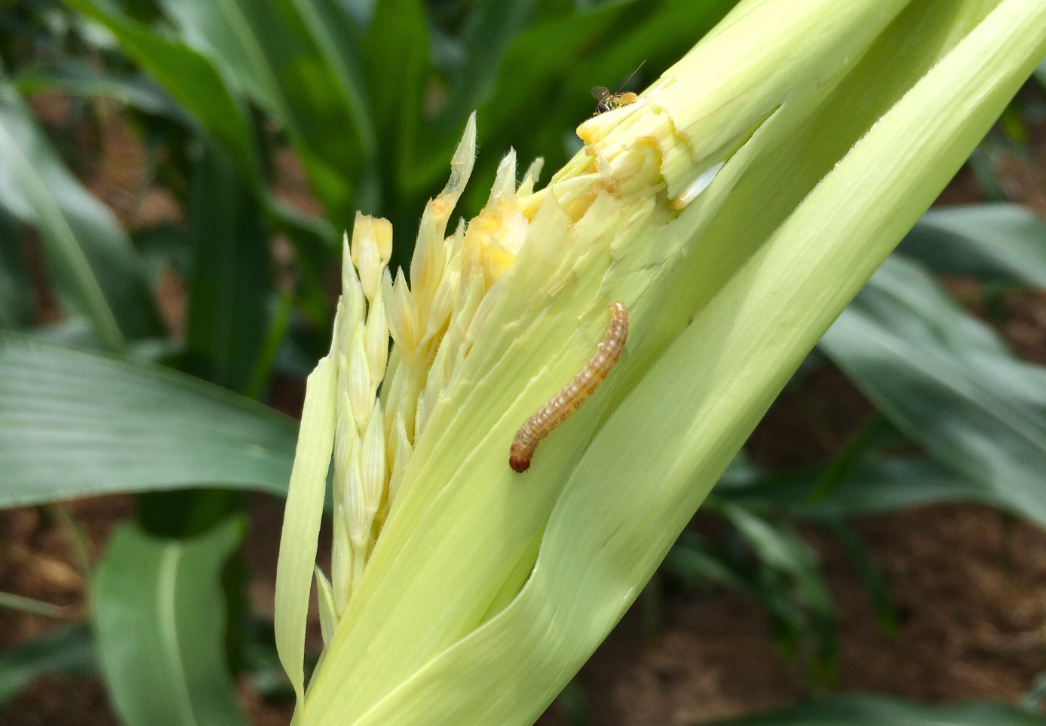 European corn borer larva | K. Hamilton DATCP
|
|
Pupation of first-generation European corn borers is underway in the southwest and west-central areas of the state. Black light traps in locations where 1,400 degree days (modified base 50°F) are surpassed could register the earliest moths of the summer flight in the week ahead. Larvae from the spring flight currently range in development from third to fifth instar and have begun boring into corn leaf midribs and stalks. The treatment window for spring European corn borer larvae has closed over much of southern and central Wisconsin with the accumulation of 1,100 degree days. Chemical control targeting newly hatched corn borer larvae remains an option for a few more days (through July 15) in areas north of Highway 29. |
|
 __________________________________
|
|
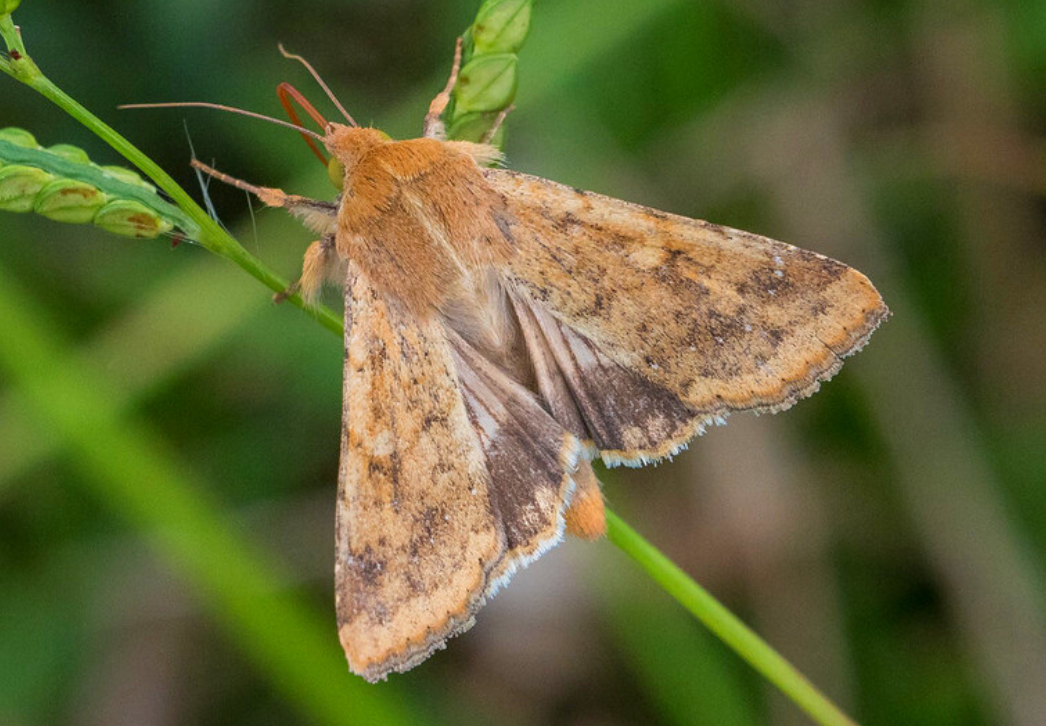
Early corn earworm migrants are arriving in Wisconsin. The pheromone traps at monitoring sites in Dane, Dodge, and Rock counties registered large flights of 123-227 moths this week. The two-week total catch of 988 moths in nine traps indicates the migration is off to a strong start and will likely produce earlier-than-normal larval infestations.
For fresh market sweet corn, the standard treatment threshold is five to 10 adult earworm moths per night for three consecutive nights (when green silks are present). The treatment threshold for tomatoes is seven moths per pheromone trap per week.
Moth counts for the state’s 13 pheromone trap sites will be published each Thursday through mid-September on the DATCP Corn Earworm Network page. |
|
|
__________________________________
|
|
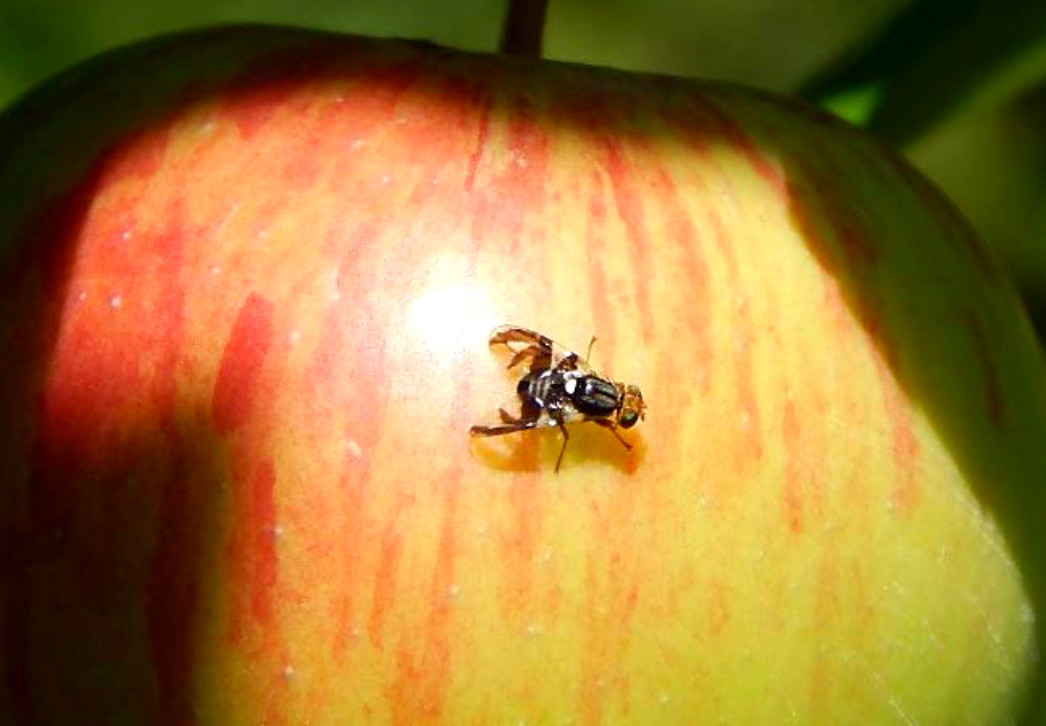
Reports from DATCP’s apple orchard pest monitoring network indicate the first apple maggot flies of the season are emerging. Apple growers concerned about this pest can set a minimum of three red sphere traps per 10 acres in early-ripening cultivars, and one trap every 200-300 feet in perimeter trees adjacent to wild hosts. The traps should be placed at eye-level and be clearly visible on the outside edge of the canopy. Home gardeners may also use the visual traps to monitor apple maggot populations. The economic threshold for control is one fly per unbaited trap per week or five flies per baited trap per week. |
|
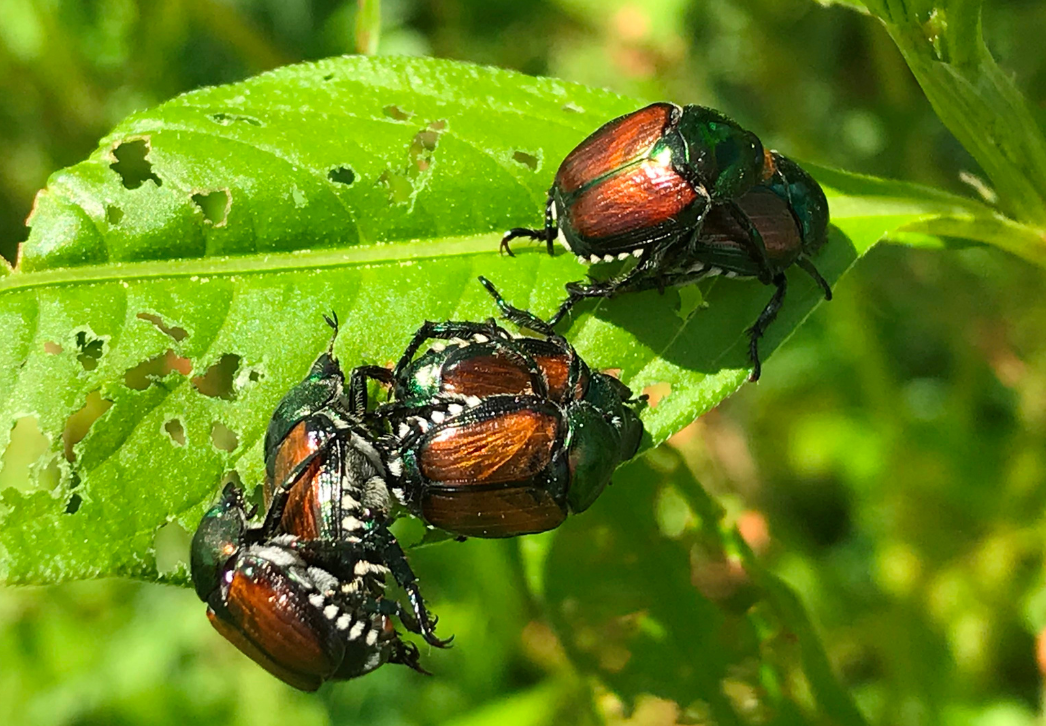 Japanese beetles | K. Hamilton DATCP
|
|
Japanese beetle pressure is likewise beginning in Wisconsin apple orchards. Feeding on fruit trees, ornamentals, and field crops will intensify throughout the month and continue well into August. If scouting indicates the need for control, targeted spot treatment of individual trees, young trees, or susceptible apple cultivars (e.g., Honey Crisp, Lodi, Pristine) is usually an effective alternative to broadcast applications, which harm non-target and beneficial insects. Research suggests apple trees can tolerate 20-30% defoliation without yield impacts or decline, and defoliation levels are seldom that severe in Wisconsin orchards.
Additional information on Japanese beetle management for orchardists is available at the UW Fruit Program site. Control options for gardeners and landowners can be found on the UWEX Horticulture page. |
|
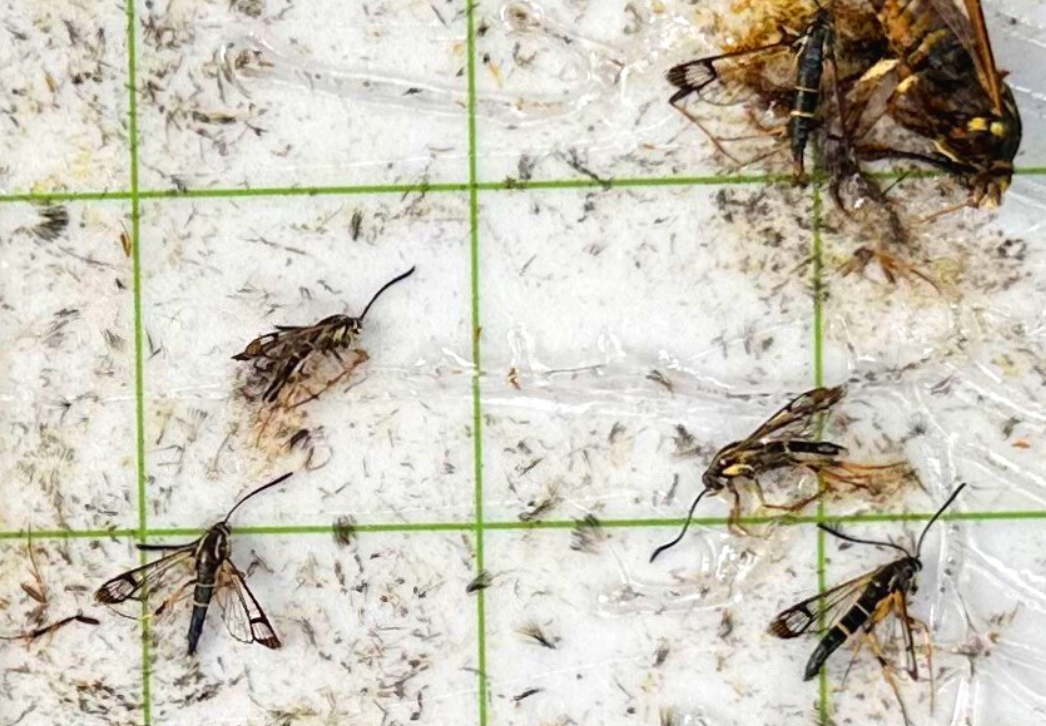 Dogwood borer males (smaller), Non-target (larger)
Laura Tisch Munchkey Apples
|
|
Dogwood borer (DWB) moths have been active since early June and the high pheromone trap counts recently reported in some apple orchards have prompted growers to inquire about DWB control. The traps do not indicate the need for control but instead help to estimate peak adult flight and when to begin scouting for frass around the graft union of trees and other evidence of larval feeding. The DWB has one generation per year in Wisconsin and trunk sprays labeled for borer control (i.e., Assail) are applied in spring, by mid-June. However, if fresh borer feeding is observed in early July, a second course of the product can be applied before early August. Orchards that consistently experience DWB pressure should consider using mating disruption with Isomate-DWB in addition to standard trunk sprays.
As several DATCP cooperators have noted this season, the commercially available dogwood borer pheromone lure often attracts non-target clearwing moth species. A few growers have sent in photos of the red oak clearwing borer (Paranthrene simulans), which is a noticeably larger yellow and black species that mimics a wasp. In the photo above, the smaller specimens are dogwood borers while the larger moth in the upper right corner is the non-target, P. simulans. Dogwood borer males can be identified by the two yellow bands on the abdomen. Note that the correct height for DWB traps is three to four feet above the ground. Scouting for this pest is especially critical for orchards with new trees planted in the last five years. |
|
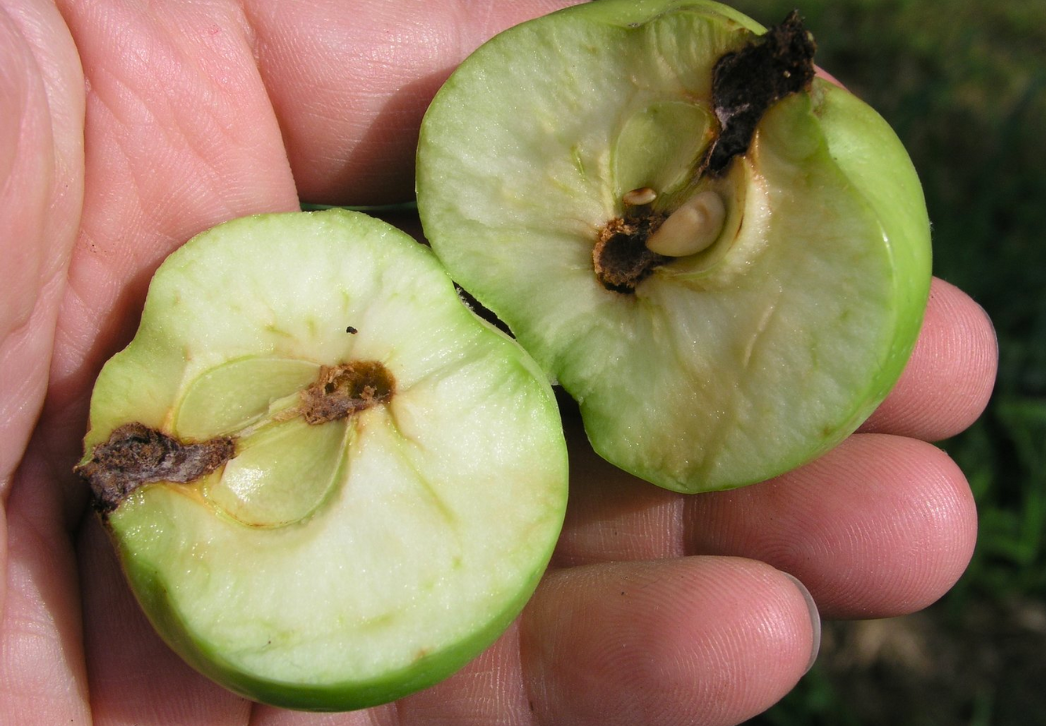 Codling moth fruit damage | Cornell CALS
|
|
The spring flight of codling moths is winding down in southern and central Wisconsin orchards, although trap counts were still very high (> 15 moths per trap) at a few monitoring sites this week. Fruit damage is becoming apparent as larvae reach the larger development stages and the summer flight is expected to begin in the next two weeks. Apple growers are advised to check their records for the spring biofix to estimate the second biofix, which generally occurs 1,000 degree days later (base 50°F). In preparation for the summer flight, cooperators should replace CM pheromone lures and begin more frequent trap checks. Larvicides or other controls should be maintained as long as trap counts remain above five moths per trap per week. Second-generation control may be particularly important this season since weather-related challenges (heavy rain, high winds, etc.) impeded CM management programs in June. |
|
 __________________________________
|
|
https://content.govdelivery.com/accounts/WIDATCP/bulletins/3e8e6cd |
|
|
|
|