|
 _____________________________________
Dear Wisconsin nurseries, Christmas tree growers, and gardeners:
Growing degree days (GDD) (simple B50) as of July 14 were 841 in Bayfield; 1025 in Cumberland; 926 in Medford; 1098 in Hancock; 1134 in Green Bay; 1209 in Racine; 1317 in Madison; 1359 in La Crosse; and 1542 in Dubuque, IA.
A few pests in vulnerable-to-treatment stages include woolly apple aphid at 800-900 GDDs, black vine weevil, European pine shoot moth, oak spider mite and boxwood psyllid at 900-1000 GDDs; two-spotted spider mite at 900-1100; and cottony maple scale, European elm scale, fletcher scale, lecanium scale and Japanese beetle at 900-1200 GDDs. Other pests soon to be in vulnerable stages include flat-headed and round-headed apple tree borer, oystershell scale (brown), and pine needle scale at 1600-1700, and locust borer and fall webworm at 1800-2100 GDDs.
Take a moment to read through a few updates from the DATCP nursery program and send any feedback, questions, or ideas for future e-news updates to datcpnursery@wisconsin.gov.
Having trouble viewing this email? View it as a Web page.
_____________________________________
|
|
|
Each year, DATCP deploys several survey strategies to monitor for new and emerging forest pests that have not yet been found in Wisconsin. Pests are chosen based on prominent pathways for introduction into the state, and the potential impact they may have on the state’s tree resources. Below are some of the Forest Pest Surveys occurring in 2025:
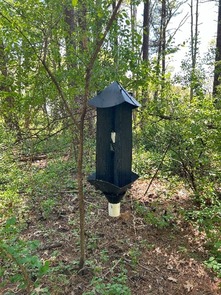
The Pine and Oak Commodity Survey is trapping for 12 insect species of national significance, focusing on bark and woodboring beetles along with defoliating moths. These insects attack various species of oak or pine and have shown invasive tendencies in other parts of the world. In total, 105 traps have been placed in 15 counties in the eastern part of the state. Traps (image left) are placed in areas with high out-of-state traffic, such as trainyards, warehouses, and parks.
The Mediterranean Pine Engraver (MPE) Survey is a small trapping survey targeting a single bark beetle species. The Mediterranean pine engraver is currently invading southwestern states and could be introduced into Wisconsin through the movement of firewood and wood packing products. Four traps have been placed at campsites and parks in the southern half of the state.
The Walnut Twig Beetle (WTB) Survey is a trapping survey occurring at sawmills that process walnut lumber. Walnut twig beetle is native to the western states and transmits Thousand Cankers Disease to walnut trees. A total of 15 traps were placed at four different sawmills in central and western parts of the state.
|
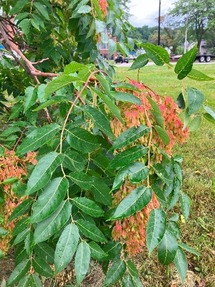
The Spotted Lanternfly (SLF) Survey is a visual survey conducted in summer and fall which consists of walking around urban and industrial areas of southern Wisconsin. During these warmer months, SLF life stages are active and can be easily searched for on buildings and vegetation. Spotted lanternfly feed on several tree and vine species ranging from maples to grapes, but the invasive tree-of-heaven (image right) is the preferred host. With SLF now established in Illinois, survey efforts are heavily focused on the southeastern corner of the state bordering the Chicago metro area.
|
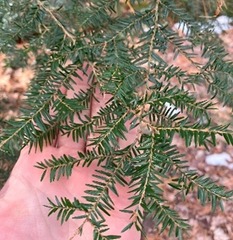
The Hemlock Woolly Adelgid (HWA) and Elongate Hemlock Scale (EHS) Survey is conducted in the winter months and consists of visually surveying urban and wildland hemlocks (image left) for HWA and EHS life stages. The mobile forms of both insects are least active in winter months, reducing the risk of accidental spread through survey work. At the same time, they are easy to spot during this time, because settled females are actively feeding all winter, and in the case of HWA, secrete waxy wool balls at the bases of the undersides of hemlock branches, making infestations much easier to spot than when insects are dormant in the summer. Both of these pests greatly reduce hemlock health and are established in the neighboring state of Michigan, making them a high-risk pest.
If you have questions about the surveys DATCP conducts, or if you suspect you have found one of these invasives, contact datcppesthotline@wisconsin.gov.
|
_____________________________________
|
|
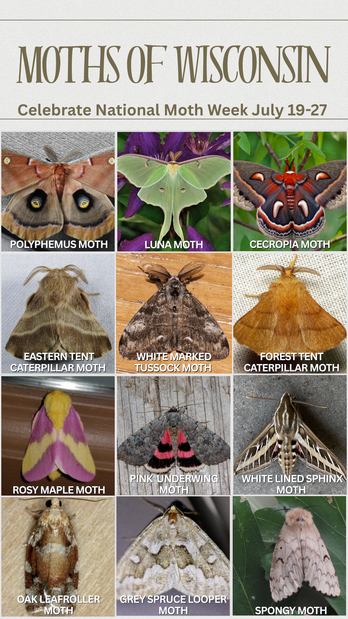
National Moth Week will be celebrated July 19-27 this year to recognize moths, which are in the insect order Lepidoptera, along with butterflies and skippers. The word "Lepidoptera" literally means "scale wing" in Latin (lepid=scale and optera=wing) and refers to the colorful scales that create the patterns on the wings of moths and butterflies.
While moths are in the same order as butterflies, there are nine times more species of moths in the world. Moths may be distinguished from butterflies by being mostly nocturnal or active at night, with many species being attracted to lights, and by the males having feathery antennae. Moths can be as small as a pinhead and as large as an adult human’s hand, with complicated wing colors and patterns.
The United States has more than 11,000 moth species and it is estimated that there are 150,000-500,000 species worldwide. Wisconsin is home to over 1,600 species of moths. These include diverse groups like sphinx moths (Family Sphingidae), such as the Nessus sphinx moth; tortricid moths (Family Tortricidae), like the oak leafroller moth; geometrid moths (Family Geometridae), like the grey spruce looper, and large saturniid moths (Family Saturniidae) such as the Luna moth; Cecropia moth; and Polyphemus moth. Though there are some damaging invasive moths such as the spongy moth; and native moths whose caterpillars can sometimes cause defoliation or become a nuisance, such as the eastern tent caterpillar or the forest tent caterpillar; native defoliators play a crucial role in nutrient cycling. They are all fascinating insects with unique adaptations. You can view a gorgeously arranged, 96 drawer collection of moths and butterflies largely obtained from Wisconsin state natural areas that were donated to UW-Madison’s Insect Research Collection by Thomas Rochealeau online here.
Moths play vital rolls in the ecosystems as pollinators, food sources, and indicators of environmental health. Many moths have long tube-like tongues that are ideal for sipping nectar, while their body picks up pollen, allowing them to easily pollinate flowering plants. Moths are an important food source for many animals such as birds, bats, frogs, mice, bears, and skunks. Moth health and populations can be important indicators about the effects of plant diversity, farming practices, pesticide use, air pollution, and climate change on the Earth.
Celebrate “Moth Week” by exploring the world of the moths. Take photos of the moths in your world and share them on social media with #NationalMothWeek and post them on Nationalmothweek.org. Check out this page to learn about some common moths in Wisconsin: https://www.mothidentification.com/moth-in-us/moths-in-wisconsin.
|
_____________________________________
|
|
|
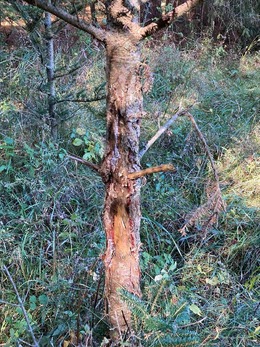
Buck rub on Fraser fir | DATCP G. Meysembourg
|
|
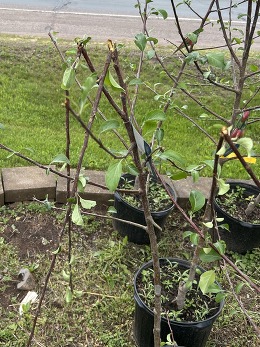
Snapped leaders caused by deer feeding | DATCP K. Jerabek
|
|
|
Most of us are familiar with deer feeding on woody fruit tree shoot tips, tender perennials, flower buds, and top whorls of young evergreen transplant trees. Whether you are a Christmas tree grower, nursery stock grower, or gardening enthusiast, deer damage can suddenly appear out of nowhere and have devastating results. Regular scouting of your plants will alert you to damage. Once they have feasted on your plants, the deer will be back! There are many options to reduce deer browsing and buck antler rub. The challenge is to quickly address deer damage for the first couple years to change their feeding preferences. A doe will teach her young fawns what to eat and where.
Heavy damage can be from a mature deer standing on their hind legs to reach the top leader of young deciduous trees then drop down to all four legs, snaping off the leader to eat the leaves and shoot tips. Trees under 10 feet in height are at risk. They will move right down the row of trees snapping leaders again and again. Winter feeding, when the snow is deep, can wipe out a Christmas tree field of Fraser Fir trees when their branches are chewed down to look like a broom handle.
Deer barriers like high fences or electric fences are more costly options and work well if the fence is maintained. Sometimes cost sharing is available for installing a fence.
Deer deterrents can be very successful if used regularly. Some products are very stinky to both the deer and the people who apply them. Once the odors wear off, they must be reapplied. Newer to the market is a deterrent made of sheep fat that smells like sheep wool to people and lasts during the winter months with only one application. It is the oil in the fat that smells like a carcass to deer causing them to avoid feeding or rubbing. This sheep fat product is advertised to even deter rabbits, elk, and moose if you have them feasting in your yard as well. Making your own deterrents of human hair or raw wool hung in trees will work if you have enough to spread around. Milk fat has also been studied with successful results as a deterrent to deer damage. Fat-based repellents cannot be washed off once the sprays have dried because the fats become incorporated with the waxy cuticle of the leaves and bark. Deer feeding pressure can be dynamically influenced by their population size and the attractiveness of alternative browse options. For more information, access this link to Dr. Richard Cowle’s “Effective Fat-based Deer Repellents” study from 2024.
Having a dog in an enclosed space will keep unwanted browsers away from nearby plants. Remote-controlled dune buggies can also effectively chase off wandering deer to teach them to stay away. You might enjoy devoting extra time using the remote-control option to change unwanted feeding behavior.
Extra deer hunting permits are sometimes available for landowners with problem deer feeding damage. Check with your DNR and county land conservation department. Successful deer control is worth the effort.
_____________________________________
|
|
|
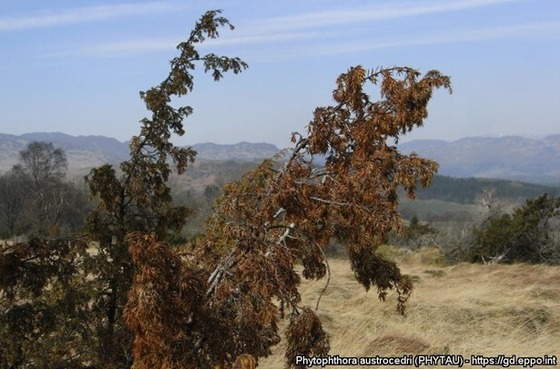
Symptoms of Phytophthora austrocedri on Juniperus communis | Alexandra Schlenzig, SASA, Edinburgh, UK.
Last year, a new Phytophthora species was detected for the first time in the U.S. at two nurseries in the state of Oregon. This species, Phytophthora austrocedri is an oomycete plant pathogen which affects plants in the Cupressaceae family. Common nursery plants in this family include Arborvitae (Thuja spp.), Juniper (Juniperus spp.), and False cypress (Chamaecyparis spp.). This pathogen was first reported in Argentina in 2007 and in the U.K. in 2012, where is has caused mortality of native cypress and juniper plants on the landscape.
Growers who purchase or grow arborvitae, juniper, or false cypress should monitor plants for P. austrocedri symptoms.
Symptoms include:
- Stunting
- Dull green or yellowish foliage in early infections
- Branch flagging and reddish brown/bronze foliage in advanced infections
- Lesions or cankers at the base of the plant or branch.
- Orange/brown discolored wood tissue under bark from lesions or cankers
This pathogen is spread through infected plants, soil, and water. Care should be taken when working with these hosts to prevent the accidental spread of this disease during routine activities, such as moving plants and pruning.
Early detection of this pathogen is key to protecting Wisconsin green industries. If you are a licensed nursery grower and suspect you may have plants infected with P. austrocedri, please contact DATCP’s nursery program at (608) 516-7617 or DATCPnursery@wisconsin.gov. If you are a home gardener or horticulture professional and suspect you may have plants infected with P. austrocedri, contact the University of Wisconsin–Madison Plant Disease Diagnostic Clinic at (608) 262-2863 or pddc@wisc.edu.
_____________________________________
|
|
|
Bark and ambrosia beetles, a group of small insects often no longer than a grain of rice, feed underneath the bark and in the wood of trees. Although small, these beetles can cause significant damage to trees including limb dieback, tree decline, and even tree mortality. Non-native bark and ambrosia beetles pose higher risks to our forests and urban landscapes as our native trees aren’t adapted to their attacks. Many bark and ambrosia beetles are native to the U.S., but more and more non-native species are showing up each year.
The western states are currently dealing with two non-native species, the Mediterranean Pine Engraver and Mediterranean Oak Borer, which attack pines and oaks respectively.
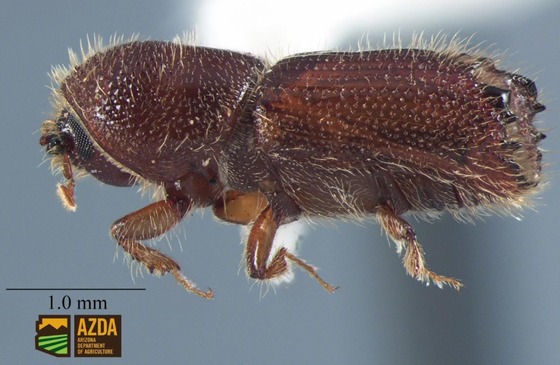
Mediterranean Pine Engraver (MPE, Orthotomicus erosus) | Image credit: AZDA
The Mediterranean Pine Engraver (MPE, Orthotomicus erosus) is a bark beetle that is currently spreading throughout the southwestern states causing large scale pine mortality in urban areas. The beetles bore underneath the bark, girdling the tree and restricting water and nutrient movement. This species has shown to quickly grow in numbers, killing even well-established trees. Although not yet found in Wisconsin, MPE is capable of reproducing in multiple pine and spruce species, making it a potential threat to our northwoods.
Mediterranean Oak Borer (MOB, Xyleborus monographus) | Image credit: University of California Agriculture and Natural Resources
The Mediterranean Oak Borer (MOB, Xyleborus monographus) is an ambrosia beetle that is spreading throughout the Pacific Northwest. MOB is responsible for oak mortality in urban and wildland areas. This species introduces fungal pathogens into the tree, first impacting the branches before killing the entire tree. This species can feed on multiple species of oak, making it a potential threat to our oak forests and savannas.
These are just two of many species that could one day work their way into Wisconsin. DATCP will continue to monitor for non-native bark and ambrosia beetles through trapping efforts. The public is encouraged to monitor their trees for bark beetle related damage, and to avoid moving firewood and wood packing products between states.
_____________________________________
|
|
|
A compliance agreement is a written agreement between a person engaged in growing, handling, or moving regulated articles (plants and plant parts), and either DATCP or USDA to facilitate the movement of those plants. Nursery growers, nursery dealers, and Christmas tree growers are some of the businesses that may need compliance agreements. Compliance agreements are valid for one year and must be renewed annually as needed. There is no fee to enter into a compliance agreement. Compliance agreements are generally pest-specific, so depending on what plant species you move, you may need multiple agreements.
To help you determine what compliance agreements you may need, DATCP created an interactive guide to generate a list of potential, applicable compliance agreements based on how you operate. By simply answering a series of yes/no questions, you can quickly learn what compliance agreements will help you facilitate the movement of the stock you’re buying in or selling out. Fill out the guide now to find out what agreements you may need.
_____________________________________
|
|
|
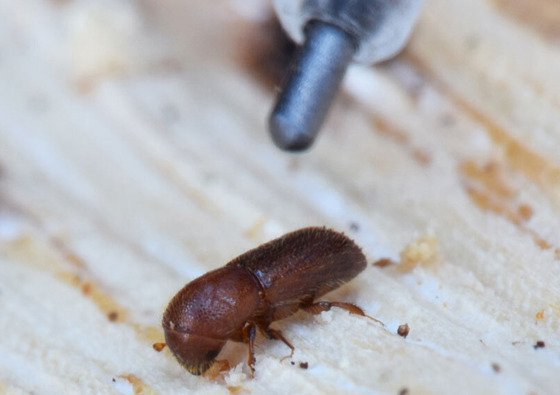
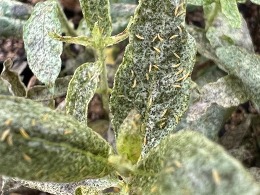
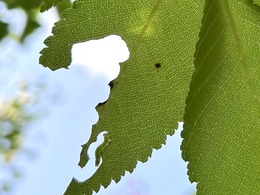
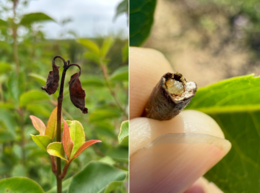
Thrips on milkweed in Marquette Co. | DATCP L. Meils
|
|
Elm zigzag sawfly on 'Pioneer' and 'Triumph' elms in Kenosha Co. | DATCP M. Wensing
|
|
|
Viburnum shoot sawfly on Blackhaw viburnum in Jefferson Co. | DATCP L. Meils
|
|
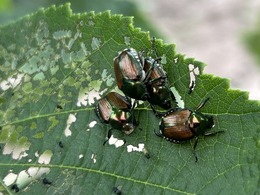
Japanese beetles have emerged in southern WI | DATCP G. Meysembourg
|
|
|
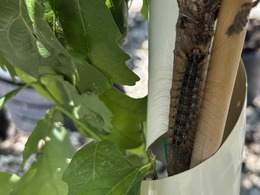
Spongy moth caterpillar hiding on oak stock in Waukesha Co. | DATCP M. Wensing
|
|
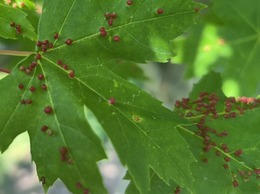
Maple gall mites on maple in Oconto Co. | DATCP J. Oestreich
|
|
|
_____________________________________
|
|
|
For more information about Wisconsin's Nursery and Christmas Tree Programs, visit DATCP's Nursery and Christmas Tree Program webpage.
Read past issues of What's Growing On?
If you haven't yet, please take this brief feedback survey for our monthly What's Growing On? e-newsletter. With this survey, we aim to measure your satisfaction regarding the format, frequency, and quality of the content provided. Please give us your most transparent feedback. The survey is anonymous.
For current counts during the growing season from our insect monitoring networks around the state, visit our Pest Survey webpage. To read articles on economically important plant pests affecting Wisconsin's field crops, fruits, and vegetables, read our Field Notes publication put out weekly during the growing season.
|
|
|
|
|