|
 _____________________________________
Dear Wisconsin nurseries, Christmas tree growers, and gardeners:
Growing degree days (GDD) (simple B50) as of June 12 were 311 in Bayfield; 406 in Cumberland; 329 in Medford; 412 in Hancock; 413 in Green Bay; 415 in Racine; 536 in Madison; 575 in La Crosse; and 704 in Dubuque, IA.
A few pests in vulnerable-to-treatment stages include lilac borer, oystershell scale (brown), euonymus caterpillar at 275-500 GDDs; black vine weevil, bronze birch borer, oystershell scale (gray), elm leaf beetle at 400-600 GDDs; leaf crumpler, peach tree borer, flat and round-headed apple tree borer, viburnum crown borer at 500-600 GDDs; and euonymus scale at 500-700 GDDs. Other pests soon to be in vulnerable stages include woolly apple aphid at 800-900 GDDs, followed by cottony maple scale, European elm scale, fletcher scale, lecanium scale as well as two-spotted spider mite, European pine shoot moth and Japanese beetle all at 900-1200 GDDs.
Take a moment to read through a few updates from the DATCP Nursery Program and send any feedback, questions, or ideas for future e-news updates to datcpnursery@wisconsin.gov.
Having trouble viewing this email? View it as a Web page.
_____________________________________
|
|
|
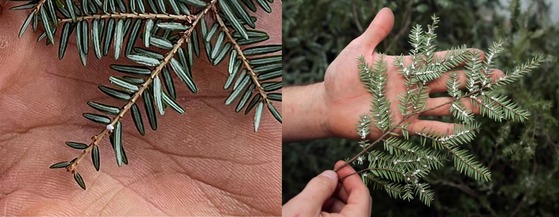
A single HWA ovisac on the underside of a hemlock branch and a more heavily HWA-infested hemlock branch | Image credits: Left- Michigan DNR, Right- John Bazemore, Associated Press
Be observant of your hemlock trees (Tsuga spp.) and look for the invasive hemlock woolly adelgid (HWA). HWA is a tiny, sap-sucking insect invasive to eastern North America that kills susceptible eastern and Carolina hemlocks within four to 10 years. HWA is not found in Wisconsin, but this pest is established in several eastern and western states, as well as areas of Canada. HWA can build up large populations through asexual reproduction (meaning all females) and completing two generations each year. HWA would most likely arrive in Wisconsin on infested hemlock nursery stock or through other human-assisted activities. However, birds and other mammals can also move these insects to new areas, and wind can assist local spread of HWA. Hemlock is a critical component of much of Wisconsin’s remaining old-growth forests, providing nesting sites, food, and cover for many forest species, as well moderating stream temperatures. Help us protect this beautiful and crucial resource!
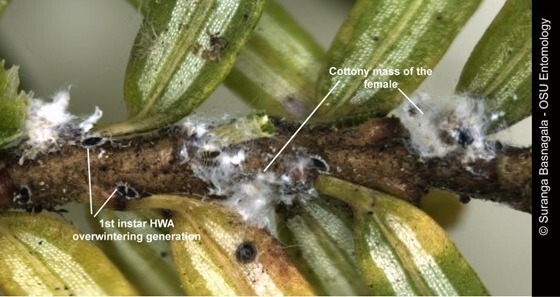 |
Hemlock woolly adelgid 1st instar nymphs and remains of the insect’s ovisac material - white woolly (or cottony) tufts at the base of hemlock needles. | OSU Entomology Suranga Basnagala
What to look for:
- White waxy or woolly tufts (ovisacs) on undersides of hemlock branches at the base of needles
- These will be the most notable sign of HWA since the adelgids themselves are small and difficult to see with the naked eye.
- Ovisacs can be present year-round but may be most visible November through July.
- Early infestations may be harder to notice if few ovisacs are present, so look closely!
- Hemlock needles becoming discolored or prematurely dropping
- Reduced hemlock growth, bud death, or tree crown thinning
- Eventual tree dieback with more progressed HWA infestations
- You should see the white ovisacs before an infestation would cause tree death.
HWA Compliance Agreement with DATCP
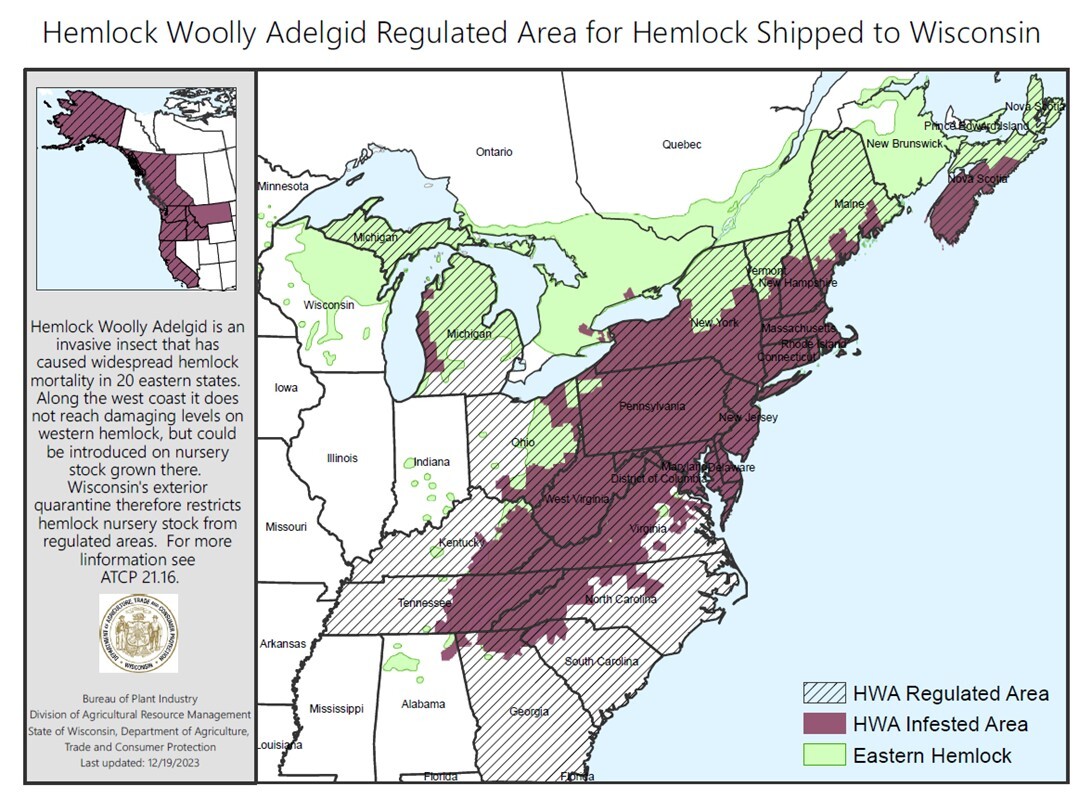
If you import hemlock from HWA-infested areas, you need to sign an HWA compliance agreement with DATCP or make sure every hemlock shipment you import from the infested area is accompanied by a phytosanitary certificate. Compliance agreements are signed annually and come at no cost to your business. In signing this, you are agreeing to pre-notify DATCP of your hemlock import plans, which greatly helps us in our efforts to ensure stock coming into Wisconsin from regulated areas is free of injurious pests such as HWA.
Hemlock shipment pre-notifications must include all of the following:
- The name and address of the importer
- The type and volume of material that may be imported
- The locations from which the material may be imported
- The names and addresses of the persons to whom and the locations to which the material may be imported
- The method by which the material may be imported
- A written certificate signed by a pest control official in the infested area, which states at least one of the following:
- The materials were inspected and found to be free of HWA at the time of inspection.
- The materials have been effectively treated with an approved, labeled pesticide to destroy HWA. The certificate shall specify the date, method of treatment, and post-treatment data indicating that treated material was examined in the laboratory and found to have no living life stages of HWA.
- The materials originate from an area that is known to be free of HWA or have otherwise been produced, processed, stored, handled, or used under conditions that preclude the transmission of HWA. The certificate shall explain the basis for the official’s statement.
Check our website for details about HWA and DATCP’s exterior quarantine for this pest. Note that hemlock is also regulated by our elongate hemlock scale (EHS) quarantine, so you may additionally need an EHS compliance agreement if your hemlock comes from EHS-infested areas.
 What else can you do?
- Monitor your hemlock trees for signs of HWA at least annually (or more!)
- Source hemlock trees locally from Wisconsin nurseries whenever possible. If you must source from out-of-state, sign an HWA compliance agreement with DATCP and use more reputable sources that include certificates with shipments to verify material is free from HWA.
- Inspect your hemlock nursery stock upon arrival.
- Do not move hemlock branches or firewood in order to minimize the risk of introduce pests from other areas.
- Healthy hemlocks can better tolerate pest infestations, so take steps to improve and maintain the health of your hemlocks:
- Mulch around trees to maintain soil moisture.
- Water trees during periods of extended drought.
- Do not use nitrogen fertilizer near hemlocks because it enhances HWA survival and reproduction.
- If you suspect HWA on your hemlocks, note the location and take several photos. Do not remove potentially infested material from the site. Report the finding to DATCP.
To report HWA or other injurious pests in Wisconsin, call the Pest Hotline at (866) 440-7523 or email a photo and your location to datcppesthotline@wisconsin.gov.
Visit plantpests.wi.gov for regulatory pest and disease information. Please reach out to Forest Pest Regulatory Coordinator Meg Sanders for information on compliance agreements and HWA/EHS identification resources and training: (715) 891-8158, MeganT.Sanders@wisconsin.gov.
_____________________________________
|
|
|
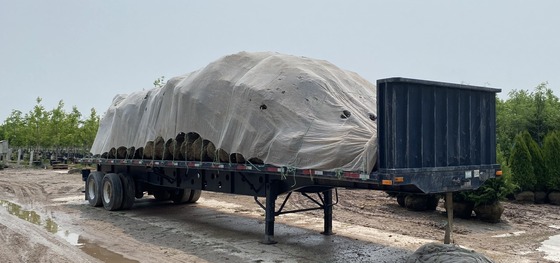
Nursery stock ready for transport | DATCP L. Meils
When Wisconsin plants and plant products are shipped to another state, the destination state may require that the plants or plant products be inspected and certified free of insects or diseases. Additionally, when a Wisconsin business brings in or imports regulated articles such as Christmas trees, nursery stock, or logs from an area known to be infested with a pest for which we have an exterior quarantine, DATCP may require that those materials come in with a certificate issued by regulatory officials in the state of origin. To meet the shipping and/or importing requirements, businesses can enter into compliance agreements with DATCP or USDA, depending on the pests of concern.
A compliance agreement is a written agreement between a person engaged in growing, handling, or moving regulated articles (plants and plant parts) and either DATCP or USDA to facilitate the movement of those plants. Compliance agreements outline what requirements must be met dependent on the origin of the articles and the destination. Federally regulated plant pests and diseases require a compliance agreement with USDA-APHIS. All other agreements are with DATCP.
Nursery growers, nursery dealers, and Christmas tree growers are some of the businesses that may need compliance agreements. Compliance agreements are valid for one year and must be renewed annually as needed. There is no fee to enter into a compliance agreement. Compliance agreements are generally pest-specific, so depending on what plant species you move, you may need multiple agreements.
To help you determine what compliance agreements you may need, DATCP created an interactive guide to generate a list of potential, applicable compliance agreements based on how you operate. By simply answering a series of yes/no questions, you can quickly learn what compliance agreements will help you facilitate the movement of the stock you’re buying or selling. Fill out the guide now to see what agreements you may need.
Here is the list of agreements offered by DATCP and USDA in Wisconsin: Black Stem Rust (barberry), blueberry plants to Michigan, Boxwood Blight Cleanliness, Elongate Hemlock Scale, Hemlock Woolly Adelgid, Japanese Beetle, Mountain Pine Beetle, and Spongy Moth. If you’d like more details about any of these agreements, refer to the contact details listed on DATCP's Plant Product Compliance Agreements webpage or fill out the interactive guide.
_____________________________________
|
|
|
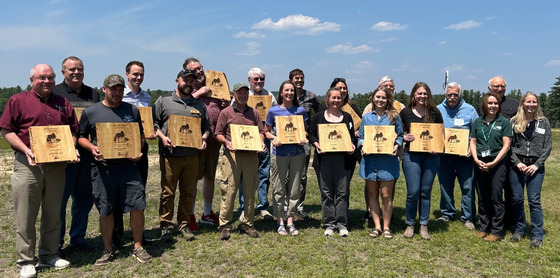
Recipients of the 2025 Invasive Species Action Awards stand with their plaques during the recognition ceremony held at the Wisconsin Cranberry Research Station on June 4 | Wisconsin DNR image
June is Invasive Species Action Month in Wisconsin. Invasive Species Action Month is an initiative to increase awareness of invasive species and ask the public to help prevent their introduction and spread. It is also an opportunity to honor volunteers and professionals who positively impact the fight against the spread of invasive species.
The Wisconsin Department of Natural Resources (DNR) will be hosting the second annual Invasive Species Awareness Weekend on June 21 and 22. Events will include educational programs, invasive species control events, and more. Find an Invasive Species Awareness Day event near you on the DNR Events calendar.
To learn more about Invasive Species Action Month and what you can do to help prevent the introduction and spread of invasive species, visit the DNR’s website.
--Contributing author Liz Tanner, DNR Organisms in Trade Coordinator
_____________________________________
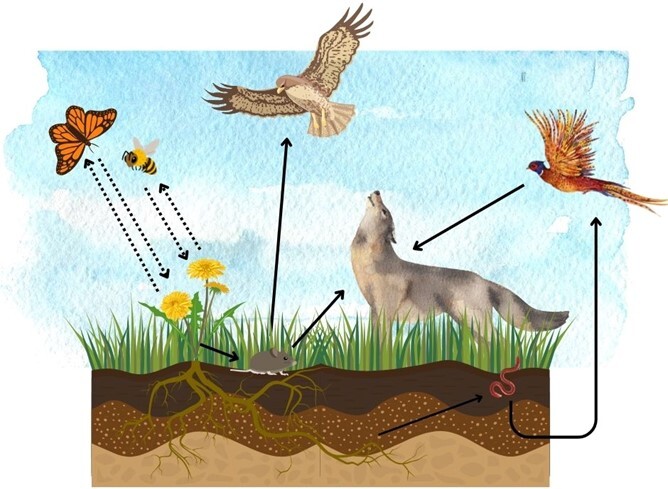
An example of ecosystem interactions | DATCP B. Nikkila-Sommerfeldt
Pollinator Week, organized by the Pollinator Partnership nonprofit and observed June 16-22 2025, is a time to celebrate pollinators, raise awareness about their importance, and share ways we can help protect them. This year’s theme is “Pollinators Weave Connection”, which highlights the interconnection between pollinators, our ecosystem, and us.
In Wisconsin, pollinators include managed honey bees; over 400 species of native bees; other insects, such as wasps, flies, butterflies, moths, and beetles; and one bird species, the ruby-throated hummingbird. Each of these pollinators plays a crucial role in the long-term health of our ecosystem. Bees and other animals pollinate crops that supply one in three bites of food we eat and 80% of flowering plants. In turn, these flowering plants support soil retention and water filtration. Whether you are a gardener, a farmer, or a beekeeper, there are things you can do to protect pollinators, our food supply, and our agricultural economy.
Below are some ways you can support pollinators, taken from the Wisconsin Pollinator Protection Plan:
- Create pollinator habitat.
-
Plant pollinator-friendly flowers, emphasizing native perennials and avoiding invasive plant species. Strive to have at least three types of flowers blooming throughout the season. Creeping Charlie, Dutchman’s breeches, dandelions, and serviceberries bloom very early and can be a first nectar source for bees; bee balm and coneflower bloom in midsummer; and goldenrod and asters are some of the latest seasonal nectar sources. Want to focus on a specific pollinator? Plant milkweed for monarchs and lupine for Karner blue butterflies.
-
Provide nesting habitat, including dead wood, fallen leaves, hollow stems, and bare patches of soil and bunch grasses for native, solitary bees.
-
Minimize or avoid pesticides. If you must spray for pests, be considerate of possible drift, and spray when pollinators are not foraging (dawn or dusk).
-
Participate in community science
-
Download and use WiBee. This Wisconsin wild bee app was developed by the Gratton Lab at UW-Madison for individuals to collect data on wild bee abundance and diversity.
-
Join the Bumble Bee Brigade and submit photos and observations of the bumble bees you monitor in your area.
-
Participate in Project Wingspan. Wisconsin is just one of seven states that participates in this hands-on effort to help monarchs and other pollinators.
-
Support pollinator-focused organizations, products and beekeepers.
- Nonprofits like the Pollinator Partnership and the Xerces Society focus on pollinator protection.
- Buy local honey.
-
Download the pollinator cookbook and enjoy the delicious fruits and vegetables – from tomatoes to pumpkins to avocadoes – made possible by pollinators.
Now that you know more about helping pollinators, download the pollinator protection week toolkit for links to suggested activities, planting guides, and more!
|
_____________________________________
|
|
|
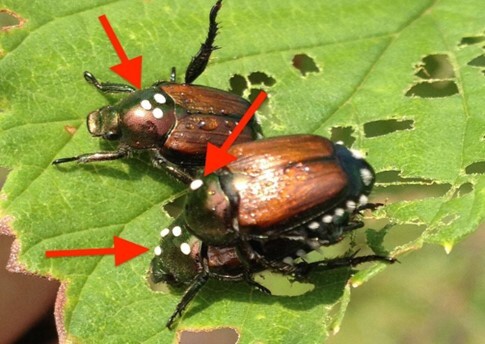
The Winsome Fly, Istocheta aldrichi (Mesnil), in the Tachinidae family, is a parasitoid of Japanese beetle (JB), Popillia japonica. The Winsome fly (WF) was introduced as a biological control agent of JB in 1923 in New Jersey, just SIX years after the accidental introduction of the beetle in the U.S. Since then, WF became well established in the Northeastern states, as well as Quebec and Ontario, Canada. It’s also notable that in the approximately 20 years since it was introduced in Minnesota, that WF expanded its range from eight counties in 2023 to 22 counties in 2024, due to an expanded Citizen Science program.
Also last year, thanks to several volunteers and PJ Liesch at the UW Insect Diagnostic Lab in Madison, WF has now been documented in 10 counties in Wisconsin. The furthest east detections in Wisconsin in 2024 were near Wausau in Marathon County and as far north as Oneida County. WF is considered one of the more effective biological control agents of JB due to its current phenological match between adult fly emergence and that of JB emergence, the direct impact of 20-50% parasitism rates, the impact of WF parasitism in reducing JB female fecundity (which results in fewer eggs laid to overwinter), and its ability to adapt to a variety of climatic conditions.
In brief, the easiest way to detect activity of WF by far is not the adult fly itself (these are very difficult to observe in the field and properly identify). Rather, it is best to search for the distinctive white eggs laid just behind the head (pronotum) of JB.
Winsome Fly eggs are easy to see in the field. WF eggs on 3 Japanese beetles, including a mating pair (Female JB below the male). One or more eggs are laid on each beetle; eggs are nearly always laid just behind the head (pronotum). WF prefers to lay its eggs on female JB. In most cases, only one egg is deposited per beetle. | Photo credit: Jacques Lasnier, Quebec
Request! Given the recent detections in Wisconsin, and with a climate similar to that of Minnesota, we anticipate that WF is in more Wisconsin counties. As per the phenology of JB, the WF season will begin the last week of June and extend through the end of August. It will be greatly appreciated if more observers could look for WF in Wisconsin! Please see the following pages for more information, including how to post observations on iNaturalist, at: https://tips.umn.edu/current/winsom-fly-survey.
For 2025, all observations (with photos) should be uploaded directly to iNaturalist (search for and select: “Winsome Fly”). Many are familiar with this process. However, for those who are new, review our UMN, TIPS page for instructions here: https://tips.umn.edu/current/winsom-fly-survey.
Any questions about the project should be sent to Bill Hutchison at hutch002@umn.edu.
--Contributing author Bill Hutchison, Dept. of Entomology & UMN Extension, University of Minnesota
_____________________________________
|
|
|
Last year, DATCP’s Plant Industry Bureau Laboratory (PIB Lab), in partnership with the University of Minnesota Plant Disease Clinic (UMN PDC), identified Cycas necrotic stunt virus (CNSV) on peony for the first time in Wisconsin. Since 2019, a DATCP inspector has observed blotching and stunting of peony plants at a Wisconsin nursery. Repeated testing of these plants for tobacco rattle virus, cucumber mosaic virus, alfalfa mosaic virus, and general Ilarviruses, which are known to infect peonies, did not yield any answers as to the cause of the symptoms observed.
In 2024, two peony varieties were sent to the UMN PDC for transmission electron microscopy. This technique is used to visualize the virus particles in plant tissue. They detected spherical virus particles in both samples, which is consistent with CNSV. While at UMN PDC, they also performed high throughput sequencing (HTS) on one of the samples. HTS is a technique used to sequence the DNA and RNA in a sample. Results from HTS showed the plant was infected with CNSV.
Cycas necrotic stunt virus was first detected in 1986, on Cycas revoluta in Japan. Since then, it has been reported in the U.S. on peony in 2019 and also in New Zealand, Australia, South Korea, Japan, and China. Additional research conducted by the University of Michigan showed co-infection of peonies with tobacco rattle virus and CNSV at the University of Michigan Nichols Arboretum, which houses one of the largest peony collections in the U.S.
Cycas necrotic stunt virus has been detected on both herbaceous and tree peonies (Paeonia lactiflora, P. suffruticosa, P. officinalis X P. lactiflora), daphne (Daphne ordora), gladiolus (Gladiolus spp.), easter lilies (Lilium longiflorum), and cycad (Cycas revoluta).
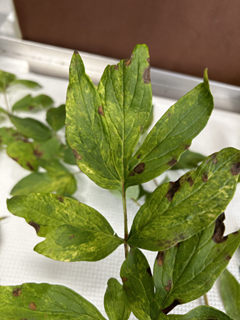
Image left: Chlorotic leaf blotches and necrotic spots on leaf margins typical of CNSV infection on peony. Photo credit: DATCP PIB Laboratory
Symptoms of CNSV include:
- Stunting
- Chlorotic leaf blotches
- Interveinal chlorosis
- Purple-red spots at leaf margin
- Necrotic areas at leaf margin
DATCP inspectors and the PIB Lab will monitor for CNSV on peony nursery stock in 2025.
If you are a licensed nursery grower and suspect you may have plants infected with CNSV, please contact DATCP’s nursery program at (608) 516-7617 or DATCPnursery@wisconsin.gov. If you are a home gardener or horticulture professional and suspect you may have plants infected with CNSV, contact the University of Wisconsin–Madison Plant Disease Diagnostic Clinic at (608) 262-2863 or pddc@wisc.edu.
|
_____________________________________
|
|
|
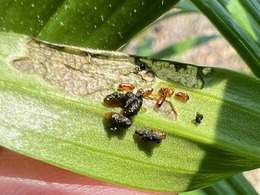
Lily leaf beetle larvae on Asiatic lilies in multiple counties. | DATCP L. Meils
|
|
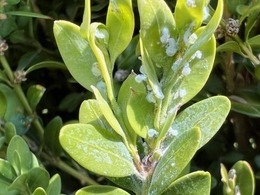
Boxwood psyllids on boxwood in Milwaukee & Waukesha counties | DATCP L. Meils
|
|
|
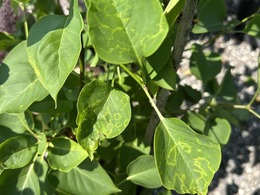
Virus symptoms on 'President Grevy' lilac in Ozaukee Co. | DATCP M. Wensing
|
|
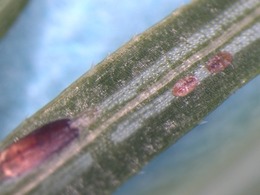
Live EHS with crawlers on imported hemlock in Ozaukee Co. | DATCP M. Lannan
|
|
|
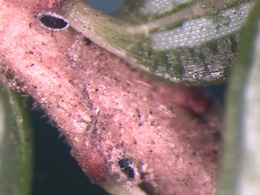
Live HWA nymphs on imported hemlock in Milwaukee Co. | DATCP M. Lannan
|
|
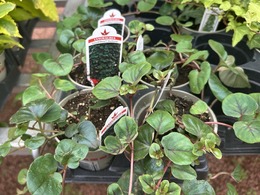
NR 40 invasive Lysimachia nummularia 'FanciFillers Sunburst' in Outagamie Co. | DATCP B. Sanneh
|
|
|
_____________________________________
|
|
|
For more information about Wisconsin's Nursery and Christmas Tree Programs, visit DATCP's Nursery and Christmas Tree Program webpage.
Read past issues of What's Growing On?
If you haven't yet, please take this brief feedback survey for our monthly What's Growing On? e-newsletter. With this survey, we aim to measure your satisfaction regarding the format, frequency, and quality of the content provided. Please give us your most transparent feedback. The survey is anonymous.
For current counts during the growing season from our insect monitoring networks around the state, visit our Pest Survey webpage. To read articles on economically important plant pests affecting Wisconsin's field crops, fruits, and vegetables, read our Field Notes publication put out weekly during the growing season.
|
|
|
|
|