|
|
Dear Wisconsin honey bee and pollinator fans:
We hope you are enjoying summer in Wisconsin! This is the third quarterly update of 2025 from the Wisconsin Department of Agriculture, Trade and Consumer Protection’s (DATCP) Apiary Program. If there is something you would like us to write about, please feel free to contact us at our general email, DATCPapiary@wisconsin.gov.
|
|

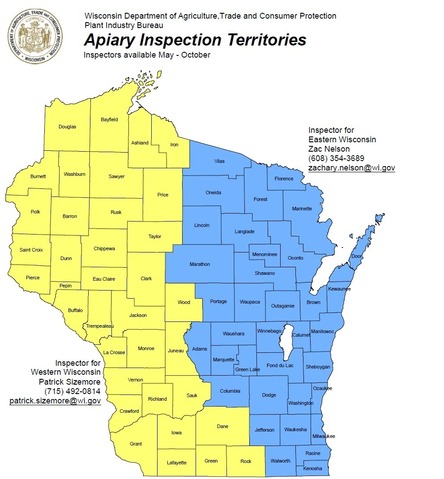
The Apiary Program is excited to announce that Zac Nelson has been hired as our new seasonal Eastern Apiary Inspector!
Zac has a Bachelor of Science degree in Biochemistry and Molecular Biology from Marquette University where he worked as a lab technician and field researcher performing hands-on experiments to study honey bee thermoregulatory behavior in the Chelsea Cook Lab. During his time at Marquette, Zac managed honey bee colonies on campus, designed experiments, worked with graduate experiments, and received awards for his research. He also gained valuable apiary field experience working with Lloyd Street Bees.
Since starting with DATCP on April 21, Zac has completed the University of Minnesota's Beekeeping in Northern Climates short course, performed 29 voluntary apiary inspections, and attended the Wisconsin Honey Producers Association Summer meeting.
Apiary Program Coordinator Brooke Nikkila-Sommerfeldt, Western Wisconsin Apiary Inspector Patrick Sizemore, and Eastern Wisconsin Apiary Inspector Zac Nelson are eager to provide inspection services to beekeepers from May through October. If you would like to request a free, voluntary apiary inspection of your bees; if you are a migratory beekeeper needing one or more $50 Certificate(s) of Inspection to move your bees to another state for crop pollination (generally in September and October); or if you have 10 or more hives and are also interested in participating in the National Honey Bee Survey, please contact us at DATCPapiary@wisconsin.gov so that our staff can follow up with you. While we try to meet all inspection requests we receive, contacting us as far in advance as possible is always helpful, as it enables staff to cover all requests in a county or region at once. You can schedule an apiary inspection online here: https://forms.office.com/g/qsHqzpvfia.
|
 |
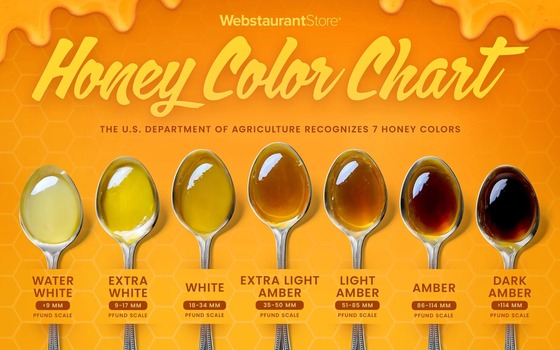 It is well known that honey is sweet and delicious, but it’s not as well known that the flavor and color of honey is determined by the flowers the bees forage on. Honey bees make honey by gathering nectar that they bring back to the hive to evaporate down into honey. Each of these nectars have a unique nutrient profile including amino acids (both essential and non-essential) proteins, carbohydrates (sugars: glucose, sucrose, and fructose), minerals, and water.
According to the National Honey Board, there are more than 300 unique types of honey available in the United States. These honeys range in color from almost colorless to very dark in color with flavors ranging from subtle to bold. Often, light-colored honey is subtle and milder while the darker honey is stronger and bolder. In Wisconsin, early season blooms such as dandelion, basswood, and fruit trees produce a light-colored honey. As our season progresses, the nectar gets darker in color with our darkest honey being produced by buckwheat.
Honey can be extracted as single source or multi source varieties. A single source honey means that the bees foraged on one singular floral source, such as orange blossom, and the beekeeper extracted the honey once that source stopped blooming. Multi source honey is commonly sold as wildflower and contains all the nectars foraged throughout the season.
UNIVERSITY OF MINNESOTA BEE SQUAD HONEY TASTING GUIDE
Bee Squad Beekeeper Clara Costello wrote up a short guide so you can identify the flowers responsible for your honey flavor. Below, you will find the most common honey bee flowers in our area. You may well detect one or more flavors in your particular honey, and different people can taste different thing in the same honeys!
Early season (May-June)
Basswood: very light and sweet. Notes of butterscotch, wood, and green apple with a brief mint/menthol finish.
Dandelion: light chamomile spice flavor with a bright floral pop at the end. Mid-season.
(June-July)
Clover: What many people think of as “normal” honey. Light, sweet, and floral, with a vanilla undertone and a fun cinnamon twist at the end.
Alfalfa: very mild sweet hay with spice notes and a little bit of bite that you can feel at the back of your throat.
Late season (August-September)
Aster: Not overly sweet, with a rich smooth caramel wood spice flavor.
Goldenrod: Similar to aster, but a lighter, silky texture. Floral start and butterscotch spice finish, sometimes with an unpleasant gym-sock odor.
Buckwheat: Molasses-dark with a malty, burnt caramel start and lingering woody notes. Tends to be a love-it-or-hate-it varietal. (Buckwheat can also be found in mid-season honey.)
Unique Notes:
If your honey has a yellow-green neon cast when you hold it up to the light, your bees may have been visiting star thistle: buttery texture with notes of wet grass and anise, with a light molasses-almond finish and a faintly gamy odor.
Purple loosestrife: medicinal, herbal, and tangy, with a black tea finish.
Find local honey here: WHPA Find Local Honey
Pollen Colors
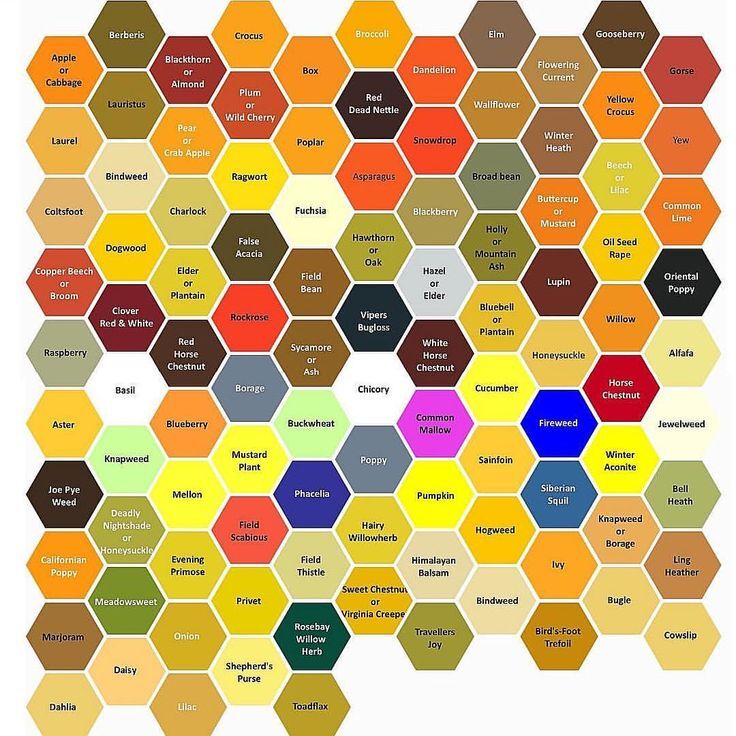
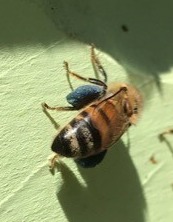
Pollen color and composition also changes with floral source. Each plant species produces a uniquely shaped, sized, and colored pollen grain. The pigments in pollen come from flavonoids, carotenoids (yellow or orange), and anthocyanins (red or purple). Yellow pollen is the most common color, with 75% of plant species having a spectrum of this hue. The image to the right, taken by Brooke Nikkila-Sommerfeldt, shows blue pollen baskets on a worker bee returning from visiting Siberian squill. Siberian squill is invasive in Wisconsin - do not plant it.
|
A chart displaying common pollen colors and their associated flower. Image created by a beekeeping association in the UK.
|
|
|
In Wisconsin, pollinators include managed honey bees; over 400 species of native bees; other insects, such as wasps, flies, butterflies, moths, and beetles; and one bird species, the ruby-throated hummingbird. Every one of these pollinators plays a crucial role in the long-term health of our ecosystem. Bees and other animals pollinate crops that supply one in three bites of food we eat and 80% of flowering plants. In turn, these flowering plants support soil retention and water filtration. Whether you are a gardener, a farmer, or a beekeeper, there are things you can do to protect and support pollinators, our food supply, and our agricultural economy.
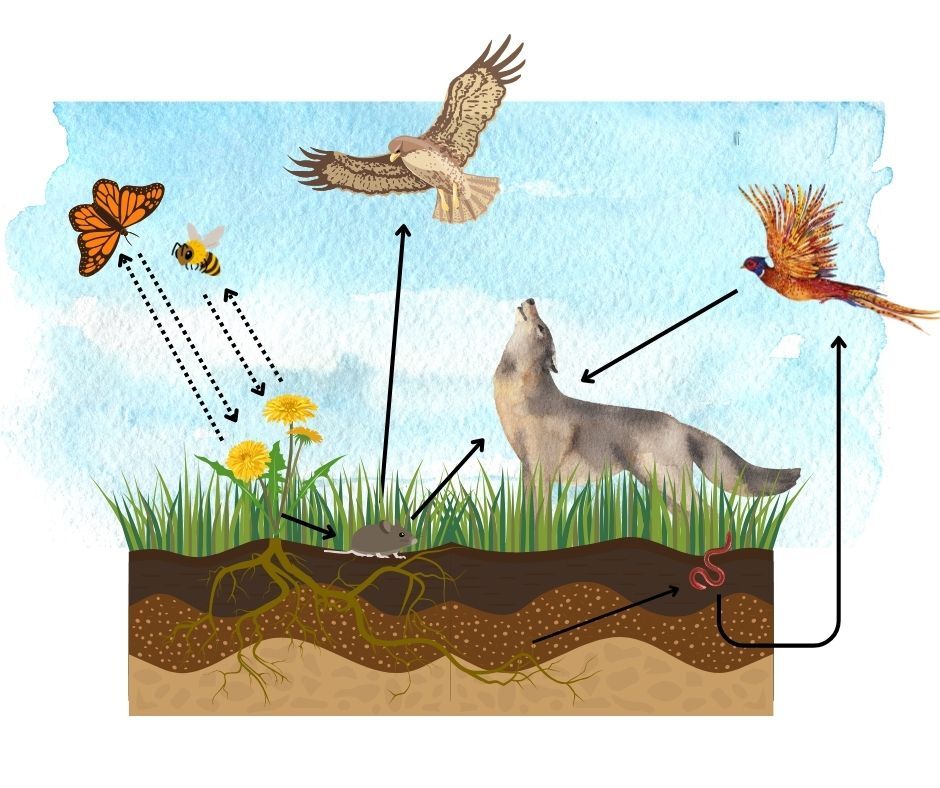 Example of an ecosystem interaction. Pollinators visit flowers that provide food or blooms for us and other animals. Those animals feed us and other animals while the root systems improve soil retention and water filtration. Graphic by Brooke Nikkila-Sommerfeldt
Below are some ways you can support pollinators, taken from information garnered from Pollinator Partnership and the Wisconsin Pollinator Protection Plan:
1. Create pollinator habitat.
-
- Plant pollinator-friendly flowers. Strive to have at least three types of flowers blooming throughout the season. Dandelions and serviceberries bloom very early and can be a first nectar source for many bees; bee balm and coneflower bloom in midsummer; and goldenrod, cardinalflower, and asters are some of the latest seasonal nectar sources. Want to focus on a specific pollinator? Plant for them! Focus on milkweed for monarchs and lupine for Karner blue butterflies, prioritize natives, and avoid invasive plants for our native bee species.
-
- Provide nesting habitat (dead wood, bare patches of soil, hollow stems, bunch grasses) for native, solitary bees.
- Keep flowers and lawns pesticide-free.
-
- If you must spray for pests, be considerate of possible drift, try to treat when flowers aren't blooming, and spray when pollinators are not foraging (dawn or dusk).
3. Participate in community science (or data collection).
-
- Download the WiBee App. The Wisconsin Wild Bee App was developed by the Gratton Lab at the University of Wisconsin-Madison for individuals to collect data on wild bee abundance and diversity in your area.
- Join the Bumble Bee Brigade and submit photos and observations of the bumble bees you monitor in your area.
- Participate in Project Wingspan. Wisconsin is just one of seven states that participates in this hands-on effort to help monarchs and other pollinators.
4. Support pollinator organizations, pollinator products and beekeepers.
Now that you know more about helping pollinators, download the pollinator protection week toolkit for links to suggested activities, planting guides, and more today!
|
|
|
Alarming honey bee colony losses, surpassing historical loss rates, were reported in January 2025 by commercial beekeepers. In response, Project Apis m. launched a Domestic Losses Steering Committee with the American Beekeeping Federation, Apiary Inspectors of America, the Honey Bee Health Coalition, the Almond Board of California, USDA-ARS, and the American Honey Producers Association to develop a survey to assess the scope and severity of these losses, gather critical data, and help researchers determine potential causes. When the survey closed, there were 846 respondents reporting an average loss of:
- 51% by hobby beekeepers (1-49 colonies)
- 54% by sideline beekeepers (50-500 colonies)
- 62% by commercial beekeepers (>500 colonies)
These losses include an estimated 1.7 million honey bee colonies and approximately $600 million in economic impact. In February 2025, scientists from the U.S. Department of Agriculture’s Agricultural Research Service (USDA-ARS) Bee Research Laboratory in Beltsville, Maryland collected and analyzed samples from across California and other western states. Preliminary findings from these samples, released in June 2025, show that high levels of deformed wing virus (DWV) A and B and acute bee paralysis virus (ABPV) were present in all USDA-sampled bees. These viruses are vectored and spread by Varroa destructor mites which encouraged the scientists to test the mites from these collapsed colonies and found all resistant to amitraz, a common miticide used by beekeepers. Other stressors, such as nutritional stress and agrochemicals, likely played significant roles in these losses.
USDA-ARS scientists are currently working on metagenomics, pesticide analysis, qPCR of pollen, and stock/breeding to determine why these viruses are more virulent and an explanation for the increased resistance to amitraz. Varroa and viruses are not the only answers to these colony losses and researchers are working diligently to uncover the other causes.
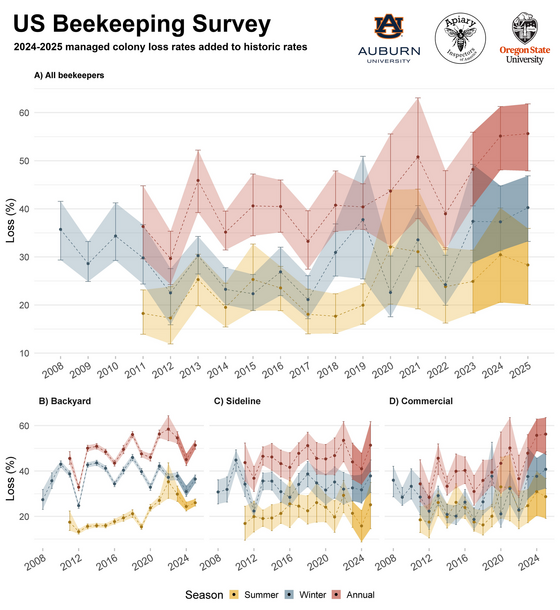
Results from the U.S. Beekeeping Survey, a collaboration with Auburn University, the Apiary Inspectors of America, and Oregon State University corroborated these findings as both surveys showed increased winter losses by commercial beekeepers. This survey of 2,453 beekeepers estimated colony losses at 55.6%, which is the highest loss rate since the survey started in 2010.
Based on these findings, recommendations for beekeepers include:
-
Monitoring for varroa and treating to keep mites below the 2% infestation threshold. Monitor after treatments to verify effectiveness.
-
Using more than one miticide to treat varroa, to avoid overreliance on Amitraz, including rotating between active ingredients and cultural controls. Check DATCP's 2025 honey bee treatment options for guidance.
-
Sanitizing hive tools with alcohol or flame between yards and holding equipment from deadout colonies aside before reuse to allow viruses to dissipate.
-
Isolating sick colonies from healthy ones.
-
Keeping hives healthy by replacing old black comb with foundation and making sure healthy, well-mated, young queens are present, and ensuring bees have adequate food (see the HBHC’s Nutrition Guide.)
Refer to the U.S. BEEKEEPING SURVEY results here: Apiary Inspectors of America - 2024-2025 Survey Results.
Review Project Apis M. presentation on the colony losses here: Complete Colony Losses Survey Summary Apr 2025.
|
|
|
|
|