|
 _____________________________________
Dear Wisconsin nurseries, Christmas tree growers, and gardeners:
Growing degree days (GDD) (simple B50) as of May 14 were 135 in Bayfield; 175 in Cumberland; 127 in Medford; 146 in Hancock; 121 in Green Bay; 145 in Racine; 216 in Madison; 263 in La Crosse; and 310 in Dubuque, Iowa.
A few pests in vulnerable-to-treatment stages include fletcher scale, spongy moth, boxwood psyllid, spruce spider mites, viburnum leaf beetle, and zimmerman pine moth at 100-200 GDDs; and pine needle scale and maple spider mite at 200-300 GDDs. Other pests soon to be in vulnerable stages include lilac borer, oystershell scale (brown), and euonymus caterpillar at 275-500 GDDs; and black vine weevil, bronze birch borer, oystershell scale (gray), and elm leaf beetle at 400-600 GDDs.
Take a moment to read through a few updates from the DATCP nursery program and send any feedback, questions, or ideas for future e-news updates to datcpnursery@wisconsin.gov.
Having trouble viewing this email? View it as a Web page.
_____________________________________
|
|
|
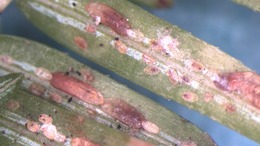
Elongate Hemlock Scale with crawlers | DATCP M. Lannan
|
|
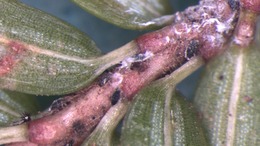
Settled Hemlock Woolly Adelgids | DATCP M. Lannan
|
|
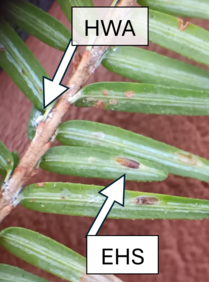
On April 30, 2025, DATCP staff became aware of a report of elongate hemlock scale (EHS) on a hemlock seedling in Wisconsin. The report was submitted by a UW-Stevens Point (UWSP) student on iNaturalist, a social network for sharing observations of biodiversity (image left: hemlock planted at UWSP, credit: iNaturalist). Because EHS is an invasive, non-native pest that Wisconsin has an exterior quarantine for, DATCP immediately investigated the report. DATCP learned Schmeeckle Reserve, a 280-acre conservancy area on the UWSP campus, had planted 50 hemlocks on April 27 which they had recently obtained from a Wisconsin nursery. On May 1, DATCP and UWSP staff worked together to remove all seedlings from three areas at Schmeeckle, finding most infested with EHS, including live immatures (known as crawlers), as well as 10% that were also infested with live hemlock woolly adelgid (HWA).
DATCP followed up with the Wisconsin nursery that sold the seedlings and learned the nursery had purchased 2,200 hemlocks from a nursery in Warren County, Tennessee. Although the Wisconsin nursery had a compliance agreement to import hemlocks from Michigan, they switched suppliers when the Michigan nursery couldn’t fill their order. The Wisconsin nursery surrendered for examination and destruction 275 remaining unsold seedlings to DATCP. They also provided information for 34 customers who purchased hemlock seedlings and immediately reached out to those individuals with instructions to quickly remove and destroy infested seedlings and to offer a credit or refund. DATCP also contacted these customers to share information on HWA and EHS and offered to pick up or help remove any hemlocks that were planted. DATCP tracked and verified all plant material customers destroyed on their own. Material picked up by DATCP staff was examined and found to have a much more significant infestation of HWA, along with the EHS.
DATCP issued a rejection notice to the Tennessee nursery after determining these wild collected hemlocks were not shipped in accordance with State of Wisconsin EHS or HWA exterior quarantine requirements. These quarantines require plant material be officially inspected and certified to be free of regulatory pests, or effectively treated to kill these invasive, non-native insects. EHS and HWA are not known to be established in Wisconsin. Fortunately, no other hemlocks were shipped from this Tennessee nursery to Wisconsin.
As of May 12, a total of 2,185 hemlock seedlings, or 99.3%, have been recovered from the field. DATCP staff are considering this to be a successful “regulatory interception” in which infested material is brought into the state but destroyed before the pest has a chance to establish. Notably, most of the hemlock seedlings were in very poor health. As is standard protocol, DATCP plans to work with partners in coming months and years to perform follow up surveys at sites that received infested stock and have significant amounts of hemlocks or other conifers that may be at risk.
|
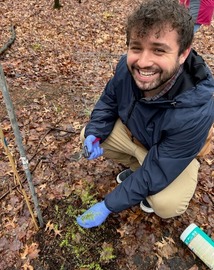
This “close call" highlights the importance of following terms of compliance agreements and quarantines to protect Wisconsin’s native hemlocks, other conifers, and the green industry. DATCP is grateful for the people and actions that led to the early detection and rapid response to this situation, including UWSP students and faculty, the Wisconsin nursery, their customers, and DATCP staff who went above and beyond to track down source information and recover hemlocks from the field. (image right: DATCP forest entomologist collecting an infested hemlock, credit: DATCP J. Oestreich)
|
_____________________________________
|
|
|
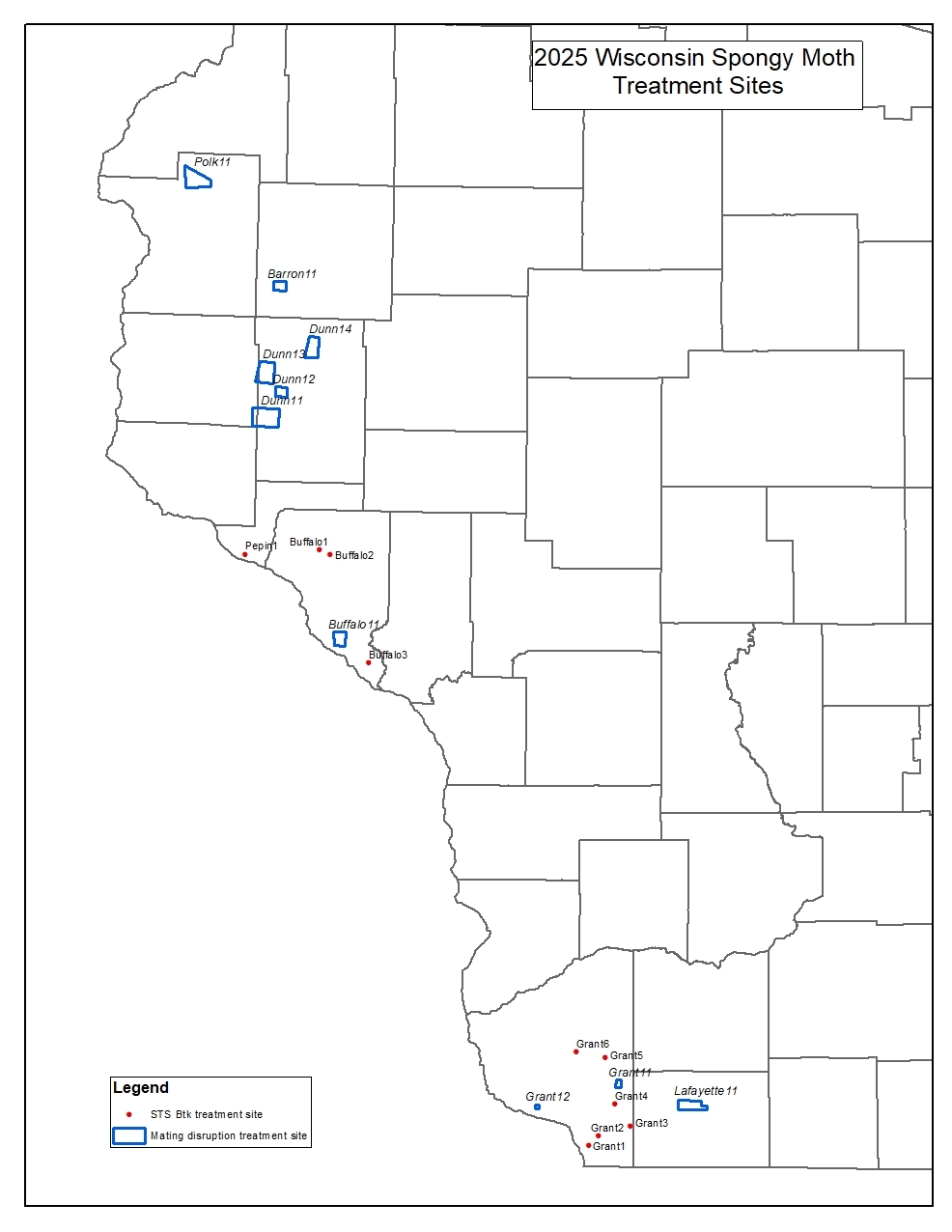
2025 Spongy Moth Treatment Map | DATCP N. Clemens
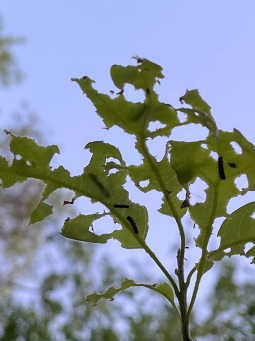
Spongy moth (Lymantria dispar) is a non-native insect that has spread throughout the eastern two-thirds of Wisconsin. After establishing in an area, spongy moth can completely defoliate trees and make them vulnerable to death from other environmental stressors. Besides the negative impact to forests, dead trees can decrease property values and require costly removal. Additionally, spongy moth caterpillars’ bristly skins can trigger allergic reactions in humans, including eye, skin, and respiratory system irritation.
DATCP utilizes trapping surveys and treatment to slow the westward spread and impact of spongy moth in Wisconsin as part of the National Slow the Spread Program. Approximately 8,000 traps will be placed in central and western Wisconsin from mid-May to early July both to monitor known spongy moth populations and to find new populations in previously uninfested areas. Aerial treatments will be utilized in targeted areas in western Wisconsin shortly after caterpillars hatch, and again in mid-summer just prior to their mating season.
From mid-May to early June, the planes will spray Bacillus thuringiensis var. kurstaki (Btk), a naturally-occurring soil bacteria which kills spongy moth caterpillars feeding on tree foliage. Btk is not toxic to people, bees, pets, or other animals and is certified for use in organic food production. The following counties are currently scheduled to receive Btk treatments: Buffalo, Grant, and Pepin.
In late June to mid-July, planes will spray an organic, biodegradable spongy moth pheromone to disrupt the mating process. Pheromone treatments spread the scent of female moths over a wide area, preventing male moths from locating real female moths. The following counties are currently scheduled for this mating disruption: Barron, Buffalo, Dunn, Grant, Lafayette, Polk, and St. Croix.
Residents in and near treatment sites can expect to see and hear loud, low-flying planes as early as sunrise. These aerial treatments are the safest, most efficient, and effective methods to slow the moth’s spread and impact westward. However, treatment plans may be adjusted at any time due to unforeseen changes in weather, funding, or other challenges.
An interactive map of the planned treatment areas is available at https://smaerialspray.wi.gov. To receive up-to-date information on treatment plans, sign up for email updates, call the Spongy Moth Hotline toll-free at (800) 642-MOTH, email spongymoth@wisconsin.gov, or follow us on Facebook or X.
|
_____________________________________
|
|
|
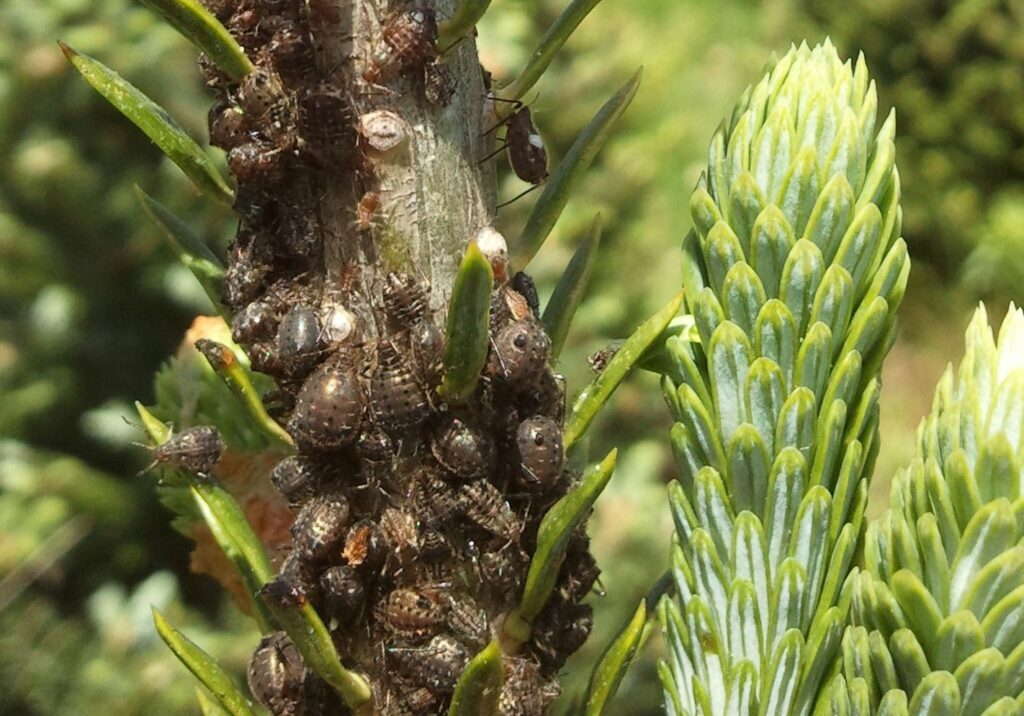
Cinara aphids on fir may be brown or black | NC State Extension image
Have you noticed large dark brown or black aphids on your Fraser fir trees? Cinara is a genus of several species of large brown or black aphids that feed on many conifers, including Fraser fir and white pines. They feed on tree sap and excrete honeydew, a sweet sticky substance that attracts ants and later in the season can cause black sooty mold to grow. Some Cinara aphids have wings and can move short distances with the help of wind. Cinara aphids can lay eggs, but most reproduce giving birth to live young. Their populations can quickly expand from a few aphids into hundreds.
When and where to scout for Cinara aphids on fir? As you work among your Fraser fir trees this May and June, be on the lookout for clusters of big black aphids on branches. Inspect Fraser fir trunks, leaders, or upper branch whorls. They may be found in large colonies. Cinara aphids leave a purple stain if squished, so take notice of purplish stains on your gloves and work shirts when shearing or at harvest time.
Why are they a problem? While their presence doesn’t always damage the trees, during drought conditions, the leader or top stems may be distorted and needles yellowed. Another concern, post-harvest, is the potential for customers to find big black aphids crawling inside their home after setting up their Christmas tree. Customers finding hundreds of these big aphids excreting honeydew on their ornaments, presents, and floors; as well as leaving a purple stain when squished on their carpet, furniture, and curtains, is not ideal and is difficult to remedy.
While DATCP inspectors have not observed Cinara aphids specific to Fraser fir trees in Wisconsin, there is a white pine aphid (Cinara strobi) that's black with white markings on its abdomen, which we commonly find on white pine. White pine aphid isn’t typically a problem indoors on cut Christmas trees.
Request to report: DATCP Christmas tree field inspections take place during September and October, so it is possible that we may be missing seeing these insects. We are asking you to scout your Fraser fir throughout May and June and notify your inspector if you observe the Cinara aphid in your Fraser fir field. Document by taking photos and collect a sample of several aphids so our DATCP entomologist can confirm their identity. We would like to know if this Fraser fir pest is present in Wisconsin. Thank you for your help.
_____________________________________
|
|
|
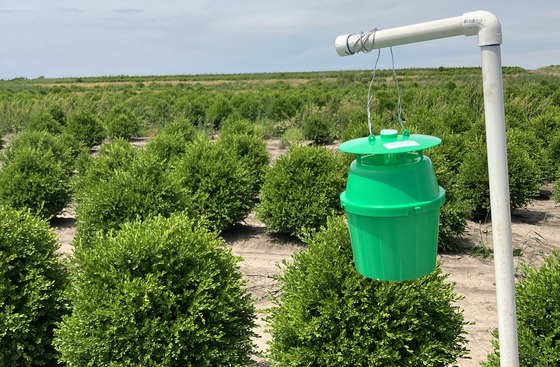
Box tree moth trap set at a production nursery in 2024 | DATCP image
DATCP’s Pest Survey Program is planning a detection survey in 2025 for the box tree moth (Cydalima perspectalis). This lethal boxwood defoliator is new to the U.S. and poses a significant economic threat to the nursery industry. First detected in North America in 2018 in Toronto, Canada, box tree moth has quickly spread into the U.S., including Connecticut, Delaware, Massachusetts, Michigan, New York, Ohio, and Pennsylvania. Although the moth and its larvae have not yet been found in Wisconsin, recent detections in nearby states make surveillance for box tree moth here especially timely and important for protecting boxwoods in landscapes and nurseries.
Will you join our detection effort? For the 2025 season, we are seeking 10 southern Wisconsin nurseries that grow or import boxwoods for public or wholesale purchase to help with our survey. Participating nursery growers or dealers will be asked to allow a DATCP field technician to set and monitor two plastic green bucket traps near the boxwood growing fields or near holding yards or retail sales areas. The traps, which contain a pheromone lure that attracts male box tree moths, will be checked every other week from June 1 through August 31 and removed at the end of the season. Nursery managers who are willing to assist with this important pest detection effort are asked to email Krista Hamilton at krista.hamilton@wisconsin.gov by May 16 with:
- Your name, cell phone number, and email address
- Company name
- Nursery or field location (county, address, GPS coordinates)
DATCP entomologists will screen and identify all trap samples. Nurseries will be notified if box tree moth is detected in a survey trap, but specific trap or field locations and nursery information will not otherwise be shared.
_____________________________________
|
|
Have you ever encountered an unusual insect or mysterious damage on your plants and just haven’t had a clue? That’s where the UW Insect Diagnostic Lab (IDL) can help!
The IDL was established in 1978 to provide free insect/arthropod diagnostics to Wisconsinites. Each year, the lab fields approximately 2,500 identification requests from Wisconsin’s growers, industry, colleagues in Extension and government, and the general public. This includes hundreds of samples from landscape trees, shrubs, and flowers, as well as nursery stock and greenhouses.
The IDL provides diagnostic services free of charge in most situations. Sample turnaround time is typically one to two business days upon sample arrival in most cases to allow you to respond to emerging pest issues in a timely manner. There are two main ways to get diagnostic assistance at the IDL: digital samples and physical samples.
-
Digital samples: (e., digital photographs) are often the quickest way to get a diagnosis from the IDL and are often a good starting point. When submitting digital photos, please indicate the size of the specimen(s), any relevant clues (e.g., host plant, description of damage, etc.), and where the insect was found (state/county/city). Geographic location can help narrow down possibilities and is also used for record-keeping purposes at the lab to help identify insect trends within Wisconsin.
-
Physical samples: While photos can be a good starting point, nothing beats a physical sample under the microscope. In some cases, a definitive diagnosis can only be made with a physical sample. The most important factor is making sure that samples arrive in good condition. Instructions for submitting physical samples to the IDL, as well as a printable sample submission form, can be found here: russell.wisc.edu/samples.
For additional information about the UW Insect Diagnostic Lab and its services, visit the IDL website at insectlab.russell.wisc.edu. Feel free to contact me (PJ Liesch) at pliesch@wisc.edu or (608) 262-6510 with any specific questions.
--Contributing author PJ Liesch, UW-Madison Dept. Entomology, Insect Diagnostic Lab
|
_____________________________________
|
|
|
EAB University Spring Webinar series
May 6, 2025: Elongate Hemlock Scale: Phenology and Impacts of Michigan's New(ish) Invasive Hemlock Pest. View recorded webinar
May 15, 2025, 9:00 a.m. CST: Hairy Situations: The Browntail Moth Problem in Maine. REGISTER
May 22, 2025, 9:00 a.m. CST: Invasive Mosquitoes and Their Implications for Human Health Around the World and Close to Home. REGISTER
May 29, 2025, 10:00 a.m. CST: An Update on Ticks for 2025. REGISTER
_____________________________________
|
|
|
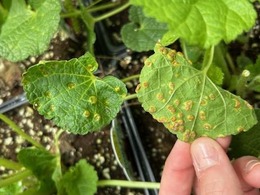
Rust on hollyhock in Racine Co. | DATCP G. Meysembourg
|
|
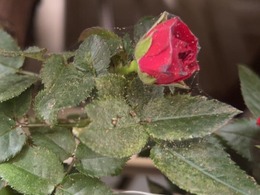
Spidermites on rose in Dane Co. | DATCP A. Kayfish
|
|
|
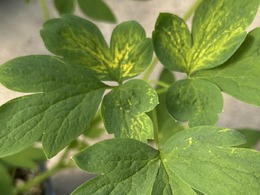
Virus symptoms on bleeding heart in Racine Co. | DATCP M. Wensing
|
|
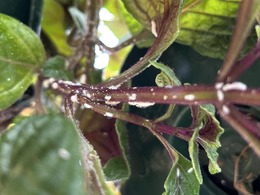
Mealybugs on purple leaved Swedish ivy in Walworth Co. | DATCP G. Meysembourg
|
|
|
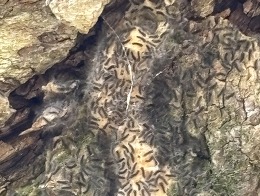
Spongy moth egg hatch (taken on May 8) in Grant Co. | DATCP M. Bogden Muetzel
|
|
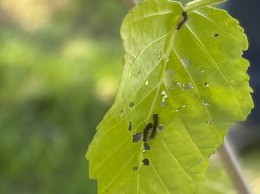
Spongy moth larvae on birch (taken on May 8) in Grant Co. | DATCP M. Bogden Muetzel
|
|
|
_____________________________________
|
|
|
For more information about Wisconsin's Nursery and Christmas Tree Programs, visit DATCP's Nursery and Christmas Tree Program webpage.
Read past issues of What's Growing On?
If you haven't yet, please take this brief feedback survey for our monthly What's Growing On? e-newsletter. With this survey, we aim to measure your satisfaction regarding the format, frequency, and quality of the content provided. Please give us your most transparent feedback. The survey is anonymous.
For current counts during the growing season from our insect monitoring networks around the state, visit our Pest Survey webpage. To read articles on economically important plant pests affecting Wisconsin's field crops, fruits, and vegetables, read our Field Notes publication put out weekly during the growing season.
|
|
|
|
|