|
 _____________________________________
Dear Wisconsin nurseries, Christmas tree growers, and gardeners:
Growing degree days (GDD) (simple B50) as of April 14 were 11 in Bayfield; 13 in Cumberland; 11 in Medford; 11 in Hancock; 9 in Green Bay; 33 in Racine; 33 in Madison; 40 in La Crosse; and 56 in Dubuque, IA. A few pests in (or very soon to be in) a vulnerable-to-treatment stage include first applications for Cooley and eastern spruce gall adelgid, pine bark adelgid, and spruce needle miner (50-100 GDDs). Once we hit 100 GDD(B50), some pests in vulnerable stages include fletcher scale, spongy moth, boxwood psyllid, spruce spider mites, viburnum leaf beetle, and Zimmerman pine moth (all at 100-200 GDDs), to name a few.
Take a moment to read through a few updates from the Wisconsin Department of Agriculture, Trade and Consumer Protection's (DATCP) nursery program and send any feedback, questions, or ideas for future e-news updates to datcpnursery@wisconsin.gov.
Having trouble viewing this email? View it as a Web page.
_____________________________________
|
|
|
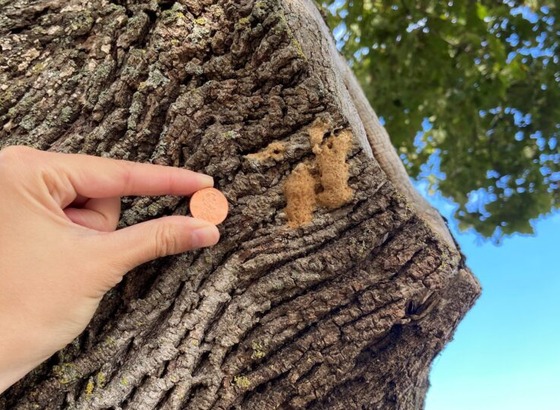
Spongy moth egg masses (tan colored objects on the bark) | DNR image
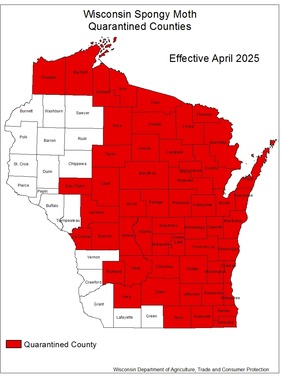
Because the spongy moth (formerly known as gypsy moth) is now well-established in La Crosse County, the USDA Animal and Plant Health Inspection Service (APHIS) and DATCP added this county to the state and federal quarantine on April 1, 2025, joining the eastern two-thirds of the state that is already regulated and infested with this pest. Despite spongy moth populations generally decreasing in 2024 after reaching outbreak levels in the preceding years, La Crosse County actually saw another increase of male moths caught by DATCP pheromone traps in 2024. This data, along with new egg mass detections in the city of La Crosse and continued pest spread despite pesticide treatments in prior years, all contributed to the decision to quarantine La Crosse County.
A quarantine is a type of plant protection regulation to stop the introduction of invasive plant pests and diseases, and to prevent them from spreading within the state. Items regulated by the spongy moth quarantine include woody nursery stock; cut Christmas trees; firewood, logs; pulpwood; wood waste such as wood chips, bark, and bark products; household items, including outdoor patio furniture; and mobile homes.
How do businesses comply with the quarantine?
Learn to identify spongy moth and train all employees handling regulated items to identify this insect. Watch DATCP's updated spongy moth ID training video on YouTube: Slow the Spread: 2025 Spongy Moth (Lymantria dispar) Identification Training.
If your business regularly transports any regulated items out of the 54-county quarantine area but not outside of Wisconsin, contact DATCP to obtain a state spongy moth compliance agreement. If your business ships regulated articles out of Wisconsin, contact APHIS for a federal compliance agreement. The agreement specifies risk mitigation requirements, is no cost to your business, and is renewed annually. To learn more about compliance agreements and who to contact, visit this webpage: Plant Product Compliance Agreements.
Inspect regulated items prior to shipment or request inspection by DATCP inspectors to certify shipments are free of spongy moth life stages. After inspection, utilize accurate statements, digital stamp certificates, or APHIS PPQ forms to facilitate shipment of regulated articles.
|
_____________________________________
|
|
|
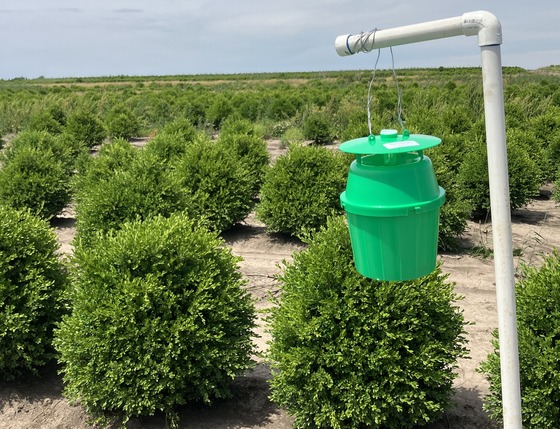
Box tree moth trap set at a production nursery in 2024 | DATCP image
DATCP’s Pest Survey Program is planning a detection survey in 2025 for the box tree moth (Cydalima perspectalis). This lethal boxwood defoliator is new to the U.S. and poses a significant economic threat to the nursery industry. First detected in North America in 2018 in Toronto, Canada, box tree moth has quickly spread into the U.S., including Connecticut, Delaware, Massachusetts, Michigan, New York, Ohio, and Pennsylvania. Although the moth and its larvae have not yet been found in Wisconsin, recent detections in nearby states make surveillance for box tree moth here especially timely and important for protecting boxwoods in landscapes and nurseries.
Will you join our detection effort?
For the 2025 season, we are looking for 10 Wisconsin nurseries that grow or import boxwoods for public or wholesale purchase to help with our survey. Participating nursery growers or dealers will be asked to allow a DATCP field technician to set and monitor two plastic green bucket traps near the boxwood growing fields or near holding yards or retail sales areas. The traps, which contain a pheromone lure that attracts male box tree moths, will be checked every other week from June 1 through August 31 and removed at the end of the season. Nursery managers who are willing to assist with this important pest detection effort are asked to email Krista Hamilton at krista.hamilton@wisconsin.gov by May 9 with:
- Your name, cell phone number, and email address
- Company name
- Nursery or field location (county, address, GPS coordinates)
DATCP entomologists will screen and identify all trap samples. Nurseries will be notified if box tree moth is detected in a survey trap, but specific trap or field locations and nursery information will not otherwise be shared.
_____________________________________
|
|
|
April is Invasive Plant Pest and Disease Awareness Month as declared by the United States Department of Agriculture (USDA). This national outreach month is the perfect time to learn about invasive plant pest and disease impacts on plant health nationwide as well as actions you can take to help reduce their spread.
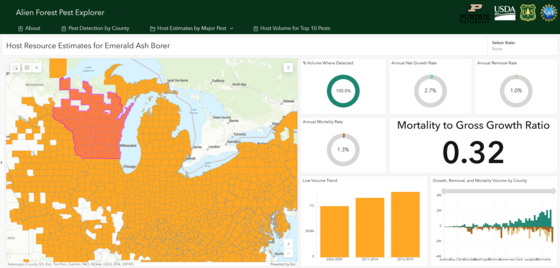
USDA Forest Service and Purdue University scientists worked together to update the Forest Service’s Alien Forest Pest Explorer. This user-friendly dashboard combines information from multiple sources to show the impact of different forest insects and diseases and the potential for further damage in U.S. forests. The Alien Forest Pest Explorer is a science-based interactive data visualization tool that can do a number of things, such as track ranges of invasive forest pests, quantify trends in host tree species abundance, and calculate increases in mortality caused by insect and disease invasions across the U.S. Explore this incredible tool to learn more about invasive pests impacting your area: Pest Detection by County.
Alien forest pest explorer website
To learn more about invasive plant pests and diseases regulated in Wisconsin, visit plantpests.wi.gov.
To report a pest or disease that is not known to be present in Wisconsin, or to report one that has spread to a new area within the state, call the Pest Hotline at (866) 440-7523 or email a photo and your location to datcppesthotline@wisconsin.gov.
_____________________________________
|
|
|
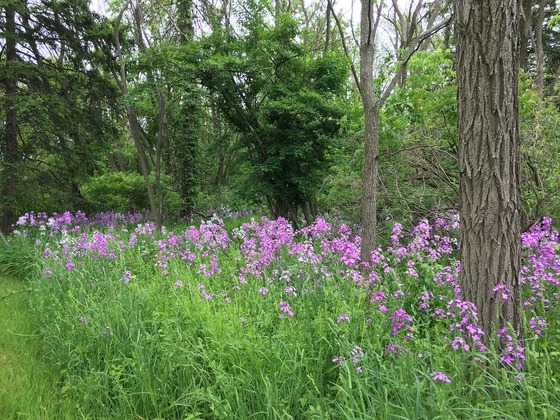
Invasive Dame's Rocket growing along forest edge | DNR image
Managing invasive plants can be overwhelming whether doing it yourself or encouraging others to do the same. Like any big project, dividing it into smaller more achievable steps can help prevent you from giving up while still making progress to the desirable outcome.
Start by doing some research to avoid adding invasive and potentially invasive plants to your landscape. Check the Wisconsin Department of Natural Resources' website and encourage those you counsel to do the same. You’ll find a list of restricted and prohibited plants in Wisconsin and detailed information on the identification, environmental impact, and control of these problem plants. Consult this site regularly to make sure you access the most accurate information available.
This resource is especially helpful when ordering plants online. Although regulations for the sale, purchase, and possession of invasive species are in place, some online sellers are not aware, up-to-date, or concerned with following existing state and federal regulations. Just because you can purchase a plant does not mean it is allowed in Wisconsin.
The same goes for DIY or purchased door swags, wreaths, and arrangements containing teasel, bittersweet, phragmites, and other invasive plants. Their seeds are released from the decorations into nearby soil where they can grow and eventually spread into natural spaces.
Next, survey your landscape looking for and making note of any invasive plants present. Check out these videos “Identifying Eight Aquatic Invasive Species in Wisconsin” and “Identifying Terrestrial Invasive Plants” for help identifying some of the more common invasive plants. Eradication may not be possible, but you can help contain and reduce the spread of Dame’s rocket (Hesperis matronalis), woodland forget-me-nots (Myosotis sylvatica), and a few others in the meantime by cutting them back and disposing of the trimmings before they go to seed.
Step up your efforts and begin tackling problem plants with the goal of eliminating as many as possible. Start in areas with the lowest density of invasive plants and work your way to the area with the greatest density of invasive plants. The goal is to contain the spread as you work to eliminate the problem.
Control options include manual, mechanical, biological, and cultural. Understanding how the invasive plant grows and spreads will help you select the best control for the problem plant and your situation.
Digging and pulling works best for small plants, especially those growing in sandy or loose and damp soils. Weed wrench-type tools with long handles allow you to lever somewhat larger woody plants like buckthorn (Rhamnus) and honeysuckle (Lonicera) out of the ground.
Covering plants like bishop’s goutweed (Aegopodium podagraria) and crown vetch (Coronilla varia) with carpets, tarps, or other impenetrable material can kill any of the plants, desired or invasive, in the covered area. If possible, mow or cut back the plants first and leave the cover in place for at least one growing season.
Properly timed mowing can also help manage crown vetch (Coronilla varia) and slow the spread of bishop’s goutweed. Mowing the plants back once or twice a season at the right time and for several subsequent years can help.
Although many people are trying to eliminate the use of pesticides, properly applied herbicides may be the best option for some plants and some situations. The invasive plant, its stage of growth, and the presence of nearby desirable plants will help determine the best product and means of application. Herbicides are applied to the basal bark, cut stump, or foliage based on those factors. As always, read and follow label directions for the safest and most effective control.
Once the invasive plants are removed, dispose of them properly. After all, you don't want to go to all that effort only to leave seeds, roots, or rhizomes behind to repopulate the area. Many municipalities allow you to bag, label them as “Invasive Plants”, and dispose of them in the garbage. Contact your municipality for disposal options in your area.
Continue to monitor your landscape for invasive plants. Look for sprouts from seeds that remain viable in the soil for years or blow in from surrounding properties. Pull or dig them as soon as they appear. Working together, we can make a difference.
--Contributing author Melinda Myers, Horticulturist and Certified Arborist, MelindaMyers.com
_____________________________________
|
|
|
A bee lawn | Photo credit: Rachel Urick
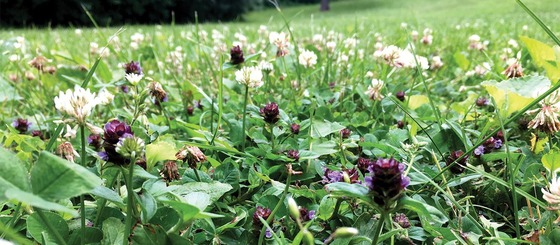
The number of people interested in protecting pollinators is on the rise, as are "No Mow May" initiatives. While mowing less early and often can certainly be helpful to allow early flowering plants to support bees coming out of hibernation, people don't necessarily need to take the catchphrase quite so literally.
The basic idea of increasing the availability of flowers for pollinators is good. However, it is not crucial to postpone mowing for the entire month. For example, if you give dandelions a chance to flower but mow them in May before they go to seed, you can provide resources for pollinators while preventing their seed from spreading. For white clover, you may need to mow in May to encourage them to flower again if the flowers are going to seed.
Also of note, ground-nesting native bees, such as miner bees or the endangered rusty-patched bumble bee, are not likely harmed by mowing in May as they tend to prefer habitat other than lawns (NOTE: avoiding applications of systemic pesticides to soil can be an important way to protect these pollinators). Even if a rusty-patched queen does happen to dig a hole to overwinter in someone's lawn, they would be deeper (about two inches underground) where they would be unlikely to be impacted by mowing.
Finally, replacing part of your lawn with native perennial flower beds can be a way to reduce the amount of mowing all season long, yielding more lasting benefits to pollinators than "No Mow May".
While “No Mow May” is a catchy slogan, we agree with the Minnesota Bee Squad's proposal to replace it with “Slow Mow Summer” because mowing less, rather than not at all, can actually provide more benefits to bees and other pollinators. “Slow Mow Summer” takes the sentiment of “No Mow May” and expands it to the entire growing season since bees need pollen and nectar after May, too. In fact, many bee species emerge from hibernation in June or July, when planting native roses, coreopsis (tickseed), monarda (bee balm), milkweed, and pale purple coneflowers can provide crucial sustenance. Later in fall, aster, goldenrod, and cardinal flower can support bees and migrating monarchs.
There are many native plants to choose from if you want to support pollinators. Read Wisconsin Pollinator Protection Plan's Best Management Practices for Gardeners for more information.
_____________________________________
|
|
This brief, 10-question quiz on invasive plant pests and their host plants was put together for winter outreach and tradeshow events. Take the quiz for fun to see how well you know some of the top invasive plant pests of concern for Wisconsin.
|
_____________________________________
|
|
|
EPA Integrated Pest Management (IPM) Webinar series
April 22, 2025, 1-2:30 p.m. CST: "Promoting Pollinators Through Plant Selection"
May 13, 2025, 1-2:30 p.m. CST: "Protecting the Public from Illegal and Unregistered Pesticides"
REGISTER HERE
_____________________________________
|
|
|
For more information about Wisconsin's Nursery and Christmas Tree Programs, visit DATCP's Nursery and Christmas Tree Program webpage.
Read past issues of What's Growing On?
If you haven't yet, please take this brief feedback survey for our monthly What's Growing On? e-newsletter. With this survey, we aim to measure your satisfaction regarding the format, frequency, and quality of the content provided. Please give us your most transparent feedback. The survey is anonymous.
To read articles on economically important plant pests affecting Wisconsin's field crops, fruits, and vegetables, read our Field Notes publication put out weekly during the growing season. For current counts during the growing season from our insect monitoring networks around the state, visit our Pest Survey webpage.
|
|
|
|
|