|
|
Dear Wisconsin honey bee and pollinator fans:
We hope you are enjoying the slightly warmer weather and longer days! This is the second quarterly update of 2025 from the Wisconsin Department of Agriculture, Trade and Consumer Protection’s (DATCP) apiary program. We enjoy writing these newsletters for you and hope that you find them beneficial. If there is something you would like us to write about, please feel free to contact us at our general email, DATCPapiary@wisconsin.gov.
|
|
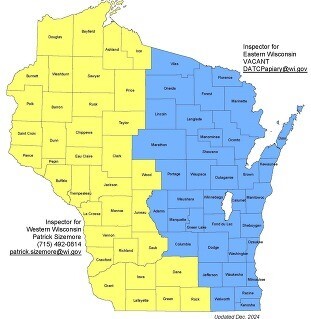
Wisconsin apiary staff are eager to provide inspection services to beekeepers from May through October. We have also applied to participate in the National Honey Bee Survey again this year, pending funding. If you would like to request a free, voluntary apiary inspection of your bees; if you need a $50 Certificate of Inspection to move your bees to another state (generally in September and October); or if you have eight or more hives and are also interested in participating in the National Honey Bee Survey, please contact us at DATCPapiary@wisconsin.gov so that our staff can follow up with you later this season. New for 2025, you can schedule an apiary inspection online here: https://forms.office.com/g/qsHqzpvfia.
Each year, Wisconsin apiary program staff work with Bureau of Agrichemical Management staff to update our Honey Bee Pest Management Options handout for beekeepers. This document provides a list of legal chemical treatments for common honey bee pests and diseases, such as Varroa mites, European foulbrood (EFB), and small hive beetle.
Finally, we are excited to announce that we are in the process of hiring and training a new eastern apiary inspector. We expect the new apiary inspector to start in late April or early May while our program coordinator, Brooke Nikkila-Sommerfeldt, is on planned leave from April to June. Please direct any inquiries to DATCPapiary@wisconsin.gov during this time.
|
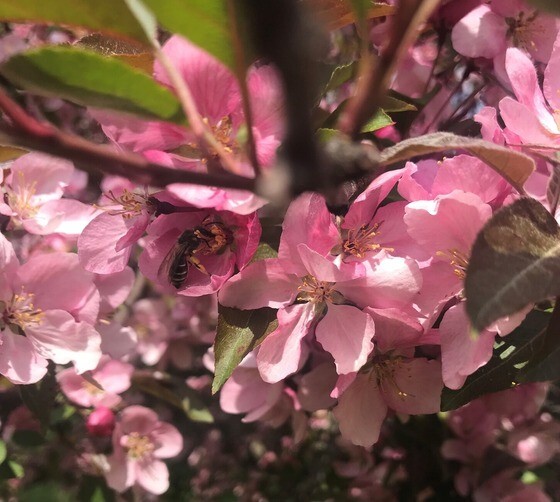 A native sweat bee gathering pollen from a blooming crab apple flower. Photo by Brooke Nikkila-Sommerfeldt
When thinking of flowers for honey bees and other pollinators, one might picture a flower garden or a wildflower prairie, but did you know that trees and shrubs are also crucial for providing pollen and nectar?
Why do trees matter?
Although flowering herbaceous plants are important for pollinators (especially those tied to specialists, like lupine and Karner blue butterflies, or milkweed and monarchs), most bloom only for short periods and offer only a handful of blooms. By comparison, many trees offer a steady and abundant source of nectar and pollen. The mass blooms flowering trees and shrubs produce make it a quick and easy foraging trip for even our smallest native bees.
Trees like willows, maples, and poplars are especially valuable as they bloom early in the spring, providing crucial resources when flowers are scarce. From mid to late spring, basswood, honeylocust, apple, pear, and crabapple trees provide abundant blooms for honey bees, bumble bees, and other pollinators, along with herbaceous perennials like columbine, Dutchman’s breeches, and wild geranium. When summer comes, dogwood and sumac complement the blooms of milkweed, coneflower, coreopsis, black-eyed Susan, and other plants. Later in fall, the seven-son flower is a shrub that can potentially sustain pollinators even after cardinal flowers, goldenrod, and aster cease their blooms.
How can you help?
Consider planting a variety of trees, shrubs, perennials, and annuals with overlapping blooming periods to provide a constant series of blooms throughout the season. No matter what you plant, it is important to keep those flowers free of pesticides especially while they are in bloom. Beyond supporting honey bees, having a mix of blooms from various types of plants also ensures that your landscape will support a wide variety of native pollinators. For example, white flowers are especially attractive to beetles and flies, yellow flowers attract bees and wasps, red ones attract hummingbirds, and purple ones attract butterfly pollinators.
Find out more information about supporting pollinators, including Best Management Practices for beekeepers and gardeners, on our Pollinator Protection Plan webpage.
|
|
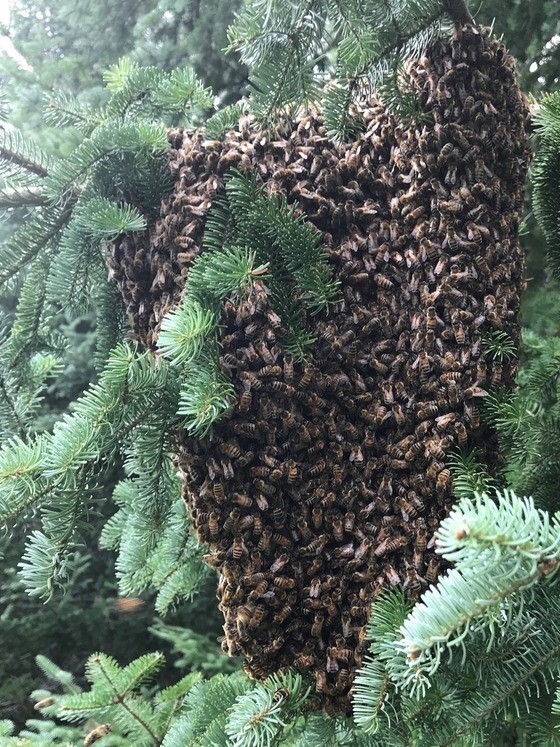 A big swarm of honey bees waiting for "house hunters" to return so they can decide where their new nest will be. Photo by Brooke Nikkila-Sommerfeldt
To understand swarming, a beekeeper needs to understand honey bee biology and behavior. Swarming is a honey bee colony’s natural way of reproducing and ensuring the queen's genetics persist. Essentially, one large, overcrowded colony becomes two smaller, less crowded colonies. When honey bees swarm, they take the old queen and half the bee population with them, leaving behind worker bees and queen cells. Many factors can contribute to a colony wanting or needing to swarm, including increasing bee population, limited space, and a surplus of incoming food resources. “Swarm season” often occurs in the spring or early summer when colonies successfully come out of winter and nectar starts to become available. Swarms can, however, occur any time during the active bee season as overcrowding and lack of space are major drivers of this behavior.
When honey bees are preparing to swarm, a beekeeper will notice:
- A booming bee population of adult worker bees, drones, and capped brood
- The production of swarm cells or multiple queen cells on the bottom of brood frames
- Little to no open cells in the brood nest or on resource frames
- Nectar and pollen being stored in the brood nest or wherever there is space - often between brood boxes
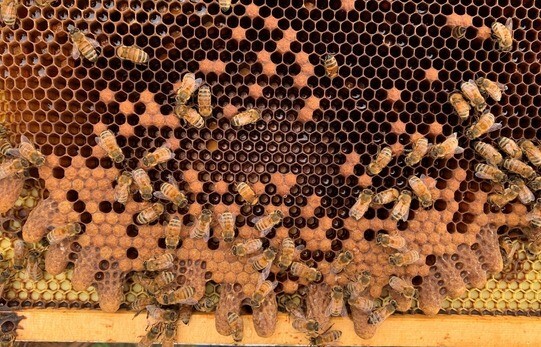 A line of queen cells near the bottom of the brood nest indicative of swarming. Photo by Brooke Nikkila-Sommerfeldt.
What a beekeeper may not see during swarm preparation is the queen losing weight and the workers gaining it. Because a mated queen is too heavy to fly due to the size of her ovaries, the worker bees begin feeding the queen less food, which decreases her egg laying while also encouraging her to work out by chasing her around the hive. Several days before the swarm leaves the workers will begin engorging themselves with honey so they have energy for the move as well as a small food reserve once they arrive to their new nest.
When the time comes for the swarm to leave, a beekeeper may or may not notice a frenzy of activity outside the front of the hive. This frenzy only lasts a few minutes before the bees take off for the nearest tree or structure approximately 20 feet away from their original colony. Once clustered nearby with the queen safely tucked away in the middle of the bees, the swarm sends out house hunters or scouts to find a new place to live (yes, they leave before even knowing where they are going!) This endeavor may take anywhere from a few minutes up to a few days and is a democratic decision made by the swarm. To read more about this democratic process, read “Honeybee Democracy” by Thomas D. Seely.
Once a colony has made the decision to swarm, it is difficult to get them to change their mind, so being proactive by splitting or dividing the hive is the best management practice. Performing splits or divides in the spring should happen six to eight weeks before the fruit tree bloom.
Please remember to be a good beekeeping neighbor and don’t let your bees just swarm as creating a nuisance for your neighbors can lead to changes in beekeeping ordinances.
Read more about this specific topic here: Minding Your Bees and Cues | Bee Culture: Divide and Prosper
Want to learn more about swarming or performing a split?
Watch: Colony Division: An Easy Method to Split a Colony
Read: DIVIDES
Interested in being added to a list for swarm removals? Consider joining the groups below:
Join Swarmed
WHPA Members | Wisconsin Honey Producers Association
|
|
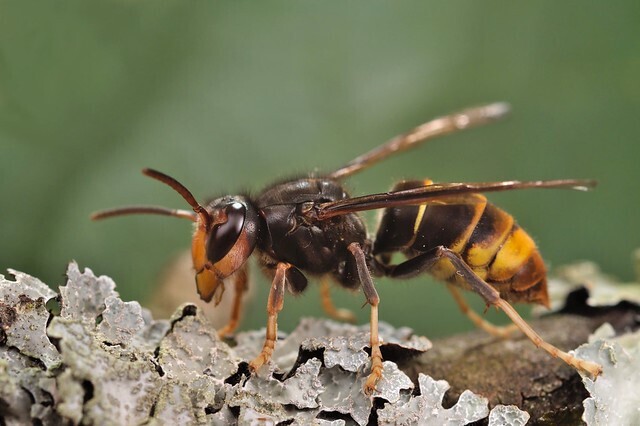 An adult yellow legged hornet showing it's characteristic yellow bottom half of legs . Photo by Georgia Department of Agrictulture
The yellow-legged hornet (Vespa velutina), native to Southeast Asia, has become an invasive species in parts of Europe and the United States. First detected in Savannah, Georgia in August 2023, and later detected in Jasper County, South Carolina in November 2023, this predatory wasp poses a significant threat to honey bees and other pollinators (and, by extension, agriculture.) In 2024, the Georgia Department of Agriculture (GDA) set 1,200 traps in efforts to capture active queens. To date, 52 nests have been detected and eradicated, with all nests within a 25-mile radius of the Savannah area. GDA will continue to monitor and trap throughout 2025.
Yellow-legged hornets (YLH) are social wasps that build large, paper-like nests in trees or elevated structures. These nests can house up to 6,000 workers, making them formidable colonies. The hornets are identified by their dark brown or black bodies, yellow abdominal bands, and distinctive yellow color on the bottom half of their legs.
What sets the yellow-legged hornet apart is its aggressive behavior toward honey bees. These hornets attack hives, picking off bees as they enter or exit, and they have the potential to destroy entire colonies. Predation by this emerging invasive species is another strike against honey bee populations, which has also been impacted by varroa mites and other pests, poor nutrition (due to lack of forage), climate change, pesticides, and habitat loss.
Efforts to control the spread of yellow-legged hornets focus on early detection and nest removal. Embryo nests, often the size of a tennis ball, are built by queens in spring. By removing embryo nests, queens are prevented from establishing new nests. This is crucial in reducing the spread of this invasive species. In South Carolina, for example, the first abandoned embryo nest was found in April 2024 and the first secondary nests were found and destroyed in August 2024. While we have other similar wasps in Wisconsin, we have never had a report of YLH in the state. Any suspected YLH adults or nest locations should be photographed and reported to DATCPapiary@wisconsin.gov. Public awareness and vigilance are key to preventing the establishment of this invasive species.
Find more information at https://agr.georgia.gov/yellow-legged-hornet.
|
|
|
|
|