|
|
The Dane County Law Library will be closed on Wednesday, November 11 in observance of Veterans Day. The Lavinia Goodell State Law Library and Milwaukee County Law Library will be open that day.
Over the Thanksgiving holidays, the Lavinia Goodell State Law Library and Milwaukee County Law Library will be closed on Thursday, November 26. The Dane County Law Library will be closed both Thursday, November 26 and Friday, November 27.
While any of our libraries are closed, you may email your questions to wsll.ref@wicourts.gov or call us at 608-267-9696. We will get back to you as soon as possible.
By Michael Keane
Based on recent elections, Wisconsin’s election for governor in November 2026 will involve the participation of over 2 million voters, whose votes will be counted and tabulated by numerous election officials around the state. Here is how Wisconsin law requires the counting of the vote to proceed.
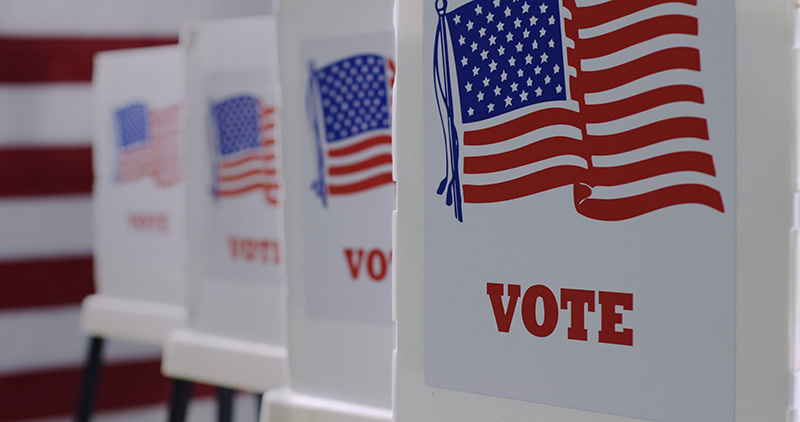 Local canvassers inspect ballots and voting machines and provide tally sheets for each municipal ward to the county clerk pursuant to Section 7.51, Wisconsin Statutes.
County canvassers tabulate the county totals from the municipal tally sheets and the county clerk posts all results on the county internet site within 2 hours of receiving them, as required by Section 7.60, Wisconsin Statutes.
The Wisconsin Elections Commission conducts the statewide canvass and, with certain exceptions, completes the canvass and determines winners by December 1. The Elections Commission then provides certificates of election to the successful candidates in each race. It also prepares certificates indicating which individuals have been elected to serve in the U.S. House of Representatives. This is detailed in Section 7.70, Wisconsin Statutes.
Candidates for office who receive within 1% of the total votes of the leading candidate may request a recount (Wis. Stat. 9.01). Other candidates may also request a recount, but will be charged expenses realized from the recount. Unlike some states, a recount must be requested; there is no threshold that will trigger an automatic recount. The recount is normally conducted by the same canvassers who made the initial count, but observers from the campaigns, political parties, and the public may view the recount. The exact method of recounting the ballots is in the discretion of the board of canvassers, within certain statutory limits. Recounts are governed under Chapter 9, Wisconsin Statutes.
The two houses of the state legislature may choose to be the judge of the elections, returns, and qualifications of their own members under Article IV, Section 7 of the Wisconsin Constitution. The two houses of the federal Congress have a similar provision found in Article I, Section 5 of the United States Constitution.
The Elections Commission governs elections in this state and has published online a number of manuals that detail the manner in which elections must be conducted.
|
|
|
By Noelle Brasch
 |
|
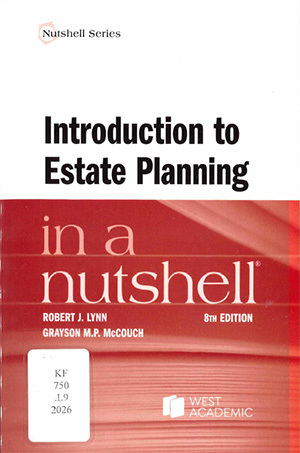
New Book! Introduction to estate planning in a nutshell, by Robert J. Lynn & Grayson M.P. McCouch
Call number: KF 750 .L9 2026
The new edition of this concise guide breaks down estate planning for students and lawyers alike. Each chapter details a particular topic, keeping citations limited to make the sections easily digestible. Start here for a convenient reference on the basic concepts and techniques of estate planning.
Topics include:
- “Simple” wills
- Social security
- Insurance
- Community property
|
 |
|
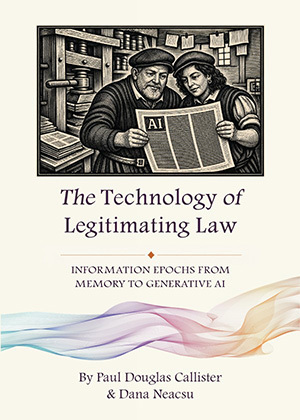
New Book! The technology of legitimating law: information epochs from memory to generative AI, by Paul D. Callister & Dana Neacsu
Call number: KF 487 .T4 C35 2026
Thinking about AI and the law? This new title puts today’s uncertainties in a broader historical context of information technology and legal practice. From oral tradition to the printing press, how we preserve and communicate knowledge has been evolving for centuries. Read this book for insight on how technology changes the law.
Topics include:
- Public performance and preservation
- Early writing systems and recordkeeping
- The American legal treatise
|
Don't forget to check out this month's new book list, with new and updated books in our collection.
By Heidi Yelk
Clear All Formatting in Microsoft Word
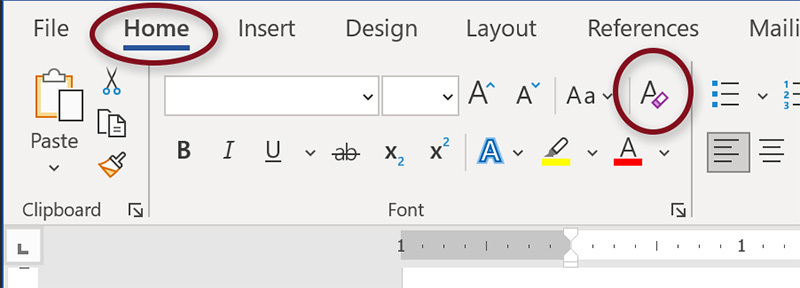
A handy button in Microsoft Word that may have escaped your attention is the "Clear All Formatting" option. This can be useful if you have multiple areas where you wish to remove the formatting. Rather than making manual changes to multiple parts of a document, simply select the sections (or the entire document) and then click the Clear All Formatting button.
This button is found under the Home menu, along with other formatting options.
|
|
|
By Carol Hassler
In remembrance
It is with deep sorrow that we remember Lucille Busse, former Library Assistant at the Wisconsin State Law Library who passed away in September. For nearly 16 years Lucille was the welcoming face and voice of the State Law Library, greeting both telephone and in-person library users. Former State Law Librarian Julie Tessmer Robinson remembers that “Lucille had a knack for remembering everyone’s name and made each person feel valued. She was truly one of those special people who made our library such a wonderful place.” Lucille retired in 2003 and continues to be fondly remembered.
Join our November webinar
Intro to Legislative History
Wednesday, November 18, Noon-1:00 PM
Live Webcast – Register for Intro to Legislative History
I need the legislative history of a Wisconsin statute. Where do I start? What do I do? Participants will look at the primary resources used to research Wisconsin legislative history, learn about the online Wisconsin legislative drafting files, and learn some helpful tips and tricks along the way. This introductory class covers basic research strategies and sources.
Contact Jaden Henneman with any questions about registering for this upcoming class.
OLR’s Lunch & Learns
The Office of Lawyer Regulation has two upcoming free webinars to close out 2026.
Perfect as the Enemy of Good: Strategies for Combatting Perfectionism & The Fear of Mistakes, presented by Tracy Keplar
November 10, Noon – 1 PM
Live Webcast - Register for Perfect as the enemy of good
Approved for 1 LAU credit
Beyond "Just Say No": The Mindset & Strategy of Effective Boundaries
December 3, Noon – 1 PM
Live Webcast – Register for Beyond just say no
Government Information Day 2026
Virtually meet with librarians, researchers, archivists, and government professionals to explore multiple government information topics. Sessions throughout the day include federal and state depository program updates, a discussion about AI and its impact on government and libraries, a history of the ratification of the U.S. Constitution, and an overview of various government data rescue initiatives. Government Information Day is hosted by the Wisconsin Department of Public Instruction.
Topics include
- the Center for the Study of the American Constitution (CSAC), presented by John Kaminski, CSAC founder;
- the Data Rescue Project, presented by Lynda Kellam, Director of Research Data & Digital Scholarship (RDDS) at the University of Pennsylvania, and Director and Co-Treasurer of the Data Rescue Project;
- and AI & The Search for Authenticity, presented by David McHugh, Instruction Manager & Teaching Faculty member at the University of Wisconsin-Madison Information School.
- This info-packed day also includes lightning talks, including our library’s Reference and Instruction librarian, Michael Keane on researching the Wisconsin constitution.
Date: November 17, 2026, 9:00 a.m. - 3:30 p.m. CST
Location: Virtual via Microsoft Teams
Cost: Free
Register for Government Information Day, and mark your calendar to be part of the conversation that’s shaping tomorrow’s public information landscape. Please note that this conference will not be recorded, and no CLE credits are offered for this seminar. This event is sponsored by Wisconsin Federal Depository Libraries and the Wisconsin Document Depository Libraries located throughout the State.
|
|
|
Laura Ingalls Wilder reproduction cabin
Photo by Noelle Brasch
Text by Emma Rocha, Madison College Paralegal Intern
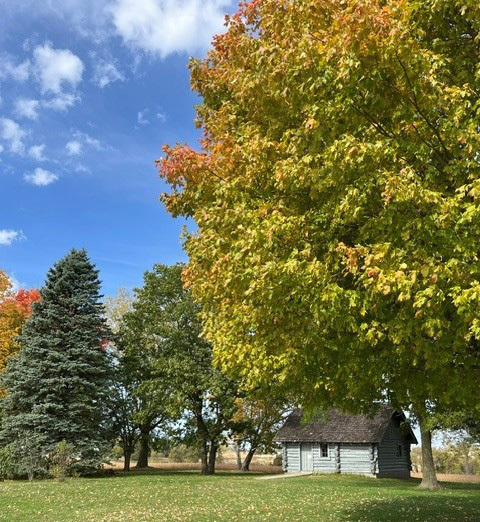 The cabin shown in this photo stands about seven miles northwest of Pepin, near the spot where Laura Ingalls Wilder was born on February 7, 1867. It is also a small lesson in how the law decides what counts as historic.
Start with the cabin itself, which is a reproduction of the original home based upon the details of Wilder remembered in her book, Little House in the Big Woods. The real cabin has been lost to time. It was built in 1978 by the Laura Ingalls Wilder Memorial Society on three acres of the original Ingalls farm. This is what keeps the site off the National Register of Historic Places. Federal rules say reconstructed buildings are not eligible unless they meet a narrow exception, such as being a part of a restoration master plan when no original survives, under 36 CFR § 60.4. Pepin County's only two Register listings are the Durand Free Library and the county courthouse and jail.
Wisconsin, however, took its own route. In 1962, the State Historical Society erected Official Wisconsin Historical Marker No. 118 in Laura Ingalls Wilder Park in the village of Pepin. The marker program now runs under Wis. Stat. 44.15 and Wisconsin Administrative Code HS 4. Any person may apply, but the applicant must fund and maintain the sign. One approval criterion fits Wilder exactly. HS 4.06(3) of the code offers approval of applications to sites in association with deceased people who have made significant contributions to the broad patterns of history and culture.
The Little House books that grew from this cabin and contributed greatly to our history and culture had legal issues of their own as well. Wilder's will left her literary estate to her daughter, Rose Wilder Lane, for life, with rights passing to the library in Mansfield, Missouri afterward. When Lane died in 1968, the copyrights went instead to her heir, Roger Lea MacBride. In 1999, the Wright County Library Board sued HarperCollins and MacBride's heirs in federal court. The court granted MacBride's motion to dismiss the Wright County Library Board's claims to the first six books renewed by Rose Wilder Lane, but ordered all parties to attend mediation where a settlement of $875,000 was tentatively agreed upon. See Library board to benefit from royalty settlement and Little Copyright Dispute on the Prairie: Unbumping the Will of Laura Ingalls Wilder
While the cabin may be a reconstruction, the law has kept its own record of the place. Regulations that exclude it, a marker that honors it, and court proceedings about the stories it inspired are now all included as part of its history.
We are accepting snapshots! Do you have a photo highlighting libraries, attractions or points of historical interest? Send your photo to the editor at carol.hassler@wicourts.gov to be included in a future issue.
|
|
|
|
|