|
by Michael Keane
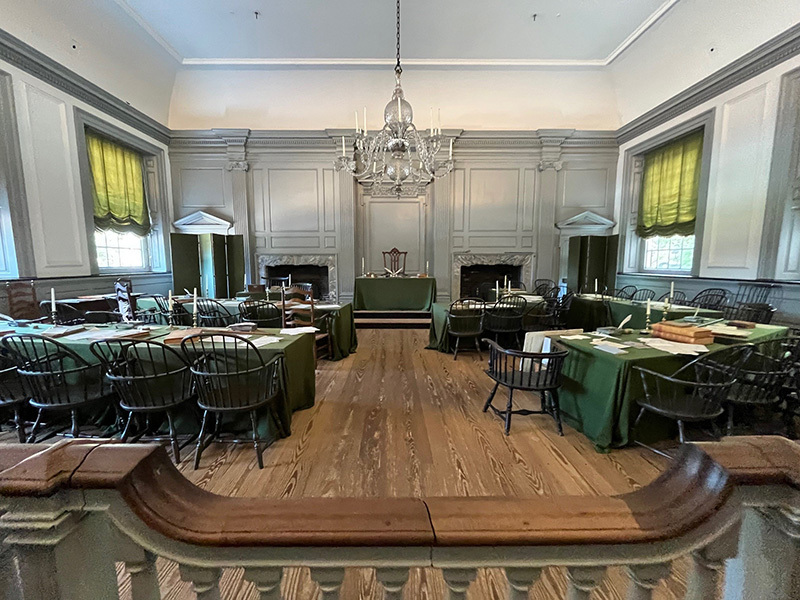
We have marked our beginnings from the year 1776 throughout our history. “Four score and seven years ago” begins one of the most famous speeches in American history. Even the United States Constitution concludes that it was done “In the year of our Lord one thousand Seven Hundred and Eighty-Seven and in the Independence of the United States, the twelfth.” The Constitution of the State of Maryland states that its citizens “are entitled to the common law of England and to the benefit of such English statutes as existed on the Fourth day of July, seventeen hundred and seventy-six”, asserting the English sovereignty of Maryland until the date of severance - that is, the date of the Declaration of Independence.
This year we mark a milestone - the 250th Anniversary of this event. The Revolutionary War had been underway for well over a year at that point. The delay between the start of the war and the Declaration came from a lack of consensus on whether the American colonies should sever their ties with England, or if the war was merely seeking a more favorable place for America in the British constitutional framework. The citizens of North Carolina, for example, in sweeping away their colonial government in 1775 and establishing a form of their own, were careful to assert publicly their continued allegiance to the King of Great Britain. Generally, the desire for independence was strongest in New England and less so in the central and southern colonies. The passionate patriot Samuel Adams of Massachusetts asked, “Is not America already independent? Why then not declare it?” His more sober cousin John Adams stated, “progress must be slow,” comparing America to “a coach and six, the swiftest horses must be slackened, and the slowest quickened, that all may keep an even pace.”
The early months of 1776 marked a change in public opinion in favor of independence. An act of parliament declaring the American colonies beyond the protection of the British government influenced some people toward independence. The publication of the pamphlet Common Sense early in 1776 also caused many to embrace the cause of independence. On June 7, Richard Henry Lee of Virginia offered a resolution in Congress proposing that “these united colonies are, and of right ought to be, free and independent states. . . absolved from all allegiance to the British crown…”
Congress delegated a committee of Roger Sherman, Thomas Jefferson, John Adams, Benjamin Franklin, and Robert R. Livingston to draft a declaration providing the reasons for the separation. Jefferson drafted the declaration alone, then submitted to numerous amendments by the committee, primarily from Adams and Franklin. The committee submitted the declaration to Congress in late June, and on July 1, Lee’s independence resolution was taken up. Three states still dissented, but during the course of debate Pennsylvania and South Carolina came around to firmly supporting independence. The final colony, New York, withheld its vote, but gave assurances that it would approve independence if the other 12 states did so. And so, on July 2, Lee’s resolution was approved. Many thought at the time, and some still argue, that this is the true anniversary of American independence. John Adams himself predicted that July 2 would be celebrated by future generations “with Pomp and Parade, with Shows, Games, Sports, Guns, Bells, Bonfires and Illuminations…” However, on the following day, Congress took up the declaration itself, making numerous amendments to the committee’s work.
The declaration was enrolled and approved by Congress on July 4, although contrary to the popular image, the declaration was probably only signed on that day by John Hancock, the president of Congress, and Charles Thomson, the secretary of Congress. At first, the word “unanimous” was left off of printed copies, mindful of New York’s abstention – that state’s approval did not reach Congress until July 19. Copies were printed and read throughout the nation, embedding in the public consciousness the date of July 4. Abigail Adams reported to her husband John that after a public reading in Boston, the royal arms were taken down and burned in the street. Similar symbolic acts around the country marked the passing of one era and the beginning of the next. Later, a parchment copy was made available for members of Congress to sign; apparently, most signed the document on August 2; others added their signatures later. It is also worth noting that the Continental Congress voted in state units; the unanimity referred to in the declaration was of all 13 states.
Yet the question of American independence was not decided. Numerous individual members of Congress opposed independence and declined to sign. The War of Independence dragged on for years; Great Britain did not concede the point until 1783.
History records July 4, 1776 as the date of our birth as a nation, and on this, the 250th anniversary of that event, we remember in a special way those who pledged “our lives, our fortunes, and our sacred honor.”
The official website of the semiquincentennial, or 250th birthday of the United States, can be found here: https://america250.org/ The State Historical Society of Wisconsin also offers resources for commemorations or celebrations.
The Wisconsin State Law Library has a number of venerable but worthy resources on the Declaration of Independence:
The Declaration of Independence: The Evolution of the Text as Shown in Facsimiles of Various Drafts by its Author, Thomas Jefferson, by Julian P. Boyd, Princeton University Press, 1945. JK 128 B66
The Story of the Declaration of Independence, Text by Dumas Malone, Oxford University Press, 1954. JK 128 M3
The Declaration of Independence: Its History, by John H. Hazelton, Dodd Mead and Company, 1906. E 221 .H25 1906
The Declaration of Independence, by William Henry Michael, U.S. Gov’t Printing Office, 1904. E 221 .M62
Don’t miss display
Visit the Lavinia Goodell State Law Library before July 16 for a look into America's history.
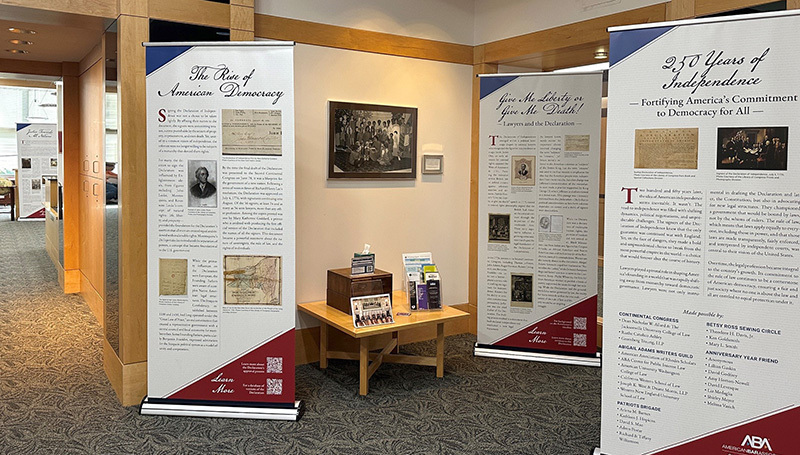 In celebration of the 250th anniversary of the signing of the Declaration of Independence in 1776, this American Bar Association (ABA) exhibit will highlight the role lawyers played in the creation of this crucial document and the important place it has held in American law.
Visit the Lavinia Goodell State Law Library at 120 Martin Luther King Jr. Blvd in Madison. The exhibit is available for viewing Monday through Friday, from 8:30-4:30.
|