 April News
Solar project to provide economic resilience and workforce opportunities
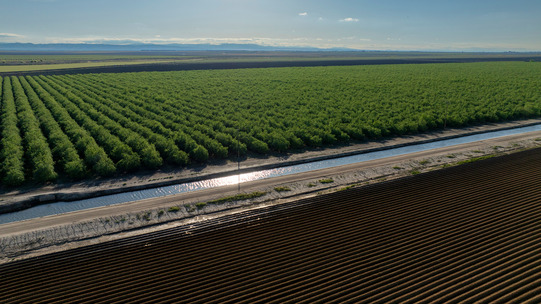
A major solar proposal in California’s San Joaquin Valley aims to repurpose fallowed farmland into 21,000 megawatts of clean energy generation. The effort, led by Westlands Water District, is viewed by landowners as a mechanism to stabilize local economies and support remaining agricultural operations. Farmworker communities are advocating for training programs and community benefits to offset potential job losses. If successful, the project could demonstrate how large‑scale clean energy development can align with regional economic resilience and workforce opportunity.
New federal funding for Tribal energy projects
The U.S. Department of Energy Office of Indian Energy is solicitating applications through the Unleashing Tribal Energy Development NOFO specific to Tribal groups and consortiums. Eligible groups will focus on:
- Construction and installation of Tribal community-scale energy projects.
- Predevelopment activities to identify community-scale energy opportunities.
- Planning and assessment activities to advance large-scale Tribal energy projects for economic development; includes critical minerals and materials projects.
Full applications are due July 24.
Water shortage in Texas may have impacts across the nation
Corpus Christi, Texas is nearing a critical water shortage that threatens jet‑fuel distribution to Texas airports, as well as oil exports from a major U.S. petroleum hub, according to Inside Climate News. City forecasts indicate that, without significant rainfall, water demand will soon exceed supply, putting industrial operations across Texas at risk in the next few months. Officials warn that inadequate preparation could lead to economic disruption, including layoffs and emergency response measures. The situation highlights the urgency of proactive water management and long-term infrastructure planning to safeguard critical energy supply chains and regional economies.
U.S. Department of Energy competitions advance critical minerals and hydropower innovation
The U.S. Department of Energy’s Hydropower and Hydrokinetic Office has opened applications for the 2026-27 Critical Minerals and Energy Innovation Hydropower and Marine Energy Collegiate Competitions. These programs engage undergraduate and graduate students in addressing real‑world challenges in hydropower and marine energy challenges, with a growing emphasis on critical minerals and energy innovation. Register for an informational seminar on April 15. With up to $715,000 in cash prizes available, teams can apply by May 1, 2026. Together, these competitions help accelerate clean‑energy innovation and strengthen the future workforce.
Enhanced geothermal technology: A reliable complement to clean energy
Enhanced geothermal systems (EGS) use deep underground heat to deliver constant, low-carbon power with a relatively small land footprint. Stanford researchers found that integrating EGS into the energy mix can significantly reduce the need for wind, solar and battery infrastructure while keeping electricity costs low. Stanford’s global modeling shows that adding EGS to 100% wind‑water‑solar systems has minimal impact on overall costs, while significantly reducing land, storage and generation needs. EGS provide constant, clean power, strengthens energy security and reduces air pollution. The technology works by drilling deep into hot rock, circulating fluid and generating electricity from the returning heat, offering notable land‑use and infrastructure savings. Enhanced geothermal systems tap deep‑earth heat to produce clean, reliable energy in far more locations than conventional geothermal.
Nobel prize winning chemist develops framework for capturing carbon dioxide from the air
A Nobel Prize winning chemist discovered his passion for molecular science at age 10 after encountering structural drawings in a school library in Amman, Jordan. Omar Yaghi, now a professor of chemistry at UC Berkley, was awarded the Nobel Prize in Chemistry in 2025 for developing metal‑organic frameworks that are sponge-like materials capable of capturing carbon and harvesting water from air. These breakthroughs in reticular chemistry have real‑world climate applications. Yaghi, who grew up in a family of 10 children in a single room that lacked electricity and running water, emphasizes that his final aim is universal water independence.
Sourcing carbon from the air for agriculture, beverages, food, and refrigeration
An independent California brewery known for its farm-to-barrel production is the first to carbonate their beer onsite with high purity carbon dioxide captured directly from the atmosphere. Aircapture developed a circular system for industrial and commercial customers to produce beverage-grade carbon dioxide instead of relying on volatile, fossil fuel-linked supply chains that can unpredictably reduce product or sequester supply. The direct air capture system pulls carbon dioxide directly from ambient air and purifies it to beverage-grade specifications. This allows manufacturers to generate their own supply independent of fuel markets.
Boeing signs carbon removal deal with Carbonfuture
Boeing signed a multi‑year agreement with Carbonfuture to buy at least 40,000 tonnes of long‑lasting carbon removal credits. (A tonne is a metric measurement equal to 2,204.6 U.S. pounds.) These credits come from biochar projects in the Global South, which store carbon for centuries and help improve soil quality. Boeing will use them to offset business‑travel emissions that are difficult to eliminate through aircraft or fuel improvements. Carbonfuture provides full digital tracking to verify each tonne of carbon removed. The agreement reflects growing demand for high‑quality carbon removal and gives the company room to expand its purchases over time.
______________________________________________________________________
Find out more about Clean Energy workforce issues and read the 2025 Clean Energy Workforce Report here. Please contact the Workforce Board's Ilene Munk for more information.
|