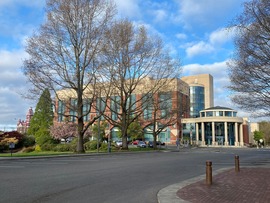
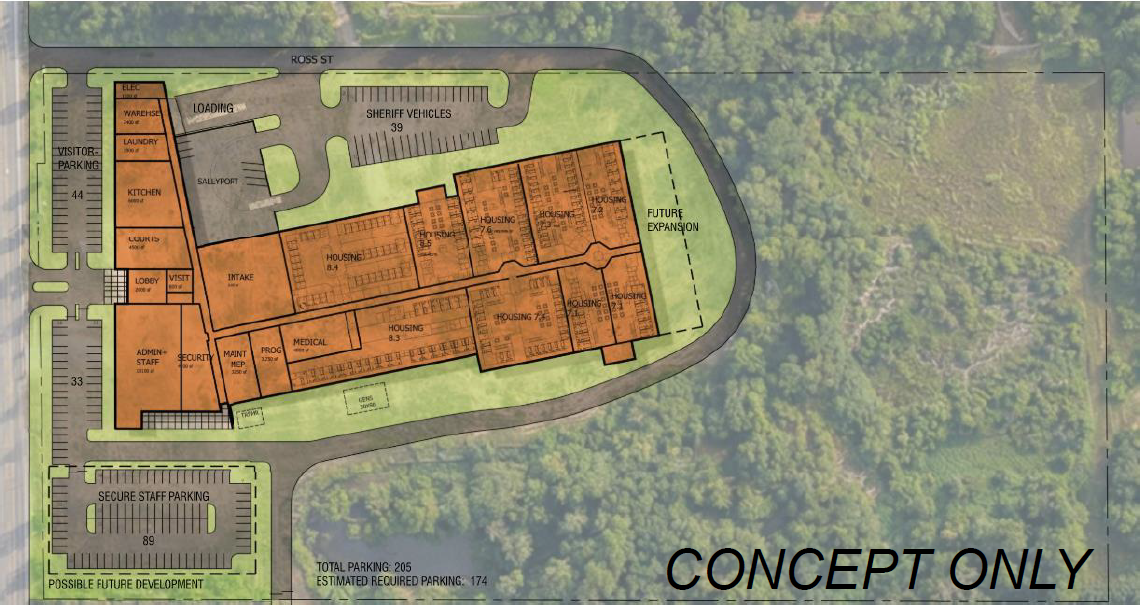
 Early design concept for the new jail, which will be located on Hannegan Road in Bellingham.
At its August 11th meeting, Council voted 5-2 with Councilmembers Jessica Rienstra and Mark Stremler dissenting, to accept the jail program, a necessary step that allows the project team to move forward with design and preliminary construction activities.
Council’s motion included a request that the project team prioritize—without sacrificing housing capacity—the inclusion of a second courtroom, rapid resource center, and family visitation space in the jail, all highly-desired features that were not included in early programming due to budget constraints.
In discussions, councilmembers and stakeholders expressed concerns that, with only one jail courtroom, not all cases could be processed on site, necessitating costly and time-consuming transport from the jail to the courthouse in downtown Bellingham.
“In the absence of courtroom capacity, we are just backlogging the criminal legal system,” said Councilmember Galloway during an August 4 Special Committee of the Whole meeting. “People should have the right to a quick and speedy trial.”
The project team has since committed to working with the courts to explore the possibility of incorporating a second courtroom within existing allotted square footage.
To accommodate Council’s other major priority, the rapid resource center, the county will seek funding from the state during the next legislative session. The purpose of the rapid resource center is to provide individuals leaving the jail with the support needed to successfully re-enter the community, such as housing or employment assistance, healthcare referrals, transportation, or even just a quick phone charge.
With Council’s approval of the jail program secured, the project team now moves into the schematic design phase, which will translate the results of initial planning into functional designs and blueprints. The new facility is anticipated to hold between 450 and 460 beds, including approximately 120 behavioral-health beds. Construction is scheduled to begin in 2027.
Draft programming for the new behavioral care center, which will be located at the Division Street behavioral health campus in Bellingham, is anticipated to be released in September with a final report and estimated operational costs expected by the end of the year.
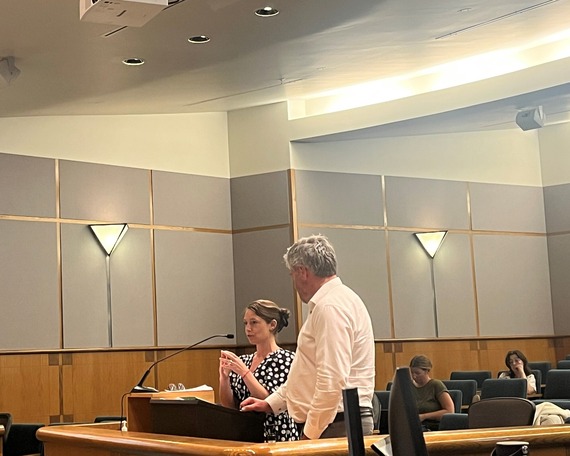 Task Force Co-Chairs Heather Flaherty and Peter Frazier shared a presentation with Council on July 28 regarding the Task Force's 2026 Annual Report.
The Incarceration Prevention and Reduction Task Force launched two new workgroups in July, a 50/50 Funding Workgroup, which will identify funding opportunities for Justice Project Implementation Plan projects, and an Average Daily Population and Length of Stay Reduction Workgroup, which will make recommendations for policies, programs, and processes that most effectively reduce the average daily population (ADP) and average length of stay (ALOS) in the jail.
The workgroups were created at the request of Council as part of Resolution 2026-018, which established a preliminary budget cap for construction of the new Whatcom County Jail and Behavioral Care Center.
Voters approved a two-tenths of one percent sales and use tax in November 2023 to fund the 15 projects outlined in the Justice Project Implementation Plan, including construction of the new county jail and behavioral care center. Whatcom County and its partner cities signed an interlocal agreement in 2024 outlining how revenue from the sales tax would be distributed and spent, which included a goal that 50% of revenues would be applied to non-jail-related priorities starting in 2030. Since then, inflation has increased and revenue projections have decreased, necessitating changes to the Justice Project’s financing model.
Councilmember Barry Buchanan, who sponsored Resolution 2026-018 and also serves as the chair of the Task Force’s Steering Committee, said the workgroups are needed to help inform key policy and budget decisions.
“Council recognizes that the financial landscape has shifted,” Buchanan said. “We launched the 50/50 Funding Workgroup and the Average Daily Population and Length of Stay Workgroup to help the county find the best path forward that still addresses the goals and needs of our community.”
To develop recommendations for funding Implementation Plan projects, the 50/50 Funding Workgroup will deliberate the potential use of proceeds from any future sale of the LaBounty Road property (previously considered as a site for the new jail), as well as grants, reimbursements, and other sources. The workgroup will share findings and recommendations with Council in the coming months.
The ADP and ALOS Workgroup will focus on two of the most important variables impacting jail population size. A number of factors play a role in determining how long an individual remains in jail, such as severity and number of charges, court and case processing timelines, access to diversion programs, availability of competency restoration services, and more. Reducing barriers to timely case processing and speeding up due process reduces demand on space in the jail. The workgroup aims to submit a progress report at the end of September and deliver recommendations for funding and sustaining interventions that can reduce ADP and ALOS to Council by the end of the year.
|