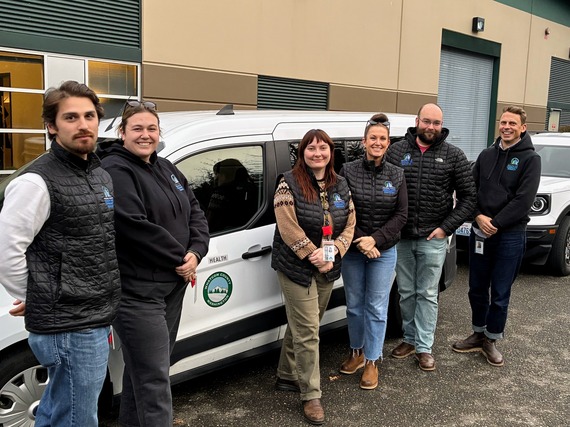
Alternative Response Team Celebrates Three Years of Improving Lives
Jon Dukes, Alternative Response Team Supervisor, reflects on the work of community response
Jon Dukes sees his mission as one of compassion. A clinical social worker by trade, Dukes has worked in crisis response for over ten years, and in his current role as supervisor of Whatcom County’s Alternative Response Team (ART) he sees the impact of his work every day.
“We’re providing an offramp for folks. When law enforcement responds to a call, they have jail or the hospital, and both those resources are needed at different times, but we need more tools in our toolbox to support our community’s behavioral health needs – and that’s what we provide.”
ART in Action
Established in January 2023, the ART is a behavioral health crisis team that is dispatched by 911 in the place of law enforcement for non-violent, non-criminal calls. They handle a range of situations from welfare checks and community caretaking to disorderly conduct and people contemplating suicide, and everything in between.
“Our most common call is someone acting bizarrely downtown,” said Dukes. “Someone is dancing on the street corner or camped out in front of a business and they need some support.” In 2025, ART responded to 2,410 calls in Whatcom County.
With a fourteen-minute response time from dispatch call to a friendly greeting, the ART brings a trauma-informed and client-centered approach.
“We don’t want to be judging people on their worst day, we want to be supporting them when they need it most. Hopefully, by the time we leave, we leave them in a better position,” says Dukes.
In practice, this means engaging with our neighbors and supporting them in the direction they want to go, using behavioral health techniques and de-escalation to connect them with the services they need – whether that’s housing, sanitation, substance use treatment or mental health supports.
Diversion, Support, and Safety
“Our community has fantastic law enforcement that does a wonderful job with behavioral health calls,” says Dukes. “However, I think law enforcement is in our community to enforce laws, and they don’t always have the time, resources, or abilities to do the behavioral health social services work that is needed. That’s where we come in.”
“We have the ability to slow things down and stay with the person as long as they need to get help.”
Safety concerns are central to the work ART does. They always respond in two-person teams, using the 911 CAD system so law enforcement can see where they are at any given time and all ART members are given extensive training around de-escalation and violence prevention.
Have any calls escalated to require law enforcement involvement? “Yes, but they are few and far between,” says Dukes. “A vast majority of our calls are responded to without any law enforcement involvement – that’s the whole point of our program.”
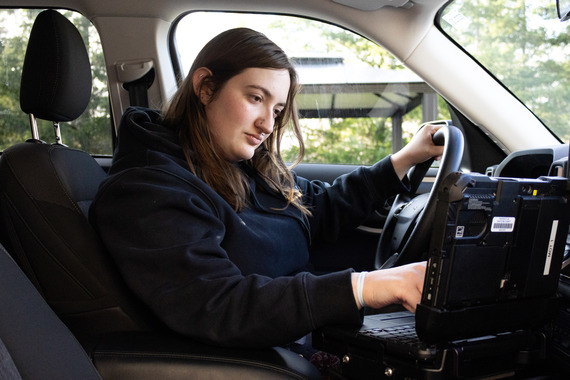 ART intern Kayanne McNeill, a senior in the Human Services Department at WWU, tracks incoming calls
|